Faithful Conversations #25
Introduction to Readers: For those of us walking the Christian road in 2023, our current environment presents significant challenges. I stumbled on two articles in The Atlantic in the past week worth mentioning here. The first one, “Will the Christian Church Survive?”, caught my eye because it appeared (wait for it) in October of 1942 — 81 years ago! Concerns about the future of the church are apparently not new! And, a second one in the most recent edition of the magazine — “The Misunderstood Reason Millions of Americans Stopped Going to Church.” Within his compelling analysis, author Jake Meador makes the following assertion: “Contemporary America simply isn’t set up to promote mutuality, care, or common life. Rather, it is designed to maximize individual accomplishment as defined by professional and financial success. Such a system leaves precious little time or energy for forms of community that don’t contribute to one’s own professional life or, as one ages, the professional prospects of one’s children.” Meador’s comments focused on a recent book by Jim Davis and Michael Graham (“The Great Unchurching”), and his words remind me that we live and work within a faith experience that is counter-cultural to its core. Dwell on that idea as you work your way through this week’s readings! Thanks for your continued interest in the Lectionary! My reflections will focus on this week’s Gospel reading from Matthew.
Readings for Pentecost 10
Isaiah 55:1-5
Psalm 145:8-9, 14-21
Romans 9:1-5
Matthew 14:13-21
The Gospel: Matthew 14:13-21: The Feeding of the Five Thousand
13 Now when Jesus heard this, he withdrew from there in a boat to a deserted place by himself. But when the crowds heard it, they followed him on foot from the towns. 14 When he went ashore, he saw a great crowd, and he had compassion for them and cured their sick. 15 When it was evening, the disciples came to him and said, “This is a deserted place, and the hour is now late; send the crowds away so that they may go into the villages and buy food for themselves.” 16 Jesus said to them, “They need not go away; you give them something to eat.” 17 They replied, “We have nothing here but five loaves and two fish.” 18 And he said, “Bring them here to me.” 19 Then he ordered the crowds to sit down on the grass. Taking the five loaves and the two fish, he looked up to heaven and blessed and broke the loaves and gave them to the disciples, and the disciples gave them to the crowds. 20 And all ate and were filled, and they took up what was left over of the broken pieces, twelve baskets full. 21 And those who ate were about five thousand men, besides women and children.
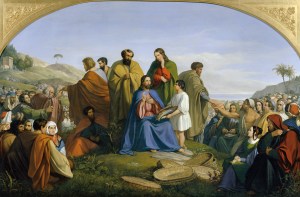
“The Miracle of Five Loaves and Two Fishes” by Anton Ritter von Perger (1838)
This Week’s Reflection: “The Centrality of Compassion”
Miraculous stories of Jesus feeding large crowds appear throughout the Gospels. Beyond this week’s text, there is another such story in Matthew (15:32-39), and the Matthew stories are paralleled in Mark (6:32-44 and 8:1-10). Luke (9:10-17) and John (6:1-13) provide similar versions as well. Such stories echo earlier stories from the Jewish experience (see 1 Kings 17:8-16 and 2 Kings 4:42-44). Further, “breaking bread” with others is a common theme throughout Jesus’ first century ministry, and serve as a continual reminder of the Eucharist.
There are three aspects of story of this week’s Gospel story that bring it alive in my mind. First, unlike the other Gospels, Matthew directly connects the death of John the Baptist (Matthew 14:1-12) with the story of the feeding of the 5,000 (note verse 13). Marilyn Salmon, Professor of New Testament at United Theological Seminary in St. Paul, provides this important insight in her analysis of this text. John’s death, understandably, impacts Jesus and he seeks sanctuary in a “deserted place,” something he often did (sidebar: I have more appreciation for the severity of the desert landscape after a recent visit with our son at Fort Irwin, located in the Mohave Desert!). Jesus needs solitude, but the crowds follow him into the wilderness for healing and hope. Can we see ourselves in that wilderness crowd, a metaphor, perhaps, for those times in our lives when we feel “lost in the desert?” Jesus’ response to the crowd is empowering beyond measure.
And that leads to my second point. When I read and reread this week’s Gospel, one phrase (in verse 14) — “he had compassion for them” — jumped out for me. To have compassion for another means to suffer with them, to actually feel their pain. Throughout his ministry, Jesus showed compassion for any and all who typically faced rejection, especially from those in power — children, women, those who were broken in body, mind, or spirit. His compassion was constantly on display (click here for examples).
Finally, Jesus’ capacity for love and his compassion for the wilderness crowds, illustrates how God’s Kingdom breaks into this world — now! Christ’s example provides a model for us. Recall that when he was questioned by the Pharisees about the coming of the Kingdom, Jesus responded by saying, “The coming of the kingdom of God will not occur with signs that can be observed. Nor will people say, ‘Here it is,’ or ‘There it is.’ For the kingdom of God is in your midst.” (Luke 17:20-21). Yes, we live with the hope of entering God’s Kingdom in the future, but let us remind ourselves each day that the Kingdom is already here!
Soli Deo Gloria
This Week’s Prayer (inspired by the poem, “Christ Has No Body” by Teresa of Avila (1515-1582):
Lord God, grant us the wisdom and strength to be your eyes and ears and your hands and feet within our communities. Give us eyes of compassion. Amen.
And, here’s the poem — you can find it (and many others) at Journey With Jesus, a weekly webzine for the global church.
Christ Has No Body
Christ has no body but yours,
No hands, no feet on earth but yours,
Yours are the eyes with which he looks
Compassion on this world,
Yours are the feet with which he walks to do good,
Yours are the hands, with which he blesses all the world.
Yours are the hands, yours are the feet,
Yours are the eyes, you are his body.
Christ has no body now but yours,
No hands, no feet on earth but yours,
Yours are the eyes with which he looks
compassion on this world.
Christ has no body now on earth but yours.
