Faithful Conversations #31

“Holy Hill” in Black River Falls, Wisconsin
Introduction to Readers:
506 years ago, a 34-year-old Augustinian monk named Martin Luther, rocked the European Christian world when he tacked those 95 Theses on the door of the Castle Church in Wittenberg, Germany. As early as 1519, Luther’s opponents caustically referred to his followers as Lutherans, a term that soon came into common usage. Lutheranism, although not a unified denomination, is one of the five major branches of Protestantism (the others are Anglicanism, Calvinism, Methodism, and the Baptists). In our small city, we live with physical reminders of that rupture in Christendom at the top of what some locals call “Holy Hill.”
This week’s readings center on the concept of REPENTANCE, and it is noteworthy for us to recall that Luther offered this as Thesis #1 in 1517: “When our Lord and master Jesus Christ said ‘Repent,’ he intended the entire life of believers to be repentance.” Keep that in your mind as you tackle the Lectionary this week! My commentary will focus on the Gospel, with a reference to the reading from Ezekiel. Thanks for your continued interest in Bible study!
Readings for Pentecost 18
Ezekiel 18:1-4, 25-32
Psalm 25:1-9
Philippians 2:1-13
Matthew 21:23-32
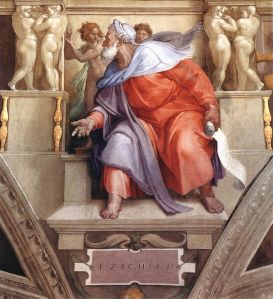
Ezekiel (1510) by Michelangelo (1475-1564) Sistine Chapel in Rome
First Reading: Ezekiel 18:1-4, 25-32
The word of the Lord came to me: 2 What do you mean by repeating this proverb concerning the land of Israel, “The parents have eaten sour grapes, and the children’s teeth are set on edge”? 3 As I live, says the Lord God, this proverb shall no more be used by you in Israel. 4 Know that all lives are mine; the life of the parent as well as the life of the child is mine: it is only the person who sins who shall die.
25 Yet you say, “The way of the Lord is unfair.” Hear now, O house of Israel: Is my way unfair? Is it not your ways that are unfair? 26 When the righteous turn away from their righteousness and commit iniquity, they shall die for it; for the iniquity that they have committed, they shall die. 27 Again, when the wicked turn away from the wickedness they have committed and do what is lawful and right, they shall save their life. 28 Because they considered and turned away from all the transgressions that they had committed, they shall surely live; they shall not die. 29 Yet the house of Israel says, “The way of the Lord is unfair.” O house of Israel, are my ways unfair? Is it not your ways that are unfair? 30 Therefore I will judge you, O house of Israel, all of you according to your ways, says the Lord God. Repent and turn from all your transgressions; otherwise iniquity will be your ruin. 31 Cast away from you all the transgressions that you have committed against me, and get yourselves a new heart and a new spirit! Why will you die, O house of Israel? 32 For I have no pleasure in the death of anyone, says the Lord God. Turn, then, and live.
The Gospel Reading: Matthew 21:23-32
23 When he entered the temple, the chief priests and the elders of the people came to him as he was teaching and said, “By what authority are you doing these things, and who gave you this authority?” 24 Jesus said to them, “I will also ask you one question; if you tell me the answer, then I will also tell you by what authority I do these things. 25 Did the baptism of John come from heaven, or was it of human origin?” And they argued with one another, “If we say, ‘From heaven,’ he will say to us, ‘Why, then, did you not believe him?’ 26 But if we say, ‘Of human origin,’ we are afraid of the crowd, for all regard John as a prophet.” 27 So they answered Jesus, “We do not know.” And he said to them, “Neither will I tell you by what authority I am doing these things. 28 “What do you think? A man had two sons; he went to the first and said, ‘Son, go and work in the vineyard today.’ 29 He answered, ‘I will not,’ but later he changed his mind and went. 30 The father went to the second and said the same, and he answered, ‘I go, sir,’ but he did not go. 31 Which of the two did the will of his father?” They said, “The first.” Jesus said to them, “Truly I tell you, the tax collectors and the prostitutes are going into the kingdom of God ahead of you. 32 For John came to you in the way of righteousness, and you did not believe him, but the tax collectors and the prostitutes believed him, and even after you saw it you did not change your minds and believe him.
This Week’s Reflection: “A New Heart and a New Spirit”
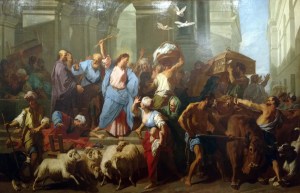
“Driving the Merchants from the Temple”
French artist, Jean Jouvenet (1644–1717)
Jesus rarely found favor with the religious authorities of his day. His exchange with the chief priests and elders in Matthew 21 came on the heels of a dramatic moment in scripture — Christ’s righteous anger and cleansing of the temple (Matthew 21:12-17). Prompted by this disturbing temple performance and expanding following, religious leaders, in a “how dare you!” moment, questioned the source of Jesus’ authority (verse 23). Jesus, clearly frustrated with his inquisitors, responded, as he often did, with an unsettling question and simple story, in this case, the parable of the two sons. It goes like this: A man had two sons and asked the first son to go work in the vineyard. The son refused (verse 29) but later changed his mind and did the work requested by his father. The father then asked the second son to go help in the vineyard, and he said he would (verse 30), but then did not go. Jesus then poses the question to the religious leaders, “Which of the two did the will of his father?” (verse 31). The answer was clear — the first son did the will of his father. I’m reminded of that familiar line, “actions speak louder than words.” Jesus followed the story of the two sons with a piercing commentary that must have cut the religious authorities to the quick (verses 31-32). In a stunning reversal of conventional thinking, he let them know that prostitutes and tax collectors — societal outcasts — would enter the Kingdom of Heaven ahead of them! Their disbelief, their dismissal of God’s messenger (John the Baptist), their hypocrisy, was scathingly exposed. In short, their refusal to repent, to turn around, was a roadblock. Jesus’ scolding echoed the words of the prophet Ezekiel: Repent and turn from all your transgressions; otherwise iniquity will be your ruin. Cast away from you all the transgressions that you have committed against me, and get yourselves a new heart and a new spirit!
What should we take away from this challenging exchange? We all can hear different things here, of course, but I’m going to circle back to our fundamental need for repentance as highlighted in Luther’s opening thesis, as cited in my introduction. Listen to these familiar words that are often part of our weekly public confession:
**Most merciful God, we confess that we have sinned against you in thought, word, and deed, by what we have done, and by what we have left undone. We have not loved you with our whole heart; we have not loved our neighbors as ourselves. We are truly sorry and we humbly repent. For the sake of your Son Jesus Christ, have mercy on us and forgive us; that we may delight in your will, and walk in your ways, to the glory of your Name. Amen.
Those words are worth a hard look. They humble us and bring us to our knees. And though it may seem that repentance is a bit out of style in our 2023 “me-oriented” culture, those words are life-giving and remind us that the path of repentance is a daily exercise, an attitude, that gives us a “new heart and new spirit,” motivating us for action in God’s world.
Soli Deo Gloria
** The Confession of Sin comes from the English Book of Common Prayer and has been part of the ELCA’s Holy Communion setting for decades. You will find it in the ELW on page 95.
Prayer (from Psalm 25, the Modern English version):
To You, O Lord, do I lift up my soul. O my God, I trust in You; may I not be ashamed; may my enemies not triumph over me. Yes, let none who wait on You be ashamed; let them be ashamed who transgress without cause. Make me to know Your ways, O Lord; teach me Your paths. Lead me in Your truth and teach me, for You are the God of my salvation; on You I wait all the day. Remember Your mercies, O Lord, and Your lovingkindness, for they are from old. Do not remember the sins of my youth or my transgressions according to Your lovingkindness remember me, on account of Your goodness, O Lord. Good and upright is the Lord; therefore He will teach sinners in the way. The meek will He guide in judgment, and the meek He will teach His way. Amen.
Finally . . . an update on our Adult Education/Bible Study at ELC:
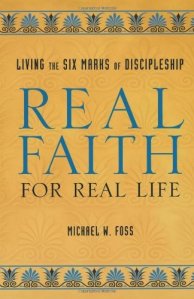 What does it mean to be a disciple of Jesus Christ? Join us for an exploration of that question in September and October. We will read and discuss Michael Foss’s book, Real Faith for Real Life: Living the Six Marks of Discipleship. In his book’s introduction, Foss writes: “This book was written to help you grow deep. It was written to help you on your journey of spiritual discovery and renewal. So it’s more than a book; it is workbook or notebook for the soul. Its pages will invite you to be open to hear the greatest call on earth, the call to Jesus the risen Messiah.”
We had our initial meeting last week, but there is still time to join! Remaining meeting dates (Wednesdays from 6:30-7:30) September 27, October 11, and 18) I am leading the study and all are welcome! We have several books on hand, but you may want your own copy – available at a reasonable cost through Amazon. Feel free to contact me with any questions! Call or text at 715-299-0311.
