Faithful Conversations #34
Introduction to Readers:
The echoes of history lurk around every corner in the tortured factionalism of the modern Middle East. The Israel-Hamas conflict on full display serves as a reminder of our broken world and the failure of political solutions in the seemingly intractable divisions of our time (other regional wars rock out planet right now — Ukraine, Myanmar, and Somalia, to name just three). I suspect I speak for many when I say the issues underlying such conflicts — the full slate of issues — remain known only to God and we are seeing “through a glass darkly” in our attempts to understand. That said, this week I again offer the following explanations (hyperlinked) that, though incomplete, helped me understand things somewhat more fully. I commend them to you if you are seeking more information! (I’m seeking sources that offer balance, but that is difficult when approaching this topic).
The first comes from an Australian news service and traces the history of the conflict.
The second one offers a further explanation of the background of Hamas.
We continue to pray for the region and all its people — Jews, Muslims, and Christians — especially those that are most vulnerable. It is truly hard to fathom what they are experiencing.
Speaking of politics, they are infused into the Old Testament reading and the Gospel this week. My reflections will center on the Isaiah passage and the story of Cyrus the Great. Thanks for your ongoing interest in the Lectionary and may God bless your spiritual journey this week!
Readings for Pentecost 21
Isaiah 45:1-7
Psalm 96:1-9 (10-13)
1 Thessalonians 1:1-10
Matthew 22:15-22
Focus Reading: Isaiah 45:1-7
Thus says the Lord to his anointed, to Cyrus, whose right hand I have grasped
to subdue nations before him and to strip kings of their robes,
to open doors before him—and the gates shall not be closed:
2 I will go before you and level the mountains; I will break in pieces the doors of bronze
and cut through the bars of iron;
3 I will give you the treasures of darkness and riches hidden in secret places,
so that you may know that it is I, the Lord, the God of Israel, who call you by your name.
4 For the sake of my servant Jacob and Israel my chosen,
I call you by your name; I give you a title, though you do not know me.
5 I am the Lord, and there is no other; besides me there is no god.
I arm you, though you do not know me,
6 so that they may know, from the rising of the sun and from the west, that there is no one besides me; I am the Lord, and there is no other.
7 I form light and create darkness, I make weal and create woe; I the Lord do all these things.
This Week’s Reflection: Our God and History
He looked at me over his glasses and said, “It’s always important to contemplate the role of God in human history” (I recall him offering Galatians 4:4 as a worthy illustration — you may want to look that up!). Dr. Herman Larsen (1915-2003), a commanding presence, served as my freshman year advisor at Concordia in 1975. I was doing an oral book report (an intimidating experience) with him in his office for my European history class — a biography of Martin Luther, no less — when he interjected with his admonition concerning history. It was later that I learned that Dr. Larsen, the brilliant St. Olaf and Yale educated man, spent three years in a Japanese prison camp during World War II, a result of his service as a missionary in China. Clearly, this history professor and ordained pastor attributed his survival to God. I thought about him this week while reading Isaiah’s prophetic description of Cyrus.
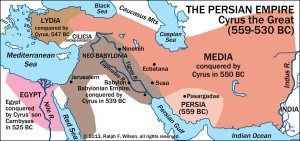
The Ancient Middle East
Cyrus the Great (590-529 BCE), by all accounts, was a remarkable leader. He ruled over the Persian Empire, the largest at the time, that stretched from present day Iran into modern Turkey. The only non-Jewish person in the Bible referred to as “Messiah,” Cyrus appears 23 times in the scriptures (in Isaiah, Ezra, 2 Chronicles, and Daniel). A hero in Jewish history, this pagan ruler is credited with overtaking Babylon and liberating the Jews being held in captivity and assisting in the rebuilding of the Temple in Jerusalem. Further, he is often cited as a tolerant ruler, allowing those under his authority to live and worship as they pleased, while having at least some voice in their political lives.
In this week’s reading from Isaiah, the prophet foretells Cyrus’ coming more than a century prior to his birth. Despite not knowing God, Cyrus will be chosen and honored (45:4). Beyond the verses cited in the Lectionary, we hear these words: “I have aroused Cyrus in righteousness, and I will make all his paths straight; he shall build my city and set my exiles free, not for price or reward, says the Lord of hosts” (45:13). Indeed, Cyrus is chronicled in Jewish history for his great deeds, notably in the book of Ezra, written in 400 BCE and aimed at Jewish descendants of those who were exiled. Note the language attributed to him in Ezra 1:2-4:
2 “Thus says King Cyrus of Persia: The Lord, the God of heaven, has given me all the kingdoms of the earth, and he has charged me to build him a house at Jerusalem, which is in Judah. 3 Let any of those among you who are of his people—may their God be with them!—go up to Jerusalem in Judah and rebuild the house of the Lord, the God of Israel; he is the God who is in Jerusalem. 4 And let all survivors in whatever place they reside be assisted by the people of their place with silver and gold, with goods, and with livestock, besides freewill offerings for the house of God in Jerusalem.”
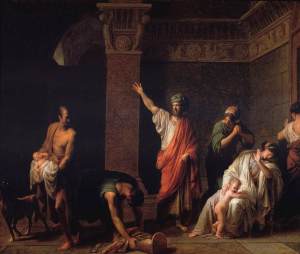
Cyrus and Astyages by French painter
Jean-Charles Nicaise Perrin (1754–1831)
What lessons should we draw from the story of Cyrus? First, I’m drawn back to my professor’s assertion to me from nearly 50 years ago: we should contemplate God’s role in history. Our all-powerful Creator intervenes in ways that may seem evident but, in truth, are often incomprehensible to us. I was not raised within the traditions of those who frame our times within specific Biblical prophecies and always sense some overreach when we do that — there is so much we simply don’t know. That said, the story of Cyrus reminds us that it is possible for our God to motivate those we may least expect — those outside the traditional faith — to accomplish His ends. Cyrus, it seems, was positioned well to carry out God’s will.
And second, though our present situation seems fraught with danger and, at times, hopeless beyond measure, our God surrounds us with His love, a love that motivates us to be grace-filled people who are willing to walk into a dangerous world with courage and strength.
Soli Deo Gloria
Prayer (inspired by Psalm 96):
Lord God, We sing to you this day, a new song and glorify your name. Inspire us to share your marvelous works within our families and communities. You make the seas roar, and the trees and forests sing for joy! May all creation praise your holy name! Amen.
 What does it mean to be a disciple of Jesus Christ? We are exploring that question in September and October. We are reading and discussing Michael Foss’s book, Real Faith for Real Life: Living the Six Marks of Discipleship.
We have one meeting left — Wednesday 18 October at 6:30 at ELC. If you have missed the study and are interested in the book, let me know!
Text (715.299.0311)
Email: pstrykken@gmail.com
Stay tuned for further updates regarding our Adult Education and Bible Studies.
