Faithful Conversations #35
Introduction to Readers: Next Sunday provides an example of how the ELCA and other churches that trace their heritage to the Protestant Reformation utilize different texts than those prescribed by the Revised Common Lectionary. Recall that the RCL is a guideline for churches, not a mandate, as such. For example, there is also something called the “Narrative Lectionary” and various preaching series that offer alternative texts (sidebar: the same can be said of the various liturgies available to us in the ELW).
The readings listed below will be used in ELCA churches this weekend (while the RCL offers the following for Pentecost 22: Leviticus 19:1-2, 15-18; Psalm 1; 1 Thessalonians 2:1-8; and Matthew 22: 34-46). As you work your way through the Reformation texts, find the common threads and consider WHY each of them is appropriate for a Sunday that focuses on our Lutheran heritage. My commentary will focus on Psalm 46. In addition, I will point you to an excellent commentary focusing on the situation in the Middle East. Thanks for your continued interest in the Lectionary!
Readings for Reformation Sunday (Pentecost 22)
Jeremiah 31:31-34
Focus Reading: Psalm 46 (text below my reflection)
Romans 3:19-28 (Luther’s favorite book!)
John 8:31-36
This Week’s Reflection, Part 1: “A Mighty Fortress is our God!”

Martin Luther (1483-1546)
506 years ago, this week (October of 1517), the rebellious Augustinian monk Martin Luther posted his famed Ninety-Five Theses on the door of the Castle Church in Wittenberg, Germany prompting debates that, over time, fractured Roman Catholicism and planted the seeds for the Protestant Reformation. A brilliant and complex individual, Luther spent years translating the Bible into German, produced tracts and commentaries that fill volumes, and produced a large and small catechism for the education of both clergy and common people. A gifted musician, Luther also wrote hymns — thirty-six are attributed to him. Most famously, he composed “Ein feste Burg ist unser Gott,” known to us as “A Mighty Fortress is our God” (hymn number 504 in the ELW). Known as “The Battle Hymn of the Reformation,” Luther most likely penned it between 1527-1529, according to Anglican clergyman and hymnology expert John Julian.

Luther’s Hymn — An Early Printing
Luther clearly derived great strength from the Psalms, referring to them as the “Bible in miniature.” Psalm 46 held a special place in his heart, specifically in 1527 with the plague surging through Europe while Luther faced enormous pressures in his own life, including the near death of his son. Reflecting on Psalm 46, Luther made the following gritty observation: “We sing this psalm to the praise of God, because He is with us and powerfully and miraculously preserves and defends His church and His word against all fanatical spirits, against the gates of hell, against the implacable hatred of the devil, and against all the assaults of the world, the flesh, and sin.”
There are many great versions of this powerful hymn available, and this one by the St. Olaf Choir is especially majestic. Take a listen while you explore Psalm 46 adjacent to the lyrics of the hymn — imagine the mind of Luther at work!
| Psalm 46 | A Mighty Fortress is our God |
| 1 God is our refuge and strength, a very present help in trouble. 2 Therefore we will not fear, though the earth should change, though the mountains shake in the heart of the sea, 3 though its waters roar and foam, though the mountains tremble with its tumult. Selah 4 There is a river whose streams make glad the city of God, the holy habitation of the Most High. 5 God is in the midst of the city; it shall not be moved; God will help it when the morning dawns. 6 The nations are in an uproar; the kingdoms totter; he utters his voice; the earth melts. 7 The Lord of hosts is with us; the God of Jacob is our refuge. Selah 8 Come, behold the works of the Lord; see what desolations he has brought on the earth. 9 He makes wars cease to the end of the earth; he breaks the bow and shatters the spear; he burns the shields with fire. 10 “Be still, and know that I am God! I am exalted among the nations; I am exalted in the earth.” 11 The Lord of hosts is with us; the God of Jacob is our refuge. Selah |
1 A mighty fortress is our God, A bulwark never failing; Our helper He amid the flood Of mortal ills prevailing. For still our ancient foe Doth seek to work us woe– His craft and power are great, And, armed with cruel hate, On earth is not His equal. 2 Did we in our own strength confide, Our striving would be losing. Were not the right man on our side, The man of God’s own choosing. Dost ask who that may be? Christ Jesus, it is He– Lord Sabaoth His name, From age to age the same, And He must win the battle. 3 And though this world with devils filled, Should threaten to undo us, We will not fear, for God hath willed His truth to triumph through us. The prince of darkness grim, We tremble not for him– His rage we can endure, For lo, his doom is sure: One little word shall fell him. 4 That word above all earthly powers, No thanks to them, abideth; The Spirit and the gifts are ours Through Him who with us sideth. Let goods and kindred go, This mortal life also– The body they may kill; God’s truth abideth still: His kingdom is forever. Amen. |
Those of us that old enough will recall the Yom Kippur War of 1973, when a coalition of Arab states attacked Israel on the Jewish holiday known as Yom Kippur (I was a junior in high school). Among other major ramifications, it is one of very few times during the Cold War that our nation went to “high alert” with our nuclear arsenal, meaning that use of the weapons could have occurred within 15 minutes! That moment from my youth has been on my mind for the past several days.
We are now 17 days beyond the horrific attacks by Hamas on Israel (October 7), and the heartbreaking story continues to evolve. I am attempting to follow it without becoming overwhelmed, in part, by seeking out good sources of information and commentary. Protestant theologian and scholar Daniel B. Clendenin (who I have cited previously in Faithful Conversations) has offered an excellent reflection on the current situation, and I commend it to your reading here. He draws inspiration from the Matthew’s Gospel, part of this week’s RCL.
Soli Deo Gloria
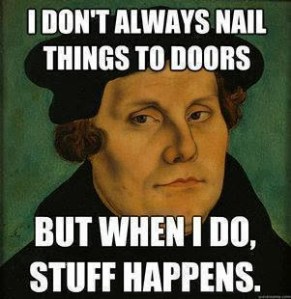
Some Reformation Humor!
Prayer: Luther’s Evening Ritual (a good one!):
In the evening when you go to bed, make the sign of the holy cross and say:
In the name of the Father and of the + Son and of the Holy Spirit. Amen.
Then kneeling or standing, repeat the Creed and the Lord’s Prayer. If you choose, you may also say this little prayer:
I thank You, my heavenly Father, through Jesus Christ, Your dear Son, that You have graciously kept me this day; and I pray that You would forgive me all my sins where I have done wrong, and graciously keep me this night. For into Your hands I commend myself, my body and soul, and all things. Let Your holy angel be with me, that the evil foe may have no power over me. Amen.
Then go to sleep at once and in good cheer.
