Faithful Conversations #36
Introduction to Readers:
Each time we say the Lord’s Prayer and utter the phrase, “Hallowed be Thy Name,” we are referencing a word of Old English origin, meaning “to make holy.” Three days this week, collectively known as Allhallowtide, have deep roots in Christian history: All Hallows’ Eve (commonly referred to as Halloween), All Hallows’ (or All Saints) Day, and All Souls’ Day. Those of us who share Lutheran heritage, of course, also recognize October 31st as the date in 1517 that Martin Luther posted his famous 95 Theses on that church door in Wittenberg, igniting a discussion that continues 506 years on. Some have long speculated that Luther chose that day because it would catch the attention of the common folk on the eve of All Saints’ Day, a day set aside to pray for those great examples of faith who have journeyed before us to our heavenly home. Though not verifiable, it is certain that Luther, an Augustinian monk, would have been well aware of the 8th Century origins of All Saints’ Day within the Catholic tradition. That said, isn’t it fascinating (and perhaps a bit troubling) that Halloween in 2023 is primarily a secular holiday, an evolution with a long and winding history? And, is it just me, or has Halloween grown exponentially in recent years, compared to my memories of it from childhood? As often happens, the origins get lost in the mists of time.
Approach the events of this week, and the various readings for All Saints Sunday, with this backstory in mind. Also, I heartily encourage you to pray for those saints in your life — people who pointed you toward faith in Jesus Christ. My reflections will draw from the Revelation and 1 John passages. As always, thanks for your continued interest in the Lectionary! We have three Sundays left in our current church year.
(Note: I do highlight phrases, and also offer hyperlinks that offer background — those are of a different color, italicized, and bolded).
Readings for All Saints Sunday (Pentecost 23)
Revelation 7:9-17 (Focus Passage)
Psalm 34:1-10, 22
1 John 3:1-3 (Focus Passage)
Matthew 5:1-12

“John Writing Revelation”
Italian Artist Carlo Dolci (1616-1686)
Reading From Revelation 7:9-17
9 After this I looked, and there was a great multitude that no one could count, from every nation, from all tribes and peoples and languages, standing before the throne and before the Lamb, robed in white, with palm branches in their hands. 10 They cried out in a loud voice, saying, “Salvation belongs to our God who is seated on the throne and to the Lamb!” 11 And all the angels stood around the throne and around the elders and the four living creatures, and they fell on their faces before the throne and worshiped God, 12 singing,
“Amen! Blessing and glory and wisdom
and thanksgiving and honor
and power and might
be to our God forever and ever! Amen.”
13 Then one of the elders addressed me, saying, “Who are these, robed in white, and where have they come from?” 14 I said to him, “Sir, you are the one who knows.” Then he said to me, “These are they who have come out of the great ordeal; they have washed their robes and made them white in the blood of the Lamb.
15 For this reason they are before the throne of God
and worship him day and night within his temple,
and the one who is seated on the throne will shelter them.
16 They will hunger no more and thirst no more;
the sun will not strike them,
nor any scorching heat,
17 for the Lamb at the center of the throne will be their shepherd,
and he will guide them to springs of the water of life,
and God will wipe away every tear from their eyes.”
Reading From 1 John 3:1-3
1 See what love the Father has given us, that we should be called children of God, and that is what we are. The reason the world does not know us is that it did not know him. 2 Beloved, we are God’s children now; what we will be has not yet been revealed. What we do know is this: when he is revealed, we will be like him, for we will see him as he is. 3 And all who have this hope in him purify themselves, just as he is pure.
This Week’s Reflection: “Simul Justus et Peccator”
In his commentary on Romans (his favorite book), Martin Luther gave voice to one of the fundamentals of Lutheranism, that in our Christian journey, we are both sinner and saint. Luther wrote and delivered lectures in Latin and the phrase “Simul Justus et Peccator” is how he would have said it (simul = both, justus = just or righteous, peccator = sinner). The lectionary readings for this Sunday encourage us to reflect on this bedrock of our faith.
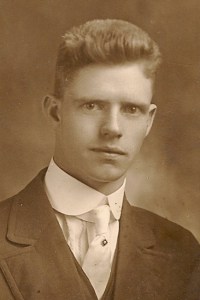
Thorvald M. Rykken
(1897-1945)
The Revelation passage, especially verses 13-14, immediately reminded of one of the saints in my background, my grandfather, Thorvald Melvin Rykken. Let me explain. Born in 1897 to Norwegian immigrants, TM attended Augsburg College in Minneapolis (connected to the Lutheran Free Church) and Luther Seminary in St. Paul. Upon ordination, he served as mission pastor for eleven years at the Bethany Indian Mission in Wittenberg, Wisconsin (1920-1930), ministering to Ho-Chunk, Oneida, Menominee, and Mohican people, among others. The Rykken family then moved on to Petersburg, North Dakota, where he served several parishes from 1930 until his untimely death (age 48) in 1945.
Though he died twelve years before I was born, he has been a presence in my life from early on. My father, Thorwald Ansgar Rykken, lost his role model while serving in the Italian Theater in World War II, learning of the death of his father eight days after the fact. Perhaps, in part, to make up for this searing loss, he spent years introducing his “Pop” to me and my sisters through stories, pictures, and various impressions. Among other things, I learned that my grandfather was a bit of a maverick, loved baseball, laughed heartily and often, was deeply patriotic, and intensely driven. One story I heard multiple times was that TM’s favorite poem, one he apparently often referenced, was Vachel Lindsay’s “General William Booth Enters Heaven,” a dramatic portrayal of the moment that Booth, the eccentric founder of the Salvation Army, finds himself face to face with Jesus Christ. Intrigued by this window into the mind of the grandfather I never knew, the poem became a bit of a fascination for me. Here it is.

William Booth (1829-1912)
Founder of the Salvation Army

Poetry: A Magazine of Verse, 1913
What to make of this poem? Clearly inspired by Booth’s recent death (1912), Lindsay anchors his poem in the 7th Chapter of Revelation and the Social Gospel Movement of the early 20th Century. And though written over a century ago, the rhythmic description of Booth and his band of broken souls entering heaven has a modern ring to it. My grandfather’s fascination with it helps me understand what drove him to mission work.
Finally, I suspect most of us have tried to imagine our future journey into the afterlife, the great mystery. The authors of Revelation and 1 John certainly did. Will we meet those saints that have gone before us there, in that place where “God will wipe away every tear” from our eyes . . . “where we will be like him, for we will see him as he is?” This remains our redeeming, liberating, and powerful hope! May we boldly share this message of salvation!
Soli Deo Gloria
Prayer (Source: Christianity.com: 10 Beautiful All Saints Day Prayers):
God, when I hear the word “saint” I often associate it with those who no longer walk this earth, who are dwelling in eternal rest. I can think of many people in my own life who had an impact with me, who I cannot wait to see them again. Lord, I dearly miss my friends and family who are not here on earth anymore. But I also rejoice that they will no longer experience pain or shed any tears of sadness. God, although I’m sad I am temporarily away from them, I want to thank you so much for bringing them into my life. They have shaped me to be more like you, and I will forever remember their example. Amen.
And, finally, here is a great version of this powerful hymn (from Singapore):
