Faithful Conversations #38
Introduction to Readers:
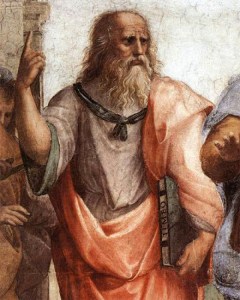
Plato (428/427 or 424/423 – 348 BC)
Greek Philosopher
One of my favorite passages from Scripture is 1 Corinthians 13:12: “For now we see through a glass, darkly; but then face to face: now I know in part; but then shall I know even as also I am known.” It’s my go-to when I’m struggling to understand God’s word (and is widely applicable in many aspects of our lives, including our understanding of history, by the way!). It gives me great hope — one day things will be clearer! Paul’s Greek heritage is coming through here, particularly the influence of Plato, the philosopher who lived four centuries before Christ’s birth. It was Plato who suggested in his cave analogy that what we perceive to be reality is merely a shadow-like reflection on the walls of the cave, and that truth is outside the cave in splashing sunlight — and that truth is only available to a select few. Forgive the drifty metaphor, but 1 Corinthians 13:12 has been on my mind all week, especially as I try to decipher and process the news of our day. I have had several conversations with friends in the past week who are voicing much anxiety about our world. The readings for Pentecost 25 feel especially modern (or timeless) to me in that regard. And since I have been trying to dig into the Psalms more of late, my focus will be on Psalm 90 and especially the fascinating connection between it and one of the great hymns of the Christian church. As always, thanks for your continuing interest in the Lectionary and I hope your reading is going well. Relax, breathe, and take time to listen as one with a “wise heart” (Psalm 90:12).
(Note: I do highlight phrases, and also offer hyperlinks that offer background — those are of a different color, italicized, and bolded).
Readings for Pentecost 25
Zephaniah 1:7, 12-18
Psalm 90: 1-8 (9-11) 12 (focus passage)
1 Thessalonians 5:1-11 (prayer inspiration)
Matthew 25:14-30

Abraham Lincoln (1809-1865)
This is a photograph from 5 days before he was assassinated.

Isaac Watts
(1674-1748)
Psalm 90 |
Oh God Our Help in Ages Past |
| 1 Lord, you have been our dwelling place in all generations. 2 Before the mountains were brought forth or ever you had formed the earth and the world, from everlasting to everlasting you are God. 3 You turn us back to dust and say, “Turn back, you mortals.” 4 For a thousand years in your sight are like yesterday when it is past or like a watch in the night. 5 You sweep them away; they are like a dream, like grass that is renewed in the morning; 6 in the morning it flourishes and is renewed; in the evening it fades and withers. 7 For we are consumed by your anger; by your wrath we are overwhelmed. 8 You have set our iniquities before you, our secret sins in the light of your countenance. 9 For all our days pass away under your wrath; our years come to an end like a sigh. 10 The days of our life are seventy years or perhaps eighty, if we are strong; even then their span is only toil and trouble; they are soon gone, and we fly away. 11 Who considers the power of your anger? Your wrath is as great as the fear that is due you. 12 So teach us to count our days that we may gain a wise heart. 13 Turn, O Lord! How long? Have compassion on your servants! 14 Satisfy us in the morning with your steadfast love, so that we may rejoice and be glad all our days. 15 Make us glad as many days as you have afflicted us and as many years as we have seen evil. 16 Let your work be manifest to your servants and your glorious power to their children. 17 Let the favor of the Lord our God be upon us and prosper for us the work of our hands— O prosper the work of our hands! |
1. O God, our help in ages past, Our hope for years to come, Our shelter from the stormy blast, And our eternal home. 2. Under the shadow of Thy throne Thy saints have dwelt secure; Sufficient is Thine arm alone, And our defense is sure. 3. Before the hills in order stood, Or earth received her frame, From everlasting Thou art God, To endless years the same. 4. Thy Word commands our flesh to dust, “Return, ye sons of men”: All nations rose from earth at first, And turn to earth again. 5. A thousand ages in Thy sight Are like an evening gone; Short as the watch that ends the night Before the rising sun. 6. The busy tribes of flesh and blood, With all their lives and cares, Are carried downwards by the flood, And lost in foll’wing years. 7. Time, like an ever-rolling stream, Bears all its sons away; They fly, forgotten, as a dream Dies at the op’ning day. 8. Like flow’ry fields the nations stand Pleased with the morning light; The flow’rs beneath the mower’s hand Lie with’ring ere ’tis night. 9. O God, our help in ages past, Our hope for years to come, Be Thou our guard while troubles last, And our eternal home. |
Prayer (Inspired by Thessalonians 5:1-11): Lord, help us to walk as children of the light. Grant us a sense of urgency, but also calm, as we confront our daily challenges — our lives are brief, but you assure us of eternity in the Kingdom. As we worship you, both publicly and privately, help us to encourage each other in the faith. Amen.
Enjoy this powerful hymn!
