Faithful Conversations #40
Introduction to Readers: Welcome back to Faithful Conversations! We have arrived at the start of the new liturgical church year. To reiterate, the lectionary is arranged in a three-year cycle and each year features a different synoptic Gospel (Matthew, Mark, or Luke — called synoptic because they are similar and can be viewed side by side). John’s Gospel, different in both content and style, is interspersed throughout all three years. We are now in Cycle B and Mark is featured in 2023-24. If you’re like me, an occasional reboot is necessary when it comes to spiritual disciplines, and I encourage you to pray about your daily faith practices. Now might be a good time, for example, to experiment with different approaches.
 This week marks the start of the Season of Advent. The word Advent derives from the Latin, adventus meaning “coming.” And while we tend to emphasize the birth of Jesus (looking back), Advent also boldly reminds us of Christ’s second coming (looking forward), as noted in this week’s Gospel. Amidst the stress foisted upon us by the overt consumerism and rush that infuses this time of year, Advent calls Christians to pause, to wake-up, to focus on Christ’s presence in our lives — and to seek God amidst the chaos that surrounds us. The readings for this week project themes of lamentation, anticipation, and hope. Keep those ideas in mind as you work through them.
Note: I do utilize various hyperlinks within the body here for further exploration on your part if interested! They are a different color and italicized.
Readings for the First Sunday in Advent
Isaiah 64:1-9
Psalm 80:1-7, 17-19
1 Corinthians 1:3-9
Mark 13: 24-37

Mosaic of the prophet Isaiah in the Dome of Immanuel in St Mark’s Basilica (Venice)
First Reading: Isaiah 64:1-9: O that you would tear open the heavens and come down, so that the mountains would quake at your presence— 2 as when fire kindles brushwood and the fire causes water to boil— to make your name known to your adversaries, so that the nations might tremble at your presence! 3 When you did awesome deeds that we did not expect, you came down; the mountains quaked at your presence. 4 From ages past no one has heard, no ear has perceived, no eye has seen any God besides you, who works for those who wait for him. 5 You meet those who gladly do right, those who remember you in your ways. But you were angry, and we sinned; because you hid yourself we transgressed. 6 We have all become like one who is unclean, and all our righteous deeds are like a filthy cloth. We all fade like a leaf, and our iniquities, like the wind, take us away. 7 There is no one who calls on your name or attempts to take hold of you, for you have hidden your face from us and have delivered us into the hand of our iniquity. 8 Yet, O Lord, you are our Father; we are the clay, and you are our potter; we are all the work of your hand. 9 Do not be exceedingly angry, O Lord, and do not remember iniquity forever. Now consider, we are all your people. Second Reading: 1 Corinthians 1: 3-9 3 Grace to you and peace from God our Father and the Lord Jesus Christ.4 I give thanks to my God always for you because of the grace of God that has been given you in Christ Jesus, 5 for in every way you have been enriched in him, in speech and knowledge of every kind— 6 just as the testimony of Christ has been strengthened among you— 7 so that you are not lacking in any gift as you wait for the revealing of our Lord Jesus Christ. 8 He will also strengthen you to the end, so that you may be blameless on the day of our Lord Jesus Christ. 9 God is faithful, by whom you were called into the partnership of his Son, Jesus Christ our Lord. The Gospel Reading: Mark 13: 24-37 24 “But in those days, after that suffering, the sun will be darkened, and the moon will not give its light, 25 and the stars will be falling from heaven, and the powers in the heavens will be shaken.
26 “Then they will see ‘the Son of Man coming in clouds’ with great power and glory. 27 Then he will send out the angels and gather the elect from the four winds, from the ends of the earth to the ends of heaven. 28 “From the fig tree learn its lesson: as soon as its branch becomes tender and puts forth its leaves, you know that summer is near. 29 So also, when you see these things taking place, you know that he is near, at the very gates. 30 Truly I tell you, this generation will not pass away until all these things have taken place. 31 Heaven and earth will pass away, but my words will not pass away. 32 “But about that day or hour no one knows, neither the angels in heaven nor the Son, but only the Father. 33 Beware, keep alert, for you do not know when the time will come. 34 It is like a man going on a journey, when he leaves home and puts his slaves in charge, each with his work, and commands the doorkeeper to be on the watch. 35 Therefore, keep awake, for you do not know when the master of the house will come, in the evening or at midnight or at cockcrow or at dawn, 36 or else he may find you asleep when he comes suddenly. 37 And what I say to you I say to all: Keep awake.”
This Week’s Reflection: “From Despair to Hope”
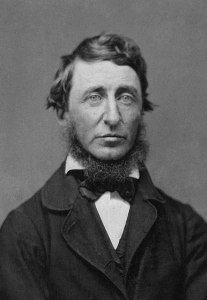
Henry David Thoreau
(1817-1862)

Dietrich Bonhoeffer
(1906-1945)
These words from one of the great heroes of Lutheranism, Dietrich Bonhoeffer, executed at age 39 for resisting Nazism in Germany. “The celebration of Advent is possible only to those who are troubled in soul, who know themselves to be poor and imperfect, and who look forward to something greater to come.”
