Faithful Conversations #47
Introduction to Readers:
“A political campaign, like a religious revival, was in part a social event, an entertainment, and in part a crusade waged on high moral grounds with a strong emotional charge. In a scale of values, loyalty to one’s party, belief in its principles often ranked only slightly below devotion to one’s church and faith in its creed.” (Kenneth Stampp)
The vexing nature of politics has been on my mind this week due to both the lectionary readings and the drumbeat of campaign-related news. The eerily contemporary sounding quote noted above comes from a book I’m reading called, America in 1857: A Nation on the Brink. Noted Civil War historian, Kenneth Stampp (1912-2009) was describing election politics in 1857, a good reminder that we often see contemporary events as unique in the annals of time (“this has never happened before!”). Any reading of our history indicates that fractured politics have been with us from the start. Sometimes it is important to take a breath, step back, and take the longer view.
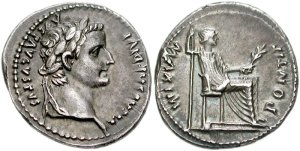
A denarius featuring Tiberius. The inscription on the obverse reads Ti[berivs] Caesar Divi Avg[vsti] F[ilivs] Avgvstvs (“Caesar Augustus Tiberius, son of the Divine Augustus”), and the reverse reads Pontif[ex] Maxim[us] (“Highest Priest”).
Since my youth, I have sought to navigate the intersection of history and politics with my faith journey. Regardless of where you identify on the political spectrum — and we certainly have legitimate disagreements within the Christian community — my sense is that as followers of Christ, our guiding principle — our liberating worldview, if you will — should be love of God and love of neighbor (Matthew 22: 38-39). And, while it’s important to be actively involved in our civic lives, we also must recognize the inherent imperfections of political systems and leaders and avoid placing absolute trust in either. Our first century spiritual ancestors, people whose world we seek to understand every week in this space, walked within an empire that emphasized glorification of the leader. The phrase “Caesar is Lord!” was an expected pledge by those living under the empire, a feature reinforced on those ancient coins we see from time to time. Many Christians, of course, refused to accept such public allegiances, and evidence suggests that martyrdom often awaited those who refused. Anyway, let’s all brace ourselves for the 10-month roller coaster ride leading to November! Keep that in mind as you walk through the readings for Sunday and, as always, thanks for your continued interest in exploring the lectionary! My reflections this week will focus on the passages from Mark and 1 Corinthians.
Note: I do utilize various hyperlinks within the body here for further exploration on your part if interested! They are a different color and italicized. If you click out to the supplemental information, simply click back to return to the blog. The images included, mostly, are from Wikimedia Commons, and therefore are in the public domain. As is often the case, this week I am indebted to Journey With Jesus, a weekly webzine, directed by theologian Dan Clenendin.
Readings for Epiphany 3 (21 January)
Jonah 3: 1-5, 10
Psalm 62: 5-12
1 Corinthians 7: 29-31
Mark 1: 14-20
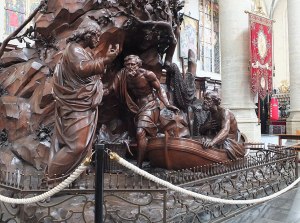
Sculpture in St Andrews’ Church, Antwerp (Belgium) by Jan-Baptist van Hool and Jan-Frans van Geel
The Gospel Reading: Mark 1: 14-20
14 Now after John was arrested, Jesus came to Galilee proclaiming the good news of God 15 and saying, “The time is fulfilled, and the kingdom of God has come near; repent, and believe in the good news.” 16 As Jesus passed along the Sea of Galilee, he saw Simon and his brother Andrew casting a net into the sea, for they were fishers. 17 And Jesus said to them, “Follow me, and I will make you fishers of people.” 18 And immediately they left their nets and followed him. 19 As he went a little farther, he saw James son of Zebedee and his brother John, who were in their boat mending the nets. 20 Immediately he called them, and they left their father Zebedee in the boat with the hired men and followed him.
The Second Reading: 1 Corinthians 7: 29-31
29 I mean, brothers and sisters, the appointed time has grown short; from now on, let even those who have wives be as though they had none, 30 and those who mourn as though they were not mourning, and those who rejoice as though they were not rejoicing, and those who buy as though they had no possessions, 31 and those who deal with the world as though they had no dealings with it. For the present form of this world is passing away.
This Week’s Reflection: “The Time is Now!”
Labels are often confusing. Our church is called the Evangelical Lutheran Church in America (ELCA), an entirely appropriate title based on our heritage and role in the world! Nevertheless, the word evangelical, can be problematic. It has come to mean different things to different people. Its roots are complex (explore further here if you wish!) Within our present media environment, for example, we often hear about the Evangelical Movement or who Evangelicals are supporting in an election — a sloppy shorthand for Christians who are considered to be politically conservative (although there is a problem with that word as well, but I digress), and from denominations considered fundamentalist in nature, who adhere to a strictly literal interpretation of scripture (i.e. Southern Baptists or Assemblies of God). Frankly, in the mind of many, especially those outside the Christian community, all Christians are put into that box (we do like to label people!). So, what does the word evangelical actually mean? Mark’s Gospel provides answers (sidebar: I’m gaining a greater appreciation for Mark, the highlighted Gospel in Year B).
Take a look at the very first line in Mark — “The beginning of the good news (gospel) of Jesus Christ, the Son of God” (RSV). “Gospel” traces to the Old English, “godspel,” meaning good news.* If we were reading this line in the original Greek, we would see the word euangelion, meaning “good news.” Evangelism, in short, means “spreading the good news.” Luther, by the way, was taken by the Latin version of the word — evangelium — and considered it the best description of the religious changes sweeping through Europe in the 16th Century — in his language, the “evangelische kirche” (I feel I have used my quota of quotation marks in this paragraph!!).
In today’s gospel, Jesus bursts on the scene (verse 14) preaching the good news — He is evangelizing!). He then calls for repentance because the kingdom of God is near — the time is now! (verse 15). Again, specificity of language is important. The original Greek word for “time” as Jesus referenced it here is kairos, meaning a turning point or divine intervention of some kind (as opposed to chronos, meaning the time we understand by looking at our watch, if you wear one!). There is a sense of urgency here. The time is now! Repentance, fundamental to our lives as Christians, refers to an abrupt turnaround, a complete reorientation in our thinking (picture Jonah marching through the streets of Ninevah!).
Writing from Ephesus to the church in Corinth in the early 50s CE, Paul amplifies Christ’s words, emphasizing that as Christians, we walk in two worlds simultaneously** (again, remember the world these early Christians navigated!). Phil Wold, pastor of Trinity Lutheran in Sheridan, Wyoming, offers the following commentary on these verses: The Reformation tradition values deeply the insight that there is a “simul” quality to the Christian life. We are simultaneously saint and sinner. We are also—simultaneously—people with no concerns about daily troubles, and people immersed in life’s daily affairs. Paul’s other worldliness is balanced by deep love for the world God loves. “The present world is passing away,” Paul says, and our faith assures us that God is also working to make us and God’s world new.
In the swirl of the world of 2024, I find the passage from 1 Corinthians and Wold’s interpretation remarkably powerful and comforting!***
Soli Deo Gloria
* Of the 64 translations of the Bible available on the Bible Gateway website, I note that 28 use the word “gospel” in Mark 1:1, including the King James version, the Bible that may have been utilized by many of our ancestors.
**We’re hearing a lot these days about Chat GPT and the increasing use of Artificial Intelligence (AI). I am confronting this new world with my students right now, and, as you might imagine, it is challenging. Just for fun, I went to Chat GPT and posed this prompt: Write a short paragraph about what it means for Christians to walk in two worlds. This is what I got:
The phrase “Christians walk in two worlds” often refers to the dual nature of the Christian faith, emphasizing the believers’ simultaneous existence in both the earthly realm and the spiritual realm. On one hand, Christians navigate their daily lives in the tangible, material world, engaging with worldly responsibilities, relationships, and challenges. On the other hand, their faith teaches them to live according to spiritual principles, guided by religious teachings and a connection with the divine. This duality underscores the idea that Christians are called to integrate their faith into every aspect of their lives, striving to embody the values of love, compassion, and righteousness while participating in the complexities of the secular world. The concept highlights the balance between the earthly and the spiritual dimensions that Christians seek to maintain in their journey of faith.
Amazing, right? Just so you’re aware, I am writing the blog myself, although I borrow freely from multiple sources — people who are experts!
***Wold’s interpretation is from God Pause, an excellent daily devotional provided by alumni of Luther Seminary in St. Paul, which you can subscribe to if interested!
This Week’s Prayer Reflection (a poem):
FOUND
Maybe it’s all utterly meaningless.
Maybe it’s all unutterably meaningful.
If you want to know which,
pay attention to
what it means to be truly human
in a world that half the time
we’re in love with
and half the time
scares the hell out of us…
The unexpected sound of your name on somebody’s lips.
The good dream.
The strange coincidence.
The moment that brings tears to your eyes.
The person who brings life to your life.
Even the smallest events hold the greatest clues.
Frederick Buechner (1926–2022)
(Accessed from Journey with Jesus website)
Announcement Regarding Our Lectionary Discussions:
Join us, if you can, for a free-wheeling discussion of this week’s readings after worship on Sunday (10:45) in the library. All are welcome!
And . . . .
looking over the horizon . . . “Faithful Conversations: Resilient Voices”
 We continue to “think digitally” and how we can share the Good News in our community and beyond. We have secured the various pieces of technology necessary to begin conducting interviews and developing podcasting capabilities. Thanks to Peter Bushman for his excellent guidance with technology and to Pastor Jen for her ongoing conversations regarding new and different ways to approach adult education! Starting in February, we plan to do a series of interviews with members regarding their faith journeys. Stay tuned for further announcements!
