Faithful Conversations #49
Introduction to Readers:
Before getting into this week’s installment, let me double back on last week’s Gospel (Mark 1: 21-28), focusing on verses 23-24: Just then a man in their synagogue who was possessed by an impure spirit cried out, “What do you want with us, Jesus of Nazareth? Have you come to destroy us? I know who you are—the Holy One of God!” In her sermon at ELC on Sunday (Epiphany 4), Pastor Jen highlighted this exchange between Jesus and the man with the unclean spirit, and likened it to the cynical, worldly reaction we may face as Christians, a compelling and relevant interpretation for our time. I cannot remember a time in my life when toxic anger, negativity, and division were as prevalent, seemingly impacting all aspects of our lives. The opportunity for Christians, it seems to me, is to provide a healing counter-narrative in this environment. Keep that thought in mind as you walk through this week’s readings. My reflections will be primarily drawn from 1 Corinthians and Mark’s Gospel. As always, thanks for your continued interest in exploring the scriptures together!
Note: I do utilize various hyperlinks within the body here for further exploration! They are a different color and italicized. If you click out, simply click back to return to the blog. The images included, mostly, are from Wikimedia Commons, and therefore are in the public domain.
Readings for Epiphany 5 (4 February)
Isaiah 40: 21-31
Psalm 147: 1-11, 20c
1 Corinthians 9: 16-23 (focus)
Mark 1: 29-39 (focus)
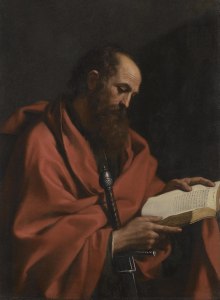
Saint Paul by
Guercino (1591–1666)
The New Testament Reading: 1 Corinthians 9: 16-23
16 If I proclaim the gospel, this gives me no ground for boasting, for an obligation is laid on me, and woe to me if I do not proclaim the gospel! 17 For if I do this of my own will, I have a wage, but if not of my own will, I am entrusted with a commission. 18 What then is my wage? Just this: that in my proclamation I may make the gospel free of charge, so as not to make full use of my rights in the gospel. 19 For though I am free with respect to all, I have made myself a slave to all, so that I might gain all the more. 20 To the Jews I became as a Jew, in order to gain Jews. To those under the law I became as one under the law (though I myself am not under the law) so that I might gain those under the law. 21 To those outside the law I became as one outside the law (though I am not outside God’s law but am within Christ’s law) so that I might gain those outside the law. 22 To the weak I became weak, so that I might gain the weak. I have become all things to all people, that I might by all means save some. 23 I do it all for the sake of the gospel, so that I might become a partner in it.
The Gospel: Mark 1: 29-39
29 As soon as they left the synagogue, they entered the house of Simon and Andrew, with James and John. 30 Now Simon’s mother-in-law was in bed with a fever, and they told him about her at once. 31 He came and took her by the hand and lifted her up. Then the fever left her, and she began to serve them. 32 That evening, at sunset, they brought to him all who were sick or possessed by demons. 33 And the whole city was gathered around the door. 34 And he cured many who were sick with various diseases and cast out many demons, and he would not permit the demons to speak, because they knew him. 35 In the morning, while it was still very dark, he got up and went out to a deserted place, and there he prayed. 36 And Simon and his companions hunted for him. 37 When they found him, they said to him, “Everyone is searching for you.” 38 He answered, “Let us go on to the neighboring towns, so that I may proclaim the message there also, for that is what I came out to do.” 39 And he went throughout all Galilee, proclaiming the message in their synagogues and casting out demons.
This Week’s Reflection: “healing in a divided world”
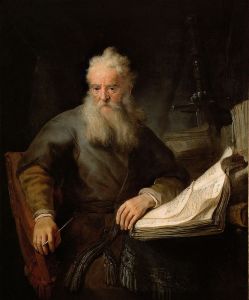
St. Paul by Rembrandt (1606-1669)
In his book, The Paul Quest: The Renewed Search for the Jew of Tarsus, author Ben Witherington III offers this less than flattering description of Saint Paul: “Most moderns, even most modern Western Christians, would have been taken aback by Paul. Certainly before his conversion, and probably after it as well, we would see him as a fanatic . . . We would also likely see Paul as too driven, too single-minded and single-purposed . . .” Paul’s zealotry is on display in this week’s reading from 1 Corinthians (verses 16-18). And though zealotry seems synonymous with rigidity, verses 19-23 offer a different perspective for us to consider. Again, to quote from Witherington, ” . . . the apostle appears to have been a remarkably flexible person in a very inflexible world. This is not to say that Paul does not have fixed and unalterable commitments to the gospel and its theological and ethical ramifications; but the way Paul theologizes and thinks ethically out of these commitments is remarkably adaptable to his audience’s situation.” The takeaway here for me is that as followers of Christ, it is vital that we are willing to interact with all people, even those that we may disagree with, for the furtherance of the Gospel! Again, this is our great opportunity, perhaps our special calling, in our deeply divided world.

Christ in the Wilderness
by Ivan Kramskoi (1837–1887)
Jesus, of course, interacted with people from all walks of life, and spent much of his time with those on the margins of society, the shunned outcasts of the world. In Mark’s crisp account from this week’s Gospel, we see our Lord in action and prayer. He brings miraculous healing to many and, as He often does, retreats early in the morning to pray in solitude. In these moments, we see His humanity and need for communion with God. We see Him in the world, offering hope to broken people without judgement or condemnation, while also remaining apart from the world, a perfect window into the Christian journey.
Soli Deo Gloria
Prayer (based on Isaiah 40: 28-31)
Gracious Father,
We come before you, acknowledging your everlasting nature and infinite wisdom. In moments of weariness, we find comfort in your promise that you never grow tired or weary. Today, we surrender our fatigue to you and ask for the strength to endure. Renew us, Lord, as we place our hope in you. Grant us wings like eagles, that we may rise above the challenges we face. May we run without growing weary, walk without fainting, and find our strength in the assurance of your unfailing love. In the name of Jesus, our source of strength and hope, we pray. Amen.
And, here is a beautiful hymn inspired by Isaiah 40: 28-31. It comes from a UCC Church in Ashland, Oregon.
Announcement Regarding Our Lectionary Discussions:
We will resume our in-person meetings after church on Sunday (2.4) at 10:45 in the library. Invite a friend! ALL ARE WELCOME!
And . . . .
update on “Faithful Conversations: Resilient Voices”

Like other denominations in the first quarter of the 21st Century, the ELCA has been navigating many challenges, and we are clearly in a time of transition. More than 60% of ELCA membership, for example, is age 50 or older – 31% are 65 or older. We feel strongly that we need to garner the wisdom of the older generation as we move forward and work to make cross-generational connections to strengthen our future. We are a church rooted in strong traditions, while at the same time, attempting to remain resilient and relevant in our ever-changing world. Starting in February of 2024, we are initiating the “Resilient Voices” project as part of our Faithful Conversations adult education and Bible study initiatives. The purpose of Resilient Voices will be to document faith journeys or stories of many of our parishioners. We conducted our first two interviews this week! Thanks for Rollie Lee and Jerry Humphrey for their terrific participation! Also, a shout-out to Peter Bushman for his help with a couple new tech applications, and Lizzie as well!
