Faithful Conversations #50
Introduction to Readers:

Intense battles over Biblical Interpretation!
(1960s Lutheran humor)
We’re nearing one year into this blogging experiment (hard to believe). From the start, the goals have been to learn more about the Revised Common Lectionary (RCL) and to encourage engagement with scripture in a more systematic way. If you’re like me, interpreting scripture is both challenging and exhilarating.! This week marks the end of the brief season of Epiphany and Ash Wednesday is just around the corner (14 February), at which point we begin to interact with the 40-day journey to Easter. My reflections this week focus on the readings from Elijah and Mark. As always, thanks for your interest in Bible study!
Note: I do utilize various hyperlinks within the body here for further exploration! They are a different color and italicized. If you click out, simply click back to return to the blog. The images included, mostly, are from Wikimedia Commons, and therefore are in the public domain.
Readings for The Transfiguration of our Lord
2 Kings 2: 1-12 (focus)
Psalm 50: 1-6
2 Corinthians 4: 3-6
Mark 9: 2-9 (focus)
The First Reading: 2 Kings: 2: 1-12: Elijah Ascends to Heaven
Now when the Lord was about to take Elijah up to heaven by a whirlwind, Elijah and Elisha were on their way from Gilgal. 2 Elijah said to Elisha, “Stay here, for the Lord has sent me as far as Bethel.” But Elisha said, “As the Lord lives and as you yourself live, I will not leave you.” So they went down to Bethel. 3 The company of prophets who were in Bethel came out to Elisha and said to him, “Do you know that today the Lord will take your master away from you?” And he said, “Yes, I know; keep silent.”

Elijah and the Chariot of Fire
by Giuseppe Angeli (c. 1740)
4 Elijah said to him, “Elisha, stay here, for the Lord has sent me to Jericho.” But he said, “As the Lord lives and as you yourself live, I will not leave you.” So they came to Jericho. 5 The company of prophets who were at Jericho drew near to Elisha and said to him, “Do you know that today the Lord will take your master away from you?” And he answered, “Yes, I know; keep silent.” 6 Then Elijah said to him, “Stay here, for the Lord has sent me to the Jordan.” But he said, “As the Lord lives and as you yourself live, I will not leave you.” So the two of them went on. 7 Fifty men of the company of prophets also went and stood at some distance from them, as they both were standing by the Jordan. 8 Then Elijah took his mantle and rolled it up and struck the water; the water was parted to the one side and to the other, and the two of them crossed on dry ground. 9 When they had crossed, Elijah said to Elisha, “Tell me what I may do for you before I am taken from you.” Elisha said, “Please let me inherit a double share of your spirit.” 10 He responded, “You have asked a hard thing, yet if you see me as I am being taken from you, it will be granted you; if not, it will not.” 11 As they continued walking and talking, a chariot of fire and horses of fire separated the two of them, and Elijah ascended in a whirlwind into heaven. 12 Elisha kept watching and crying out, “Father, father! The chariots of Israel and its horsemen!” But when he could no longer see him, he grasped his own clothes and tore them in two pieces.
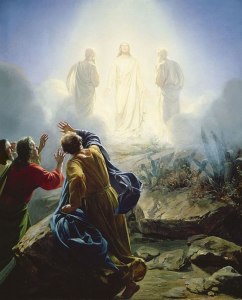
The Transfiguration
by Carl Heinrich Bloch (1834–1890)
The Gospel: Mark 9: 2-9: The Transfiguration
2 Six days later, Jesus took with him Peter and James and John and led them up a high mountain apart, by themselves. And he was transfigured before them, 3 and his clothes became dazzling bright, such as no one on earth could brighten them. 4 And there appeared to them Elijah with Moses, who were talking with Jesus. 5 Then Peter said to Jesus, “Rabbi, it is good for us to be here; let us set up three tents: one for you, one for Moses, and one for Elijah.” 6 He did not know what to say, for they were terrified. 7 Then a cloud overshadowed them, and from the cloud there came a voice, “This is my Son, the Beloved; listen to him!” 8 Suddenly when they looked around, they saw no one with them any more, but only Jesus. 9 As they were coming down the mountain, he ordered them to tell no one about what they had seen, until after the Son of Man had risen from the dead.
This Week’s Reflection: “Turning points!”

David Blight
(b. 1949)
David Blight, a favorite historian of mine, once remarked, “History must be imagined before it can be understood.” A corollary to that assertion is that stories are central to our understanding of history, and I would argue that is also true regarding our engagement with scripture. The readings from Elijah and Mark for Transfiguration Sunday both pack powerful imagery and ignite our imaginations.
First, the Old Testament story. Elijah is a significant figure in both Judaism and Christianity. Revered as a prophet and miracle worker and known for his unwavering commitment to the worship of the one true God, Elijah confronted the idolatrous practices of his time, notably during the reign of King Ahab and Queen Jezebel in ancient Israel (874-853 BCE). Elijah’s life was marked by his courage, faith, and eventual departure from earth in a chariot of fire, symbolizing his unique relationship with the divine. In the episode from this week’s reading, Elijah is about to be taken up to heaven, and his disciple Elisha accompanies him on his journey. As they travel from Gilgal to Bethel and then to Jericho, a group of prophets forewarn Elisha about Elijah’s imminent departure (verse 5). Despite these warnings, Elisha remains steadfast in his commitment to stay with Elijah. Eventually, as they reach the Jordan River, Elijah strikes the water with his cloak, causing the river to part, and they cross on dry ground (verse 8). Elijah then asks Elisha for his final request before his departure, and Elisha requests a double portion of Elijah’s spirit (verses 9-10). Witnessing Elijah being taken up in a whirlwind to heaven, Elisha inherits his mentor’s mantle and performs miracles with the power of the Spirit that rested on Elijah.
And, how about the Transfiguration moment? As a history teacher, this story has always been a favorite due to the three dimensions of time present in the mountaintop experience — past, present, and future. Jesus takes Peter, James, and John up Mount Tabor where he is transfigured before them (verse 2). His clothes become dazzling white, and Elijah and Moses appear, talking with Jesus (verses 3-4). Peter suggests building three shelters, but a cloud overshadows the scene, and the voice of God declares Jesus as His beloved Son, instructing the disciples to listen to Him (verses 5-7). The disciples are left in awe, and Jesus advises them to keep the event secret until after His resurrection (verse 9).
What are we to make of these stunning and transcendent moments? Both involve themes of divine manifestation and the passing of spiritual authority. Further, both are distinct turning points. While reading the passage from 2 Kings, I was reminded of that disturbing — indeed heart-wrenching — moment when one realizes that a parent is dying. Elisha cannot face losing his mentor Elijah. His anguish runs through the entire passage. Nevertheless, he must go forward, and carry on the work of this man he so admired. Elisha’s story beyond that moment is powerful and inspirational.
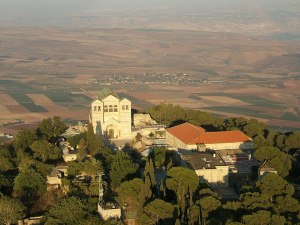
The Franciscan Church of the Transfiguration of Jesus Christ
(Mount Tabor, Israel)
In Mark’s account of the transfiguration (also found in Matthew 17: 1-13 and Luke 9:28-36), we are again witnesses to an overpowering celestial moment. The presence of Moses (the lawgiver) and Elijah (the prophet) symbolizes continuity with the Old Testament tradition. Peter’s confused response is curious. His call for building three tents, as suggested by Biblical scholars, may hearken back to the Jewish tradition of a sacred space for the divine (i.e. the Tabernacle), as exemplified during the Exodus and wilderness wanderings. Or, he may simply have wanted to extend the experience, to stay within that miraculous space. Whatever the case, God clearly indicates the unique nature of Christ, His beloved Son. Let’s imagine what was going through the minds of the disciples as they descended the mountain in this “before and after” moment, this turning point! Their lives would never be the same.
Soli Deo Gloria
Prayer (Inspired by Psalm 50: 1-6)
You, O Lord, are the Judge of all, from the rising to the setting sun. Your radiance illuminates the earth. In humility, we acknowledge that everything belongs to You. As we enter this sacred moment of prayer, may Your divine light shine upon us, revealing the path of righteousness that leads us closer to You. Grant us the wisdom to recognize Your presence in our lives and the grace to align our hearts with Your will. Amen.
And, here is a WONDERFUL SONG that came to mind when reading the passage from 2 Corinthians this week. It comes from composer David Haas. You will appreciate the energy of these young people!
Announcement Regarding Our Lectionary Discussions:
Please feel welcome to join us after church on Sundays (10:45-11:15) for some discussion of the week’s readings, and other topics. Invite a friend! ALL ARE WELCOME!
And . . . .
Update on “Faithful Conversations: Resilient Voices”
 Like other denominations in the first quarter of the 21st Century, the ELCA is navigating many challenges, and we clearly are in a time of transition. We are a church rooted in strong traditions, while at the same time, attempting to remain resilient and relevant in our ever-changing world. We feel strongly that we need to garner the wisdom of the older generation as we move forward and work to make cross-generational connections to strengthen our future. Starting in February of 2024, we initiated the “Resilient Voices” project as part of our Faithful Conversations adult education and Bible study initiatives. The purpose of Resilient Voices will be to document faith journeys or stories of many of our parishioners. Let me know if you are interested in participating!
