Faithful Conversations #54

“Christ in the Wilderness” by Russian painter Ivan Kramskoy (1872)
Introduction to Readers:
We are nearing the half-way mark of the 40-day Lenten Journey (Friday is day 20, not counting Sundays). Why 40 days? The number 40 symbolizes a period of testing, purification, and preparation. It echoes the 40 days Jesus spent fasting in the wilderness, Moses’ 40 days on Mount Sinai, and the Israelites’ 40 years of wandering in the desert, embodying themes of spiritual renewal and discipline. I pray that you are having a meaningful journey!
The readings for the 4th Sunday in Lent, focus on the narrative of redemption and salvation. I have provided several guiding questions for the Ephesians passage and my commentary this week will focus on the Gospel. As always, thanks for your ongoing interest in Bible study!
One note: I do provide links within the blog for further reading, if interested (italicized and a different color). If you click on the link, simply use the back arrow (upper left) to get back to the blog.
Readings for Lent 4 (Sunday 10 March)
Numbers 21:4-9
Psalm 107: 1-3, 17-22
Ephesians 2: 1-10
John 3: 14-21
The NT Reading: Ephesians 2: 1-10: Made Alive in Christ
You were dead through the trespasses and sins 2 in which you once walked, following the course of this world, following the ruler of the power of the air, the spirit that is now at work among those who are disobedient. 3 All of us once lived among them in the passions of our flesh, doing the will of flesh and senses, and we were by nature children of wrath, like everyone else, 4 but God, who is rich in mercy, out of the great love with which he loved us 5 even when we were dead through our trespasses, made us alive together with Christ —by grace you have been saved— 6 and raised us up with him and seated us with him in the heavenly places in Christ Jesus, 7 so that in the ages to come he might show the immeasurable riches of his grace in kindness toward us in Christ Jesus. 8 For by grace you have been saved through faith, and this is not your own doing; it is the gift of God— 9 not the result of works, so that no one may boast. 10 For we are what he has made us, created in Christ Jesus for good works, which God prepared beforehand so that we may walk in them.
Commentary and Questions for Reflection
The passage from Ephesians is pure Lutheranism. Verses 1-3 describe the time before the saving grace of Christ was known, verses 4-9 proclaim the saving love, grace, and mercy of God in Christ, and verse 10 articulates the lasting effect of gift of grace. Here are several guiding questions:
- How would you describe the powers that defy God? How are they manifested today?
- How would you describe the grace of God to someone outside the Christian faith?
- Why are verses 8-9 central to our faith?
- What is the connection between faith and good works in the Lutheran interpretation of Christianity?

“Christ and Nicodemus” by Matthias Stom (c.1600 –1652) Dutch artist (possibly Flemish)
The Gospel Reading: John 3: 14-21
14 And just as Moses lifted up the serpent in the wilderness, so must the Son of Man be lifted up, 15 that whoever believes in him may have eternal life. 16 “For God so loved the world that he gave his only Son, so that everyone who believes in him may not perish but may have eternal life. 17 “Indeed, God did not send the Son into the world to condemn the world but in order that the world might be saved through him. 18 Those who believe in him are not condemned, but those who do not believe are condemned already because they have not believed in the name of the only Son of God. 19 And this is the judgment, that the light has come into the world, and people loved darkness rather than light because their deeds were evil. 20 For all who do evil hate the light and do not come to the light, so that their deeds may not be exposed. 21 But those who do what is true come to the light, so that it may be clearly seen that their deeds have been done in God.”
This Week’s Reflection: “Born once, die twice or born Twice, die once”
Jesus’ intriguing encounters with complex characters stir my imagination. These often-brief episodes provide insights into the mind and heart of Christ. Nicodemus opened this tab for me this week (other examples are Mary Magdalene, Zacchaeus, the woman at the well, the adulterous woman, Pontius Pilate, the two disciples on the road to Emmaus, to name a few). Nicodemus, by the way, shows up only in John’s Gospel and has two other appearances there (John 7: 50-51 and 19:39). It seems clear that he became a follower of Christ. His conversation with Jesus was one for the ages.

Nicodemus by Tissot, 1850
So, what is his story? Let’s backtrack a bit. In John 3, the Pharisee Nicodemus comes to Jesus by night, perhaps for fear of being seen. A leader within the Jewish community, he is curious about the young holy man. Miraculous signs (i.e. turning water into wine as noted in John 2) have convinced him that Christ is “from God” (verse 2). In the exchange that follows, Jesus talks openly about the necessity of being “born from above” (verse 3) — in effect, being born again, a perplexing concept for the Pharisee. The powerful dialogue continues and ultimately arrives at that most famous moment — John 3: 16 — so often visible in the endzone seating of NFL games: “For God so loved the world that he gave his only Son, so that everyone who believes in him may not perish but may have eternal life.”
So, what does it mean to be “born again?” Owing to my ELCA roots, this was not a phrase that tripped off the tongue while growing up. People who were “born again,” it seemed to me, belonged to a different type of church than me, and often spoke with a southern accent. As I have explored the concept this week, I’m curious as to WHY that was my perception. (This space, I suspect, does not allow the time, nor do I have the expertise for that discussion. I must admit, this is one of those moments when I would love to converse with my father!).

Martin Luther
(1483-1546)
Luther, apparently, was clear on this. In the margin of his famous Bible (translated into German), next to the verses we are reading, he wrote the famous phrase, “born once, die twice or born twice, die once.” Beyond the fact that it does my heart good to know that Luther scribbled notes while reading, something I have done for years, what did he mean exactly? Let’s try this. Those who are “born once” only experience physical birth and subsequently spiritual death, leading to both physical and spiritual demise. Conversely, those who are “born twice,” experiencing both physical birth and spiritual rebirth through faith in Christ, will only face physical death, as they are assured of eternal life with God. Wow.
Oh, brother Martin, you have given us much to think about there! And Nicodemus! What an amazing moment you shared with Jesus!
Soli Deo Gloria
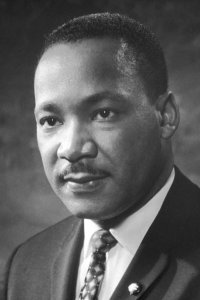
Martin Luther King, Jr. (1929-1968)
** Note: If you are interested in exploring a beautiful example of Christian faith intersecting with historical events and actors, Martin Luther King’s speech from August of 1967 is worth your time. King raises the story of Nicodemus and applies it to the movement for social justice in the United States. Access the speech here.
His commentary on Nicodemus comes near the end of the speech!
(Note: Martin Luther King’s father named his son after . . . you guessed it — Martin Luther!)
Prayer (inspired by PSALM 107: 17-22):
Gracious God, we come before you with hearts filled with gratitude, acknowledging your steadfast love and faithfulness. We confess our moments of distress and affliction, times when we wandered in darkness and found no way out. Yet, you, O Lord, in your mercy, heard our cries and delivered us from our troubles. We praise you for turning our mourning into dancing and our sorrow into joy. Help us, Lord, to always remember your goodness and to share with others the hope and comfort we have found in you. Grant us the strength and courage to trust in your unfailing love, even in the midst of life’s storms. May our lives be a reflection of your grace and compassion, shining brightly for all to see. In Jesus’ name, we pray. Amen.
The suggested hymn for Lent 4: Lift High the Cross (check out this majestic version!)
Announcement Regarding Our Lectionary Discussions:
Please join us after church on Sundays (10:45-11:15) for some discussion of the week’s readings, and other topics. Invite a friend! No prior knowledge is necessary, and you will not be put on the spot — just a simple and formal exchange among believers. ALL ARE WELCOME!
And . . . .
Update on “Faithful Conversations: Resilient Voices”
 We are a church rooted in strong traditions, while at the same time, attempting to remain resilient and relevant in our ever-changing world. We feel strongly that we need to garner the wisdom of the older generation as we move forward and work to make cross-generational connections to strengthen our future. Starting in February of 2024, we initiated the “Resilient Voices” project as part of our Faithful Conversations adult education and Bible study initiatives. The purpose of Resilient Voices will be to document faith journeys or stories of many of our parishioners. Let me know if you are interested in participating!
Thanks to Fred Goettle for his recent faith journey interview!
