Faithful Conversations #55
Introduction to Readers:
“The past is a foreign country; they do things differently there.” (L.P. Hartley)
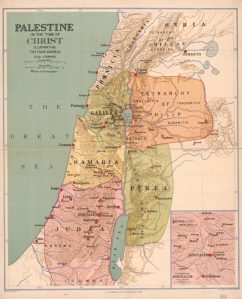
First Century Palestine
The Hartley quote is a favorite and has been on my mind throughout the Lenten season. Roughly 79 generations have passed since our spiritual ancestors stood at the foot of the cross outside the gates of Jerusalem, forever changed by the events they witnessed. And while we would agree their world and ours dramatically differ, it is intriguing to realize that when we have the opportunity to meet them beyond this life, we will quickly find common ground. Let’s imagine those energetic conversations! Centuries of tradition connect us as we grapple with the story of Jesus.
Our Sunday worship experience, for example, connects us across time. Those first-generation Christians described in Acts, gathered in the name of the Triune God, offered confession for sin, received absolution (forgiveness), leading to the celebration of communion with Christ. Over time, a formalization of practices evolved, branching in different directions. By the 12th Century, as one example, the word “Introit,” came into usage in our tradition, denoting a formal call to worship. I recall the inclusion of the word while growing up, but to my knowledge, it is not used anymore (at least, I do not find it in the 2006 ELW, our current hymnal). It simply means “beginning” or “entrance” and the subject of the introit reminds us of the name for that particular Sunday (a tie to the Lectionary). So, here’s another round of Lenten history. During the Reformation period, Luther was insistent on preserving the core traditions of Lent (including Ash Wednesday), while more radical protestants sought to purge practices tied to Roman Catholicism. For centuries, the Sundays in Lent, for example, were designated by a Latin name that stemmed from the first word of the Introit for that Sunday. The names of these Sundays are: Invocabit, Reminiscere, Oculi, Laetare, and Judica, with Palm Sunday bearing the name Palmarum. Interestingly enough, those terms (along with the term introit) were still used in the 1958 “Service Book and Hymnal” (think Red Hymnal from your growing up years if you are 60 or older). They are NOT used in our current hymnal — again, an example of traditions that drift away (to be fair, I did not check the green hymnal of 1978, but will). Perhaps other examples come to mind. (Note: If you follow the link to the 1958 Hymnal, and continue scrolling, you will reach the section titled, “The Proper of the Service” and will see the traditional liturgy for the church year).
Once again, thanks for your interest in pursuing the Lectionary! I hope it is prompting questions and energizing your faith experience. A reminder about my use of hypertext (more today than usual): these are included to enrich your understanding, and simply that. If you go out to the site, simply click back to return to the blog. Again, my images are primarily drawn from Wikimedia Commons, and therefore are free. This week, I’m providing some prompting questions related to the passage from Hebrews and my reflections will focus on Psalm 51.
Readings for Lent 5 (Sunday 17 March)
Jeremiah 31: 31-34
Psalm 51: 1-12 or Psalm 119: 9-16
Hebrews 5: 5-10
John 12: 20-33
The Psalm: 51: 1-12: Prayer for Cleansing and Pardon
1 Have mercy on me, O God,
according to your steadfast love;
according to your abundant mercy,
blot out my transgressions.
2 Wash me thoroughly from my iniquity,
and cleanse me from my sin.
3 For I know my transgressions,
and my sin is ever before me.
4 Against you, you alone, have I sinned
and done what is evil in your sight,
so that you are justified in your sentence
and blameless when you pass judgment.
5 Indeed, I was born guilty,
a sinner when my mother conceived me.
6 You desire truth in the inward being;
therefore teach me wisdom in my secret heart.
7 Purge me with hyssop, and I shall be clean;
wash me, and I shall be whiter than snow.
8 Let me hear joy and gladness;
let the bones that you have crushed rejoice.
9 Hide your face from my sins,
and blot out all my iniquities.
10 Create in me a clean heart, O God,
and put a new and right spirit within me.
11 Do not cast me away from your presence,
and do not take your holy spirit from me.
12 Restore to me the joy of your salvation,
and sustain in me a willing spirit.

Melchizedek (1681) from National Museum in Wroclaw
New Testament Reading: Hebrews 5: 5-10
5 So also Christ did not glorify himself in becoming a high priest but was appointed by the one who said to him, “You are my Son; today I have begotten you”; 6 as he says also in another place, “You are a priest forever, according to the order of Melchizedek.” 7 In the days of his flesh, Jesus offered up prayers and supplications, with loud cries and tears, to the one who was able to save him from death, and he was heard because of his reverent submission. 8 Although he was a Son, he learned obedience through what he suffered, 9 and having been made perfect, he became the source of eternal salvation for all who obey him, 10 having been designated by God a high priest according to the order of Melchizedek.
Commentary and Questions for Reflection (drawn from “Daily Faith Practices” from the ELCA):
This reading was intended for those steeped in Judaism. Psalm 110 is quoted, and the image of the high priest is used to explain the significance of Jesus’ suffering. Aside from this passage, Melchizedek is mentioned only two times in the Bible (Genesis 14: 18-20 and Psalm 110:4). The name literally means “the King of Righteousness.”
- Had you heard of Melchizedek prior to this reading?
- Think of the high priest as a bridge between God and humanity. Do you find this image of Jesus as high priest helpful, or not?
- The Christ we follow knows our suffering. Jesus is not aloof or distant from the pain of the world. He willingly enters that pain and carries it to the cross. How does this image of Jesus make you feel?
This Week’s Reflection: “Miserere mei, Deus” (“have mercy on me, o god”)
In our discussion of the lectionary readings after church last Sunday, we explored the question of whether (or not) we spend much time in the ELCA talking about repentance. I am still thinking about that. Confession of sin is certainly part of our faith practice, but we do that within a culture that trends in the opposite direction. Admitting fault in 2024 is decidedly out of step, at least that’s my take. Exhibiting humility, for many, is a clear sign of weakness. Such was not the case for King David whose “terrified conscience” is on display in Psalm 51 (see Article XX of the Augsburg Confession for Luther’s use of that term — it rightly captures David’s anguish!).

“David and Bathsheba”
A 1951 film starring Gregory Peck and Susan Hayward
First, the epic backstory (2 Samuel, chapters 11-12). King David’s relationship with Bathsheba began with his lustful gaze upon her while she bathed, leading to an adulterous affair. Bathsheba became pregnant, prompting David to devise a plan to cover up his sin by arranging for her husband Uriah’s death in battle (Bathsheba’s story seems especially heart-wrenching and complex). Despite David’s attempt to conceal his wrongdoing, the prophet Nathan confronted him, revealing the depth of his transgression. The repercussions of David’s actions included the death of the child born from his union with Bathsheba and internal strife within his family, tarnishing his reign as king. In time, however, David and Bathsheba had another son named Solomon, and the rest, as they say, is history. (Note: Matthew 1: 1-12 traces the lineage of Jesus to King David and ultimately Abraham. Verse 6 specifically references Solomon as David’s son “by the wife of Uriah” — is it just me, or does it seem strange that Bathsheba is not even named? But, I digress).
For those of us reared in the traditions of the various denominations that ultimately melded together as the ELCA, we heard and sang Psalm 51 well before we understood the tragedy that prompted its language. I can still hear my mother’s gorgeous voice rising to sing a portion of the Psalm while ushers solemnly walked those offering plates forward. Verses 10-12 are words to treasure, and I have always been partial to the King James version of verse 12: Restore unto me the joy of Thy salvation and uphold me with Thy free Spirit. I especially like that reference to the “free Spirit!”
So, on this 5th Sunday in Lent — known as Judica — the Introit we may have heard at an earlier time goes like this: “Judge me, O God and plead my cause against un ungodly nation. O deliver me from the deceitful and unjust man; for thou are the God of my strength.” Wow. No sugar-coating that. And, on this Sunday, David offers us the stark language of repentance in Psalm 51. Knowing his story, his voice seems deeply personal and filled with anguish. But I’m also struck by the first line with its emphasis on God’s “steadfast love” and “abundant mercy.” May we repent today (and every day) resting in that powerful assurance.
Soli Deo Gloria
Prayer of St. Patrick (“Christ be with me”): Written in 483
(Offering this beautiful prayer today in honor of St. Patrick and for those of us with Irish heritage — in my case, twelve percent. My Viking ancestors, apparently, made trips to Ireland!)

St. Patrick by Giovanni Battista Tiepolo (1696-1770)
Christ with me, Christ before me, Christ behind me,
Christ in me, Christ beneath me, Christ above me,
Christ on my right, Christ on my left,
Christ where I lie, Christ where I sit, Christ where I arise,
Christ in the heart of everyone who thinks of me,
Christ in the mouth of every one who speaks to me,
Christ in every eye that sees me,
Christ in every ear that hears me.
Salvation is of the Lord.
Salvation is of the Christ.
May your salvation, Lord, be ever with us.
Announcement Regarding Our Lectionary Discussions:
We continue to meet after church on Sundays (10:45-11:15) for some discussion of the week’s readings, and other topics. Invite a friend! No prior knowledge is necessary, and you will not be put on the spot — just a simple and informal exchange among believers. We mostly ask a lot of questions! ALL ARE WELCOME!
And . . . .
Update on “Faithful Conversations: Resilient Voices”
 We are a church rooted in strong traditions, while at the same time, attempting to remain resilient and relevant in our ever-changing world. We feel strongly that we need to garner the wisdom of the older generation as we move forward and work to make cross-generational connections to strengthen our future. Starting in February of 2024, we initiated the “Resilient Voices” project as part of our Faithful Conversations adult education and Bible study initiatives. The purpose of Resilient Voices is to document faith journeys or stories of many of our parishioners. Let me know if you are interested in participating!
Mange Tak! to Dave and Joy Fossum for sharing their faith journeys with our confirmands this Sunday, as part of our cross-generational ministry!
