Faithful Conversations #57
Introduction to Readers: We have arrived at Holy Week!
Prelude: Last week, I encouraged you to walk through the Holy Week readings in preparation for Easter. Maundy Thursday, Good Friday, and Holy Saturday are referred to as The Three Days (traditionally known as the Triduum), and their roots hearken back to the Jewish celebration of the Passover. Part of that tradition among our spiritual ancestors involved slaughtering a lamb and sharing a meal — a reminder of the Israelite’s liberation from slavery in Egypt. Recall that God visited a number of plagues (think water turning to blood, frogs, lice, etc.) on Pharoah Ramesses II to convince him to free the Israelites, including sending the “angel of death” to slaughter the Egyptian’s firstborn sons. The Jewish slaves marked their doorposts with the blood of a lamb so the “angel of death” would pass over them, sparing their sons. Drawing from this tradition, early Christians observed the death and resurrection of Jesus Christ, the sacrificial Lamb of God, to commemorate the Pascha, — Christ’s passage from death to new life. Further, this new life was marked by the liberating gift of baptism. If you go to pages 30-31 in the ELW (which we have been using since 2006), you will see in the inclusion of the Three Days as part of the Sundays and Principal Festivals of the Church Year. Again, if you have not taken on those readings yet, I would encourage you to do so this week! We do observe Maundy Thursday and Good Friday with worship experiences at ELC. Here they are again.
The Three Days:

Veronica Wipes the Face of Jesus (c. 1886) by Theophile Lybaert (1848-1927)
*Maundy Thursday (28 March)
Exodus 12: 1-14
Psalm 116: 1-2, 12-19
1 Corinthians 11:23-26
John 13: 1-17, 31b-35
*Good Friday (29 March)
Isaiah 52: 13-53
Psalm 22
Hebrews 10: 16-25
John 18: 1 – 19:42 (Passion Story)
*Holy Saturday (30 March — Also referred to as Easter Eve)
Job 14: 1-14
Psalm 31: 1-4, 15-16
1 Peter 4: 1-8
John 19: 38-42
Readings for Easter Day
Isaiah 25: 6-9
Psalm 118: 1-2, 14-24
Acts 10:34-43
Mark 16: 1-8 or John 20: 1-18
** Note: There are varying accounts offered in the Gospels about the events occurring at the tomb of Jesus, a good example of how stories change over time. My commentary follows John’s version of the events. John’s Gospel most likely was written near the end of the first century, perhaps 50 years after the crucifixion.
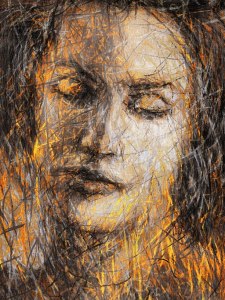
Mary Magdalene by Koorosh Orooj, Iranian Artist, 2018.
First, some background on Mary Magdalene. A fascinating individual, she is mentioned in all four Gospels as a follower of Jesus and witness to his crucifixion and resurrection. There are twelve references to her in the Gospels, more than any other woman, besides Mary, the mother of Jesus. Honored as a Saint within the Catholic Church, there is much we do not know about Mary of Magdala (another name for her). We commemorate her in the ELCA as “Mary the Apostle” on July 22nd. Most importantly, perhaps, Mary becomes the first person to carry the message of Jesus’ resurrection! (Sidenote: Though John does not mention the other “Mary,” being present at the tomb, presumably the mother of Jesus, she is mentioned in the three other Gospels — see Matthew 27:61, Mark 16:1, and Luke 24:10. Some scholars suggest that the absence of the Virgin Mary in John’s account may have symbolic significance. Mary, as the mother of Jesus, represents the earthly relationship, while Mary Magdalene, as a disciple, represents the new community of believers in Jesus).

The Disciples Peter and John running to the sepulchre on the morning of the Resurrection by Eugene Burnand (1898).
Source: Wikimedia Commons.
Be here and everywhere adored;
Thy creatures bless, and grant that we
May feast in paradise with Thee.
We thank Thee, Lord, for this our food,
For life and health and every good;
By Thine own hand may we be fed;
Give us each day our daily bread.
We thank Thee, Lord, for this our good,
But more because of Jesus’ blood;
Let manna to our souls be given,
The Bread of Life sent down from Heaven. Amen.
A reminder why Protestant Churches, like the ELCA, primarily display the empty cross, while Roman Catholic Churches primarily display the Crucifix. Here is an explanation from The Compass, a publication of the Catholic Diocese of Green Bay.
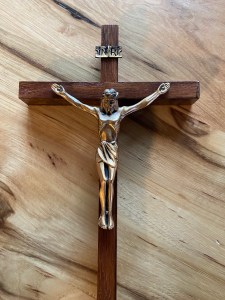
 Displaying the corpus of Jesus on the cross is a stark visual aid that helps us to more easily focus on the very real sacrifice Jesus offered for us for our salvation . . . Our brothers and sisters of mainline Protestant and non-denominational traditions typically display an empty cross in recognition that Jesus died once and for all for us and is now risen from the dead. The cross, like the tomb, is empty. We should see these not as opposing viewpoints, but as complimentary emphasis.
 I appreciate that explanation and certainly both are powerful symbols for Christians! Both reflect the dynamic story of Holy Week and beyond and we utilize both in our home. Have a joyous Easter!
Note: We will resume our Sunday blog discussions on 7 April at 10:45! All are welcome!
