Faithful Conversations #59

Albert Einstein
1879-1955
Introduction to Readers:
The dynamic nature of our faith journeys has been on my mind this week, prompted by a quote from Einstein: “The distinction between the past, present, and future is only a stubbornly persistent illusion.” Our Christian walk is predicated on an eternal engagement with Jesus Christ, an ongoing process. Our formative faith experiences, for example, stay with us, for good or bad. I have had many conversations over the years with people who carry negative emotions from their early years that prompted them to leave the church (the word “baggage” comes to mind). Our current faith practices, in turn, may feel different from what we experienced in years past and surely impact where we are headed. Einstein was right — we cannot separate past, present, and future.

“Jacob Wrestles With God”
Unidentified Artist 1630
We know that Martin Luther’s faith journey was, at times, doubt-filled and excruciating. Genesis 32 comes to mind. Jacob’s nocturnal wrestling match with God offers a metaphor perhaps. This isn’t meant to be easy.
With this in mind, let me offer a simple suggestion this week –keeping a JOURNAL. Having journaled (off and on) for years, I and can say with certainty it helps me in three ways. First, it increases my engagement with what I am reading in the moment. Second, it provides a record of where I have been spiritually. And finally, and most importantly, it significantly enhances my prayer life. If you want to discuss that or have something to add about journaling, feel free to reach out and/or post a comment here!
Thanks for your ongoing interest in Bible study, and hopefully you come away from this each week with something to think about! In this week’s edition, I’m providing a short summary of the readings, followed by prompting questions related to the reading from 1 John, and reflections on the passage from Luke.
Readings for Easter 3
Acts 3: 12-19
Psalm 4
1 John 3: 1-7
Luke 24: 36b-48
A Quick Take on This Week’s Readings
The readings from Acts 3:12-19, Psalm 4, 1 John 3:1-7, and Luke 24:36-48 are interconnected by their profound themes of repentance, forgiveness, and redemption through God’s grace. Acts 3 depicts Peter’s call to repentance, emphasizing the need for turning to God to experience forgiveness and renewal. Psalm 4 echoes this sentiment by portraying trust in God’s righteousness, seeking His favor, and finding peace in His presence. 1 John 3:1-7 underscores the transformative power of God’s love, urging believers to live righteous lives as children of God, purified by Christ’s sacrifice. Finally, Luke 24:36-48 portrays Jesus’ post-resurrection appearance, emphasizing His fulfillment of Scripture and the necessity of His death and resurrection for the forgiveness of sins. Together, these readings weave a narrative of repentance, forgiveness, and the transformative love of God, culminating in the proclamation of the Gospel for the salvation of humanity.
The Second Reading: 1 John 3: 1-7
1 See what love the Father has given us, that we should be called children of God, and that is what we are. The reason the world does not know us is that it did not know him. 2 Beloved, we are God’s children now; what we will be has not yet been revealed. What we do know is this: when he is revealed, we will be like him, for we will see him as he is. 3 And all who have this hope in him purify themselves, just as he is pure. 4 Everyone who commits sin is guilty of lawlessness; sin is lawlessness. 5 You know that he was revealed to take away sins, and in him there is no sin. 6 No one who abides in him sins; no one who sins has either seen him or known him. 7 Little children, let no one deceive you. Everyone who does what is right is righteous, just as he is righteous.
Commentary and Questions (drawn from the ELCA’s “Bible Studies” website):
Out of love, God calls and claims us to be children of God. That is not a claim issued in isolation. Our world, in fact, overflows with a Christian family. As we affirm our baptism, we promise to live among God’s faithful people — our brothers and sisters in Christ. Though we may not necessarily vote the same in an election, root for the same football team, or like the same dessert, we are united in and through Jesus Christ. Living among God’s faithful people means being an active part of the Christian community. We share the joys and sorrows of life. We grow in faith, urging each other to claim the identity of being children of God. Here are several questions to think about:
- When someone calls you a child of God, what comes to mind?
- The Holy Spirit is our advocate, our companion. What does that mean?
- How does being part of a Christian community help you to grow in faith?
- Is it possible to be a Christian and not interact with a community of faith?
The Gospel Reading: Luke 24: 36b-48
36 While they were talking about this, Jesus himself stood among them and said to them, “Peace be with you.” 37 They were startled and terrified and thought that they were seeing a ghost. 38 He said to them, “Why are you frightened, and why do doubts arise in your hearts? 39 Look at my hands and my feet; see that it is I myself. Touch me and see, for a ghost does not have flesh and bones as you see that I have.” 40 And when he had said this, he showed them his hands and his feet. 41 Yet for all their joy they were still disbelieving and wondering, and he said to them, “Have you anything here to eat?” 42 They gave him a piece of broiled fish, 43 and he took it and ate in their presence. 44 Then he said to them, “These are my words that I spoke to you while I was still with you—that everything written about me in the law of Moses, the prophets, and the psalms must be fulfilled.” 45 Then he opened their minds to understand the scriptures, 46 and he said to them, “Thus it is written, that the Messiah is to suffer and to rise from the dead on the third day 47 and that repentance and forgiveness of sins is to be proclaimed in his name to all nations, beginning from Jerusalem. 48 You are witnesses of these things.
This Week’s Reflection: God opens our minds!
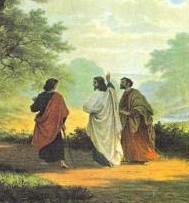
On the Road to Emmaus
In Chapter 24, Luke describes the day of the resurrection. Just prior to this week’s Gospel, we are walking along a road with Cleopas and his friend, both of whom are feeling dejected and without hope. Suddenly Jesus joins them on the path, though they fail to recognize him. In fact, they are taken aback that this “stranger” has not heard about the dramatic events of recent days. Jesus listens. Then he confronts them with a powerful interpretation of the Hebrew prophecies, clearly identifying himself as the promised Messiah, but they still don’t get it. As they reach their destination, they invite the stranger to join them since it is late. And, in one of the truly powerful moments in the post-resurrection period, Jesus breaks bread with them, then vanishes. Then suddenly, their minds are opened, and they realize who Jesus is! They rush back to Jerusalem to tell the disciples what they had experienced, and I suspect they covered the seven miles in record time!
Soli Deo Gloria
REFLECTION from Evelyn Underhill . . .

Evelyn Underhill (1875-1941)
We are the agents of the Creative Spirit in this world. Real advance in the spiritual life, then, means accepting this vocation with all it involves. Not merely turning over the pages of an engineering magazine and enjoying the pictures but putting on the overalls and getting on with the job. The real spiritual life must be horizontal as well as vertical; spread more and more as well as aspire more and more.
