Faithful Conversations #60
Introduction to Readers: “Noverim me, noverim Te!” (Augustine)

Martin Luther
Augustinian Monk
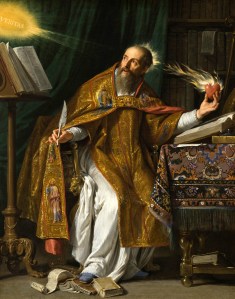
Saint Augustine (354-430)
by Philippe de Champaigne
Somewhere along the line, I recall being taught that the central purpose of education can be reduced to the phrase, “Know Thyself.” Attributed to the famed Greek philosopher Socrates and Plato, his most famous student, the implication is that we must first understand ourselves if we are to correctly understand others and the world in which we live. Makes sense. And that leads me to Augustine of Hippo and his famous Latin phrase (and short prayer) as noted in my title, Noverim me, noverim Te. It comes from his commentary on spiritual discernment and translates, “Oh God ever the same, let me know myself, let me know you!” Like many of his generation (and beyond), Augustine was influenced by the ancient Greeks and Platonic thinking. Further, this giant of Western Christianity profoundly influenced our spiritual ancestor, Martin Luther. As a young Augustinian Monk, Brother Martin delved deeply into Augustine’s writings, particularly his works on grace, sin, and salvation. Bishop Augustine’s emphasis on the primacy of grace and his teachings on justification by faith resonated deeply with young Luther.
Let us keep Augustine’s simple prayer in mind as we explore this week’s readings. As always, thanks for your ongoing interest in Bible study, and for revisiting this space each week. In this week’s edition, I’m providing a short summary of the readings, followed by prompting questions related to the reading from 1 John 3, followed by some commentary on the passage from Acts 4.
Readings for Easter 4
Acts 4: 5-12
Psalm 23
1 John 3: 16-24
John 10: 11-18
A Quick Take on This Week’s Readings
The Bible readings for the 4th Sunday of Easter are linked by a common theme of shepherding and protection. In Acts 4:5-12, Peter boldly declares the name of Jesus as the only means of salvation, emphasizing the role of Jesus as the Good Shepherd who leads and protects his flock. Psalm 23 beautifully illustrates God’s care and guidance, depicting Him as the shepherd who leads His people to safety and abundance. This theme continues in 1 John 3:16-24, where the sacrificial love of Christ is highlighted as the ultimate example of shepherding, urging believers to love one another sacrificially. Finally, in John 10:11-18, Jesus explicitly identifies Himself as the Good Shepherd who lays down His life for His sheep, emphasizing His intimate knowledge of and care for His followers. Together, these readings underscore the comforting truth of God’s faithful shepherding and sacrificial love for His people.
The Third Reading: 1 John 3: 16-24
16 We know love by this, that he laid down his life for us—and we ought to lay down our lives for the brothers and sisters. 17 How does God’s love abide in anyone who has the world’s goods and sees a brother or sister in need and yet refuses help? 18 Little children, let us love not in word or speech but in deed and truth. 19 And by this we will know that we are from the truth and will reassure our hearts before him 20 whenever our hearts condemn us, for God is greater than our hearts, and he knows everything. 21 Beloved, if our hearts do not condemn us, we have boldness before God, 22 and we receive from him whatever we ask, because we obey his commandments and do what pleases him. 23 And this is his commandment, that we should believe in the name of his Son Jesus Christ and love one another, just as he has commanded us. 24 All who obey his commandments abide in him, and he abides in them. And by this we know that he abides in us, by the Spirit that he has given us.
Commentary and Questions (drawn from the ELCA’s Website):
After his last supper with them, Jesus instructs his disciples with those famous words from John 13:34: “I give you a new commandment, that you love one another. Just as I have loved you, you also should love one another. By this everyone will know that you are my disciples, if you have love for one another.” This new commandment is a central theme in the First Letter of John, and Jesus’ words do not allow wiggle room to be selective of who we love and when we love. Jesus seems to cut through any confusion. Here are several questions to think about (and discuss):
- Does it sound like love in an option with Jesus? Explain.
- How would you describe the love of Jesus?
- How does the commandment to love invite you to see others in need?
- Is it possible as a Christian not to see a neighbor in need and respond? Explain.
The First Reading: Acts 4: 5-12
5 The next day their rulers, elders, and scribes assembled in Jerusalem, 6 with Annas the high priest, Caiaphas, John, and Alexander, and all who were of the high-priestly family. 7 When they had made the prisoners stand in their midst, they inquired, “By what power or by what name did you do this?” 8 Then Peter, filled with the Holy Spirit, said to them, “Rulers of the people and elders, 9 if we are being questioned today because of a good deed done to someone who was sick and are being asked how this man has been healed, 10 let it be known to all of you, and to all the people of Israel, that this man is standing before you in good health by the name of Jesus Christ of Nazareth, whom you crucified, whom God raised from the dead. 11 This Jesus is ‘the stone that was rejected by you, the builders; it has become the cornerstone.’ 12 “There is salvation in no one else, for there is no other name under heaven given among mortals by which we must be saved.”
This Week’s Reflection: The kingdom of god is here!
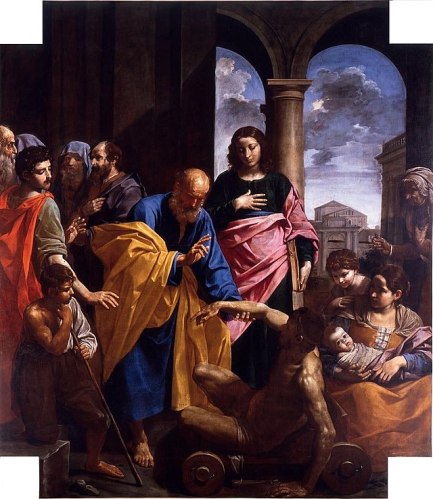
Peter Healing the Cripple by Cantarini (17th Century)
We are continuing our walk through the post-resurrection period with these readings. In Acts 4:5-12, Peter and John are brought before the high priest and other religious leaders for questioning after healing a crippled beggar in the name of Jesus. As they boldly testify, Peter, filled with the Holy Spirit, asserts that the healing was done through the power of Jesus Christ, whom the religious leaders had crucified but who had been raised from the dead. He proclaims that there is salvation in no one else, for there is no other name under heaven given among men by which we must be saved. This passage highlights the unwavering faith and courage of the apostles in the face of opposition, as well as their steadfast belief in the uniqueness and saving power of Jesus Christ.
What should we draw from this confrontation between the disciples and the Jewish leaders? There is much here, but one thing that came home to me is this. Our faith is based on an understanding of salvation that is both here and now and yet to come. The healing of the crippled beggar — the event that led to the questioning of Peter and the others in front of the authorities — is a metaphor for God’s work in our world. One of my favorite scenes in scripture is the image of that broken and crippled man who suffered such great humiliation, leaping for joy upon being healed (Acts 3: 7-9). Imagine how it felt to witness such an event! As Christians, we are not simply sitting around waiting for the Second Coming. The Kingdom of God is here, right now, present in our world, and we are compelled to carry it forward with the guidance of the Holy Spirit, our powerful advocate. Luther would admonish us to “get busy” and go to work!
Prayer: psalm 23 (King James Version):
The 23rd Psalm holds a special place in our tradition. Take time to pray the Psalm this week, focusing on the beautiful language.
The Lord is my shepherd; I shall not want. 2 He maketh me to lie down in green pastures: he leadeth me beside the still waters. 3 He restoreth my soul: he leadeth me in the paths of righteousness for his name’s sake. 4 Yea, though I walk through the valley of the shadow of death, I will fear no evil: for thou art with me; thy rod and thy staff they comfort me. 5 Thou preparest a table before me in the presence of mine enemies: thou anointest my head with oil; my cup runneth over. 6 Surely goodness and mercy shall follow me all the days of my life: and I will dwell in the house of the Lord for ever.
Finally, a personal note: Psalm 23 was the inspiration for The King of Love, an Irish tune with words written by Henry W. Baker (1821-1877). It is one of the great hymns in our Lutheran tradition (page 502 of the ELW) . My mother, Cathryn Wambheim Rykken, sang under Paul J. Christiansen at Concordia College in the 1940s, and often sang this hymn (including at MaryBeth’s and my wedding 44 years ago!). Here is a recent version of the hymn from the Concordia Choir.

I very much enjoyed the study and the choir was an added bonus. Thank you.
LikeLike
You’re welcome and thanks for the feedback!
LikeLike
Well done Paul. I enjoyed the anology of the readings to your interpretation.
It was easy to follow. The song was a good ending.
LikeLike