Faithful Conversations #64
Introduction to Readers:
Campus protests in the United States remind us that we live in a small world. Events thousands of miles from our shores impact us whether we like it or not. That said, I am struck by the inverse relationship between the news coverage (high) and the lack of historical awareness of the Middle East among US citizens in general (low). My evidence for that is anecdotal, and yes, it is a hazard of my profession to feel this way (I have lived my life believing we do not teach enough history in our schools, nor with enough depth, but I digress!). If you feel like you could use a primer on this region, give this site a try, especially if you like maps! History provides context.
As Christians, our Judeo-Christian heritage runs deep, and Pentecost offers a good reminder of that. In Jewish tradition, the celebration of Pentecost derives from the Festival of Weeks coming 50 days after the Passover (penta is Greek for 50). Celebrating the spring wheat harvest, among other things, including God’s gift of the law — the Torah — to Moses (as described in Exodus 24). For the Christian community, the Jerusalem Pentecost, as described in Acts 2, signals the coming of the Holy Spirit. Steeped in the traditions of Judaism, our first spiritual ancestors, those who walked this earth with Jesus, encountered the risen Christ and received the gift of the Holy Spirit on what we consider the birth of our church in roughly 33 CE. We know that by the Second Century, Christians marked this day on the calendar. Keep that history in mind as you tackle this week’s readings. My commentary will focus on the Ezekiel passage, a personal favorite. As always, thanks for visiting this space each week!
Readings for Pentecost
Acts 2: 1-21 or Ezekiel 37: 1-14
Psalm 104: 24-34, 35b
Romans 8: 22-27
John 15: 26-27; 16: 4b-15
A Quick Take on This Week’s Readings:
The Pentecost passages paint a vivid picture of the Spirit’s work initiating new life, renewal, and empowerment within the Christian community (I’m reminded of that phrase, sing a new song unto the Lord). Acts 2:1-21 recounts the dramatic outpouring of the Holy Spirit upon the disciples, echoing Ezekiel 37:1-14 where the breath of God revitalizes dry bones, symbolizing the restoration of Israel. Psalm 104:24-34, 35b praises God’s creative and life-giving power, echoing the themes of renewal and vitality found in both Acts and Ezekiel. Romans 8:22-27 speaks to the groaning of creation and the Spirit’s role in interceding for believers, linking back to the transformative power of the Spirit. Finally, in John 15:26-27; 16:4b-15, Jesus promises the coming of the Advocate, the Spirit of Truth, who will guide and empower the disciples, fulfilling the prophecies and prayers found throughout these readings.
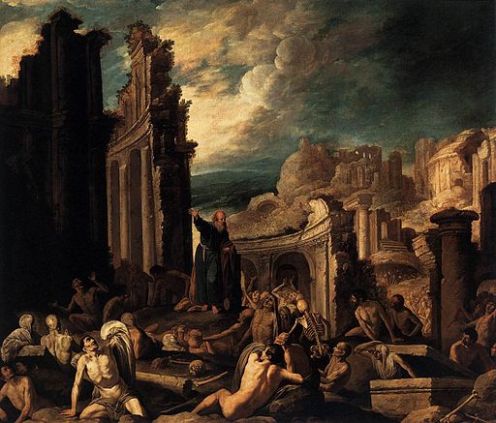
“The Vision of Ezekiel” (1630) by Spanish painter Francisco Collantes (1599-1656)
The First Reading: Ezekiel 37: 1-14: The Valley of Dry Bones
37 The hand of the Lord came upon me, and he brought me out by the spirit of the Lord and set me down in the middle of a valley; it was full of bones. 2 He led me all around them; there were very many lying in the valley, and they were very dry. 3 He said to me, “Mortal, can these bones live?” I answered, “O Lord God, you know.” 4 Then he said to me, “Prophesy to these bones and say to them: O dry bones, hear the word of the Lord. 5 Thus says the Lord God to these bones: I will cause breath to enter you, and you shall live. 6 I will lay sinews on you and will cause flesh to come upon you and cover you with skin and put breath in you, and you shall live, and you shall know that I am the Lord.” 7 So I prophesied as I had been commanded, and as I prophesied, suddenly there was a noise, a rattling, and the bones came together, bone to its bone. 8 I looked, and there were sinews on them, and flesh had come upon them, and skin had covered them, but there was no breath in them. 9 Then he said to me, “Prophesy to the breath, prophesy, mortal, and say to the breath: Thus says the Lord God: Come from the four winds, O breath, and breathe upon these slain, that they may live.” 10 I prophesied as he commanded me, and the breath came into them, and they lived and stood on their feet, a vast multitude. 11 Then he said to me, “Mortal, these bones are the whole house of Israel. They say, ‘Our bones are dried up, and our hope is lost; we are cut off completely.’ 12 Therefore prophesy and say to them: Thus says the Lord God: I am going to open your graves and bring you up from your graves, O my people, and I will bring you back to the land of Israel. 13 And you shall know that I am the Lord when I open your graves and bring you up from your graves, O my people. 14 I will put my spirit within you, and you shall live, and I will place you on your own soil; then you shall know that I, the Lord, have spoken and will act, says the Lord.”
Reflections on ezekiel 37: “The breath of god”
This passage from Ezekiel is part of a rich landscape, the theater of the mind, we find throughout the Old Testament. It is one of my favorite stories from the scriptures. Ezekiel, the lonely prophet, stands on the floor of a valley filled with dry bones, conversing with God about what he is experiencing. His prophetic call, it should be noted, coincides with the early period of the Babylonian Captivity and in a moment of desperate fear and sadness, God assures the prophet that He will breathe new life into the parched souls of the people. This was news they needed to hear!

Saint Augustine (354-430)
by Philippe de Champaigne
How should we think about this story twenty-six centuries later? Two things come to mind for me. First, Ezekiel’s encounter is an affirmation of God’s energetic Spirit at work through history. We live with a visual reminder of that in our community with the sturdy structures that grace “Holy Hill” atop Main Street (for those of you not familiar with Black River Falls, I have inserted an aerial photograph at the end of my reflections). Let me explain. Saint Joseph Church is the most visible symbol of Roman Catholicism in our community. One strand of that tradition derives from the works of Augustine, the 4th Century Church Father from North Africa. Augustine was spiritually dry until his 32nd year when he converted to Christianity. God infused the mind of this powerful intellectual with a desire to write and teach, ultimately leading to the founding of the Augustinian Order, one of the most influential in the training of priests.
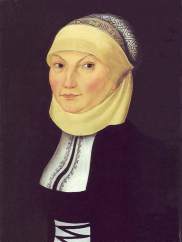
Katie Luther
(1499-1552)
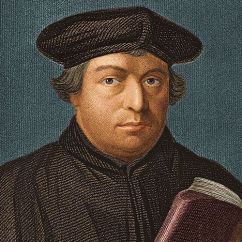
Martin Luther
(1483-1546)
Just north of St. Joseph, we arrive at Evangelical Lutheran Church. Let’s imagine a young Augustinian Monk named Luther nailing those 95 Theses on the door of the Wittenberg Church in Germany. Like Augustine, Luther experienced a crisis of faith as a young man and was infused with God’s Spirit to PROTEST various traditions within Roman Catholicism. Ultimately leaving the Augustinian Order, he married a former nun (Katharina von Bora), and wrote prolifically for the remainder of his life, providing many of the foundations of the Protestant Reformation. His critics referred to those who followed him as “Lutherans,” a name the protesters eventually embraced. (Sidebar: Luther was not comfortable with that term and favored the label of “Evangelical” instead — I suspect he would be OK with the name of our church — ELC!).
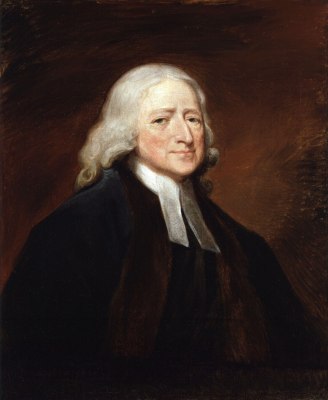
John Wesley
(1701-1793)
Fifty meters north of ELC stands the United Methodist Church. Once again, the work of God’s Spirit is evident in the tradition. Let’s go back to 18th Century England and Oxford University and hear discussions among a small band of students led by a young man name Wesley. A troubled soul, Wesley believed the Anglican Church had become too formal — spiritually dry — and that reform was needed. Methodical and disciplined in their personal habits, others derisively called them “Methodists.” Young Wesley’s often tortured journey of faith reached what he called a defining moment at age 35 while listening to someone reading, interestingly enough, Luther’s Preface to the Book of Romans. Wesley himself, by the way, never left the Anglican Church, but his followers did.
Beyond the Holy Spirit’s role in history, Ezekiel’s story offers a powerful metaphor for each of us. How often do we confront “valleys of dry bones” in our faith journeys, when faith seems tenuous, hope seems lost, and life seems grim? If we notice that situation in another, for example, we might even remark, they have lost their spirit, an interesting expression. As Christians, we know it is the breath of God that sustains us, liberating us from sadness and despair, and driving us forward in hope. It is the Holy Spirit that sparks our thoughts and actions. And isn’t that a powerful realization! We are not simply a constellation of genetics and environmental influences. We carry within us a force that lies beyond our human understanding. Interestingly, the word enthusiasm derives from the Greek, theos, meaning God — hence, en + theos means God in us! The next time you are with someone that exhibits authentic enthusiasm about anything, and especially in matters of faith, remember that word origin (I’m reminded of a recent conversation with Pastor Jen. I asked her how things were going, to which she replied, “Oh, things are going well — I’m just trying to keep up with the Holy Spirit!”). My prayer for all of us is that we carry that breath of God into our relationships, into our work, and into our communities!
Soli Deo Gloria

“Holy Hill” in Black River Falls, Wisconsin
Reflecting on the spiritual discipline of prayer
In recent weeks, I have been offering ideas regarding prayer. Recently I have been reading Martin Luther’s A Simple Way to Pray, a short tract he wrote at the request of his barber, Peter Beskendorf, in 1535. I love the fact that he wrote this for his barber! I commend to your reading the article link included here. I have found it exceedingly helpful!
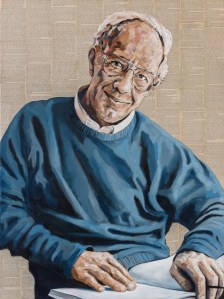
Henri Nouwen
(1932-1996)
And, once again, an offering from the wordsmith, Henri Nouwen:
Prayer is not introspection. It is not a scrupulous, inward-looking analysis of our own thoughts and feelings, but it is a careful attentiveness to the Presence of Love personified inviting us to an encounter. Prayer is the presentation of our thoughts— reflective thoughts, as well as daydreams, and night dreams—to the One who receives them, sees them in the light of unconditional love, and responds to them with divine compassion. This context of thinking in the Presence, of conversation and dialogue with Love, is the joyful affirmation of our gentle Companion on the journey with God who knows our minds and hearts, our goodness and our beauty, our darkness and our light. The Psalmist prays the prayer for us (Psalms 139:1–3; 23–24):
O Lord, you search me and you know me, you know my resting and my rising,
you discern my purpose from afar.
You mark when I walk or lie down,
all my ways lie open to you. . . .
O search me, God, and know my heart. O test me and know my thoughts.
See that I follow not the wrong path and lead me in the path of life eternal. Amen.

Good Morning Paul! Another enjoyable blog/read. Thank you! I especially enjoyed the comparison of “Holy Hill” to Ezekiels encounter on affirmation of Gods energetic spirit at work! I also will print out the offering about prayer from Henri Nouwen. I loved it! One more thing…I smiled reading what Pastor Jenni said about keeping “up with the Holy Spirit”…she is doing a great job keeping up!
Could you add our sons email address to your blog? Thank you Paul! pegearing@uwalumni.com
LikeLike
Thanks for that feedback Ellen! And yes, I will add Phillip’s address.
LikeLike