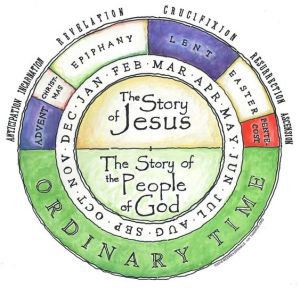
Summer is around the corner, and believe it or not, we have reached Ordinary Time, the longest phase in the liturgical calendar! We will be here until Advent and the start of the new church year. My reflections this week will focus on the presence of the Holy Trinity in the official creeds of the ELCA and the Isaiah reading. As always, thanks for returning to this space each week. I submit these posts with great humility, realizing that many who are reading know much more than I do about these spiritual topics! (Sidebar: I have provided more hyperlinks than normal this week due to the subject matter. These are offered for the benefit of those who want to take a deeper dive into the material — they are italicized and in bold type and a different color).
Let’s Start With a prayer and Some Context!
Almighty Creator and ever-living God: we worship your glory, eternal Three-in-One, and we praise your power, majestic One-in-Three. Keep us steadfast in this faith, defend us in all adversity, and bring us at last into your presence, where you live in endless joy and love, Father, Son, and Holy Spirit, one God, now and forever. Amen.
The Book of Common Prayer 1760 Edition
Across many denominations, formal worship includes the liturgy (customary public ritual performed by a religious group). The Propers are part of the liturgy that vary according to the date (think special observances like Epiphany or Pentecost) and correspond with the Revised Common Lectionary. The Prayer of the Day cited above (formerly referenced as the “Collect”), is designated for Holy Trinity Sunday and is from page 37 of the ELW (our hymnal). Such prayers derive, at least in part, from the Book of Common Prayer, dating back to the 16th Century Anglican Church. I included this prayer to spur reflections on what some have called, “the central mystery of the Christian faith and life,” the Holy Trinity.
“Shield of the Trinity” (Illustrating the Athanasian Creed) A Modern View of the 12th Century Diagram
While exploring the Holy Trinity this week, I was transported back to my religion classes at Concordia College in the mid-1970s, especially discussions regarding theological differences in the early Christian Church, most of which seemed beyond my ken! One such dispute that burned hot in the 4th Century centered on Arianism, the belief that Jesus was created by God and was not one with God. As one born into Lutheranism, I suspect I have taken the unity of Father, Son, and Holy Spirit for granted, but it is important to realize how central this is to our faith. As an illustration of that, I have included the three belief statements cited by the ELCA as sources for its official doctrine, the Apostle’s, Nicene, and Athanasian Creeds. It is fascinating to note the actual language in each creed (especially the Nicene and Athanasian) that is devoted to the concept of the Trinity! Scholars believe the Apostle’s Creed, the one we say most often, dates back to the 2nd Century. Both the Nicene and Athanasian Creeds, it should be noted, were written in response to heretical movements in their time, and primarily Trinitarian disputes (325 and the 5th Century, respectively). And, just for the record, I’m not sure I would want to tackle the Athanasian Creed every Sunday in our worship experience!
The Apostle’s Creed (2nd century)
I believe in God, the Father almighty, creator of heaven and earth.I believe in Jesus Christ, God’s only Son, our Lord, who was conceived by the Holy Spirit, born of the virgin Mary, suffered under Pontius Pilate, was crucified, died, and was buried; he descended to the dead.* On the third day he rose again; he ascended into heaven, he is seated at the right hand of the Father, and he will come to judge the living and the dead.
I believe in the Holy Spirit, the holy catholic Church, the communion of saints, the forgiveness of sins, the resurrection of the body, and the life everlasting. Amen.*Or, “he descended into hell,” another translation of this text in widespread use.
Nicene Creed (325 CE)
Athanasian Creed
(5th Century CE)
We believe in one God, the Father, the Almighty, maker of heaven and earth, of all that is, seen and unseen.
We believe in one Lord, Jesus Christ, the only Son of God, eternally begotten of the Father, God from God, Light from Light, true God from true God, begotten, not made, of one Being with the Father; through him all things were made. For us and for our salvation he came down from heaven, was incarnate of the Holy Spirit and the virgin Mary and became truly human. For our sake he was crucified under Pontius Pilate; he suffered death and was buried. On the third day he rose again in accordance with the scriptures; he ascended into heaven and is seated at the right hand of the Father. He will come again in glory to judge the living and the dead, and his kingdom will have no end.
We believe in the Holy Spirit, the Lord, the giver of life, who proceeds from the Father and the Son,* who with the Father and the Son is worshiped and glorified, who has spoken through the prophets.
We believe in one holy catholic and apostolic church.
We acknowledge one baptism for the forgiveness of sins.
We look for the resurrection of the dead, and the life of the world to come. Amen.
*Or, “who proceeds from the Father.” The phrase “and the Son” is a later addition to the creed.
Whoever wants to be saved should above all cling to the catholic faith. Whoever does not guard it whole and inviolable will doubtless perish eternally. Now this is the catholic faith:
We worship one God in trinity and the Trinity in unity, neither confusing the persons nor dividing the divine being. For the Father is one person, the Son is another, and the Spirit is still another. But the deity of the Father, Son, and Holy Spirit is one, equal in glory, coeternal in majesty. What the Father is, the Son is, and so is the Holy Spirit. Uncreated is the Father; uncreated is the Son; uncreated is the Spirit. The Father is infinite; the Son is infinite; the Holy Spirit is infinite. Eternal is the Father; eternal is the Son; eternal is the Spirit: And yet there are not three eternal beings, but one who is eternal; as there are not three uncreated and unlimited beings, but one who is uncreated and unlimited. Almighty is the Father; almighty is the Son; almighty is the Spirit: And yet there are not three almighty beings, but one who is almighty. Thus the Father is God; the Son is God; the Holy Spirit is God: And yet there are not three gods, but one God. Thus the Father is Lord; the Son is Lord; the Holy Spirit is Lord: And yet there are not three lords, but one Lord. As Christian truth compels us to acknowledge each distinct person as God and Lord, so catholic religion forbids us to say that there are three gods or lords. The Father was neither made nor created nor begotten; the Son was neither made nor created, but was alone begotten of the Father; the Spirit was neither made nor created, but is proceeding from the Father and the Son. Thus there is one Father, not three fathers; one Son, not three sons; one Holy Spirit, not three spirits. And in this Trinity, no one is before or after, greater or less than the other; but all three persons are in themselves, coeternal and coequal; and so we must worship the Trinity in unity and the one God in three persons.
Whoever wants to be saved should think thus about the Trinity. It is necessary for eternal salvation that one also faithfully believe that our Lord Jesus became flesh. For this is the true faith that we believe and confess: That our Lord Jesus Christ, God’s Son, is both God and man. He is God, begotten before all worlds from the being of the Father, and he is man, born in the world from the being of his mother—existing fully as God, and fully as man with a rational soul and a human body; equal to the Father in divinity, subordinate to the Father in humanity. Although he is God and man, he is not divided, but is one Christ. He is united because God has taken humanity into himself; he does not transform deity into humanity. He is completely one in the unity of his person, without confusing his natures. For as the rational soul and body are one person, so the one Christ is God and man. He suffered death for our salvation. He descended into hell and rose again from the dead. He ascended into heaven and is seated at the right hand of the Father. He will come again to judge the living and the dead. At his coming all people shall rise bodily to give an account of their own deeds. Those who have done good will enter eternal life, those who have done evil will enter eternal fire.
This is the catholic faith. One cannot be saved without believing this firmly and faithfully.
Readings for The Holy Trinity
Isaiah 6: 1-8
Psalm 29
Romans 8: 12-17
John 3: 1-17
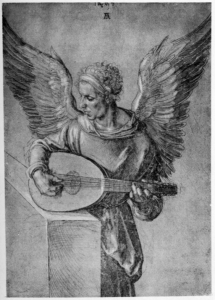
“Seraphim Plays the Lute” Albrecht Dürer (1471 – 1528)
A Quick Take on This Week’s Readings:
Think about the concept of the Holy Trinity as you walk through Sunday’s readings. In Isaiah 6:1-8, we are witnesses to Isaiah’s vision of the Lord seated on a throne, surrounded by seraphim (the closest angels to God who focus on praising and worshiping God for who he is and what he does). This imagery reflects the Father’s sovereignty. Psalm 29 portrays the powerful voice of God that thunders over the waters, shaking the wilderness, showcasing the might and authority of God, reminiscent of the Father’s divine power. In Romans 8:12-17, Paul discusses our adoption as children of God through the Spirit, highlighting the intimate relationship between believers and God as Father, while also acknowledging the role of the Holy Spirit in uniting us with Christ. Finally, in John 3:1-17, Jesus speaks to Nicodemus about being born of water and the Spirit, revealing the transformative work of the Holy Spirit in bringing about spiritual rebirth and salvation, thus portraying the unity of the Father, Son, and Holy Spirit in the divine plan of redemption.
Mosaic of the prophet Isaiah in the Dome of Immanuel in St Mark’s Basilica (Venice)
The First Reading: Isaiah 6: 1-8: A Vision of God in the Temple
In the year that King Uzziah died, I saw the Lord sitting on a throne, high and lofty, and the hem of his robe filled the temple. 2 Seraphs were in attendance above him; each had six wings: with two they covered their faces, and with two they covered their feet, and with two they flew. 3 And one called to another and said,
“Holy, holy, holy is the Lord of hosts;the whole earth is full of his glory.”
4 The pivots on the thresholds shook at the voices of those who called, and the house filled with smoke. 5 And I said, “Woe is me! I am lost, for I am a man of unclean lips, and I live among a people of unclean lips, yet my eyes have seen the King, the Lord of hosts!” 6 Then one of the seraphs flew to me, holding a live coal that had been taken from the altar with a pair of tongs. 7 The seraph touched my mouth with it and said, “Now that this has touched your lips, your guilt has departed and your sin is blotted out.” 8 Then I heard the voice of the Lord saying, “Whom shall I send, and who will go for us?” And I said, “Here am I; send me!”
Reflections on isaiah’s call
Isaiah by Michelangelo (1475-1564)
Old Testament encounters between individuals and God are often profound and pivotal moments in biblical narratives.* Varied in nature, they range from visions and dreams to physical manifestations, but they all serve to convey God’s awesome power and direct communication with humanity. This week’s vivid story from Isaiah, one such encounter, narrates the prophet’s overwhelming vision of God’s majesty in the temple. Isaiah sees the Lord seated on a throne (verse 1), surrounded by seraphim who proclaim His holiness (verses 2-3). The temple shakes, and smoke fills the air (verse 4). Feeling unworthy in the presence of such divine glory, Isaiah acknowledges his sinfulness and the sin of his people (verse 5). One of the seraphim purifies Isaiah’s lips with a burning coal, symbolizing forgiveness (verses 6-7). In response to God’s call for someone to deliver His message, Isaiah volunteers, saying, “Here am I; send me!” (verse 8).
What should we take away from this episode that so triggers our imagination? First, it reminds us that we are not alone in this universe. Our God is all-powerful, eternally holy, and loves us, despite our flaws. Further, we encounter God in nature, in our daily interactions with other people, in our work, and in our dreams. God is present in us. Let that sink in. Second, the most powerful moment of this Isaiah encounter, it seems to me, is the prophet’s response — his readiness to serve as God’s messenger despite his own imperfections. It reminded me of that famous line from Mark Twain: “The two most important days in your life are the day you are born and the day you find out why.” God called Isaiah and he responded. He didn’t analyze the situation and make a list of pros and cons, he simply said YES! Soli Deo Gloria*Here are six well-known encounters: Moses and the Burning Bush in Exodus 3, Abraham and the Covenant in Genesis 15, Sarah’s Promise of a Son in Genesis 18, Miriam’s Leadership in Exodus 15, Moses on Mount Sinai in Exodus 19-20, and Deborah the Judge in Judges 4-5). Prayer (portions of psalm 29)
Ascribe to the Lord, O heavenly beings, ascribe to the Lord glory and strength.
Ascribe to the Lord the glory of his name; worship the Lord in holy splendor!
The voice of the Lord is over the waters; the God of glory thunders, the Lord, over mighty waters.
The voice of the Lord is powerful; the voice of the Lord is full of majesty!
The voice of the Lord flashes forth flames of fire.
The voice of the Lord shakes the wilderness!
The voice of the Lord causes the earth to shake and in God’s temple, all shall say “Glory!”
The Lord sits enthroned as king forever. May the Lord give strength to us, the people of God!
May the Lord bless the whole world with peace! Amen.
a hymn inspired by isaiah, Chapter 6
The inspiration for hymns is a favorite topic of mine. This one will be familiar to many and has been part of our hymnal since 2006. Both the text and the music come from Dan Schutte, a Jesuit Priest, who drew his inspiration from chapter 6 of Isaiah. Enjoy this wonderful rendition from the Luther College Nordic Choir (Decorah, Iowa).
In-Person Lectionary Discussions!
Remember that ELC will have one service on Memorial Day Weekend at Russell Park in Hatfield (10:15). We will not meet on the 26th.
Luther’s Seal
Starting June 2nd, there will be two services: 8:30 at ELC and 10:15 at Russell Park. We will resume our in-person lectionary discussions on June 2nd, after the in-town service (roughly 9:30). We will do that for the Sundays in June (we will generate a new schedule beyond June). All are welcome!