Faithful Conversations #68
Introduction to Readers:
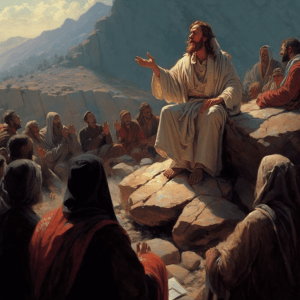
Jesus Teaching on the Mountain
(A.I. Generated, 2023)
“With many such parables he spoke the word to them as they were able to hear it; he did not speak to them except in parables, but he explained everything in private to his disciples.”
These two verses (Mark 4: 33-34) stopped me in my tracks this week. On one level, they remind us that Jesus, reared within the tradition of Jewish storytelling, frequently used parables — allegorical stories — to convey spiritual truths. This was how his listeners were able to hear such truths. It’s that second clause, however, that was NEW to me — that he explained everything in private to his disciples. That feels personal as if Jesus is speaking directly to us across the centuries! Give that some thought this week.

Neil Postman
(1931-2003)
So, WHY Jesus’ reliance on stories? Having been raised by a father who loved stories and subtly used them to enhance my understanding of the world, Jesus’ approach seems perfectly natural to me, and fitting with our human nature. Author and educator Neil Postman (1931-2003) offered this sharp assessment of the value of stories in an article from the late 1980s: “Nations need stories, just as people do, to provide themselves with a sense of continuity, or identity . . . Without stories as organizing frameworks we are swamped by the volume of our own experience, adrift in a sea of facts . . . A story gives us direction by providing a kind of theory about how the world works—and how it needs to work if we are to survive.” It seems to me that Jesus’ parables clearly do that! (Sidebar: Postman’s quote is exceedingly relevant, by the way, as we observe the twists and turns of our current political campaign. Clearly, candidates and political parties offer their worldview — an “organizing framework” and “theory about how the world works.” And, of course, they do this, in part, by attacking their opponent’s theory of the case. As citizens, we are left to sort this out — and we draw on our own stories to do that!)
After offering a short summary of this week’s readings, my reflections will focus on the two parables included in the passage from Mark. As always, thanks for your continuing interest in tackling the lectionary! One thing you might want to try this week is to take one reading per day and simply spend time with it — give yourself a few minutes to contemplate its meaning.
Before you read . . . A Quick Take on Sunday’s Lectionary:
Look for these connecting themes in the readings for Pentecost 4: growth, renewal, and the flourishing of God’s kingdom. Ezekiel 17:22-24 speaks of God’s promise to bring about new life and growth, using the imagery of a tender shoot growing into a majestic cedar tree. Psalm 92:1-4, 12-15 celebrates the flourishing of the righteous, comparing them to strong and resilient trees planted by God. In 2 Corinthians 5:6-10 [11-13] 14-17, Paul discusses the transformation that occurs in those who are in Christ, emphasizing the newness of life and the reconciliation between humanity and God. Finally, in Mark 4:26-34, Jesus uses parables about seeds and mustard seeds to illustrate the gradual yet powerful growth of God’s kingdom.
The Readings for Pentecost 4
Ezekiel 17: 22-24
Psalm 92: 1-4, 12-15
2 Corinthians 5: 6-10 [11-13] 14-17
Mark 4: 26-34 (Focus Reading)
The Gospel Reading: Mark 4: 26-34
26 He also said, “The kingdom of God is as if someone would scatter seed on the ground 27 and would sleep and rise night and day, and the seed would sprout and grow, he does not know how. 28 The earth produces of itself first the stalk, then the head, then the full grain in the head. 29 But when the grain is ripe, at once he goes in with his sickle because the harvest has come.” 30 He also said, “With what can we compare the kingdom of God, or what parable will we use for it? 31 It is like a mustard seed, which, when sown upon the ground, is the smallest of all the seeds on earth, 32 yet when it is sown it grows up and becomes the greatest of all shrubs and puts forth large branches, so that the birds of the air can make nests in its shade.” 33 With many such parables he spoke the word to them as they were able to hear it; 34 he did not speak to them except in parables, but he explained everything in private to his disciples.
reflections: the mystery of the kingdom
Depending on how they are identified in the Gospels, we have roughly forty parables from Jesus. There are nine in Mark’s gospel and in this week’s passage, we are are challenged with two of them. The Parable of the Growing Seed (Mark 4:26-29), only present in Mark, illustrates how the kingdom of God grows mysteriously and gradually, much like a seed planted in the ground that grows and produces a harvest without the farmer fully understanding how it happens. The Parable of the Mustard Seed (Mark 4:30-32) appears in all three Synoptic Gospels** (compare to Matthew 13:31-32 and Luke 13: 18-19) and likens the kingdom of God to the tiny mustard seed that grows into a large plant, providing shelter for birds. What should we take away from these stories?

The Mustard Flower
Let me start with the more familiar of the two — that of the mustard seed. In ancient Palestine, where agriculture was a primary way of life, listeners would have been familiar with mustard seeds and the plants they produced. The seeds were commonly used as a spice and for medicinal purposes, and mustard plants were known for their exponential growth. We might imagine that for a small group of people, many of them from the lower echelons of society, many of them considered outcasts, Jesus’ metaphor signaled hope for the future. God’s entrance into history in human form meant something big was about to happen, and they had a front row seat.
The first parable (verses 26-29), that of the growing seed, surprised me, as is often the case with scripture. I’m sure I have read it a number of times, but I must have glossed over it. Jesus’ message here — that our work is simply to “plant the seeds” of the kingdom in our world — is profound. We do not (and cannot) fully grasp the working of the Holy Spirit in our midst. The awesome power of God is beyond our comprehension. Our role is to simply to be guided by the Holy Spirit and do the work in whatever manner we can. It’s that simple. We are not responsible for the outcome of that work. There will be successes and there will be failures, but God is in charge. It seems to me, especially as we navigate the challenges facing the Christian community in 2024, this is a powerful and liberating message for all of us!
Soli Deo Gloria!
**The Synoptic Gospels refer to the first three books of the New Testament: Matthew, Mark, and Luke. They are called “synoptic” because they share a similar structure, content, and even wording in many passages when compared side by side. The term “synoptic” comes from Greek roots meaning “to see together” or “to have a common view,” highlighting their shared perspectives on the life, teachings, death, and resurrection of Jesus Christ. The Gospel of John, while also about Jesus’ life and teachings, is distinct from the Synoptic Gospels in both its style and content. It includes unique stories, discourses, and theological reflections not found in Matthew, Mark, or Luke.

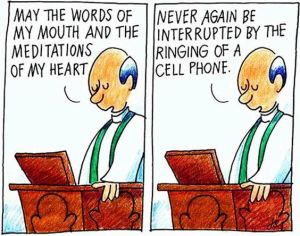 I thought you might appreciate a bit of humor with today’s post! Join us after the 10:15 service at Hatfield on 16 June for some in-person discussion of this week’s readings. No special expertise or prior knowledge is necessary! all are welcome!
