Faithful Conversations #69
Introduction to Readers:
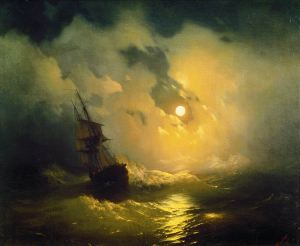
“Stormy Sea at Night”
Ivan Aivazovsky (1817–1900)
Stormy seas are on my mind this week. In April of 1868, my great-great grandfather Torger Rykken and his wife Agata, along with their seven children, including my twelve-year-old great-grandfather Kittel, boarded a ship in Bergen to begin the 3,000-mile journey across the North Atlantic to Quebec. Encountering a terrifying two-day storm early in the voyage that blew them 100 miles off course, they nearly perished. One of their infant children, Kristi (my great-aunt), died several days before they reached North America, a fact they kept hidden from the ship’s captain to avoid a burial at sea.* Once in Quebec, they traveled by train to Detroit, then across southern Michigan and a ferry crossing to Milwaukee. From there, they boarded a train to Rushford, Minnesota, arriving on the 4th of July to start their new life in America.
Beyond the fact that this week’s Gospel reading involves another dangerous crossing, I’m sharing this family story for two reasons. First, it is humbling to imagine the staggering challenges my ancestors navigated compared to my own, something we have all contemplated. One can only admire their courage and rock-solid faith. And second, their survival in the face of that dramatic storm 156 years ago, reminds me of what historians call contingency — the notion that historical events are not predetermined but are influenced by a complex interplay of unpredictable factors, circumstances, and individual actions. The fact is, I would not be writing this had they not survived. We all have such moments in our backstories, known or unknown, and they prompt us to examine the meaning of our lives.
My reflections this week will focus on that long-ago storm in the Sea of Galilee recounted on Mark’s Gospel. I’m also including a powerful poem by Howard Thurman. As always, thanks for taking a few minutes in this space again this week. I pray for all of us as we move forward in our understanding of the scriptures!
* Torger buried Kristi near the shores of the St. Lawrence once they arrived in Quebec. A few months later, at the behest of Agata, he made the difficult journey from Rushford back to Quebec to retrieve Kristi’s body and bring her back to Rushford for burial. What a painful and difficult trip that must have been!
Before you read this week . . . A Quick Take on Sunday’s Lectionary:
The four lectionary readings for Pentecost 5 share common themes of God’s supreme power over creation, His deliverance and care for His people, and the call for human faith and trust in His sovereignty. Job 38 emphasizes God’s control over the natural world, setting the stage for recognizing His omnipotence. Psalm 107 illustrates God’s ability to calm storms and save those in trouble, urging people to give thanks. 2 Corinthians 6 speaks to enduring hardships with faith, relying on God’s grace and support. Mark 4 portrays Jesus calming a storm, showcasing His divine authority and encouraging the disciples to trust in Him. Together, these readings highlight the importance of recognizing God’s power, trusting in His care, and remaining steadfast in faith during life’s challenges.
The Readings for Pentecost 5
Job 38: 1-11
Psalm 107: 1-3, 23-32
2 Corinthians 6: 1-13
Mark 4: 35-41 (Focus Reading)
A Portion of Psalm 107 (as a backdrop for the Gospel)
Some went down to the sea in ships,
doing business on the mighty waters;
24 they saw the deeds of the Lord,
his wondrous works in the deep.
25 For he commanded and raised the stormy wind,
which lifted up the waves of the sea.
26 They mounted up to heaven; they went down to the depths;
their courage melted away in their calamity;
27 they reeled and staggered like drunkards
and were at their wits’ end.
28 Then they cried to the Lord in their trouble,
and he brought them out from their distress;
29 he made the storm be still,
and the waves of the sea were hushed.
30 Then they were glad because they had quiet,
and he brought them to their desired haven.

Storm on the Sea of Galilee (1663)
Rembrandt (1606–1669)
The Gospel Reading: Mark 4: 35:41: Jesus Stills a Storm
35 On that day, when evening had come, he said to them, “Let us go across to the other side.” 36 And leaving the crowd behind, they took him with them in the boat, just as he was. Other boats were with him. 37 A great windstorm arose, and the waves beat into the boat, so that the boat was already being swamped. 38 But he was in the stern, asleep on the cushion, and they woke him up and said to him, “Teacher, do you not care that we are perishing?” 39 And waking up, he rebuked the wind and said to the sea, “Be silent! Be still!” Then the wind ceased, and there was a dead calm. 40 He said to them, “Why are you afraid? Have you still no faith?” 41 And they were filled with great fear and said to one another, “Who then is this, that even the wind and the sea obey him?”
reflections: “he made the storm be still”
As Mark tells it, Jesus and his disciples set out across the Sea of Galilee when a fierce storm arises. With chaos swirling around them, Jesus remains asleep in the stern. The terrified disciples wake him, pleading for help, astonished by his seeming nonchalance. Jesus then rebukes the wind, commanding the sea to be still, resulting in immediate calm. He questions their lack of courage and faith, leaving the disciples in awe and wonder at his authority over nature, asking each other, “Who then is this, that even the wind and the sea obey him?”

“Christ on the Sea of Galilee” c. 1611
Peter Paul Rubens (1577-1640)
What are we to make of this perplexing story? The dialogue between Jesus and his disciples is thought-provoking, especially these four questions: (the disciples) Teacher, do you not care that we are perishing? (Jesus) Why are you afraid? Have you still no faith? (the disciples) Who then is this, that even the wind and the sea obey him?
I find myself in every one of those questions. But let’s focus on Jesus for a minute. Notably, he goes to sleep amidst this terrifying storm. How can he do that? Was he simply exhausted from his ministry? Perhaps there is a different answer. Writing in a 2009 article in The Christian Century, UCC Minister Kate Layzer (Cambridge, Massachusetts), makes the following observation:
Jesus’ ministry is one dangerous crossing after another, starting with his baptism. The moment the waters close over his head, the moment God’s rushing Spirit meets and merges with his, his path through the world becomes one of confrontation: confrontation between entrenched interests and the in-breaking kingdom; confrontation between the way things are and the way God means them to be. The unclean spirits don’t want their boat rocked. Neither do the authorities. But the Spirit of the Lord is upon Jesus. Rocking the boat is what he’s come to do.
In other words, Jesus navigated storms from the very beginning, and we should learn from that. His earthly existence was perilous to say the least. In the dangerous crossings of our lives — physical and emotional pain, depression, addiction, broken relationships, fractured politics, the violence of war — it is easy to feel that God is distant, that Jesus is sleeping. Why is this happening to me? To us? Our fears and anxieties are real, and we want them to end! Echoing Psalm 107, we are in the depths and our courage melts away. Jesus, however, does not take away the calamities of our lives. Rather, he helps us navigate our storms. He provides courage, He provides hope. Nothing can defeat us. This is news that we need to share with others.
Soli Deo Gloria!
If interested, join us after the 10:15 service at Hatfield on 23 June for some in-person discussion of this week’s readings. No special expertise or prior knowledge is necessary! all are welcome!
