Faithful Conversations #73
Introduction to Readers:
“We hardly need to be reminded that we are living in an age of confusion—a lot of us have traded in our beliefs for bitterness and cynicism or for a heavy package of despair, or even a quivering portion of hysteria. Opinions can be picked up cheap in the marketplace while such commodities as courage and fortitude and faith are in alarmingly short supply.”
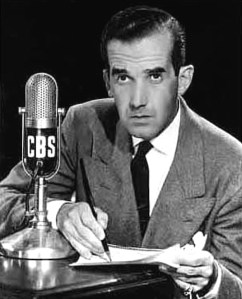
Edward R. Murrow
(1908-1965)
Edward R. Murrow said that . . . in 1951! Seventy-three years later, his words ring true. My first political memory (a flashbulb memory) is from 22 November 1963. My first-grade teacher, Mrs. Larkin, stood in front of our class and told us school was letting out early because the President had been killed. I walked home on the cold autumn day and sat with my grim-faced father watching the news unfold on our small black and white TV. Sixty-one years later, it feels like an “end of innocence” moment in my young life.**
Saturday’s fearsome assassination attempt on former President Trump and heart-wrenching death of Corey Comperatore are but the latest chapter in our roller-coaster political world. As Christians, we may be shocked by such events, but we should never be surprised. There is an evil presence in our world. As Luther said, We need not invite the Devil to our table; he is too ready to come without being asked. The air all about us is filled with demons. So it is.

Do you see the old woman?
Or, do you see the young woman?
Brace up, my friends, and be reminded that for the next four months, we will be inundated with all-things election related. How should we handle that on our Christian journey? In a past life, I spent over forty years walking young people into their civic and political lives, and I often utilized the accompanying optical illusion as a way of illustrating the political world to them. In the binary political context of the United States, we are offered two competing (and plausible) versions of reality — two people can look at the same thing (person, issue, situation) and see something entirely different. It can be frustrating and aggravating. And, EXHAUSTING. My advice to you — and I offer this with humility — is to avoid the echo chambers of our politics. Vary your news sources, be willing to listen to contrary views, and pray for a discerning mind. As Christians, we cannot divorce ourselves from the political world, and we have an opportunity — and perhaps an obligation — to offer a different voice.
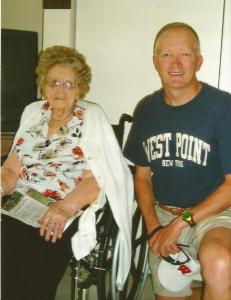
Josephine Larkin
(1916-2009)
**Before she died in 2009 at age 93, I visited Mrs. Larkin. She remains a hero in my life, in part, because she taught me to read! She had a remarkable memory and recounted the day of Kennedy’s assassination and also provided details about my class — amazing!
Beyond a short summary of this week’s readings, my short reflections will focus on the passage from Mark. Beyond that, take some time with a wonderful reflection from Henri Nouwen, and a gorgeous song based on Psalm 23. As always, MANGE TAK for visiting this space for a few minutes, and may God bless your journey!
Before you read this week . . . A Quick Take on Sunday’s Lectionary:
The readings for Pentecost 9 weave a rich tapestry of themes centered around divine guidance, restoration, and unity. Jeremiah 23:1-6 and Psalm 23 both highlight God as a shepherd who leads and cares for the people, promising safety and righteousness. Ephesians 2:11-22 continues this theme by emphasizing the breaking down of barriers and the creation of a unified spiritual community through Christ. Finally, Mark 6:30-34, 53-56 depicts Jesus as the compassionate shepherd who heals and guides the weary, underscoring the theme of Christ’s nurturing presence amid life’s challenges.
The Readings for Pentecost 9
Jeremiah 23: 1-6
Psalm 23
Ephesians 2: 11-22
Mark 6: 30-34, 53-56
The Gospel Reading: Mark 6: 30-34, 53-56
30The apostles gathered around Jesus and told him all that they had done and taught. 31He said to them, “Come away to a deserted place all by yourselves and rest a while.” For many were coming and going, and they had no leisure even to eat. 32And they went away in the boat to a deserted place by themselves. 33Now many saw them going and recognized them, and they hurried there on foot from all the towns and arrived ahead of them. 34As he went ashore, he saw a great crowd; and he had compassion for them, because they were like sheep without a shepherd; and he began to teach them many things.
53When they had crossed over, they came to land at Gennesaret and moored the boat. 54When they got out of the boat, people at once recognized him, 55and rushed about that whole region and began to bring the sick on mats to wherever they heard he was. 56And wherever he went, into villages or cities or farms, they laid the sick in the marketplaces, and begged him that they might touch even the fringe of his cloak; and all who touched it were healed.
Reflections: finding the balance between compassion and rest
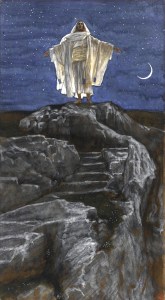
Jesus Praying on the Mountain
James Tissot (1836–1902)
This week’s Gospel reading puzzled me at first. Abruptly following the death of Jesus’ cousin and friend, John the Baptist, the two unspectacular stories bracket better known and miraculous episodes in Christ’s journey — the feeding of the five thousand (35-44), Jesus going up the mountain to pray (45-46), and Jesus walking on water (47-52). In Mark 6:30-34, Jesus and His disciples seek a quiet place to rest, but a large crowd follows them, prompting Jesus to teach them with compassion as they are like sheep without a shepherd. In Mark 6:53-56, after crossing the sea, Jesus heals the sick and those in need as the people recognize Him and bring their loved ones to touch the hem of His garment, hoping for healing.
What should we take away from this reading? There are lessons here for us, and two things stand out to me. First, our Lord’s humanity is on full display here. He is tired, as are his disciples. They had just returned from missionary work, and he sensed both their excitement and fatigue. Jesus took them to a deserted place to rest (verse 31), but the crowds — those desperate crowds — followed quickly. And that leads me to the second observation. In spite of his exhaustion — and grief for his cousin John — he exhibits amazing patience and compassion for the people. These searching and excited people — our spiritual ancestors — were the first Christians and their hope rested on this young man from Nazareth. Two thousand years later in our exhausted world, may we continue to seek his healing presence!
Soli Deo Gloria!

