Faithful Conversations #74
Introduction to Readers:
Let me start with a quick reminder of where we are in Year B of our lectionary journey. We are ten Sundays into Ordinary Time in our church calendar, the longest phase of the Revised Common Lectionary. The term ordinary refers to the fact that these Sundays are numbered (think “ordinal”), not that they are unimportant. We remain in Ordinary Time through November when we arrive at the first of five major liturgical seasons of the church year, starting with Advent (followed by Christmas, Epiphany, Lent, and Easter). Each season celebrates a particular aspect of the mystery of Christ. Here’s another thing. During each of the three years of the Lectionary Cycle, one of the Synoptic Gospels is highlighted (Year A = Matthew, Year B = Mark, and Year C = Luke). John’s Gospel is sprinkled in during each of the three years and for five Sundays (starting last week), we are reading from John. The full Lectionary Cycle, by the way, is located on pp. 18-53 of the ELW.
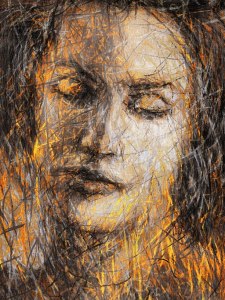
Mary of Magdala
(Modern Interpretation)
Another reminder: As part of our church calendar, we also designate various days each year as Lesser Festivals, Commemorations, and Occasions (similar to what our Roman Catholic friends refer to as Feast Days, and a reminder of aspects of our tradition that is rooted there). Monday, July 22nd, for example, is a Lesser Festival in the ELCA dedicated to Mary Magdalene, Apostle. (It also happens to be my birthday, which has nothing to do with the Lectionary, but I appreciate sharing that calendar date with Mary of Magdala, a fascinating individual!) Again, these days are all listed on pages 54-63 of the ELW, and you might want to take a look!
As always, thanks for visiting this space again this week! Allow yourself a time of contemplation as you read from the scriptures and pray for clarity of thinking — a practice I have begun to incorporate. I will offer a short commentary on two major themes found in the four readings, along with some reflections on the Gospel story.
Before you read this week . . . A Quick Take on Sunday’s Lectionary:
Look for two major themes in the readings for Pentecost 10: divine provision and God’s boundless love. In 2 Kings 4:42-44, the miracle of feeding a hundred men with just a few loaves of bread demonstrates God’s ability to provide abundantly beyond human expectations. Similarly, John 6:1-21 highlights Jesus’ miraculous feeding of the 5,000 and walking on water, emphasizing His role as a provider and source of strength. Complementing these acts of provision, Psalm 145:10-18 and Ephesians 3:14-21 celebrate God’s immense and enduring love, reflecting His commitment to care for all creation and dwell within believers, revealing a divine presence that nurtures and sustains.
The Readings for Pentecost 10
2 Kings 4: 42-44
Psalm 145: 10-18
Ephesians 3: 14-21
John 6: 1-21
The Gospel Reading: John 6: 1-21 (Focus Passage)
6 After this Jesus went to the other side of the Sea of Galilee, also called the Sea of Tiberias. 2 A large crowd kept following him because they saw the signs that he was doing for the sick. 3 Jesus went up the mountain and sat down there with his disciples. 4 Now the Passover, the festival of the Jews, was near. 5 When he looked up and saw a large crowd coming toward him, Jesus said to Philip, “Where are we to buy bread for these people to eat?” 6 He said this to test him, for he himself knew what he was going to do. 7 Philip answered him, “Two hundred denarii would not buy enough bread for each of them to get a little.” 8 One of his disciples, Andrew, Simon Peter’s brother, said to him, 9 “There is a boy here who has five barley loaves and two fish. But what are they among so many people?” 10 Jesus said, “Make the people sit down.” Now there was a great deal of grass in the place, so they sat down, about five thousand in all. 11 Then Jesus took the loaves, and when he had given thanks he distributed them to those who were seated; so also the fish, as much as they wanted. 12 When they were satisfied, he told his disciples, “Gather up the fragments left over, so that nothing may be lost.” 13 So they gathered them up, and from the fragments of the five barley loaves, left by those who had eaten, they filled twelve baskets.
14 When the people saw the sign that he had done, they began to say, “This is indeed the prophet who is to come into the world.” 15 When Jesus realized that they were about to come and take him by force to make him king, he withdrew again to the mountain by himself. 16 When evening came, his disciples went down to the sea, 17 got into a boat, and started across the sea to Capernaum. It was now dark, and Jesus had not yet come to them. 18 The sea became rough because a strong wind was blowing. 19 When they had rowed about three or four miles, they saw Jesus walking on the sea and coming near the boat, and they were terrified. 20 But he said to them, “It is I; do not be afraid.” 21 Then they wanted to take him into the boat, and immediately the boat reached the land toward which they were going.
Reflections: “Christ amidst the stormy seas”
In her introduction to John in the Lutheran Study Bible, Professor Karoline M. Lewis of Luther Seminary, describes the book as a “spiritual account of Jesus’ life and teaching.” No doubt, John has a completely different feel than the Synoptic Gospels and has always been my favorite (I would urge you to spend some time with the book this week). Among other things, John includes the seven signs (or miracles) attributed to Christ and this week’s passage includes miracles number four and five — the feeding of the five thousand and Jesus walking on water (sidebar: the feeding of the five thousand is the only miracle found in all four Gospels, and Jesus walking on water is found in Matthew, Mark, and John but not in Luke. Matthew’s account includes Peter’s attempt to walk toward Christ on the water, and I’m partial to that one). Perhaps because the feeding of the five thousand was part of last week’s study, I am especially drawn to that fifth sign this week — the account of Jesus walking on water.
First, a quick summary. The story of Jesus walking on the water occurs after the feeding of the five thousand. There were those in the crowd, steeped in Jewish prophecy, who openly speculated that Jesus was the prophet/king as promised in the scriptures (verse 14). Sensing this, Jesus departs the scene and goes up the mountain to pray (verses 15-16). As evening falls, Jesus’ disciples set out across the Sea of Galilee (verses 16-17). (Sidebar: is anyone else wondering why they did not wait for Jesus?). A strong wind stirs up the waters, making their journey challenging. Jesus approaches them, walking on the water, and reassures them with the words, “It is I; don’t be afraid” (verses 18-20). The disciples are amazed and want to take him into the boat, which then miraculously reaches the shore immediately (verse 21).

“Christ Walking on the Water,” c. 1880
Julius Sergius Von Klever (1850–1924)
This story — or image — of Jesus walking on the water has always been one of my favorite moments of his earthly journey. What are the takeaways? Let me offer two. First, I’m fascinated by the debates over Christ’s identity in the early centuries of Christianity — critically important debates that ultimately led to the formation of the three ecumenical creeds we follow within the ELCA (the Apostles’, Nicene, and Athanasian). Proof of his divine nature (and the Trinity) rested on the hundreds of prophecies found in the Old Testament and the miracle stories. And it strikes me that those debates continue into the present period. I have encountered my share of skeptics over the years who simply cannot accept the miracles and consider those of us that do as being naive and delusionary. As “people of the way,” however, we have been granted the gift of faith. We do not understand the full range of mysteries inherent in that faith — at least not yet! And second, the episode on the Sea of Galilee also provides a powerful metaphor for our Christian journey. When we encounter darkness and stormy waters, Jesus appears to offer us the most powerful encounter imaginable — a sustaining and uplifting love — full stop. Echoing the words from Isaiah 43:2 — When you pass through the waters, I will be with you; and when you pass through the rivers, they will not sweep over you — we are charged with sharing this assurance with those in our midst who are living with despair today. Jesus affords us that opportunity!


Happy Belated Birth Day Paul!
I enjoyed this lectionary this week as I always do! Just two comments…one about “I will pray for you”…(Henri Nouwen)…I was once told that if you say you will pray for someone…then you better do it and mean it sincerely. That it is a sin to say you will and then not do it. My mother told me this. I was also, just recently taught, by me dear friend Kris, to have a prayer journal so you can keep track of who you are praying for and the reason and can follow the person as a reminder as to how they are doing. This has been so beneficial to me in my prayer journey for others.
The second comment is…do you remember the musical “Jesus Christ Superstar”…1973? I, also have older sisters, as you do…I remember them playing this album…yes album…over and over again! I, too, think Mary Magdalene was an interesting woman. Mary Magdalene truly loved Jesus! I remember two of my sisters saying that Mary and Jesus were more than just friends…and my mother would get so upset and say ” They were just really good friends…nothing more. I did go down a “rabbit hole”…last night researching this…then realized …did it really matter. Mary Magdalene was there for Jesus…she was a true friend…she was a woman…she loved him deeply. I think as a Christian woman…I can say “I love him deeply also”.
That is all for now. Once again, Paul, thank you for these lectionary’s! I hear that the gathering on Sunday gets to be really interesting and I hope to join in this fall.
Grace and Peace to All!
LikeLiked by 1 person
Thanks Ellen! I believe you know how old I am! I certainly do remember “Jesus Christ Superstar” and “Godspell” from that era — and yes, Mary Magdalene became a subject of fascination by many, including the implication that she and Jesus had a unique relationship. Much has been written about her, as you alluded to, and one of my takeaways on her is that she always is present at key moments, particularly at the foot of the Cross and outside the tomb. I’m always struck by the prominent role of women in the Bible, and especially in Christ’s journey, especially at a time in history when the role of women was so restricted. Powerful.
Your references to your mother indicate that she must have been instrumental in your faith formation!
LikeLike