Faithful Conversations #75
Introduction to Readers:
The rhythm of our spiritual lives has been on my mind this week, prompted by a couple things. First, in our Lectionary journey, we are eleven Sundays into the twenty-six that make up the season of Pentecost (which runs into late November). It’s a long stretch, and it’s easy to lose focus. And second, we have reached the “dog days of summer,” a phrase often associated with baseball, but with ancient origins. It’s a phase of the year when the heat and humidity run high in the north country, and life slows a bit. As Christians, how should we react when our faith hits a lull, feels distant, or trapped in routine? A good question to ponder.
 My coaching background kicks in at this point. I have had the privilege of working with runners for over 40 years, and a favorite phrase within our fraternity is, “Trust the Process!” In other words, hold fast to the disciplines that help you grow as a runner, even when things don’t seem to be progressing. The same could be said about our Christian journey. Spiritual disciplines — prayer, interacting with scripture, communal worship experiences — these are ALL important and open us to the work of the Holy Spirit — and often, it seems, when we least expect it! I cannot tell you the number of times I have had an unexpected revelation on a Sunday morning or in the middle of praying, or when wading through a challenging passage of scripture! And, I might add, such spiritual disciplines are deeply rooted in the Lutheran experience! Keep that thought in mind this week and stay the course!
As always, thanks for visiting this space again today! After providing a brief summary of the readings, my reflections will focus on the Ephesians passage. Also, as a sidebar, let me share (again) a four-question approach to reading that can be beneficial (and widely applicable). Our son Jake learned this during his years at West Point in the early 2000s, and I have been utilizing it with my students ever since. It works well with the Lectionary readings — here are the questions:
What is something new you learned from the reading? (NEW)
What is something that caught your attention or made you think? (REFLECT)
What did you read that relates to other reading you have done? (RELATE)
What would you like to discuss from the reading? (DISCUSS)
The Readings for Pentecost 11
Exodus 16: 2-4, 9-15
Psalm 78: 23-29
Ephesians 4: 1-16 (focus reading)
John 6: 24-35
Quick Take on This Week’s Readings
Look for the themes of divine provision, unity, spiritual nourishment, and faith in this week’s readings. In Exodus 16:2-4, 9-15, we witness God’s provision of manna to the Israelites, emphasizing His care and sustenance even in times of doubt and need. Psalm 78:23-29 recounts that miraculous event, celebrating God’s abundant generosity and faithfulness. Ephesians 4:1-16 calls for unity within the body of Christ, urging believers to live in humility, patience, and love, recognizing the diverse gifts that contribute to the church’s growth and maturity. John 6:24-35 presents Jesus as the true bread of life, inviting us to seek spiritual fulfillment in Him, contrasting the temporary satisfaction of physical hunger with the eternal nourishment He provides. Together, these readings highlight the interplay between physical and spiritual sustenance, God’s unwavering provision, and the call for a unified, faith-filled community.
The Second Reading: Ephesians 4:1-16 (Focus Passage)
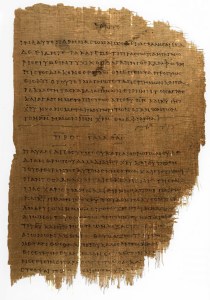
Ephesians Manuscript
c. 150 CE
4 I, therefore, the prisoner in the Lord, beg you to walk in a manner worthy of the calling to which you have been called, 2 with all humility and gentleness, with patience, bearing with one another in love, 3 making every effort to maintain the unity of the Spirit in the bond of peace: 4 there is one body and one Spirit, just as you were called to the one hope of your calling, 5 one Lord, one faith, one baptism, 6 one God and Father of all, who is above all and through all and in all.7 But each of us was given grace according to the measure of Christ’s gift. 8 Therefore it is said,
“When he ascended on high, he made captivity itself a captive;
he gave gifts to his people.”
9 (When it says, “He ascended,” what does it mean but that he had also descended into the lower parts of the earth? 10 He who descended is the same one who ascended far above all the heavens, so that he might fill all things.) 11 He himself granted that some are apostles, prophets, evangelists, pastors and teachers 12 to equip the saints for the work of ministry, for building up the body of Christ, 13 until all of us come to the unity of the faith and of the knowledge of the Son of God, to maturity, to the measure of the full stature of Christ. 14 We must no longer be children, tossed to and fro and blown about by every wind of doctrine by people’s trickery, by their craftiness in deceitful scheming; 15 but speaking the truth in love, we must grow up in every way into him who is the head, into Christ, 16 from whom the whole body, joined and knit together by every ligament with which it is equipped, as each part is working properly, promotes the body’s growth in building itself up in love.
Reflections: “Growing in christ”
Ephesians 4:1-16 is jam-packed! Paul calls for unity within the Christian community, emphasizing humility, gentleness, patience, and love. The passage encourages believers to maintain the unity of the Spirit through the bond of peace, recognizing the one body and Spirit they share (note the seven uses of “one” in the passage, representative of “completeness” in Christian theology). It highlights the diverse gifts given to each member of the community to build up the body of Christ. Ultimately, it underscores the goal of spiritual maturity and growth into Christ, who is the head of the church.
What should we take away from this powerful passage? One of the most appealing things to me is the language emphasizing both our UNITY in Christ and the DIVERSITY of our gifts (“he gave gifts to his people”). Talk about a relevant message for 2024! Within the horrible divisions we are experiencing in our civic lives, it is such a powerful reminder that as Christians we are called to UNITY and that our differences make us stronger. A second feature of Paul’s message that stands out to me is that our lives are a process of becoming (“trust the process”). As cliche as it may sound, we are all a “work in progress.” Listen to what brother Martin, our forebear in the faith, had to say about that:

Martin Luther
(1483-1546)
This life, therefore, is not godliness but the process of becoming godly, not health but getting well, not being but becoming, not rest but exercise. We are not now what we shall be, but we are on the way. The process is not yet finished, but it is actively going on. This is not the goal but it is the right road. (From “A Defense and Explanation of All the Articles.” Luther’s Works 32, p. 24. Edited by George Forell. Augsburg, 1958).
Excellent thoughts, Luther, for the “dog days” of summer!
Soli Deo Gloria!

If interested, join us after the 8:30 service at ELC on 4 August for some in-person discussion of this week’s readings. No special expertise or prior knowledge is necessary! all are welcome!

1960s Lutheran Humor
by Charles Schultz
