Faithful Conversations #77
Introduction to Readers:

Yin Yang Symbol
The Principle of Balance
2024 is a significant year when it comes to global elections, and it is important to view our own elections in that context. The potential for political violence, as exhibited in our own campaign, remains a significant threat. The day-to-day news cycle regarding this, prompts me to grapple with a couple questions: Do those of us who walk within a strong faith tradition have a special obligation to engage with the political process? If so, what should that look like? Of course, these are deeply personal questions prompting a range of views. History is filled with multiple examples of horrific episodes when those in political power usurp religion for selfish purposes, so I tend to be wary of that kind of language. On the other hand, as Christians, Jesus’ words and actions certainly should inform all parts of our lives, including our civic lives. How do we find the balance? I continue to explore — as I have mentioned previously in this space — HOW, as Christians, we can provide another voice in our politics, a voice that needs to be heard.
As mentioned in several previous entries, the ELCA crafts social statements on many societal issues and these are all available for us to read and study. We certainly do not have uniformity of opinion on the various issues that are addressed, nor should we expect that. The social statements are not hastily constructed (in fact, clearly, we study things for a LONG TIME within our denomination — that’s part of our tradition!). This week, for those who are inclined, let me offer a timely resource which I found to be refreshing and hopeful — this article from this month’s Living Lutheran Magazine. And a heads up, you will find a link to an excellent social message from 2020 included, along with a draft statement on civic life and faith that is being developed for action by the 2025 Churchwide Assembly. There is much to digest in both!
Thanks for visiting this space again this week! After providing a commentary on the common themes found in the Pentecost 13 readings, I will be revisiting Psalm 34 in my reflections (recall that we have three Sundays with this Psalm). I hope and pray that your scriptural exploration continues to go well!
The Readings for Pentecost 13
Proverbs 9: 1-6
Psalm 34: 9-14
Ephesians 5: 15-20
John 6: 51-58
Common Themes in the Pentecost 13 Readings
Look for these themes as you work your way through the Pentecost 13 readings: wisdom, righteous living, and spiritual nourishment. Proverbs 9:1-6 and Psalm 34:9-14 both call for a pursuit of wisdom and a life marked by reverence and moral integrity, suggesting that true understanding leads to fulfillment and peace. Ephesians 5:15-20 further elaborates on living wisely, urging believers to align their actions with divine principles and be filled with the Spirit. John 6:51-58 underscores the necessity of spiritual sustenance through communion with Christ, reinforcing the idea that wisdom and righteous living are sustained by a deep, life-giving relationship with Jesus.
Psalm 34: 9-14: Focus Reading (New Revised Standard Version)
for those who fear him have no want.
10 The young lions suffer want and hunger,
but those who seek the Lord lack no good thing.
11 Come, O children, listen to me;
I will teach you the fear of the Lord.
12 Which of you desires life
and covets many days to enjoy good?
13 Keep your tongue from evil
and your lips from speaking deceit.
14 Depart from evil, and do good;
seek peace and pursue it.
Reflections: “Let us fear and love god”
We’re continuing our walk with Psalm 34 this week. A quick recap from last week: Psalm 34 is attributed to King David and dates from roughly 1000 BCE and references a harrowing story found in 1 Samuel 21 when David fled from Saul and took refuge with the Philistines. He was afraid of King Achish of Gath, pretended to be insane, and ultimately escaped. In verses 1-8, David testifies to God’s power and invites the community to join him in praising God.
This week’s passage (9-14) emphasizes that the fear of the Lord is the starting point for our faith lives. Deeply rooted in the Judeo-Christian tradition, this phrase is used roughly 300 times in the Bible (depending on the translation). When we think of fear, being afraid — perhaps terrified — comes to mind. But the word has a different meaning in this context and refers to that sense of awe we have in God’s presence. The concept of REVERENCE captures the idea. (Sidebar: Can we all think of people that inspired that feeling in us in our formative years? My basketball coach at Concordia College — Sonny Gulsvig — and my father fit the bill for me in that regard. My respect for them made me want to imitate them, and I certainly never wanted to disappoint them in any way).
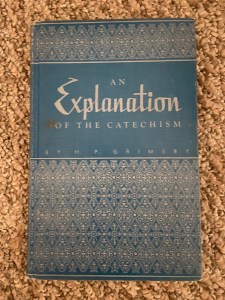
An Explanation of the Catechism
H.P. Grimsby
Augsburg Publishing House, 1941
The phrase also takes me back to my Confirmation days and my rough attempt at memorizing Luther’s Small Catechism. In revisiting some of that material this week, I was reminded that Luther presented the chief parts of the Catechism — the Ten Commandments, the Apostle’s Creed, and the Lord’s Prayer — in that order for a reason. I’m lifting this quote from a wonderful explanation of this in my Lutheran Study Bible: “In 1522, in the preface to the Personal Prayer Book, a forerunner of the Small Catechism, Luther compared this order to recovery from illness. First, one receives the diagnosis (the Ten Commandments), then one is told the source for God’s healing (God’s grace revealed in the Creed), and finally one calls the pharmacist to fill this gracious prescription (Lord’s Prayer).”

Martin Luther
(1483-1546)
And, now back to that phrase, the fear of the Lord. It is notable that Luther started each of the explanations of the Commandments with the phrase, We are to fear and love God . . . and then offered what we SHOULD NOT DO, followed in each case by WHAT WE SHOULD DO. The explanation of the 8th Commandment, a personal favorite of mine, goes like this (the version I learned in Confirmation): We should fear and love God so that we do not deceitfully belie, betray, backbite, nor slander our neighbor, but apologize for him, speak well of him, and put the most charitable construction on all that he does. Those words have stayed with me for more than 50 years, and just imagine if we applied this approach to our political lives! The point Luther was making, it seems to me, is that the Commandments are not simply “the law,” but also provide a healthy path for living — a point that was brought home to me in one of our recent Sunday morning Lectionary discussions! And, yes, this all starts with our fear of the Lord.
Soli Deo Gloria!

