Faithful Conversations #79
Introduction to Readers:
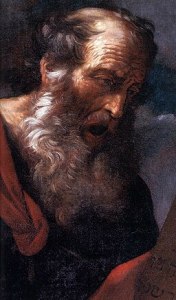
Moses by Italian Painter Guido Reni (1575-1642)
Moses is on my mind this week. The Deuteronomy passage reminded me of Israel’s 40-year desert journey from Egyptian slavery to the promised land. When I learned that story as a boy, it always bothered me that Moses was not allowed to enter! In fact, he was buried in an unmarked grave to eliminate the possibility that any of the Israelites might gather his bones and take them into Canaan (Deuteronomy 34: 5-6). It seemed so patently unfair. But I digress.
I suppose I had thousands of conversations with Unk (my father) while growing up, but certain ones have stayed with me (memory is such a random thing!). One I vividly recall was his explanation of why those Israelites — former slaves — wandered for 40 years — I must have been curious about that. After all, the Sinai Desert was only roughly 120 miles across. He explained to me that the enslaved generation disobeyed God and doubted his promises and therefore could not enter the promised land. They needed to pass away, being replaced by a purified generation with a new mindset. Further, he explained that the wandering was a metaphor for how change often happens in our world — old things must pass away and be replaced by new things, and that often takes a generation or more. As an elder historian fifty years later, that metaphor makes a lot of sense to me, and I will comment further on it in my reflections below.
Thanks for visiting this space again this week! After providing a commentary on the common themes found in the Pentecost 15 readings, I will offer some introduction to the Deuteronomy passage and share a compelling excerpt from a new book by John Philip Newell. I came across the excerpt in Diana Butler Bass’ “The Cottage” a weekly column (“Sunday Musings”) on the lectionary.
One other note: We will be dealing with the book of James five times between now and the end of September, and I plan to get started with that next week. James does not show up in the Lectionary often, so let’s challenge ourselves to learn more about this particular book!
The Readings for Pentecost 15
Deuteronomy 4: 1-2, 6-9
Psalm 15
James 1: 17-27
Mark 7: 1-8, 14-15, 21-23

Mark the Evangelist by Frans Hals (1583-1666)
Common Themes in the Pentecost 15 Readings
The common themes among the readings for Pentecost 15 focus on the importance of living according to God’s commandments and embodying righteousness in daily life. Deuteronomy 4:1-2, 6-9 emphasizes the significance of observing God’s laws as a testament to wisdom and understanding, urging the Israelites to keep these statutes close to their hearts. Psalm 15 describes the qualities of those who may dwell in God’s sanctuary, highlighting the necessity of leading a blameless life marked by truthfulness, integrity, and justice. James 1:17-27 underscores that every good and perfect gift comes from God, calling believers to be doers of the word, not just hearers, and to practice true religion through care for others and personal purity. Finally, Mark 7:1-8, 14-15, 21-23 addresses the issue of external rituals versus inner purity, teaching that true defilement comes from within, from the evil thoughts and actions of the heart. Together, these readings encourage a faith that is both deeply rooted in God’s teachings and manifested through righteous living.
Focus Reading: Deuteronomy 4: 1-2, 6-9 (New Revised Standard Version)
4 “So now, Israel, give heed to the statutes and ordinances that I am teaching you to observe, so that you may live to enter and occupy the land that the Lord, the God of your ancestors, is giving you. 2 You must neither add anything to what I command you nor take away anything from it but keep the commandments of the Lord your God with which I am charging you. . . 6 You must observe them and perform them, for this will show your wisdom and discernment to the peoples, who, when they hear all these statutes, will say, ‘Surely this great nation is a wise and discerning people!’ 7 For what other great nation has a god so near to it as the Lord our God is whenever we call to him? 8 And what other great nation has statutes and ordinances as just as this entire law that I am setting before you today? 9 “But take care and watch yourselves closely, so as neither to forget the things that your eyes have seen nor to let them slip from your mind all the days of your life; make them known to your children and your children’s children—
Reflections:

The View from Mount Nebo
(Effi Schweizer)
Deuteronomy 34: 1-12
The Book of Deuteronomy is the fifth book of the Torah and the Old Testament, serving as a series of speeches by Moses to the Israelites before they enter the Promised Land. Written around 700-640 B.C.E., it reiterates and expounds upon the laws given in previous books, emphasizing the importance of obedience to God’s commandments. (Sidebar: Deuteronomy means Second Law or Repetition of the Law. The book focuses on Moses’ reaffirming and explaining God’s law one final time before his death). Moses reminds the Israelites of their covenant with God and warns them against idolatry and disobedience. The book concludes with Moses blessing the tribes of Israel and his death on Mount Nebo, overlooking the promised land. Prior to this transcendent moment, the Israelites wandered for 40 years in the Sinai Desert. Their wandering — their exile, if you will — perhaps mirrors our own time of transition and disruption within Christianity, something we have often discussed.
And that leads me to this. While researching this week, I stumbled on this excerpt from John Philip Newell’s new book, The Great Search: Turning to Earth and Soul in the Quest for Healing and Home.

John Philip Newell
(born 1953)
What is the spiritual vision at the heart of our religious inheritance that we have forgotten or neglected? The Spirit is urging us to remember that we are to do to others, including Earth and every species, what we would most want done to us. This is the teaching of Jesus at the heart of our Christian inheritance, with its equivalent in the ‘Golden Rule’ of nearly every great spiritual tradition in the world. It is the teaching that can lead us into new beginnings. In our Great Search of today, we are searching for what will bring healing, not only for ourselves, whether as individuals or nations or races, but for all people and for every species. And it is for all things that we are seeking a new sense of home address, not only physically but spiritually. We are longing for a deeper sense of shared origin and spiritual kinship, including a sense of family responsibility for everything that has being. . . .
During this time of transition, many of us, as we have been emphasizing, are in religious exile, whether that be literally as fugitives from our religious tradition or simply as dissatisfied members of it, longing for more depth and vision. The modern Scottish poet, Kenneth White, says that “exile is the mark of any deep and far-going creativity.” By this he means that leaving home, whether that be the home territory of our nation or race or religion, either willingly or by force, presents us with the possibility of expanding our vision beyond what it has been. His emphasis is not on what we are losing in exile, which may be painful and unsettling, but on what we are being invited to open to in exile in new and creative ways. And those who are in exile, he adds, will often take with them more of the essential vision of home than what is prevalent in the places they have left. Exile, therefore, whether individually or collectively, can be a time of great openness to new vision and creativity.
This time of spiritual exile in the Western world is a moment in which we are being invited to find relationship with Earth and one another in ways that surpass anything we have known. It is a time of opening to the Spirit in our own depths and the depths of every human being and lifeform. And it can be a time of liberation from the closed boundaries of nationhood or race or religion that have confined us in the past. . . Our cherished places of religious authority from the past, including our local churches or temples or mosques, can serve us at this moment in time but only if they remember that the centre of the divine is everywhere. It is deep in my soul and your soul, and it is deep in Earth’s soul and every soul….
Though I am still trying to absorb what Newell is saying here, it made me think that our experience in the Church today — the frustrations we have experienced with declining membership, the shortage of clergy, the various cultural pressures that seem to threaten the faith — is perhaps our “Sinai moment.” We are wandering, sometimes feeling adrift, but in that journey are moving toward something regenerative and exciting! May we continue to pray for insight as we share the story of Jesus with those around us!
Soli Deo Gloria!