Faithful Conversations #80
Introduction to Readers:
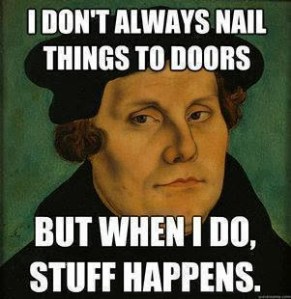
Some Reformation Humor!
Being raised by “cradle to grave” Lutherans (of the Norwegian Lutheran Church to American Lutheran Church to ELCA lineage), James has always inhabited a second-tier status among the New Testament books in my worldview. Luther, as is widely acknowledged, objected to James due to its lack of focus on Jesus Christ and emphasis on “works” righteousness. He referred to it as a “right strawy epistle,” and deemed it inappropriate for use in the religious schools of his day. Indeed, I remember an old religion professor of mine at Concordia getting downright worked up about James in one of his lectures! That said, between now and the end of September (including last Sunday), we encounter James five times in the Lectionary, so I hope to confront my Lutheran biases and give James another look!
Thanks for visiting this space again this week! I hope you feel as challenged as I do walking through the Lectionary! After providing a short summary of common themes among the Pentecost 16 readings, my reflections will focus on the passage from James. Beyond that, we will hear from Henri Nouwen again this week and conclude with a new interpretation of a familiar tune.
(Sidebar: Nikolai Frederik Severin Grundtvig is commemorated in the ELCA this week (2 September), and if you want some background on his life, here is a good link. My sense is that Rollie Lee will appreciate it! You will find the calendar for “Lesser Festivals and Commemorations” in the ELW, pages 15-17. It’s quite a list!)
The Readings for Pentecost 16
Isaiah 35: 4-7a
Psalm 146
James 2: 1-10 (11-13) 14-17
Mark 7: 24-37
Common Themes in the Pentecost 16 Readings
The readings for Pentecost 16 emphasize God’s justice, mercy, and the call to live out an inclusive and active faith. Isaiah 35:4-7a speaks of God’s promise to bring healing and transformation, offering hope to those who are weak and oppressed. Psalm 146 praises God as the one who upholds the marginalized, executes justice, and provides for those in need. James 2:1-17 and Mark 7:24-37 challenge believers to reject favoritism, live out their faith through compassionate actions, and recognize the expansive reach of God’s healing and love, which transcends social and cultural boundaries.
Note to Readers:
I’m including the James reading from Pentecost 15 (last Sunday) to add context to this week’s focus reading from James. Here it is:
17 Every generous act of giving, with every perfect gift, is from above, coming down from the Father of lights, with whom there is no variation or shadow due to change.18 In fulfillment of his own purpose he gave birth to us by the word of truth, so that we would become a kind of first fruits of his creatures. 19 You must understand this, my beloved brothers and sisters: let everyone be quick to listen, slow to speak, slow to anger, 20 for human anger does not produce God’s righteousness. 21 Therefore rid yourselves of all sordidness and rank growth of wickedness, and welcome with meekness the implanted word that has the power to save your souls. 22 But be doers of the word and not merely hearers who deceive themselves. 23 For if any are hearers of the word and not doers, they are like those who look at themselves in a mirror; 24 for they look at themselves and, on going away, immediately forget what they were like. 25 But those who look into the perfect law, the law of liberty, and persevere, being not hearers who forget but doers who act—they will be blessed in their doing. 26 If any think they are religious and do not bridle their tongues but deceive their hearts, their religion is worthless. 27 Religion that is pure and undefiled before God the Father is this: to care for orphans and widows in their distress and to keep oneself unstained by the world.
Focus Reading: James 2: 1-10 (11-13) 14-17: Warning Against Partiality
2 My brothers and sisters, do not claim the faith of our Lord Jesus Christ of glory while showing partiality. 2 For if a person with gold rings and in fine clothes comes into your assembly, and if a poor person in dirty clothes also comes in, 3 and if you take notice of the one wearing the fine clothes and say, “Have a seat here in a good place, please,” while to the one who is poor you say, “Stand there,” or, “Sit by my footstool,” 4 have you not made distinctions among yourselves and become judges with evil thoughts? 5 Listen, my beloved brothers and sisters. Has not God chosen the poor in the world to be rich in faith and to be heirs of the kingdom that he has promised to those who love him? 6 But you have dishonored the poor person. Is it not the rich who oppress you? Is it not they who drag you into the courts? 7 Is it not they who blaspheme the excellent name that was invoked over you? 8 If you really fulfill the royal law according to the scripture, “You shall love your neighbor as yourself,” you do well. 9 But if you show partiality, you commit sin and are convicted by the law as transgressors. 10 For whoever keeps the whole law but fails in one point has become accountable for all of it. {11 For the one who said, “You shall not commit adultery,” also said, “You shall not murder.” Now if you do not commit adultery but you murder, you have become a transgressor of the law. 12 So speak and so act as those who are to be judged by the law of liberty. 13 For judgment will be without mercy to anyone who has shown no mercy; mercy triumphs over judgment.} 14 What good is it, my brothers and sisters, if someone claims to have faith but does not have works? Surely that faith cannot save, can it? 15 If a brother or sister is naked and lacks daily food 16 and one of you says to them, “Go in peace; keep warm and eat your fill,” and yet you do not supply their bodily needs, what is the good of that? 17 So faith by itself, if it has no works, is dead.

“Saint James the Less”
Peter Paul Reubens
(1610-1612)
Often as I work on the blog, I am humbled by Alexander Pope’s (1688-1744) famous admonition, a little learning is a dangerous thing. The authorship of the book of James, for example, took me down a rabbit hole. Like other NT books, debates over the actual source have stirred for centuries, so likely I will not solve it here. There are several men named James referenced in the New Testament. Some believe the book was written by James, the brother of Jesus, while others believe a later author simply wrote “in the name of James,” a common practice of the time.
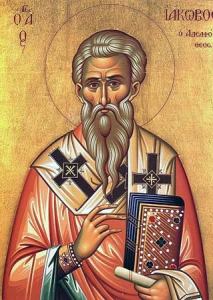
James the Just
Neo-Byzantine Icon
Russian Orthodox Church
And one more thing about his identity. I found this reference to James on the site of a Russian Orthodox Church: “Saint James the Just, also called James Adelphos and James the Brother of Our Lord (died AD 62), was the first Bishop or Patriarch of Jerusalem. According to the Protoevangelion of James, James was the son of Joseph—along with the other ‘brethren of the Lord’ mentioned in the scripture—from a marriage prior to his betrothal to Mary (another theory! my emphasis). He wrote an epistle which is part of the New Testament. St. James is commemorated on October 23″ (and yes, we commemorate James the Martyr on that day in the ELCA!).
Major Sidebar — I feel compelled to include this since I married a “Mary,” born to Catholic parents!): The question of whether Mary and Joseph had other children besides Jesus is interpreted differently across Christian traditions. The Catholic and Eastern Orthodox Churches teach that Mary remained a perpetual virgin, meaning she had no other children, and interpret references to Jesus’ “brothers” and “sisters” as either cousins or close relatives. In contrast, many Protestant denominations believe that Mary had additional children based on a literal reading of biblical passages that mention Jesus’ siblings. Luther, owing to his strong Catholic training, held to the perpetual virgin theory and referred to Mary as the “Queen of Heaven.” In fact, he included this statement regarding the “Hail Mary” in his Little Prayer Book: “Let not our hearts cling to her in faith, but through her penetrate to Christ and to God himself. Thus, what the Hail Mary says is that all glory should be given to God, using these words: ‘Hail, Mary, full of grace. The Lord is with you; blessed are you among women and blessed is the fruit of thy body, Jesus Christ. Amen.’ ” (Living Lutheran Magazine, 31 August 2018). I may never hear the “Hail Mary” the same way again after reading this!
The ELCA, as far as I can tell, does not have an official doctrine on whether Mary had additional children besides Jesus, leaving the interpretation largely to individual belief. The ELCA tends to emphasize the centrality of Scripture and does not require adherence to the doctrine of Mary’s perpetual virginity. Therefore, many within the ELCA are open to the possibility that Mary had other children, interpreting biblical references to Jesus’ “brothers” and “sisters” as literal siblings. However, there is also room for diverse personal beliefs within the denomination, and members are not required to take a specific stance on this issue (not surprising!).
Regardless of who authored James, the book offers sound advice for practical Christian living and is often compared to Proverbs. The Lutheran Study Bible identifies the following themes in the 108 verses of the book: joy, wisdom, creation, word, first fruits, faith, blessing, growth, and endurance. And I appreciate this sentence from that same introduction: “These themes give powerful encouragement for responsible Christian action amid the complex realities of daily life” (Lutheran Study Bible, page 1992).
Finally! What about this week’s passage? What should we take away from that? Like so much of this book, it seems straightforward. If we claim to be Christians, and yet show partiality to those who hold power and wealth, we are missing the mark. If we talk a good game, but never show it with our actions, we are empty. So, where was Luther coming down on this? It seems to me, if we could talk to brother Martin, he would say, “Ah, but be careful that you don’t start thinking you can earn salvation by ‘doing this’ or ‘doing that’ — we simply cannot! We all sin and fall short of the Glory of God, and it happens to us every day!” I can see Luther’s point here, but also feel like the words from James could have come from Christ — reread the passage again with that in mind. It is this tension between “faith and works” that we must continually grapple with in our Christian journey. My interpretation of Lutheranism is simply this: I have been given the gift of faith and my salvation is settled — I did nothing to earn it. My response to that, however, is to share the gift, including a greater understanding of it!
Soli Deo Gloria!
The Doxology
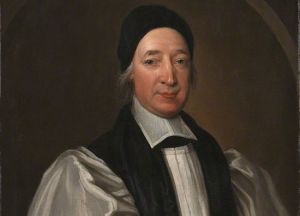
Thomas Ken
(1637-1711)
English Cleric
(Nostalgia Warning! This song takes me back to the many church basements of my youth, or family gatherings where people spontaneously broke into harmony! I found this description of the hymn’s background that you will appreciate. I also appreciate using the expression “Holy Ghost!” The version I posted takes an old hymn and puts a new twist on it — so heartfelt).
Thomas Ken (1637–1711), who crafted these plain and profound words in the late 1600s, wrote them as the final and “doxological” stanza of three hymns he published, first for students at Winchester College at Oxford University. Ken, who was an Anglican minister, royal chaplain, and eventually bishop, first penned verses for his students at Winchester to sing upon arising in the morning, and at bedtime each evening. Later he added a third hymn, to rehearse at midnight, were students to have trouble sleeping. Each hymn was a confession of faith, and an invocation of divine blessing, tailored to its particular moment of the day. And each hymn ended with the same 25-word doxological verse in praise of God, three in one.
Ken’s hymns have by no means been lost today. However, it is his final verse — our beloved “Doxology” — that has endured, so well-known is it that it needs no placeholder in our hymnbooks. Christians the world over simply know it, almost without fail — both Ken’s timeless words and the tune, which Ken did not write, but which much later began to accompany the song. The tune, called Old One-Hundredth, originally designed to accompany the singing of Psalm 134, and later Psalm 100, first appeared in the Geneva Psalter in 1551 and was written by Louis Bourgeois (1510–1561), who served as head of choirs and music, alongside famous pastor and theologian John Calvin.
(Source: desiringGod website: The Best Known Hymn in History)
