Faithful Conversations #83
Introduction to Readers:

St. John’s Abbey Church
Collegeville, Minnesota
Sacred spaces and their relation to our faith journeys have been on my mind this week prompted, in part, by travels west to attend an “All-70s” reunion at West Fargo High School (proud member of the class of 1975!). One stop along the route was St. John’s University in Collegeville, Minnesota. Thirty years ago, this summer, I spent a month there in a study program with 25 other teachers from around the country. We were studying the writings of Machiavelli with a renowned scholar, but that became secondary due to my absorption into the day-to-day life of the Benedictine Monastery. I read “The Rule of St. Benedict” and joined the Monks in the rhythm of their daily prayers. I tried to imagine Luther’s struggle with Roman Catholicism (they had a huge section of their library devoted to Luther, by the way). This moment of repose came at a moment in my life when I needed help, and I felt the presence of God in that place, profoundly. Walking the grounds again this week brought it all back to me. (Sidebar: Unk, my father, came to visit me there and jokingly asked, “We aren’t going to lose you to the Catholics are we? A perfect example of his humor). I urge you to think about sacred spaces in your life this week, past and present. We live in a time and within a culture that crowds out the sacred spaces of our lives, and I am convinced that so many sisters and brothers in our midst are struggling with anxiety, anger, depression, and hopelessness because of that.
Although each of the readings this week offer a great deal of food for thought, my reflections will focus on Psalm 19. As always, thanks for visiting this space again this week, and I pray that your time with the scriptures is meaningful!
The Readings for Pentecost 19
Numbers 11: 4-6, 10-16, 24-29
Psalm 19: 7-14d
James 5: 13-20
Mark 9: 38-50
Common Themes in the Pentecost 19 Readings!
The readings for Pentecost 19 are rich with insight for our daily lives! They emphasize themes of leadership, community, humility, and personal responsibility. In Numbers, Moses struggles with the burden of leading a complaining people and shares authority with others, showing the need for shared leadership and God’s provision. Psalm 19 praises God’s laws as perfect and life-giving, urging personal reflection and moral integrity. In James, the power of prayer and confession is highlighted, while in Mark, Jesus teaches humility, inclusion, and the need for self-discipline to avoid causing harm to others or oneself spiritually.
Psalm 19: God’s Gory in Creation and the Law
and the firmament proclaims his handiwork.
2 Day to day pours forth speech,
and night to night declares knowledge.
3 There is no speech, nor are there words;
their voice is not heard;
4 yet their voice goes out through all the earth
and their words to the end of the world.
In the heavens he has set a tent for the sun,
5 which comes out like a bridegroom from his wedding canopy,
and like a strong man runs its course with joy.
6 Its rising is from the end of the heavens
and its circuit to the end of them,
and nothing is hid from its heat.
7 The law of the Lord is perfect,
reviving the soul;
the decrees of the Lord are sure,
making wise the simple;
8 the precepts of the Lord are right,
rejoicing the heart;
the commandment of the Lord is clear,
enlightening the eyes;
9 the fear of the Lord is pure,
enduring forever;
the ordinances of the Lord are true
and righteous altogether.
10 More to be desired are they than gold,
even much fine gold;
sweeter also than honey
and drippings of the honeycomb.
11 Moreover, by them is your servant warned;
in keeping them there is great reward.
12 But who can detect one’s own errors?
Clear me from hidden faults.
13 Keep back your servant also from the insolent;
do not let them have dominion over me.
Then I shall be blameless
and innocent of great transgression.
14 Let the words of my mouth and the meditation of my heart
be acceptable to you,
O Lord, my rock and my redeemer.
Reflections:

C.S. Lewis
(1898-1963)
“I take this to be the greatest poem in the Psalter and one of the greatest lyrics in the world.” (C.S. Lewis)
Prolific Christian author C.S. Lewis enjoyed the artistry of the writing in Psalm 19. Known as both an instructional and creation Psalm, this poem from David celebrates the glory of God as revealed through both the order of creation (verses 1-6) and the order of His divine law (verses 7-10). The heavens declare God’s majesty, while His laws are described as perfect, trustworthy, and life-giving, guiding people toward righteousness. The psalm concludes with a personal prayer for forgiveness and purity (verses 11-14), asking that both words and thoughts be pleasing to God. What should we take away from this powerful and poetic Psalm?
God’s order in our lives runs in and through this poem. The first portion reminds me of significance of sacred spaces in our lives, in this case God’s creation. No words can adequately describe the breathtaking beauty of the natural world. We can feel it walking on the shores of Lake Michigan, hiking in Alaska, or gliding on a river in a canoe. We can feel it in a memory from our youth of a sacred encounter. And it is good to be reminded that we need sacred spaces, including time, in our lives. Our world does so much to take that from us, if we are not mindful of it.
The second portion reminds us of the positive and instructive nature of God’s law, as presented to us in the scriptures (note the six references to the law). Again, think order. Luther, recall, taught that the law served two purposes. First, it taught us how to live in this world as children of God, both in our relationship to the Triune God and with our neighbors. And second, it reminds us that no one is perfect and that we are all in need of salvation. The third portion, a prayer, reminds us that submission to God is the starting point for order in our lives. Full stop.
And finally, dwell on verse 14 for a few moments — there is much there. We have heard these words many times from the pulpit, and we should write them on our hearts. There is a wonderful symmetry here between this verse and verse 3 (“there is no speech, nor are there words”). And though David wrote these words ten centuries before Christ walked this earth, as Christians we believe that the “meditation of our hearts” points us to Jesus in new and powerful ways every day. This is news that we need to share!
Soli Deo Gloria!
A PRAYER REFELCTION (Inspired by James 5: 13-20)
(Note: This week’s passage from James is the fifth and final reference to the Epistle in the Lectionary for Year B).
Join us on Sundays at ELC after the 9:30 worship in the library for discussions of this week’s readings. We learn from each other each week! All are welcome!
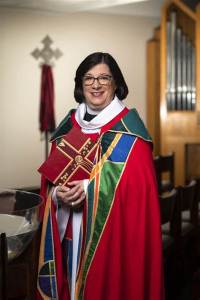
Bishop Elizabeth Eaton
Fourth Presiding Bishop
Evangelical Lutheran Church in America
Postscript: On 20 September, Elizabeth Eaton, the fourth presiding Bishop of the ELCA, and the first woman to preside as Bishop, issued the following statement in response to the recent controversies surrounding the Haitian community in Springfield, Ohio. I commend it to your reading.
