Faithful Conversations #86
Introduction to Readers:

Henri Nouwen
(1932-1996)
“I am increasingly convinced that it is possible to live the wounds of the past not as gaping abysses that cannot be fulfilled and, therefore, keep threatening us as gateways to new life. The ‘gateless gate’ of Zen and the ‘healing wounds of Christ’ both encourage us to detach ourselves from the past and trust in the glory to which we are called.”
As Christians guided by the Holy Spirit, we carry a centuries-old tradition in our hearts. In fact, we visit our spiritual ancestors each week while exploring the Lectionary. Yet, as Nouwen reminds us (above), it is through that faith that we continually find liberation from the past — approaching “gateways to new life.” I have been thinking about that space between the old and new life this week and our role as believers navigating that space. I will revisit this in the prayer reflection in this week’s blog.
Two other things by way of introduction this week. First, we are three weeks out (Tuesday) from Election Day 2024. Of course, millions of people have already voted early across the country. Like many others, I have a bad case of “election fatigue” this year and am weary of the anger and mistrust within the body politic that we witness day to day. That said, I want to share this statement from the ELCA Conference of Bishops and commend it to your reading. May God guide our nation and the world in the days ahead.

Cathryn Wambheim Rykken
(1924-2013)
And second, my mother, Cathryn Wambheim Rykken, was born one hundred years ago this Sunday (20 October 1924). Beyond being a wonderful mom and faith mentor, she was a gifted English teacher and musician. I watched her command a classroom many times during my school years, and any skills I may possess as a teacher, I owe to her. She was strict, but always with a dash of humor, and had a knack for communicating with all people, especially those that needed a lift. This week’s blog is dedicated to her.
Thanks, as always, for visiting this space again this week! My short reflections will again focus on the Hebrews passage. This is the third of seven references to this book in the Year B readings. In addition, I’m posting the Gospel here and want to make that a subject of our discussion (among other things) in our Sunday meeting.
The Readings for Pentecost 22
Isaiah 53: 4-12
Psalm 91: 9-16
Hebrews 5: 1-10
Mark 10: 35-45
Common Themes in the Pentecost 22 Readings!
As you explore the readings for Pentecost 22, look for the following themes: suffering, intercession, and servant leadership. Isaiah emphasizes the transformative power of suffering, portraying the servant who bears the pain of many, while Psalm 91 reflects on divine protection and faithfulness in times of trouble. Hebrews highlights the role of Jesus as a compassionate high priest who empathizes with human weakness, bridging the divine and the mortal. Mark challenges notions of power and greatness, calling believers to embrace humility and service, reinforcing the idea that true leadership is rooted in selflessness and sacrifice.
The Second Reading: Hebrews 5: 1-10 (Focus Reading)
Every high priest chosen from among mortals is put in charge of things pertaining to God on their behalf, to offer gifts and sacrifices for sins. 2 He is able to deal gently with the ignorant and wayward, since he himself is subject to weakness, 3 and because of this he must offer sacrifice for his own sins as well as for those of the people. 4 And one does not presume to take this honor but takes it only when called by God, just as Aaron was. 5 So also Christ did not glorify himself in becoming a high priest but was appointed by the one who said to him, “You are my Son; today I have begotten you”; 6 as he says also in another place, “You are a priest forever, according to the order of Melchizedek.” 7 In the days of his flesh, Jesus offered up prayers and supplications, with loud cries and tears, to the one who was able to save him from death, and he was heard because of his reverent submission. 8 Although he was a Son, he learned obedience through what he suffered, 9 and having been made perfect, he became the source of eternal salvation for all who obey him, 10 having been designated by God a high priest according to the order of Melchizedek.
The Gospel: Mark 10: 35-45
35 James and John, the sons of Zebedee, came forward to him and said to him, “Teacher, we want you to do for us whatever we ask of you.” 36 And he said to them, “What is it you want me to do for you?” 37 And they said to him, “Appoint us to sit, one at your right hand and one at your left, in your glory.” 38 But Jesus said to them, “You do not know what you are asking. Are you able to drink the cup that I drink or be baptized with the baptism that I am baptized with?” 39 They replied, “We are able.” Then Jesus said to them, “The cup that I drink you will drink, and with the baptism with which I am baptized you will be baptized, 40 but to sit at my right hand or at my left is not mine to appoint, but it is for those for whom it has been prepared.” 41 When the ten heard this, they began to be angry with James and John. 42 So Jesus called them and said to them, “You know that among the gentiles those whom they recognize as their rulers lord it over them, and their great ones are tyrants over them. 43 But it is not so among you; instead, whoever wishes to become great among you must be your servant, 44 and whoever wishes to be first among you must be slave of all. 45 For the Son of Man came not to be served but to serve and to give his life a ransom for many.”
Reflections: Jesus the high priest
One of my father’s common statements when discussing theology was, “Well, that remains a bit of a mystery to us.” His words echoed in my brain while tackling the Hebrews passage this week, especially when confronting Melchizedek. Who was this guy? As with many figures in scripture, he has been a subject of great debate. Here is some basic information about him.
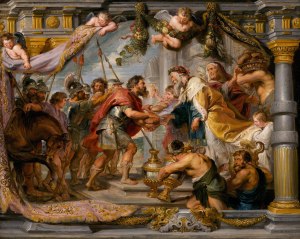
“The Meeting of Abraham and Melchizedek”
Peter Paul Rubens
(1577-1640)
Melchizedek is mentioned in the Bible in Genesis 14:18-20, where he is introduced as the King of Salem (later known as Jerusalem) and a Priest of God Most High, who blesses Abram. He is also referenced in Psalm 110:4, which declares that the Messiah will be a priest forever in the Order of Melchizedek. In the New Testament, the Book of Hebrews (particularly chapters 5-7) elaborates on Melchizedek’s significance, drawing parallels between his eternal priesthood and the Priesthood of Jesus Christ. This connection emphasizes Jesus as both a king and a priest, fulfilling and surpassing the role of Melchizedek in the divine plan of salvation. (Sidebar: Luther, by the way, posited an interesting theory about the identify of Melchizedek, which I will not get into. You can read about it here!).
How should we interpret his rather complicated story? This is a good place to think about a fancy term — Christological exegesis — simply put, a method of Biblical interpretation that seeks to understand and interpret Scripture in light of the person and work of Jesus Christ. In practice, this means looking for prophetic or direct references to Jesus in both the Old and New Testaments. (For example, a Christological exegesis might explore how the sacrificial system in the Old Testament prefigures Christ’s ultimate sacrifice on the cross). Though Melchizedek “remains a mystery,” the writer of Hebrews who is speaking to second-generation Christians, interprets the Old Testament passages that point to the coming of Jesus Christ and his role as savior, and the ultimate mediator between Christians and “God, the Father Almighty.” Let that sink in today!
Soli Deo Gloria!
Join us on Sundays at ELC after the 9:30 worship in the library for discussions of this week’s readings. We learn from each other each week! All are welcome!
Note: Among our discussion on Sunday, let’s plan to explore this week’s Gospel by reading it and applying the four-question approach (NRRD):
- What is something NEW you learned from the reading?
- What is something that caught your attention and caused you to REFLECT?
- What is something that RELATES to other reading you have done?
- What is something you would like to further DISCUSS?
