Faithful Conversations #87
Introduction to Readers:
The Revised Common Lectionary is a guideline for churches, not a mandate. For the next two Sundays, denominations that have roots in the Protestant Reformation utilize different texts than those prescribed in the RCL. Next Sunday we commemorate the Reformation, and I am listing those readings first. Part one of my commentary, partially a repeat from a year ago, will focus on Psalm 46. I am also listing the RCL readings (for your interest) and in part two will focus on the Hebrews passage as I have done for several weeks. Thanks for your continued interest in the Lectionary!
Reformation Sunday Readings
Jeremiah 31: 31-32
Psalm 46
Romans 3: 19-28
John 8: 31-36
Common Themes in the Reformation Sunday Readings
The readings for Reformation Sunday highlight themes of covenant, freedom, and the transformative power of faith. In Jeremiah, God’s promise of a new covenant emphasizes the deep, personal relationship between God and His people. Psalm 46 reinforces the notion of God’s protection and strength amid chaos, while Romans underscores the significance of grace and faith in achieving righteousness (sidebar: Romans was Luther’s favorite book). Finally, John speaks to the liberating truth found in Christ, illustrating that true freedom comes from living in accordance with His teachings.
(And the readings designated for Pentecost 23)
Jeremiah 31: 7-9
Psalm 126
Hebrews 7: 23-28
Mark 10: 46-52
Reflection (part 1): the reformation hymn
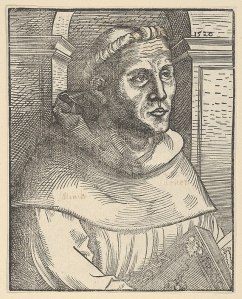
Martin Luther
Augustinian Monk
507 years ago, this week (October of 1517), the rebellious Augustinian monk Martin Luther posted his famed Ninety-Five Theses on the door of the Castle Church in Wittenberg, Germany prompting debates that, over time, fractured Roman Catholicism and planted the seeds for the Protestant Reformation. He saw the world through the prism of a cosmic struggle between good and evil, something that comes through clearly in his writing. A brilliant and complex individual, Luther spent years translating the Bible into German, produced tracts and commentaries that fill volumes, and produced a large and small catechism for the education of both clergy and common people. A gifted musician, Luther also wrote hymns — thirty-six are attributed to him. Most famously, he composed Ein feste Burg ist unser Gott, known to us as A Mighty Fortress is our God (hymn number 504 in the ELW). Known as “The Battle Hymn of the Reformation,” Luther most likely penned it between 1527-1529, according to Anglican clergyman and hymnology expert John Julian.

Luther’s Hymn — An Early Printing
Luther loved the Psalms, referring to them as the “Bible in miniature.” Psalm 46 held a special place in his heart, specifically in 1527 with the plague surging through Europe while Luther faced enormous pressures in his own life, including the near death of his son. Reflecting on Psalm 46, Luther made the following gritty observation: “We sing this psalm to the praise of God, because He is with us and powerfully and miraculously preserves and defends His church and His word against all fanatical spirits, against the gates of hell, against the implacable hatred of the devil, and against all the assaults of the world, the flesh, and sin.” There are many great versions of this powerful hymn available, and this one by the St. Olaf Choir is especially majestic. Take a listen while you explore Psalm 46 adjacent to the lyrics of the hymn — imagine the mind of Luther at work!
| Psalm 46 | A Mighty Fortress is our God |
|
1 God is our refuge and strength, a very present help in trouble. 2 Therefore we will not fear, though the earth should change, though the mountains shake in the heart of the sea, 3 though its waters roar and foam, though the mountains tremble with its tumult. Selah 4 There is a river whose streams make glad the city of God, the holy habitation of the Most High. 5 God is in the midst of the city; it shall not be moved; God will help it when the morning dawns. 6 The nations are in an uproar; the kingdoms totter; he utters his voice; the earth melts. 7 The Lord of hosts is with us; the God of Jacob is our refuge. Selah 8 Come, behold the works of the Lord; see what desolations he has brought on the earth. 9 He makes wars cease to the end of the earth; he breaks the bow and shatters the spear; he burns the shields with fire. 10 “Be still, and know that I am God! I am exalted among the nations; I am exalted in the earth.” 11 The Lord of hosts is with us; the God of Jacob is our refuge. Selah |
1 A mighty fortress is our God, A bulwark never failing; Our helper He amid the flood Of mortal ills prevailing. For still our ancient foe Doth seek to work us woe– His craft and power are great, And, armed with cruel hate, On earth is not His equal. 2 Did we in our own strength confide, Our striving would be losing. Were not the right man on our side, The man of God’s own choosing. Dost ask who that may be? Christ Jesus, it is He– Lord Sabaoth His name, From age to age the same, And He must win the battle. 3 And though this world with devils filled, Should threaten to undo us, We will not fear, for God hath willed His truth to triumph through us. The prince of darkness grim, We tremble not for him– His rage we can endure, For lo, his doom is sure: One little word shall fell him. 4 That word above all earthly powers, No thanks to them, abideth; The Spirit and the gifts are ours Through Him who with us sideth. Let goods and kindred go, This mortal life also– The body they may kill; God’s truth abideth still: His kingdom is forever. Amen. |

“Holy Hill”
Black River Falls, Wisconsin
(Photo: Joel Busse)
And something to think about today: As is true in every community, the forces of history echo across time. Driving up main street in our small city, the Protestant Reformation is illustrated by the structures atop “Holy Hill!” St. Joseph Catholic Church and Evangelical Lutheran Church are not more than fifty meters apart!
Reflection (part 2): luther and hebrews

Lutheran Humor
And finally, since we are thinking about Luther this week, a quick commentary on his reservations about the book of Hebrews. (Sidebar: I like to think Luther had a good sense of humor and would appreciate the cartoon here!). Anyway, here is what I have learned thus far. He questioned its authorship and theological content. He believed it lacked apostolic authority since the author was unknown and not clearly associated with the apostles, whom Luther regarded as primary sources of Christian doctrine. Luther was also uneasy about Hebrews’ theological emphasis on works and its interpretation of Christ’s priesthood, which he felt conflicted with his doctrine of justification by faith alone. Particularly, Hebrews 6:4-6, which warns against falling away after receiving salvation, troubled Luther as it seemed to challenge the permanence of grace. Consequently, he considered Hebrews less central to the canon, although he did not reject it entirely. Whew! I am trying to imagine what it may have been like to have theological discussions with this guy!
Here is the Hebrews passage from Pentecost 23 (Chapter 7: 23-28)
23 Now there have been many of those priests, since death prevented them from continuing in office; 24 but because Jesus lives forever, he has a permanent priesthood. 25 Therefore he is able to save completely those who come to God through him, because he always lives to intercede for them. 26 Such a high priest truly meets our need—one who is holy, blameless, pure, set apart from sinners, exalted above the heavens. 27 Unlike the other high priests, he does not need to offer sacrifices day after day, first for his own sins, and then for the sins of the people. He sacrificed for their sins once for all when he offered himself. 28 For the law appoints as high priests men in all their weakness; but the oath, which came after the law, appointed the Son, who has been made perfect forever.
A couple things to think about here. First, it is important to recall that Hebrews was written as a homily — a sermon — to convince second generation Christians to stay the course, to see the events of their lifetime within God’s cosmic plan. And remember that many of the first hearers were facing persecution for the faith or had witnessed such persecution. Second, as a teacher, I am impressed by the REPETITION that is utilized by the writer — a great technique to reinforce a powerful idea. This passage, for example, builds on last week’s reading in that it reinforces Jesus’ role as High Priest in the grand scheme of God’s plan for salvation, fulfilling the prophecies of old. What differentiates Christ from all others is that he is holy, blameless, and pure, and that he forever intercedes on our behalf. And note the use of the phrase “once for all,” that is repeated in 9:12, 9:26, 10:2, and 10:10. ONCE FOR ALL (verse 27), Jesus sacrificed for their sins. Let that idea grab hold of your heart this week and share the good news!

please note: we will not meet on reformation sunday after church due to a special meeting that will be taking place at that time. we will resume our in-person discussion of the lectionary on sunday 3 november! all are welcome!
