Faithful Conversations #92
Introduction to Readers:
Welcome back and to Year C of the three-year Revised Common Lectionary cycle (2024-25). Year C focuses on the Gospel of Luke. The Old Testament readings are of prophetic proclamation in chronological order and will highlight Jeremiah. The New Testament readings (or second readings) are mainly from Galatians, Colossians, 1 and 2 Timothy, and 2 Thessalonians. Sunday is a good reminder that as Christians, we walk in two worlds and our New Year starts now! Here is a breakdown of the upcoming Christian calendar:

The Liturgical Calendar
Advent: 1 December through 23 December 2024
Christmas: 24 December 2024 through 6 January 2025
Time After Epiphany: 7 January through 4 March 2025
Lent: 5 March through 16 April 2025
The Three Days: 17 April through 19 April 2025
Easter: 20 April through 11 June 2025
Time after Pentecost (Ordinary Time): 12 June through 26 November 2025
 This week, then, marks the start of the Season of Advent. The word Advent derives from the Latin, adventus meaning “coming.” And while we tend to emphasize the birth of Jesus (looking back), Advent also boldly reminds us of Christ’s second coming (looking forward), as noted in this week’s Gospel. Amidst the stress foisted upon us by the overt consumerism and rush that infuses this time of year, Advent calls Christians to pause, to wake-up, to focus on Christ’s presence in our lives — and to seek God amidst the chaos that surrounds us.
As always, thanks for visiting this space again this week! My reflections will focus on the passage from Jeremiah and the words of Jesus as recounted in the Gospel. I will also share a hymn that is especially fitting for Advent 1. Also, realize that I offer hyperlinks for further reading, so be alert for those. And a reminder to work through the four readings utilizing the four-question approach:
1. What is something new you learned from the reading? (NEW)
2. What is something that caught your attention and made you think? (REFLECT)
3. What did you read that relates to other reading you have done? (RELATE)
4. What would you like to discuss from the reading? (DISCUSS)
Reading for 1 Advent
Jeremiah 33: 14-16
Psalm 25: 1-10
1 Thessalonians 3: 9-13
Luke 21: 25-36
Common Themes in the Readings Advent 1
Look for these themes in the readings for next Sunday: hope, watchfulness, and God’s faithfulness. Jeremiah speaks of the promised coming of a righteous king who will restore justice, instilling hope for a better future. Psalm 25 echoes a plea for guidance and deliverance, trusting in God’s steadfast love and mercy as the faithful await His salvation. In 1 Thessalonians, Paul encourages believers to live in holiness while anticipating Christ’s return, fostering a spirit of preparation and prayer. Finally, Luke highlights the need for remaining awake and steadfast as we face trials in this life, with the assurance that God’s kingdom will ultimately prevail.
The Old Testament Reading: Jeremiah 33: 14-16
14 The days are surely coming, says the Lord, when I will fulfill the promise I made to the house of Israel and the house of Judah. 15 In those days and at that time I will cause a righteous Branch to spring up for David, and he shall execute justice and righteousness in the land. 16 In those days Judah will be saved, and Jerusalem will live in safety. And this is the name by which it will be called: “The Lord is our righteousness.”
The Gospel: Luke 21: 25-36
The Coming of the Son of Man
25 “There will be signs in the sun, the moon, and the stars and on the earth distress among nations confused by the roaring of the sea and the waves. 26 People will faint from fear and foreboding of what is coming upon the world, for the powers of the heavens will be shaken. 27 Then they will see ‘the Son of Man coming in a cloud’ with power and great glory. 28 Now when these things begin to take place, stand up and raise your heads, because your redemption is drawing near.”
The Lesson of the Fig Tree
29 Then he told them a parable: “Look at the fig tree and all the trees; 30 as soon as they sprout leaves you can see for yourselves and know that summer is already near. 31 So also, when you see these things taking place, you know that the kingdom of God is near. 32 Truly I tell you, this generation will not pass away until all things have taken place. 33 Heaven and earth will pass away, but my words will not pass away.
Exhortation to Watch
34 “Be on guard so that your hearts are not weighed down with dissipation and drunkenness and the worries of this life and that day does not catch you unexpectedly, 35 like a trap. For it will come upon all who live on the face of the whole earth. 36 Be alert at all times, praying that you may have the strength to escape all these things that will take place and to stand before the Son of Man.”
reflection: “wide awake!”

Pin Worn by Wide-Awake Members in 1860
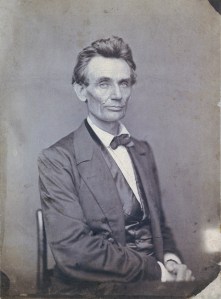
Lincoln in May of 1860
After Receiving the Republican Nomination
164 years ago, Abraham Lincoln became our 16th President. He received less than 40 percent of the popular vote in a brutally contentious four-way contest. Between the November election and his inauguration in March, seven southern states seceded from the Union, a precursor to our Civil War. One of my favorite episodes stemming from the 1860 election was the rise of the WIDE-AWAKES. Comprised mostly of young men, they were an imaginative, vocal, and often militant group supporting the anti-slavery Republican Party and its chosen candidate. Their name derived from the practice of holding torchlight parades and rallies (including in Wisconsin), and emphasis on being AWAKE to the moral and political issues of the time, particularly slavery and its expansion. Wide-Awakes saw themselves as actively engaged in the fight for justice, freedom, and reform, contrasting with those they viewed as complacent or asleep, if you will. They helped propel Lincoln to victory and their message remains relevant in 2024!
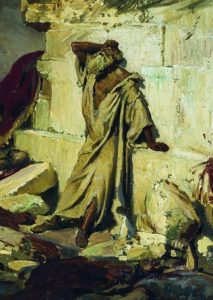
“Cry of prophet Jeremiah on the Ruins of Jerusalem” by Ilya Repin (1870)
The readings for Advent 1 spur us to wake up and be alert in our chaotic world. More than 26 centuries ago, the prophet Jeremiah was writing to a devastated people. The mighty Babylonian army had ransacked Jerusalem shipping thousands of Jewish people off to captivity, turning their world upside down. In that terrifying moment, the Prophet of God warned the “days are surely coming” when “justice and righteousness” shall return! In our interpretive framework, we hear those hopeful words to mean the coming of Jesus Christ, hence their inclusion in this week’s readings. But there’s more. As Julia M. O’Brien of Lancaster Theological Seminary and Moravian University asserts, the entire book of Jeremiah centers on the larger theme of judgement. Time and again, the Prophet hammers the Israelites for their waywardness from God (it’s actually tough to read!). My sense is that we should not read this as a finger-pointing exercise aimed at “those people back there,” but rather as a commentary on the lack of “righteousness and justice” in our time and place. Jesus echoes these words in the passage from Luke. Verses 25-26, for example, seem eerily descriptive of our time, a period of distress among nations confused by the roaring of the sea and the waves.
As we walk into Advent 2024, then, let’s imagine being in that Jerusalem temple crowd listening to Jesus, and may we take his words to heart. Let’s not become consumed with the worries of this life, but rather, **WAKE UP, focus forward, and spend our time doing God’s work in the world, as we prepare for Christ’s return!
Soli Deo Gloria!
**Note: As I worked on this blog in the past couple of days, I could not help but think of how the word “woke” has come into our political jargon. The term’s origin traces to the African-American experience, and referred to being aware of social injustices, particularly those related to racism and inequality, and staying alert to systemic issues. Over time, it evolved into a broader concept encompassing awareness and advocacy for various social issues, including gender equality, climate justice, and LGBTQ+ rights. However, it has also become a contentious term, with critics using it to label what they perceive as excessive political correctness or performative activism. As a result, “woke” can carry both positive connotations of social consciousness and negative connotations as a polarizing or pejorative term, depending on the context.
prayer reflection: “Wake awake, for night is flying”
Wake Awake, For Night is Flying is a powerful hymn (436 in the ELW) from Philip Nicolai and seems especially fitting with this week’s lectionary. A Lutheran Pastor (and a “PK”), Nicolai studied in Wittenberg from 1547-49 and was soundly influenced by Luther who died a year before Nicolai’s arrival. He ultimately served in five different parishes in Germany during his ministry. Written in 1597 in Unna during a devastating plague during which many of his parishioners died, the stirring hymn offers hope amidst desperate times. Enjoy the version below offered by the Luther College Choir.

Philipp Nicolai
(1556-1608)
Wake, awake, for night is flying,
the watchmen on the heights are crying;
awake, Jerusalem, at last.
Midnight hears the welcome voices,
and at the thrilling cry rejoices:
“Come forth, you maidens! Night is past.
The Bridegroom comes! Awake;
your lamps with gladness take!”
Alleluia!
Prepare yourselves to meet the Lord,
whose light has stirred the waiting guard.
An Announcement Regarding an Adult Education Opportunity!


Paul, I am thinking of offering this to our Men’s Bible Study Group as well…it seems somewhat daunting to me as I am dog paddling through this first call BUT such a relevant topic for our time in history. I will let you know if they accept and if I can will order the book from my local library.
LikeLike
Thanks Doris — We were able to secure a few copies from Amazon (used) and very reasonable. Also, Augsburg-Fortress, I believe, is running a special on the book right now and through November. Might be worth checking out.
LikeLike