Faithful Conversations #95
Introduction to readers

Filmstrip Projector
c. 1958

Bupe Kibiki of Tanzania
Due to my age (b. 1957), I carry around layers of memory from the world of 1950s and 60s Lutheranism. An Advent message of joy from Bupe Kibiki of Tanzania came into my inbox this week, triggering one such memory –that primitive piece of technology known as the “filmstrip” (click here or on her photo if you want to view her message). Yes, those filmstrips in Sunday School or Luther League transported us beyond our small world into the global presence of Lutheranism represented by missionaries working in exotic lands (sidebar: it was a unique thrill if the teacher asked you to assist with the filmstrip!). The joy-filled message from Bupe Kibiki came from the website of the Lutheran World Federation, a communion of Lutheran churches established in 1947 in Lund, Sweden. The LWF brings together 149 member churches (including the ELCA) from over 99 countries, representing more than 78 million Lutherans worldwide. Rooted in the Lutheran tradition, the organization addresses issues such as poverty, climate change, gender equality, and peacebuilding, working ecumenically to promote the common good. Headquartered in Geneva, Switzerland, the LWF stands as a powerful reminder that we share our version of the faith with millions of people across the world!
As always, thanks for your continuing interest in exploring the scriptures! In keeping with our walk through the various prophets for several Sundays, I have included a short video summarizing the book of Micah which I encourage you to watch. My reflections will focus on Luke’s Gospel and especially Mary’s presence — and I am including a few more verses than called for in the Lectionary.
Reading for Advent 4
Micah 5: 2-5a
Psalm 80: 1-7
Hebrews 10: 5-10
Luke 1: 39-45 (46-55)
Look for these themes as you work through next Sunday’s readings: hope, fulfillment of prophecy, and divine intervention. Micah 5: 2-5a speaks of a coming ruler from Bethlehem who will bring peace, while Psalm 80: 1-7 expresses a longing for God’s restoration and salvation. Hebrews 10: 5-10 highlights Christ’s sacrifice as the ultimate fulfillment of God’s will, and Luke 1: 39-45 (46-55) celebrates Mary’s faith and the coming of the Messiah, showing God’s intervention through humble means. Together, these texts emphasize God’s promises being realized through the coming of Christ, offering salvation and peace to all.
The Old Testament Reading: Micah 5: 2-5a
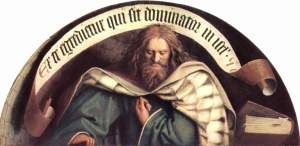
The Prophet Micah
The Ghent Altarpiece
Hubert van Eyck (c. 1385/90-1426)
But you, O Bethlehem of Ephrathah, who are one of the little clans of Judah, from you shall come forth for me one who is to rule in Israel, whose origin is from of old, from ancient days. 3 Therefore he shall give them up until the time when she who is in labor has brought forth; then the rest of his kindred shall return to the people of Israel. 4 And he shall stand and feed his flock in the strength of the Lord, in the majesty of the name of the Lord his God. And they shall live secure, for now he shall be great to the ends of the earth, 5 and he shall be the one of peace.
The Gospel: Luke 1: 26-56
26 In the sixth month the angel Gabriel was sent by God to a town in Galilee called Nazareth, 27 to a virgin engaged to a man whose name was Joseph, of the house of David. The virgin’s name was Mary. 28 And he came to her and said, “Greetings, favored one! The Lord is with you.” 29 But she was much perplexed by his words and pondered what sort of greeting this might be. 30 The angel said to her, “Do not be afraid, Mary, for you have found favor with God. 31 And now, you will conceive in your womb and bear a son, and you will name him Jesus. 32 He will be great and will be called the Son of the Most High, and the Lord God will give to him the throne of his ancestor David. 33 He will reign over the house of Jacob forever, and of his kingdom there will be no end.” 34 Mary said to the angel, “How can this be, since I am a virgin?” 35 The angel said to her, “The Holy Spirit will come upon you, and the power of the Most High will overshadow you; therefore the child to be born will be holy; he will be called Son of God. 36 And now, your relative Elizabeth in her old age has also conceived a son, and this is the sixth month for her who was said to be barren. 37 For nothing will be impossible with God.” 38 Then Mary said, “Here am I, the servant of the Lord; let it be with me according to your word.” Then the angel departed from her.
Mary Visits Elizabeth
39 In those days Mary set out and went with haste to a Judean town in the hill country, 40 where she entered the house of Zechariah and greeted Elizabeth. 41 When Elizabeth heard Mary’s greeting, the child leaped in her womb. And Elizabeth was filled with the Holy Spirit 42 and exclaimed with a loud cry, “Blessed are you among women, and blessed is the fruit of your womb. 43 And why has this happened to me, that the mother of my Lord comes to me? 44 For as soon as I heard the sound of your greeting, the child in my womb leaped for joy. 45 And blessed is she who believed that there would be a fulfillment of what was spoken to her by the Lord.”
Mary’s Song of Praise

Virgin Mary
(A.I. Generated)
46 And Mary said,
“My soul magnifies the Lord,
47 and my spirit rejoices in God my Savior,
48 for he has looked with favor on the lowly state of his servant.
Surely from now on all generations will call me blessed,
49 for the Mighty One has done great things for me,
and holy is his name;
50 indeed, his mercy is for those who fear him
from generation to generation.
51 He has shown strength with his arm;
he has scattered the proud in the imagination of their hearts.
52 He has brought down the powerful from their thrones
and lifted up the lowly;
53 he has filled the hungry with good things
and sent the rich away empty.
54 He has come to the aid of his child Israel,
in remembrance of his mercy,
55 according to the promise he made to our ancestors,
to Abraham and to his descendants forever.”
56 And Mary remained with her about three months and then returned to her home.
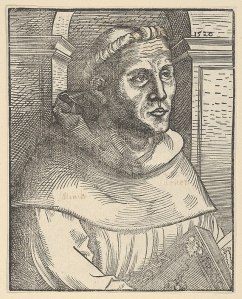
Martin Luther
Augustinian Monk
Preface to this week’s reflection: This is an updated version of my posting from Advent 3 in 2023. Let me also add the following short explanation of how Lutherans differ from our Roman Catholic sisters and brothers regarding Mary. Martin Luther’s attitude toward Mary was complex (no surprise) and evolved over time. He acknowledged her unique role in salvation history, for example, as indicated by the following excerpt of his Christmas sermon of 1531: “[She is the] highest woman and the noblest gem in Christianity after Christ . . . She is nobility, wisdom, and holiness personified. We can never honor her enough. Still honor and praise must be given to her in such a way as to injure neither Christ nor the Scriptures.” That final sentence encapsulates Luther’s objection to what he saw as excessive prayers or the attribution of mediating powers to her (similar to his attitude toward the Saints). While he continued to honor Mary as “Theotokos” (God-bearer) and believed in her perpetual virginity, he firmly opposed the idea of her being an object of intercession or veneration beyond what was biblically grounded. What a time it was in the years around 1517 when these debates were in the air!
Reflection: “mary’s radical and ancient prayer”

Young Mary and the Annunciation
First, let’s consider Mary and her world, especially from our vantage point in December of 2024, amidst the troubling events surrounding the ongoing Israel-Hamas War. While I have heard about her from a young age, especially at this time of year, I must admit not engaging more fully in her story. This Judean teenage girl (perhaps only 13!), swept into history by miraculous forces, lived a life like no other. From lowly circumstances, and a virgin, she learns in a spiritual encounter with Gabriel, that she will bear a son destined to be the Messiah for her people, and far beyond. Can we even imagine how her mind must have been racing at this moment? In what can only be described as a depth of faith that dwarfs anything I can understand, she responds with a calm and submissive courage (verse 38). And second, what of this dramatic prayer, the Magnificat (Latin for “magnify”)? As Debi Thomas, Minister of Formation and Discipleship at St. Mark’s Episcopal Church in Palo Alto, California points out in a 2020 essay on these texts points out, Mary’s prayer comprises the longest set of words spoken by a woman in the New Testament. Further, that the prayer was soaked in Jewish women’s history, echoing the words and stories of Miriam, Hannah, Judith, and Deborah (Note “Hannah’s Prayer” in 1 Samuel 2: 1-10). Most astonishing, however, is the radical and subversive nature of the prayer, what Thomas calls Mary’s fiery justice song. Read it again focusing on the highlighted verses (51-53). Our friend Dietrich Bonhoeffer, called the Magnificat the most passionate, the wildest, one might even say the most revolutionary hymn ever sung. Oscar Romero, Salvadoran Catholic Priest, murdered in 1980, later canonized, drew comparisons between Mary and the poor and powerless in his community. Indeed, the Magnificat has been banned more than a few times by those in power who fear its message. As we move toward the celebration of our Lord’s birth, we would do well to hear and reflect on his mother’s fervent prayer with fresh insight. As scholar Kenneth Craycraft asserts, A lowly birth to a lowly woman ushers in the magnificent fulfillment of God’s offer and promise of salvation.
Soli Deo Gloria!
prayer/musical reflection: “some children see him”

Wihla Hutson (1901-2002)

Alfred Burt (1920-1954)
Some Children See Him was composed by Alfred Burt, an American jazz musician who produced an annual Christmas carol from 1942 through 1954 with an old family friend, Wihla Hutson who looks right out of central casting for any lutefisk supper I ever attended as a child! This song was produced in 1951 and I’m sharing an especially fine interpretation of it from James Taylor. The lyrics are below.
The baby Jesus born this night
Some children see Him lily white
With tresses soft and fair
The Lord of heav’n to earth come down
Some children see Him bronzed and brown
With dark and heavy hair
This Saviour whom we kneel beside
Some children see Him almond-eyed
With skin of golden hue
Sweet Mary’s Son to whom we pray
Some children see him dark as they
And, oh they love Him too
Will see the baby Jesus’ face
Like theirs, but bright, with heavenly grace
And filled with holy light
And with thy heart as offering
Come worship now the infant King
‘Tis love that’s born tonight
Our next in-person meeting regarding the lectionary will be on sunday, 29 December at 10:45. join us in the library — All are welcome!
And, a reminder: the bonhoeffer book study!

Dietrich Bonhoeffer
(1906-1945)
