Faithful Conversations #103
Introduction to readers

Adam Clayton Powell, Sr.
(1865-1953)
Our faith journeys are unique, and I suspect we all can point to many things that brought us to where we are. That has been on my mind this week, prompted by our continuing study of Dietrich Bonhoeffer and this week’s Gospel reading from Luke. Let me explain.
During his 1930-31 visit to America, Bonhoeffer’s faith was significantly altered. While at Union Theological Seminary in New York, he studied under influential professors like Reinhold Niebuhr, Paul Tillich, and Albert Knudson. His time in black churches, particularly at Abyssinian Baptist Church in Harlem, deeply impacted his theology. The powerful preaching and vibrant worship, especially Adam Clayton Powell Sr.’s socially conscious sermons, made a lasting impression on him. At age 24, this exposure prompted Bonhoeffer see the gospel in a new light, emphasizing the importance of living out one’s faith amid social suffering and injustice.

Bonhoeffer and Jean Lesserre (1908-1983)
A transformative moment for the young German theologian was a 2,600-mile road trip from New York City to Mexico City in May 1931, accompanied by fellow European Jean Lasserre. It was Lasserre who helped Bonhoeffer imagine the Sermon on the Mount not just as an ideal but as a call for practical, radical obedience to Jesus’ teachings. This perspective was a departure from traditional German Lutheran interpretations, which often saw the Sermon as an impossible standard. I mention this because this week’s Gospel is the ‘Sermon on the Plain’ from Luke. I will focus on this and its connection to the Beatitudes in the ‘Sermon on the Mount’ from Matthew in my reflections.
As always, thanks for your continued interest in exploring the Lectionary! And, if you need a quick review of background of the Revised Common Lectionary, I ran across this EXCELLENT EXPLANATION this week and commend it to your reading. The author does a wonderful job of summarizing the make-up and intentions of the Lectionary readings.
Readings for 6 Epiphany
Jeremiah 17: 5-10
Psalm 1
1 Corinthians 15: 12-20
Luke 6: 17-26
Common Themes in the Readings for 6 Epiphany:
The readings for the 6th Sunday in Epiphany share common themes of trust, blessings, and the consequences of faith or lack thereof (curses). Jeremiah 17:5-10 contrasts those who trust in human strength, who are cursed like a barren bush, with those who trust in the Lord, who flourish like a tree by the water. Psalm 1 echoes this imagery, depicting the righteous as a fruitful tree and the wicked as chaff blown away by the wind (note: recall that within the Lectionary, the Psalm is a response to the first reading). In 1 Corinthians 15:12-20, Paul emphasizes the importance of faith in Christ’s resurrection, affirming that without it, faith is in vain and hope is lost. Luke 6:17-26 presents Jesus’ Beatitudes, where the blessed are those who rely on God despite suffering, while woes come to those who trust in worldly comfort, reinforcing the call to place ultimate trust in God for true life and blessing.
The Gospel: Luke 6: 17-26

The Galilee Region of Northern Israel
17 He came down with them and stood on a level place with a great crowd of his disciples and a great multitude of people from all Judea, Jerusalem, and the coast of Tyre and Sidon. 18 They had come to hear him and to be healed of their diseases, and those who were troubled with unclean spirits were cured. 19 And everyone in the crowd was trying to touch him, for power came out from him and healed all of them. 20 Then he looked up at his disciples and said:
“Blessed are you who are poor,
for yours is the kingdom of God.
21 “Blessed are you who are hungry now,
for you will be filled.
“Blessed are you who weep now,
for you will laugh.
22 “Blessed are you when people hate you and when they exclude you, revile you, and defame you on account of the Son of Man. 23 Rejoice on that day and leap for joy, for surely your reward is great in heaven, for that is how their ancestors treated the prophets.
24 “But woe to you who are rich,
for you have received your consolation.
25 “Woe to you who are full now,
for you will be hungry.
“Woe to you who are laughing now,
for you will mourn and weep.
26 “Woe to you when all speak well of you, for that is how their ancestors treated the false prophets.
reflection: “Living on the level plain”
The Gospels of Matthew and Luke were written in the latter years of the 1st Century and therefore relied on a variety of sources to tell the story of Jesus. Though there are similarities in content, the Sermon on the Mount and the Sermon on the Plain are generally considered to be different events. The Sermon on the Mount (Matthew 5-7) is delivered on a mountainside, symbolizing a connection to Moses and the giving of the Law, and contains the eight familiar Beatitudes. The Sermon on the Plain (Luke 6) takes place on a level place, emphasizing accessibility to a diverse crowd, and features four of the Beatitudes. We must assume that Jesus delivered similar teachings on multiple occasions, adapting His message to different audiences and contexts.
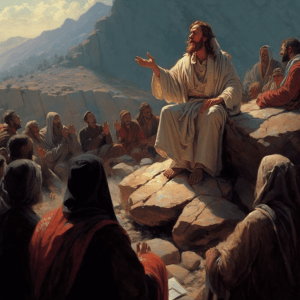
Jesus Teaching in Galilee
(A.I. Generated, 2023)
In Luke 6:17-26, Jesus does not mince words. As theologian Debie Thomas writes, his message in a nutshell is this: “Blessed are you who are poor, hungry, sad, and expendable. Woe to you who are rich, full, happy, and popular.” There it is. What are we to make of that? Let me offer these things as you reflect on the passage. First, the Beatitudes of Jesus turn the world on its head, emphasizing a reversal of societal expectations, highlighting the blessedness of the marginalized and the spiritual peril of those who rely on material wealth and social status. It calls for a life of faith and dependence on God rather than on worldly success. Let that resonate for a few minutes.
Second, Jesus’ words cut deep. Again, Debie Thomas offers her reaction to his teachings — one that spoke to me: “I might begin by admitting that Jesus is right. That is to say, I might come clean about the fact that most of the time, I am not desperate for God. I am not keenly aware of God’s active, daily intervention in my life. I am not on my knees with need, ache, sorrow, longing, gratitude, or love. After all, why would I be? I have plenty to eat. I live in a comfortable home. I have both health and health insurance. My children are safe. I have access to a vibrant social, intellectual, and recreational life. I’m not in dire need of, well, anything.” Ouch.
Lastly, I think it is important for us to imagine being in the crowd that day. Jesus didn’t aim four of the Beatitudes to one group of us and four to another group. All were meant for all. We are both saint and sinner. Our lives are complicated that way. We need to be comforted and challenged as we live “on the level plain” of this world together. My we find inspiration and hope in that!
Soli Deo Gloria!

Debie Thomas
Theologian and Writer
** Note: My reflections this week were inspired by Pastor Debie Thomas’ reflection on the passage. She currently serves as the Minister for Lifelong Formation at St. Mark’s Episcopal Church in Palo Alto, CA.
Note: In a recent blog, I offered the most famous prayer attributed to Bonhoeffer, that comes from his “Letters and Papers from Prison.” I ran across this one while researching him and found it thought-provoking, especially the phrase, “the temptations of darkness.”
O Lord my God, I thank you that you have brought this day to its close. I thank you that you have given rest to body and soul. Your hands have been over me, guarding me and preserving me. Forgive my feeble faith and all the wrong I have done this day, and help me to forgive all who have wronged me. Grant that I may sleep in peace beneath your care, and defend me from the temptations of darkness. Into your hands I commend my loved ones, I commend this household, I commend my body and soul. O God, Your holy name be praised. AMEN.
Source: United Methodist Hymnal
prayer reflection 2: commemorating Martin Luther
Note: Martin Luther died on 18 February 1546 at the age of 62. We have roughly 125 “Lesser Festivals and Commemoration” that are part of our tradition each year. You can find the complete listing in the ELW, our book of worship. Based on my knowledge of Luther, I’m not sure how he would feel about being included in such a listing, although the prayer points us to proclaiming the reality of Jesus’ reign, something he would have applauded!

Martin Luther
(1483-1546)
Almighty God, we praise you for your servant Martin Luther, through whom you have called the church to its tasks and renewed its life. Raise up in our own day teachers and prophets inspired by your Spirit, whose voices will give strength to your church and proclaim the reality of your reign, through Jesus Christ, our Savior and Lord, who lives and reigns with you and the Holy Spirit, on God, now and forever. Amen.
Source: Days of Commemoration, Prayers for Renewers of the Church, Evangelical Lutheran Worship (ELW).
update: the bonhoeffer book study!

Dietrich Bonhoeffer
(1906-1945)
We will meet on Sunday 16 February from 10:50-11:50 in the ELC Sanctuary!
