“Furnish an example, stop preaching, stop shielding, don’t prevent self-reliance and initiative, allow your children to develop along their own lines.” (Eleanor Roosevelt)
Inspired by this week’s Philippians passage, ROLE MODELS have been on my mind. Before reading further, reflect on the examples who shaped you into the person you are today. How did they do it? Eleanor Roosevelt believed children learn more from actions than words, something I understood early on as a teacher, coach, and parent. And here’s something to consider: Did those who inspired us realize their impact? I vividly recall awkwardly trying to thank my best college teacher and realizing he didn’t know how much he influenced me. The same goes for spiritual mentors. Bonhoeffer spoke to this: “The saints don’t realize the fruits of their actions. If they tried to observe themselves, they’d sever their connection to the source of their strength, ending their impact” (The Cost of Discipleship, 285). I will share more on Christian role models in my reflections this week.
As always, thanks for your continued interest in the Lectionary. I mentioned last week that I’m studying a method of scripture reading known as the Lectio Divina (“Divine Reading”) during Lent, including Luther’s modifications of it. I included his basic approach alongside the Philippians passage below if you would like to experiment with it.
The readings for the Second Sunday in Lent share the common themes of trust in God’s promises and perseverance through challenges. In Genesis 15, God reassures Abram, affirming His covenant and calling for faith even when fulfillment seems distant. Psalm 27 emphasizes unwavering confidence in God as a refuge and source of strength amidst adversity. Philippians 3 highlights perseverance in faith and a focus on heavenly priorities, encouraging believers to remain steadfast. Luke 13 presents Jesus’ trust in God’s plan as He faces opposition, demonstrating courage and love despite rejection, which mirrors the call to faithful endurance found in the other readings.
Focus Passage from Philippians
17 Brothers and sisters, join in imitating me, and observe those who live according to the example you have in us. 18 For many live as enemies of the cross of Christ; I have often told you of them, and now I tell you even with tears. 19 Their end is destruction, their god is the belly, and their glory is in their shame; their minds are set on earthly things. 20 But our citizenship is in heaven, and it is from there that we are expecting a Savior, the Lord Jesus Christ. 21 He will transform the body of our humiliation that it may be conformed to the body of his glory, by the power that also enables him to make all things subject to himself. 4 1 Therefore, my brothers and sisters, whom I love and long for, my joy and crown, stand firm in the Lord in this way, my beloved.
Luther’s Revision of the Lectio Divina (Three Steps)
Oratio (Prayer): This is the starting point, where one humbly prays for the Holy Spirit’s guidance to understand God’s Word. Luther emphasized that prayer prepares the heart and mind to receive divine wisdom.
Meditatio (Meditation): This involves deeply engaging with Scripture, not just reading it but reflecting on it repeatedly. Luther encouraged believers to “chew on” the Word, allowing its meaning to sink in and shape their thoughts and actions.
Tentatio (Struggle): Often translated as “trial” or “temptation,” this refers to the challenges and spiritual battles that arise as one seeks to live according to God’s Word. Luther saw these struggles as a way God refines faith, making it more resilient and authentic.
Reflections: “The Metanoia Journey”
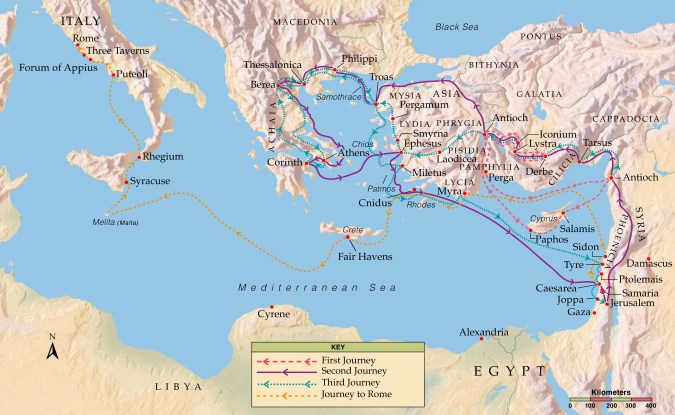
Philippi was a Roman colony in Macedonia, known for its strategic location on the Via Egnatia, a major trade route connecting Rome and Constantinople. The city was heavily influenced by Roman culture and politics, and its citizens prided themselves on their Roman citizenship. Paul visited Philippi during his second missionary journey (49-50) and again on his third in the mid-50s. It was here that he established the first Christian community in Europe, making the Philippians some of his earliest converts (Acts 16). Written from prison in Rome (c. 60-62), the letter to the Philippians is often referred to as the “Epistle of Joy.” The letter has a very personal voice in its tone.
In the passage for Sunday, Paul urges believers to follow his example and stay united with others who share their faith. He contrasts those who live according to earthly desires, whose end is destruction, with those who await their citizenship in heaven. Paul reminds the Philippians of the transformative power of Jesus Christ, who will one day bring all things under His control. Finally, he encourages them to stand firm in the Lord as his dear friends, emphasizing perseverance and faithfulness.
St. Paul in Prison
Paul’s admonition to the Philippian Christians to follow his example seems bold, especially in light of the admission of his failings voiced in chapter 3. And here, language is important. Paul wrote his letters in Koine Greek, the common language of the Eastern Mediterranean, so they could reach a wide audience. He also spoke Aramaic, the everyday language of many Jews including Jesus, and likely knew Hebrew for religious texts. However, Koine Greek was the best choice for sharing the gospel across the Roman Empire, as it connected both Jewish and Gentile communities. The word example comes from the Latin exemplum, meaning pattern or model, but its roots trace back to the Greek word παράδειγμα (paradeigma) meaning pattern or model. Although example entered English via Latin, its Greek origins highlight the role of Greek traditions in using models to teach ideas, something Paul would have understood due to this educational background.
And let me take that a step further. From the Greek paradeigma we derive the word paradigm, defined as a model or framework that shapes how we understand or approach something. It can broadly refer to a set of beliefs, methods, or examples that guide thinking or actions in a particular field or context. (Sidebar: One of the fascinating things to study in history is the notion of “paradigm shifts,” when one way of seeing the world — normally applied in science — replaces another. For example, the shift from the physics of Newton to Einstein was earth-shaking). In short, Paul is calling on the Philippian Christians (and us) to be radically transformed in our being — to move from our old selves in the flesh to our new selves as citizens of heaven (verses 20-21). There is another Greek word that speaks to this transformation — metanoia, meaning a “change of heart.” This brings to mind that powerful verse from Romans (12:2): “Do not conform to the pattern of this world but be transformed by the renewing of your mind. Then you will be able to test and approve what God’s will is—his good, pleasing and perfect will” (New International Version).
This journey of metanoia calls us to leave behind old ways and embrace a new life as citizens of heaven. Paul’s message urges us to change not just how we think, but how we live—reflecting God’s will in all we do. Let us pray for the strength to stay on that journey!
Bless all who worship you, almighty God, from the rising of the sun to its setting; from your goodness enrich us, by your love inspire us, by your Spirit guide us, by your power protect us, in your mercy receive us, now and always. Amen.
A Musical Reflection: When Twilight Comes
“When Twilight Comes” is a haunting evening hymn that associates God’s love with the image of a mother hen sheltering her brood under her wings. The author, Moises Andrade (b. 1948), a Catholic priest, wrote this beautiful hymn to reflect the joy, peace, and contentment of being with the LORD. It is hymn 566 in the ELW. Enjoy!
When twilight comes and the sun sets, mother hen prepares for night’s rest. As her brood shelters under her wings she gives the love of God to her nest.
Oh! what joy to feel her warm heartbeat and be near her all night long; so the young can find repose, then renew tomorrow’s song.
One day the Rabbi, Lord Jesus Called the twelve to share His last meal As the hend tends her young So for them He spent Himself to seek and to heal
Oh what joy to be with Christ Jesus, Hear His voice, o sheer delight! And receive His servant care all before the coming night.
So gather ’round once again, friends, Touched by fading glow of sun’s gold And recount all our frail human hopes The dreams of young and stories of old.
O what joy to pray close together, kneeling as one family By a Mother’s love embraced, In the blessed Trinity.
Faithful Conversations on Sunday
Join us on Sunday 16 March at 10:45 in the church library. We talk through the readings (some or all) in an informal setting — no prior preparation is necessary and all are welcome!