“Christ wanted love to be called his single commandment. This we owe to all men. Nobody is excepted.” (Bartolomé de las Casas)
From the world of Charles Schultz and 1960s Lutheran humor.
Prophets are on my mind this week. In the Lutheran church of my childhood — shaped by the 1950s and 60s — the preaching leaned heavily on the New Testament. Jesus was our weekly companion, Paul our theological guide, and the Psalms brought comfort. The Old Testament prophets? They were thundering off in the distance somewhere — respected but rarely central. But this week, Amos breaks through. He appears in the Revised Common Lectionary’s Year C cycle, most prominently in July and again in September. His words are sharp, poetic, and deeply unsettling — calling out injustice with a clarity that is hard to ignore. I’m working my way through Walter Brueggemann’s The Prophetic Imagination right now, a book that reframes the prophet not as a predictor of events, but as a poet of possibility — someone who dismantles the dominant narrative and dares to imagine a world shaped by divine justice.
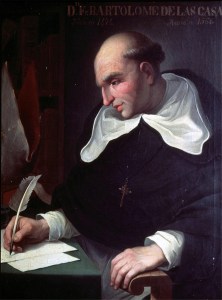
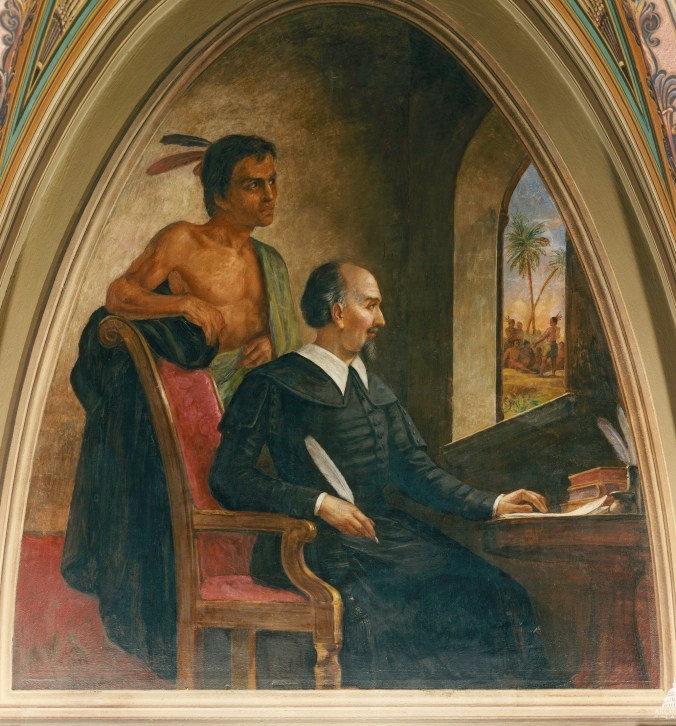
That vision resonates with another figure whose voice I’ve long admired: Bartolomé de las Casas, a prophet from a different time. This week, the ELCA commemorates Las Casas who died on 17 July 1566. A Dominican friar and missionary to the Indies, Las Casas was one of the first to publicly denounce the brutal treatment of Indigenous peoples by Spanish colonizers. He gave up his own encomienda and spent decades advocating for peaceful mission work, legal reform, and the dignity of Native lives. His writings — especially A Short Account of the Destruction of the Indies — were not just historical records; they were theological indictments. Las Casas clearly fits within the prophetic tradition. Like Amos, he spoke truth to power. And like Brueggemann’s vision of the prophet, Las Casas refused to accept the dominant consciousness of empire — and imagine the power of the Spanish empire! He imagined an alternative world rooted in mercy, justice, and the radical belief that Indigenous souls mattered to God. Like Amos, he was ridiculed, resisted, and marginalized. His courage amazes me.
Thanks for visiting this space again this week. As noted in previous blog postings, the more I learn about God’s Word, the more I realize I do not know, and I offer these with humility! July of 2025 is offering us several examples of the overwhelming power of nature with flooding in Texas and wildfires in Canada — it can be unsettling. Be reminded that God is present and in control, ever faithful. I will come back to Amos in my reflections this week and include a prayer for Las Casas that falls within our tradition. My musical offering will offer a few moments of calm and offers a wide range of interpretive possibilities! Also, note my short explanation at the end of the blog regarding the role of alternative readings within the Revised Common Lectionary, as is the case with the passage from Amos this week).
** Note 1: Links to outside references are bolded and italicized and are meant for further reading or research on your part. While the text I am including in the blog is my own, I am pulling from a multitude of sites for ideas and connections. ** Note 2: In my increasing use of A.I. (Copilot), I will cite sourcing of how I am using the tool, if necessary. I don’t want that to be overly cumbersome, but I am gradually incorporating more tools. And, by the way, I am exploring the A.I. world this summer prior to my next teaching semester. As you can imagine, it is a great challenge right now and will forever change the face of education!
** Note 3: The images I include in the blog are drawn from Wikimedia Commons to the fullest extent possible.
The readings for Pentecost 6 share a deep concern for attentiveness to God’s presence and justice. Amos warns of a society so consumed by greed and exploitation that it becomes deaf to the word of the Lord. Psalm 15 outlines the ethical posture of one who may dwell with God—marked by truthfulness, integrity, and compassion. Colossians lifts up Christ as the cosmic center, calling believers to remain grounded in him and mature in faith. In Luke’s Gospel, Mary models the “better part” by choosing presence over distraction, reminding us that spiritual attentiveness is not passive but transformative.
“Describe the common themes among the readings for Pentecost 6.” Copilot, 13 July 2025, Copilot website.
Amos 8: 1-12 This is what the Lord God showed me: a basket of summer fruit. 2 He said, “Amos, what do you see?” And I said, “A basket of summer fruit.” Then the Lord said to me,
“The end has come upon my people Israel; I will spare them no longer. 3 The songs of the temple shall become wailings on that day,” says the Lord God; “the dead bodies shall be many, cast out in every place. Be silent!”
4 Hear this, you who trample on the needy, and bring to ruin the poor of the land, 5 saying, “When will the new moon be over so that we may sell grain, and the Sabbath, so that we may offer wheat for sale? We will make the ephah smaller and the shekel heavier and practice deceit with false balances, 6 buying the poor for silver and the needy for a pair of sandals and selling the sweepings of the wheat.”
7 The Lord has sworn by the pride of Jacob: Surely I will never forget any of their deeds. 8 Shall not the land tremble on this account, and everyone mourn who lives in it, and all of it rise like the Nile, and be tossed about and sink again, like the Nile of Egypt?
9 On that day, says the Lord God, I will make the sun go down at noon and darken the earth in broad daylight. 10 I will turn your feasts into mourning and all your songs into lamentation; I will bring sackcloth on all loins and baldness on every head; I will make it like the mourning for an only son and the end of it like a bitter day.
11 The time is surely coming, says the Lord God, when I will send a famine on the land, not a famine of bread or a thirst for water, but of hearing the words of the Lord. 12 They shall wander from sea to sea and from north to east; they shall run to and fro, seeking the word of the Lord, but they shall not find it.
My source for the Bible readings each week is the Bible Gateway website.
TRY LUTHER’S METHOD OF BIBLE READING
A Revision of the Lectio Divina, a method he learned in his Augustinian training
Three Steps
Oratio (Prayer): This is the starting point, where one humbly prays for the Holy Spirit’s guidance to understand God’s Word. Luther emphasized that prayer prepares the heart and mind to receive divine wisdom.
Meditatio (Meditation): This involves deeply engaging with Scripture, not just reading it but reflecting on it repeatedly. Luther encouraged believers to “chew on” the Word, allowing its meaning to sink in and shape their thoughts and actions.
Tentatio (Struggle): Often translated as “trial” or “temptation,” this refers to the challenges and spiritual battles that arise as one seeks to live according to God’s Word. Luther saw these struggles as a way God refines faith, making it more resilient and authentic.
Luther’s Seal
Reflections: “Amos: A Prophetic Voice for 2025″
The Prophet Amos (d. 745 BCE)
‘”A prophet is not without honor except in his own country and in his own house.” (Jesus speaking: Matthew 13:57)
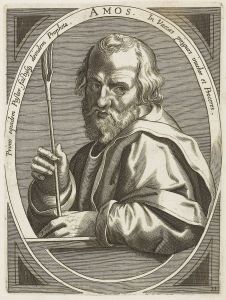
Amos, clearly, was an unsettling character. Roughly 2,700 years ago (c.760 BCE), God called this shepherd and tree farmer from Tekoa to confront the injustices of Israel during the reign of King Jeroboam II. Though Amos lacked formal training or religious credentials, he delivered piercing critiques of economic exploitation, idolatry, and hollow worship. Amos disrupted the comfort of the powerful, declaring that true faith demanded justice and compassion. His message challenged Israel’s prosperity, warning that unchecked greed would rot the soul of the nation.
In the reading designated for next Sunday, Amos uses the image of ripe summer fruit to signal that Israel’s time is running out—their prosperity has turned rotten. The prophet condemns dishonest merchants who exploit the poor and treat holy days as nuisances, revealing a deep moral failure. God warns of a coming reversal: joy will turn to mourning, light to darkness, and silence will replace divine guidance. Verses 11-12 offer a startling warning — God’s Word will ultimately be withdrawn! What to make of all this?
First, Walter Brueggemann described prophets like Amos as carriers of the prophetic imagination —voices who disrupt dominant narratives and reframe reality according to God’s vision. They do not merely critique; they reimagine. Amos reveals that wealth without justice leads to spiritual blindness. Brueggemann’s insight helps us see that prophets don’t just diagnose—they cast alternative futures shaped by divine mercy and moral clarity.
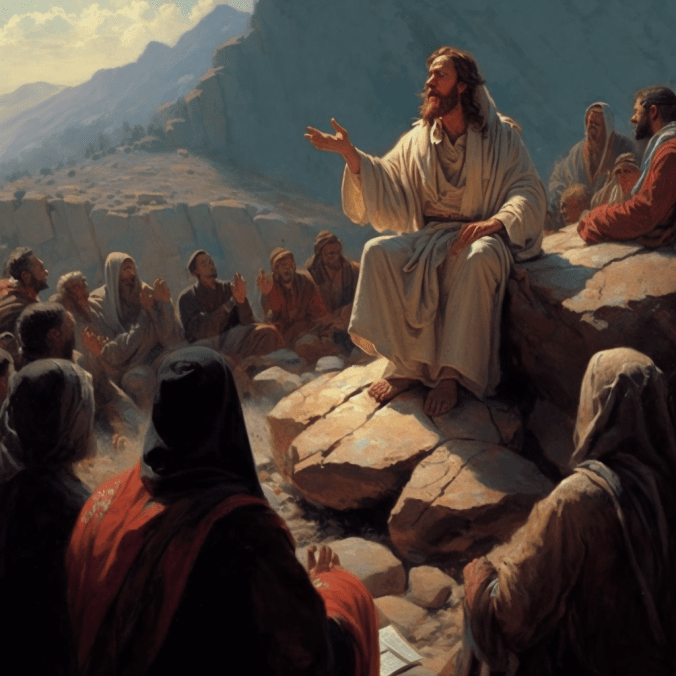
Jesus Teaching in Galilee (A.I. Generated, 2023)
Second, it’s important for us to realize that Jesus stood firmly within this prophetic tradition. When He returned to Nazareth, His own community rejected Him, unable to see beyond the carpenter they had always known. The quote cited above from Matthew 13 (similarly quoted in Mark and Luke), underscores the pattern of resistance faced by truth-tellers. Like Amos, Jesus defied expectations and confronted systems that oppressed the poor and marginalized. His teachings and actions reawakened the prophetic witness of Israel—a witness rooted not in status, but in courageous truth-telling.
Finally, Amos feels remarkably relevant to me in 2025, and his warnings resonate across time. We live in a world where profit too often outweighs compassion, where worship may become spectacle (or non-existent), and where the poor are easily forgotten. He reminds us that silence—not scarcity—may be our greatest famine: a hunger for the Word of the Lord in an age of distraction (tough words, difficult to hear, but look around!). Jesus confirms that prophetic voices will always face rejection, but also that they carry the deepest truths. In listening to Amos, and to Jesus, we recover a holy imagination—one that dares to envision justice, mercy, and transformation in our own time.
Soli Deo Gloria!
Note: I leaned heavily on an interpretation of this passage by author Rev. Courtney Pace, Ph.D. She is the Prathia Hall Scholar in Residence of Social Justice History for Equity for Women in the Church and a visiting faculty at Rhodes College. She is a contributor to Working Preacher, a resource offered through Luther Seminary in St. Paul, Minnesota.
Prayer Reflection: Let Us Pray For The Work of Missionaries!
The following prayer is drawn from the ELW (red hymnal), and specifically commemorates Bartolomé de las Casas (1484-1566), observed on July 17—the date of his death in 1566.
God of grace and glory, we praise you for your servant Bartolomé de las Casas, who made the good news known in the Americas among Indigenous people. Raise up, we pray, in every country, heralds of the Gospel, so that the world may know the immeasurable riches of your love, and be drawn to worship you, Father, Son, and Holy Spirit, one God, now and forever. Amen.
A Musical Offering: The Road Home
Stephen Paulus’ The Road Home is a reflective choral piece based on a 19th-century American folk tune. Sung without instruments, it carries a sense of longing and peace, as the lyrics tell of someone returning home after being lost. Though not explicitly Christian, the words speak to the heart of Christian hope and God’s welcome to those who have wandered. Enjoy a few moments of calm today!
Composer Stephen Paulus was a prolific American composer born in 1949. Over his career, Paulus wrote more than 600 works and earned multiple Grammy nominations before passing away in 2014 from complications following a stroke.
Tell me, where is the road I can call my own That I left, that I lost So long ago? All these years I have wandered Oh, when will I know There′s a way, there’s a road That will lead me home
After wind, after rain When the dark is done As I wake from a dream In the gold of day Through the air there′s a calling From far away There’s a voice I can hear That will lead me home
Rise up, follow me Come away, is the call With the love in your heart As the only song There is no such beauty As where you belong Rise up, follow me I will lead you home
The Road Home (Stephen Paulus, Composer)
The Dale Warland Singers was a renowned 40-voice professional choir based in St. Paul, Minnesota, founded in 1972 by conductor and composer Dale Warland. Over its 32-year history, the group performed hundreds of concerts, collaborated with major ensembles like the Mormon Tabernacle Choir and Chanticleer, and appeared on broadcasts like A Prairie Home Companion. Their final concert, I Have Had Singing, was held in 2004, after which the choir was disbanded and its archives entrusted to the University of Cincinnati College-Conservatory of Music.
“Provide a description of the Dale Warland Singers” Copilot, 14 July 2025, Copilot website.
Update on “Faithful Conversations”
Our regular gatherings for discussing the weekly lectionary are on a pause. Summer worship at ELC is at 8:30 in town and 10:15 at Hatfield by the lake. The 8:30 service will be streamed. Please stay in touch!
Looking ahead . . . and calling for ideas!
In September we will be launching “Bible 365” at ELC. The goal will be to invite any who are interested to take on the challenge of reading through the entirety of the Bible in one year. We are currently in the planning process and will offer more details as we progress. We will be following the “Challenge” plan offered in the Lutheran Study Bible (Second Edition, 2025). We hope to form teams that will go through the process together and meet from time to time for discussion. We’re looking for some feedback on this, so let me know if you have done something like this before and/or if you have ideas about the process. You can simply email me! Thanks.
What’s up with alternative readings in the RCL?
Alternate readings in the Revised Common Lectionary allow churches to choose between following the unfolding story of the Old Testament or aligning readings thematically with the Gospel (this week’s reading from Amos offers an example). This flexibility supports different liturgical traditions and theological emphases across denominations. At its core, the lectionary invites both continuity and context, allowing Scripture to speak faithfully across seasons and settings. And a reminder regarding the ELCA’s approach: we use the Revised Common Lectionary (RCL) as our primary guide for Sunday worship readings while also supporting both semi-continuous and thematic (complementary) Old Testament tracks, giving congregations flexibility in how they connect Scripture readings. You will find the entire listing of the RCL on pages 18-52 in the front portion of the ELW (the red hymnal in the pews).