15 October 2023: Pentecost 20

Faithful Conversations #33    

Introduction to Readers:

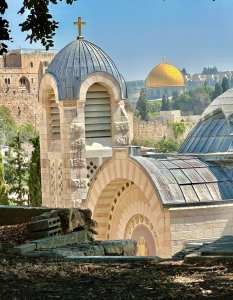
The Temple Mount, Jerusalem

The outbreak of war in the Middle East last Saturday (7 October) is a stark reminder that we are members of a faith community that originated in a region of the world that remains remarkably unstable in 2023 (consider the fact that Judaism, Islam, and Christianity all trace heritage to Abraham!). As we are well aware, political extremism among any people springs from a variety of grievances that may go back generations, and when infused with religious fervor, provides a recipe for violence on a massive scale. Unfortunately, as is always the case, innocent people get caught in the crossfire, people who share the same needs and wants that we do, people who want to earn a living, love their families, and enjoy life. It’s heartbreaking. Let us pray for our brothers and sisters in that part of the world. That said, this link will take you to a good “primer” on what is going on is Israel and Gaza — please take time if you feel a bit lost on the complexities.   

My approach to blog #33 deviates from my normal pattern. There are so many wonderful resources available to us on-line, and I am sharing one with you this week. Here are the Lectionary readings for this week. Thanks for your continued interest in exploring scriptures!   

Readings for Pentecost 20
Isaiah 25:1-9
Psalm 23
Philippians 4:1-9
Matthew 22:1-14

Focus Reading: Philippians 4:1-9
Therefore, my brothers and sisters, whom I love and long for, my joy and crown, stand firm in the Lord in this way, my beloved. I urge Euodia and I urge Syntyche to be of the same mind in the Lord. Yes, and I ask you also, my loyal companion, help these women, for they have struggled beside me in the work of the gospel, together with Clement and the rest of my coworkers, whose names are in the book of life. Rejoice in the Lord always; again I will say, Rejoice. Let your gentleness be known to everyone. The Lord is near. Do not be anxious about anything, but in everything by prayer and supplication with thanksgiving let your requests be made known to God. And the peace of God, which surpasses all understanding, will guard your hearts and your minds in Christ Jesus. Finally, brothers and sisters, whatever is true, whatever is honorable, whatever is just, whatever is pure, whatever is pleasing, whatever is commendable, if there is any excellence and if there is anything worthy of praise, think about these things. As for the things that you have learned and received and heard and noticed in me, do them, and the God of peace will be with you.

This Week’s Reflection: Who Are Euodia and Syntyche?

Euodia and Syntyche

For the past several weeks, I have been focusing on the Gospel readings, and my intention this week was to take a dive into the reading from Philippians, in part, because of the two women mentioned therein, Eudoia and Syntyche, always a curiosity to me. As I began to explore their story, I ran across a terrific essay by Michael Fitzpatrick*, an Episcopal lay teacher and preacher. He does a beautiful job explaining their story! I commend it to your reading — access it here!   

* Fitzpatrick writes for “Journey With Jesus,” a weekly webzine that I often utilize for research as I work on Faithful Conversations (see FC #14). He served for five years in the U.S. Army as a Chaplain’sl lol Assistant, including two deployments to Iraq. 

Soli Deo Gloria

Prayer (inspired by Bob Dylan’s The Times They Are A Changin’)
Lord, you have placed us at a time and place of great change within the Christian Church. We ask that your Holy Spirit walk with us through this challenging period of time, guiding and directing our thoughts and actions as we honor you by transmitting the faith to a new generation. Amen. 

Concordia College Choir, Moorhead, MN

*Note: Bob Dylan’s religious journey is interesting, to say the least. You may want to explore that. My sister Beth introduced me to Dylan back in the 1960s, and this song is one of his best. The Concordia Choir (my Alma Mater) recently has done a unique version of Dylan’s famous song. You can access it here. The second to last line of the song reminded me of this week’s Gospel!  

The Times They Are A-Changin’

Come gather ’round people wherever you roam
And admit that the waters around you have grown
And accept it that soon you’ll be drenched to the bone
If your time to you is worth savin’
Then you better start swimmin’ or you’ll sink like a stone
For the times, they are a-changin’
Come writers and critics who prophesize with your pen
And keep your eyes wide, the chance won’t come again
And don’t speak too soon for the wheel’s still in spin
And there’s no tellin’ who that it’s namin’
For the loser now will be later to win
‘Cause the times, they are a-changin’
Come senators, congressmen, please heed the call
Don’t stand in the doorway, don’t block up the hall
For he that gets hurt will be he who has stalled
‘Cause the battle outside ragin’
Will soon shake your windows and rattle your walls
For the times, they are a-changin’
Come mothers and fathers throughout the land
And don’t criticize what you can’t understand
Your sons and your daughters are beyond your command
Your old road is rapidly aging
Please get out of the new one if you can’t lend your hand
‘Cause the times, they are a-changin’
The line it is drawn, the curse it is cast
The slowest now will later be fast
As the present now will later be past
The order is rapidly fadin’
And the first one now will later be last
‘Cause the times, they are a-changin’
 
Finally . . . one more update regarding our current study: 

What does it mean to be a disciple of Jesus Christ? Join us for an exploration of that question in September and October. We will read and discuss Michael Foss’s book, Real Faith for Real Life: Living the Six Marks of Discipleship. In his book’s introduction, Foss writes: “This book was written to help you grow deep. It was written to help you on your journey of spiritual discovery and renewal.”

We have met twice, and have two remaining sessions — October 11 and 18! All are welcome! 

8 October 2023: Pentecost 19

Faithful Conversations #32

Introduction to Readers: 
Vineyards were part of everyday life in ancient Israel, and the Bible is filled with references to them (a quick google search verifies that). Often, vineyards symbolized the people of God. Stay tuned to that as you explore this week’s readings. My commentary will focus on the Gospel, with references to Isaiah. Thanks for your continued interest in exploring the infinite wisdom of the scriptures!    

Readings for Pentecost 19
Isaiah 5:1-7
Psalm 80:7-15
Philippians 3:4b-14
Matthew 21:33-46

First Reading: Isaiah 5:1-7
I will sing for my beloved my love song concerning his vineyard:

My beloved had a vineyard on a very fertile hill.
He dug it and cleared it of stones and planted it with choice vines;
he built a watchtower in the midst of it and hewed out a wine vat in it;
he expected it to yield grapes, but it yielded rotten grapes.
And now, inhabitants of Jerusalem and people of Judah,
judge between me and my vineyard.
What more was there to do for my vineyard that I have not done in it?
When I expected it to yield grapes, why did it yield rotten grapes?
And now I will tell you what I will do to my vineyard.
I will remove its hedge, and it shall be devoured;
I will break down its wall, and it shall be trampled down.
I will make it a wasteland; it shall not be pruned or hoed,
and it shall be overgrown with briers and thorns;
I will also command the clouds that they rain no rain upon it.
For the vineyard of the Lord of hosts is the house of Israel,
and the people of Judah are his cherished garden;
he expected justice but saw bloodshed;
righteousness but heard a cry!

The Gospel Reading: Matthew 21:33-46
33 “Listen to another parable. There was a landowner who planted a vineyard, put a fence around it, dug a winepress in it, and built a watchtower. Then he leased it to tenants and went away. 34 When the harvest time had come, he sent his slaves to the tenants to collect his produce. 35 But the tenants seized his slaves and beat one, killed another, and stoned another. 36 Again he sent other slaves, more than the first, and they treated them in the same way. 37 Then he sent his son to them, saying, ‘They will respect my son.’ 38 But when the tenants saw the son, they said to themselves, ‘This is the heir; come, let us kill him and get his inheritance.’ 39 So they seized him, threw him out of the vineyard, and killed him. 40 Now when the owner of the vineyard comes, what will he do to those tenants?” 41 They said to him, “He will put those wretches to a miserable death and lease the vineyard to other tenants who will give him the produce at the harvest time.” 42 Jesus said to them, “Have you never read in the scriptures:

‘The stone that the builders rejected
    has become the cornerstone;
this was the Lord’s doing,
    and it is amazing in our eyes’?

43 “Therefore I tell you, the kingdom of God will be taken away from you and given to a people that produces its fruits. 44 The one who falls on this stone will be broken to pieces, and it will crush anyone on whom it falls.” 45 When the chief priests and the Pharisees heard his parables, they realized that he was speaking about them. 46 They wanted to arrest him, but they feared the crowds, because they regarded him as a prophet.

This Week’s Reflection: “The Parable of the Wicked Tenants”

The Face of Jesus (using AI)

There has been much in the news of late about Artificial Intelligence (AI), and the ongoing and revolutionary application of this in our lives. The image to the right is a product of AI, and gives us a realistic sense, based on various probabilities from the ancient Middle East, what Christ may have looked like as he walked this earth. It is a reminder to me of his humanity, a mystery to ponder.    

Jesus, the master teacher, speaks to us across time and his use of stories, often in the form of allegories, is remarkable. In literary terms, an allegory is a “story, poem, or picture that can be interpreted to reveal a hidden meaning, typically a moral or political one” (Wikipedia). For purposes of context, the exchange we witness in this week’s Gospel comes just after the Jewish religious leaders have questioned Jesus concerning his authority. They clearly are disturbed by the young and charismatic spiritual leader, in particular, because of his rising popularity among the people. His defiance of traditional teachings, his radicalism, if you will, cannot stand. As he often did, Jesus offered a parable — one that clearly referenced Isaiah 5 — to highlight disobedience by those that should know better — those same religious leaders — and the consequences of such disobedience.

The Parable of the Wicked Husbandmen by Domenico Fetti, 1620

It went like this. A landowner planted a vineyard, secured it, and made it flourish. He then decided to lease the vineyard to a group of tenants (verse 33). In due time, he sent representatives to collect his produce, but the tenants killed them in an act of wicked and greed-filled defiance. The landowner sent a second group who met the same fate (verses 34-36).   Then, naively it seems, he reasoned that if he sends his son as collector, the tenants surely will respect his authority and give the landowner his due. Alas, the tenants murder the son, thereby eliminating the heir to the property (verses 37-39). A gruesome and tragic story. 

Jesus, of course, does not stop there. Beginning in verse 40, he walks the elders and zealots who are questioning him into a fearful realization — he is talking about them! His reference to Psalm 188:22-23 (verse 42), plays to their scriptural awareness, and cuts them to the quick. In verse 46, we get a window into their future response. 

How should we view this exchange in 2023? It’s easy to stand on the sideline and read this story as a harsh rebuke of the Jewish leaders that rejected Christ. My sense, however, is that is too small and feels like finger-pointing. Jesus is talking to us as well, and we must examine our hearts. How are we responding to him? How are we handling the vineyard in our care?

Soli Deo Gloria

Prayer (inspired by Psalm 80): 

Restore us, O God; let your face shine that we may be saved. You are our source of life, and we are the vineyard. O God; let your face shine that we may be saved. Amen.  

Finally . . . one more update regarding our current study: 

What does it mean to be a disciple of Jesus Christ? Join us for an exploration of that question in September and October. We will read and discuss Michael Foss’s book, Real Faith for Real Life: Living the Six Marks of Discipleship. In his book’s introduction, Foss writes: “This book was written to help you grow deep. It was written to help you on your journey of spiritual discovery and renewal.”

We have met twice, and have two remaining sessions — October 11 and 18! All are welcome! 


1 October 2023: Pentecost 18

Faithful Conversations #31

“Holy Hill” in Black River Falls, Wisconsin

Introduction to Readers:
506 years ago, a 34-year-old Augustinian monk named Martin Luther, rocked the European Christian world when he tacked those 95 Theses on the door of the Castle Church in Wittenberg, Germany. As early as 1519, Luther’s opponents caustically referred to his followers as Lutherans, a term that soon came into common usage. Lutheranism, although not a unified denomination, is one of the five major branches of Protestantism (the others are Anglicanism, Calvinism, Methodism, and the Baptists). In our small city, we live with physical reminders of that rupture in Christendom at the top of what some locals call “Holy Hill.”  

This week’s readings center on the concept of REPENTANCE, and it is noteworthy for us to recall that Luther offered this as Thesis #1 in 1517:  “When our Lord and master Jesus Christ said ‘Repent,’ he intended the entire life of believers to be repentance.” Keep that in your mind as you tackle the Lectionary this week! My commentary will focus on the Gospel, with a reference to the reading from Ezekiel. Thanks for your continued interest in Bible study!    

Readings for Pentecost 18
Ezekiel 18:1-4, 25-32
Psalm 25:1-9
Philippians 2:1-13
Matthew 21:23-32

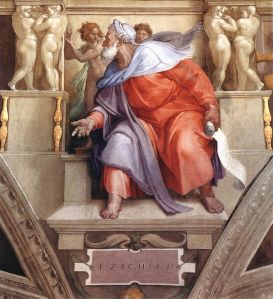
Ezekiel (1510) by Michelangelo (1475-1564) Sistine Chapel in Rome

First Reading: Ezekiel 18:1-4, 25-32
The word of the Lord came to me: What do you mean by repeating this proverb concerning the land of Israel, “The parents have eaten sour grapes, and the children’s teeth are set on edge”? As I live, says the Lord God, this proverb shall no more be used by you in Israel. Know that all lives are mine; the life of the parent as well as the life of the child is mine: it is only the person who sins who shall die. 

25 Yet you say, “The way of the Lord is unfair.” Hear now, O house of Israel: Is my way unfair? Is it not your ways that are unfair? 26 When the righteous turn away from their righteousness and commit iniquity, they shall die for it; for the iniquity that they have committed, they shall die. 27 Again, when the wicked turn away from the wickedness they have committed and do what is lawful and right, they shall save their life. 28 Because they considered and turned away from all the transgressions that they had committed, they shall surely live; they shall not die. 29 Yet the house of Israel says, “The way of the Lord is unfair.” O house of Israel, are my ways unfair? Is it not your ways that are unfair? 30 Therefore I will judge you, O house of Israel, all of you according to your ways, says the Lord God. Repent and turn from all your transgressions; otherwise iniquity will be your ruin. 31 Cast away from you all the transgressions that you have committed against me, and get yourselves a new heart and a new spirit! Why will you die, O house of Israel? 32 For I have no pleasure in the death of anyone, says the Lord God. Turn, then, and live.

The Gospel Reading: Matthew 21:23-32
23 When he entered the temple, the chief priests and the elders of the people came to him as he was teaching and said, “By what authority are you doing these things, and who gave you this authority?” 24 Jesus said to them, “I will also ask you one question; if you tell me the answer, then I will also tell you by what authority I do these things. 25 Did the baptism of John come from heaven, or was it of human origin?” And they argued with one another, “If we say, ‘From heaven,’ he will say to us, ‘Why, then, did you not believe him?’ 26 But if we say, ‘Of human origin,’ we are afraid of the crowd, for all regard John as a prophet.” 27 So they answered Jesus, “We do not know.” And he said to them, “Neither will I tell you by what authority I am doing these things. 28 “What do you think? A man had two sons; he went to the first and said, ‘Son, go and work in the vineyard today.’ 29 He answered, ‘I will not,’ but later he changed his mind and went. 30 The father went to the second and said the same, and he answered, ‘I go, sir,’ but he did not go. 31 Which of the two did the will of his father?” They said, “The first.” Jesus said to them, “Truly I tell you, the tax collectors and the prostitutes are going into the kingdom of God ahead of you. 32 For John came to you in the way of righteousness, and you did not believe him, but the tax collectors and the prostitutes believed him, and even after you saw it you did not change your minds and believe him.

This Week’s Reflection: “A New Heart and a New Spirit”

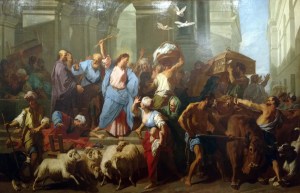
“Driving the Merchants from the Temple”
French artist, Jean Jouvenet (1644–1717)

Jesus rarely found favor with the religious authorities of his day. His exchange with the chief priests and elders in Matthew 21 came on the heels of a dramatic moment in scripture — Christ’s righteous anger and cleansing of the temple (Matthew 21:12-17). Prompted by this disturbing temple performance and expanding following, religious leaders, in a “how dare you!” moment, questioned the source of Jesus’ authority (verse 23). Jesus, clearly frustrated with his inquisitors, responded, as he often did, with an unsettling question and simple story, in this case, the parable of the two sons. It goes like this: A man had two sons and asked the first son to go work in the vineyard. The son refused (verse 29) but later changed his mind and did the work requested by his father. The father then asked the second son to go help in the vineyard, and he said he would (verse 30), but then did not go. Jesus then poses the question to the religious leaders, Which of the two did the will of his father?” (verse 31). The answer was clear — the first son did the will of his father. I’m reminded of that familiar line, “actions speak louder than words.” Jesus followed the story of the two sons with a piercing commentary that must have cut the religious authorities to the quick (verses 31-32). In a stunning reversal of conventional thinking, he let them know that prostitutes and tax collectors — societal outcasts — would enter the Kingdom of Heaven ahead of them! Their disbelief, their dismissal of God’s messenger (John the Baptist), their hypocrisy, was scathingly exposed. In short, their refusal to repent, to turn around, was a roadblock. Jesus’ scolding echoed the words of the prophet Ezekiel: Repent and turn from all your transgressions; otherwise iniquity will be your ruin. Cast away from you all the transgressions that you have committed against me, and get yourselves a new heart and a new spirit!

What should we take away from this challenging exchange? We all can hear different things here, of course, but I’m going to circle back to our fundamental need for repentance as highlighted in Luther’s opening thesis, as cited in my introduction. Listen to these familiar words that are often part of our weekly public confession: 

**Most merciful God, we confess that we have sinned against you in thought, word, and deed, by what we have done, and by what we have left undone. We have not loved you with our whole heart; we have not loved our neighbors as ourselves. We are truly sorry and we humbly repent. For the sake of your Son Jesus Christ, have mercy on us and forgive us; that we may delight in your will, and walk in your ways, to the glory of your Name. Amen.

Those words are worth a hard look. They humble us and bring us to our knees. And though it may seem that repentance is a bit out of style in our 2023 “me-oriented” culture, those words are life-giving and remind us that the path of repentance is a daily exercise, an attitude, that gives us a “new heart and new spirit,” motivating us for action in God’s world.   

Soli Deo Gloria

** The Confession of Sin comes from the English Book of Common Prayer and has been part of the ELCA’s Holy Communion setting for decades. You will find it in the ELW on page 95. 

Prayer (from Psalm 25, the Modern English version): 
To You, O Lord, do I lift up my soul. O my God, I trust in You; may I not be ashamed; may my enemies not triumph over me. Yes, let none who wait on You be ashamed; let them be ashamed who transgress without cause. Make me to know Your ways, O Lord; teach me Your paths. Lead me in Your truth and teach me, for You are the God of my salvation; on You I wait all the day. Remember Your mercies, O Lord, and Your lovingkindness, for they are from old. Do not remember the sins of my youth or my transgressions according to Your lovingkindness remember me, on account of Your goodness, O Lord. Good and upright is the Lord; therefore He will teach sinners in the way. The meek will He guide in judgment, and the meek He will teach His way. Amen. 

Finally . . . an update on our Adult Education/Bible Study at ELC: 

What does it mean to be a disciple of Jesus Christ? Join us for an exploration of that question in September and October. We will read and discuss Michael Foss’s book, Real Faith for Real Life: Living the Six Marks of Discipleship. In his book’s introduction, Foss writes: “This book was written to help you grow deep. It was written to help you on your journey of spiritual discovery and renewal. So it’s more than a book; it is workbook or notebook for the soul. Its pages will invite you to be open to hear the greatest call on earth, the call to Jesus the risen Messiah.” 
We had our initial meeting last week, but there is still time to join!  Remaining meeting dates (Wednesdays from 6:30-7:30) September 27, October 11, and 18) I am leading the study and all are welcome!  We have several books on hand, but you may want your own copy – available at a reasonable cost through Amazon. Feel free to contact me with any questions! Call or text at 715-299-0311.  

24 September 2023: Pentecost 17

Faithful Conversations #30

Introduction to Readers: 
By my count, we have 9 Sundays left in our current church year (Year A on the RCL calendar). Year B (2023-24) will start with the first Sunday in December (Advent). I mention this, in part, because as I get older, time flies.

I ran across this this statement from theologian Frederick Buechner (1926-2022) this week:  “Don’t start looking in the Bible for the answers it gives. Start by listening for the questions it asks.” The readings this week center around the idea of “fairness,” and raise tough questions. Would you agree with me that we all seem to have an innate sense of fairness? As a teacher, for example, it is never good to be accused of being unfair — students and parents will pounce on that in a hurry. Anyway, keep “fairness,” and especially our human notions of it, on your radar screen as you walk through this week’s readings. My commentary will focus on the passage from Jonah. Thanks for your continued interest in Bible study!

Readings for Pentecost 17
Jonah 3:10-4:11
Psalm 145:1-8
Philippians 1:21-30
Matthew 20:1-16

First Reading: Jonah 3:10–4:11
10 When God saw what they did, how they turned from their evil ways, God changed his mind about the calamity that he had said he would bring upon them, and he did not do it. But this was very displeasing to Jonah, and he became angry. He prayed to the Lord and said, “O Lord! Is not this what I said while I was still in my own country? That is why I fled to Tarshish at the beginning, for I knew that you are a gracious and merciful God, slow to anger, abounding in steadfast love, and relenting from punishment. And now, O Lord, please take my life from me, for it is better for me to die than to live.” And the Lord said, “Is it right for you to be angry?” Then Jonah went out of the city and sat down east of the city and made a booth for himself there. He sat under it in the shade, waiting to see what would become of the city. The Lord God appointed a bush and made it come up over Jonah, to give shade over his head, to save him from his discomfort, so Jonah was very happy about the bush. But when dawn came up the next day, God appointed a worm that attacked the bush, so that it withered. When the sun rose, God prepared a sultry east wind, and the sun beat down on the head of Jonah so that he was faint and asked that he might die. He said, “It is better for me to die than to live.” But God said to Jonah, “Is it right for you to be angry about the bush?” And he said, “Yes, angry enough to die.” 10 Then the Lord said, “You are concerned about the bush, for which you did not labor and which you did not grow; it came into being in a night and perished in a night. 11 And should I not be concerned about Nineveh, that great city, in which there are more than a hundred and twenty thousand persons who do not know their right hand from their left and also many animals?”

The Gospel Reading: The Laborers in the Vineyard
20 “For the kingdom of heaven is like a landowner who went out early in the morning to hire laborers for his vineyard. After agreeing with the laborers for a denarius for the day, he sent them into his vineyard. When he went out about nine o’clock, he saw others standing idle in the marketplace, and he said to them, ‘You also go into the vineyard, and I will pay you whatever is right.’ So they went. When he went out again about noon and about three o’clock, he did the same. And about five o’clock he went out and found others standing around, and he said to them, ‘Why are you standing here idle all day?’ They said to him, ‘Because no one has hired us.’ He said to them, ‘You also go into the vineyard.’ When evening came, the owner of the vineyard said to his manager, ‘Call the laborers and give them their pay, beginning with the last and then going to the first.’ When those hired about five o’clock came, each of them received a denarius. 10 Now when the first came, they thought they would receive more; but each of them also received a denarius. 11 And when they received it, they grumbled against the landowner, 12 saying, ‘These last worked only one hour, and you have made them equal to us who have borne the burden of the day and the scorching heat.’ 13 But he replied to one of them, ‘Friend, I am doing you no wrong; did you not agree with me for a denarius? 14 Take what belongs to you and go; I choose to give to this last the same as I give to you. 15 Am I not allowed to do what I choose with what belongs to me? Or are you envious because I am generous?’ 16 So the last will be first, and the first will be last.”

Hurlburt’s Bible Story Book
(First published in 1904)

This Week’s Reflection:

For many of us, Biblical stories from childhood are part of our faith formation. This week’s reading from Jonah triggered a memory of Hurlbut’s Story of the Bible, a staple in the Rykken household (sidebar: I have searched high and low for the book, but it must be packed away somewhere). I suspect the book was the source of many a bedtime story and the illustrations were especially intriguing to me. The story of Jonah being swallowed by the whale, of course, was a favorite and gripped my young imagination. 

“Jonah and the Whale”
Carlo Antonio Tavella (1668–1738)
Flemish Artist

Here’s the backstory. Jonah lived in the 8th century BCE and was called by God to warn the people of Ninevah to repent for their wicked ways. Ninevah was the capital city of the powerful Assyrian Empire, mortal enemy of Israel, and Jonah wanted no part of this Godly calling. He attempted to flee from God by sailing off to the western Mediterranean city of Tarshish. In the course of the stormy voyage, however, Jonah is cast into the sea by his travel companions (at his request, no less) to appease God, and hopefully save the lives of his shipmates. Jonah, alas, is swallowed by a whale and survives for three days in the belly of the great fish, only to be “spewed” onto dry land, a reprieve for the reluctant prophet. The Lord then comes to Jonah a second time with His Ninevah challenge, and Jonah accepts. He walks into the great city, tersely proclaims the Lord’s judgement, and amazingly, the citizens of the ancient city, including the King, repent from their evil ways! This is where we pick up Jonah’s story this week. 

The Lord’s mercy for the citizens of Ninevah is simply too much for Jonah — it was NOT FAIR that God would spare these evil enemies of the Jewish people (4:1-2). In fact, the prophet is so upset that he asks God to take his life (verse 3), a startling moment. God, then, challenges Jonah with one of those piercing questions: “Is it right for you to be angry?” What follows is a curious object lesson for the pouting prophet (verses 5-11) involving a shade bush, a worm, a penetrating east wind, and scorching sun. The Lord impresses on Jonah that he should not be angry over things which he cannot control (the life and death of the bush), and that God’s mercy for the Ninevites surpasses human understanding. Jonah wants justice and condemnation for the Assyrians, but God has other plans.  

What is the message here for us? I suspect all of us want to see good people rewarded and bad people punished. When the opposite occurs, we throw up our hands in disgust. (I can hear my mother’s voice right now, “Life isn’t always fair, Paul!”). God’s compassion for the people of Ninevah (“who do not know their right hand from their left”) illustrates the restorative nature of His justice, and it challenges our sense of fairness. No one is beyond the reach of God’s love, not even those who rattle us to the core, whose lives seem contrary to everything we believe to be right and true. A hard truth, to be sure.

Soli Deo Gloria

A Prayer (inspired by Psalm 145: 1-8)
Lord, we come to you to offer special prayers today and bless your holy name. As we have benefitted from those who taught us the faith, may we declare your mighty acts to the next generation. We often struggle with that work, and we pray for creative insights and authentic motivation that we may bring to bear to that process in 2023 and beyond. You are gracious and merciful, Lord, and abounding and steadfast love — help us to feel that in our hearts. Amen. 

Finally . . . a promo regarding Adult Education/Bible Study at ELC: 

What does it mean to be a disciple of Jesus Christ? Join us for an exploration of that question in September and October. We will read and discuss Michael Foss’s book, Real Faith for Real Life: Living the Six Marks of Discipleship. In his book’s introduction, Foss writes: “This book was written to help you grow deep. It was written to help you on your journey of spiritual discovery and renewal. So it’s more than a book; it is workbook or notebook for the soul. Its pages will invite you to be open to hear the greatest call on earth, the call to Jesus the risen Messiah.” 

Meeting Dates: Wednesdays at 6:30 (September 20, 27 and October 11, and 18) I will be leading the study and all are welcome!  We will order several books, but you may want your own copy – available at a reasonable cost through Amazon. Feel free to contact me with any questions!

17 September 2023: Pentecost 16

Faithful Conversations #29

Introduction to Readers:

September 11, 2010 – World Trade Center Tribute in Light, New York

Twenty-two years ago (Monday) terrorists hijacked planes and used them as missiles in attacks on the WTC in New York City and the Pentagon in Washington, D.C. It’s safe to say they changed the course of history. It’s a day that is seared in my memory, in part, because it was our son’s 17th birthday and, in many respects, changed Jake’s life trajectory. He was among his classmates sitting in my European History class when we learned of the attacks when a colleague breathlessly ran into my room and said, “You need to turn on your TV — something terrible is happening in New York City!” (Sidebar: I was in the midst of a lecture on the life of Martin Luther and the Protestant Reformation at that moment — a strange companion to this memory!). 

This week’s readings focus on the Christian practice of FORGIVENESS and the 9-11 anniversary has been on my mind in that regard. As followers of Christ, how do we respond to evil in our world? Is it possible, for example, for us to forgive those young men who perpetrated those attacks many years ago? What would Jesus say about this? Let’s reflect. 

Readings for Pentecost 16
Genesis 50:15-21
Psalm 103 (1-7)8-13
Romans 14:1-12
Matthew 18:21-35

Psalm 103 (1-7)8-13: Thanksgiving for God’s Goodness

Bless the Lord, O my soul,
    and all that is within me,
    bless his holy name.
Bless the Lord, O my soul,
    and do not forget all his benefits—
who forgives all your iniquity,
    who heals all your diseases,
who redeems your life from the Pit,
    who crowns you with steadfast love and mercy,
who satisfies you with good as long as you live[a]
    so that your youth is renewed like the eagle’s.

The Lord works vindication
    and justice for all who are oppressed.
He made known his ways to Moses,
    his acts to the people of Israel.
The Lord is merciful and gracious,
    slow to anger and abounding in steadfast love.
He will not always accuse,
    nor will he keep his anger forever.
10 He does not deal with us according to our sins
    nor repay us according to our iniquities.
11 For as the heavens are high above the earth,
    so great is his steadfast love toward those who fear him;
12 as far as the east is from the west,
    so far he removes our transgressions from us.
13 As a father has compassion for his children,
    so the Lord has compassion for those who fear him.

The Gospel Reading: The Parable of the Unmerciful Servant
21 Then Peter came to Jesus and asked, “Lord, how many times shall I forgive my brother or sister who sins against me? Up to seven times?” 22 Jesus answered, “I tell you, not seven times, but seventy-seven times. 23 “Therefore, the kingdom of heaven is like a king who wanted to settle accounts with his servants. 24 As he began the settlement, a man who owed him ten thousand bags of gold was brought to him. 25 Since he was not able to pay, the master ordered that he and his wife and his children and all that he had be sold to repay the debt. 26 “At this the servant fell on his knees before him. ‘Be patient with me,’ he begged, ‘and I will pay back everything.’ 27 The servant’s master took pity on him, canceled the debt and let him go. 28 “But when that servant went out, he found one of his fellow servants who owed him a hundred silver coins. He grabbed him and began to choke him. ‘Pay back what you owe me!’ he demanded. 29 “His fellow servant fell to his knees and begged him, ‘Be patient with me, and I will pay it back.’ 30 “But he refused. Instead, he went off and had the man thrown into prison until he could pay the debt. 31 When the other servants saw what had happened, they were outraged and went and told their master everything that had happened. 32 “Then the master called the servant in. ‘You wicked servant,’ he said, ‘I canceled all that debt of yours because you begged me to. 33 Shouldn’t you have had mercy on your fellow servant just as I had on you?’ 34 In anger his master handed him over to the jailers to be tortured, until he should pay back all he owed. 35 “This is how my heavenly Father will treat each of you unless you forgive your brother or sister from your heart.”

This Week’s Reflection: “Authentic Forgiveness: A Transformative Process”  

Every Sunday, and perhaps more often than that, we pray the Lord’s Prayer (known as the Pater Noster in Latin). We most often use this translation: Our Father, who art in heaven, hallowed be thy Name, thy kingdom come, thy will be done, on earth as it is in heaven. Give us this day our daily bread. And forgive us our trespasses, as we forgive those who trespass against us. And lead us not into temptation but deliver us from evil. For thine is the kingdom, and the power, and the glory, for ever and ever. Amen. The origin of this prayer is found in Matthew 6:9-13 and is part of the Sermon on the Mount (there is a shorter version of it in Luke 11:2-4 as well). Interestingly, the version we use actually derives from the Book of Common Prayer, dating to 1549 and the English Reformation, but that’s another story (I got caught up researching that due to the occasional arguments we have regarding what version to use in worship — and the fact that the most common Biblical translations we use simply do not have the word “trespass” in them, but rather the word “debts” — we seem to be fighting over the version from the Book of Common Prayer, and not a Biblical translation!) 

Martin Luther (1483-1546)

The 5th Petition of this familiar part of our worship — Forgive us our trespasses, as we forgive those who trespass against us — is important for our reflections this week and a strong reminder that WE FORGIVE OTHERS BECAUSE GOD FORGIVES US. Luther addressed that in his explanation of the petition in the Small Catechism (Let’s have a, “What Does This Mean?” moment A reminder of Confirmation days perhaps!): “We pray in this petition that our Father in heaven would not look at our sins or deny our prayer because of them. We are neither worthy of the things for which we pray, nor have we deserved them, but we ask that He would give them all to us by grace, for we daily sin much and surely deserve nothing but punishment. So we too will sincerely forgive and gladly do good to those who sin against us.”

“The Unforgiving Servant” 1629 (French)
Claude Vignon (1593–1670)

And that brings us to this week’s Gospel reading, the “Parable of the Unmerciful Servant.” Jesus responds to Peter’s question regarding how FAR WE ACTUALLY GO with forgiveness by sending a radical message — forgiveness is an unending process that dramatically affects both the forgiven, and the one granting forgiveness. To illustrate his point, he offers a story. A king is attempting to settle accounts with his servants. One who owes ten thousand bags of gold — perhaps as much as 15 years of wages for a laborer in that time period — is pressed for payment. The servant begs the King to give him more time, and the King has mercy and simply cancels the debt. Freed from what he owed, however, the very same servant confronts one who owes him a much smaller amount, demanding payment. Showing no mercy, he has the debtor thrown in prison. When the King learns of this situation, he becomes justifiably enraged, relegating the man he had forgiven to prison and torture. Wow! 

As with most of the parables, this one challenges us to the core. The central point Jesus makes is that we forgive others because we have been forgiven by God. Our human nature, of course, gets in the way and forgiveness seems unnatural to us. History is filled with examples of payback and vengeance. And spend any time listening to the political rhetoric of 2023, and it is clear that forgiveness is off in the distance, if present at all.  Forgiveness, yes, is yet another example of the radical and countercultural message of Jesus Christ. In fact, I would argue that our ability to forgive is a miraculous gift and a reminder that we carry within us the image of our Creator. Through authentic forgiveness, both for us and by us, we are liberated and transformed! May we continue to pray for that miracle!    

Soli Deo Gloria

Prayer (inspired by Psalm 103): Lord God, Like a soaring eagle, you renew our strength day to day. Your steadfast love for us is constant, and you forgive our transgressions again and again. Plant in our hearts the capacity to forgive, even those whose evil we cannot comprehend. Amen.   

Our next round of FAITHFUL CONVERSATIONS is coming!: “Real Faith for Real Life!” 

What does it mean to be a disciple of Jesus Christ? Join us for an exploration of that question in September and October. We will read and discuss Michael Foss’s book, Real Faith for Real Life: Living the Six Marks of Discipleship. In his book’s introduction, Foss writes: “This book was written to help you grow deep. It was written to help you on your journey of spiritual discovery and renewal. So it’s more than a book; it is workbook or notebook for the soul. Its pages will invite you to be open to hear the greatest call on earth, the call to Jesus the risen Messiah.”


All are welcome! No prior knowledge necessary! Contact me if you have any questions. Invite a friend!   Meeting Dates:

Wednesdays at 6:30 (September 20, 27 and October 11, and 18)

10 September 2023: Pentecost 15

Faithful Conversations #28

Introduction to Readers: The problem of SIN runs in and through this week’s readings, and I’m reminded of one of my favorite episodes from “The Andy Griffith Show” called The Sermon For Today (I’m dating myself here!). A visiting preacher from New York City (Dr. Breen) comes to Mayberry and warns the parishioners that modern life has simply become too stressful and that they must take a step back from the hustle and bustle and reconnect with a simpler time (hard to imagine that Mayberry was all that stressed out!). As the folks are leaving church and complimenting the visiting pastor, Barney steps forward and compliments him on his sermon on SIN, though Dr. Breen had not mentioned SIN anywhere in the sermon! Barney, apparently, had slept through the sermon, or heard what he expected hear that day! You can watch the clip here, if you want a good laugh! Anyway, as you work your way through the readings, think about the various messages regarding sin and how we deal with it as Christians. My reflections this week will draw, in part, from Ezekiel, Romans, and Matthew.  

Readings for Pentecost 15
Ezekiel 33:7-11
Psalm 119:33-40
Romans 13:8-14
Matthew 18:15-20

Ezekiel (1510) by Michelangelo (1475-1564) Sistine Chapel in Rome

First Reading: Ezekiel 33:7-11
So you, mortal, I have made a sentinel for the house of Israel; whenever you hear a word from my mouth, you shall give them warning from me. If I say to the wicked, “O wicked ones, you shall surely die,” and you do not speak to warn the wicked to turn from their ways, the wicked shall die in their iniquity, but their blood I will require at your hand. But if you warn the wicked to turn from their ways and they do not turn from their ways, the wicked shall die in their iniquity, but you will have saved your life. 10 Now you, mortal, say to the house of Israel: Thus you have said: “Our transgressions and our sins weigh upon us, and we waste away because of them; how then can we live?” 11 Say to them: As I live, says the Lord God, I have no pleasure in the death of the wicked but that the wicked turn from their ways and live; turn back, turn back from your evil ways, for why will you die, O house of Israel?

Second Reading: Romans 13:8-14
Owe no one anything, except to love one another, for the one who loves another has fulfilled the law. The commandments, “You shall not commit adultery; you shall not murder; you shall not steal; you shall not covet,” and any other commandment, are summed up in this word, “You shall love your neighbor as yourself.” 10 Love does no wrong to a neighbor; therefore, love is the fulfilling of the law. 11 Besides this, you know what time it is, how it is already the moment for you to wake from sleep. For salvation is nearer to us now than when we became believers; 12 the night is far gone; the day is near. Let us then throw off the works of darkness and put on the armor of light; 13 let us walk decently as in the day, not in reveling and drunkenness, not in illicit sex and licentiousness, not in quarreling and jealousy. 14 Instead, put on the Lord Jesus Christ, and make no provision for the flesh, to gratify its desires.

The Gospel Reading: Matthew 18:15-20 
15 “If your brother or sister sins against you, go and point out the fault when the two of you are alone. If you are listened to, you have regained that one. 16 But if you are not listened to, take one or two others along with you, so that every word may be confirmed by the evidence of two or three witnesses. 17 If that person refuses to listen to them, tell it to the church, and if the offender refuses to listen even to the church, let such a one be to you as a gentile and a tax collector. 18 Truly I tell you, whatever you bind on earth will be bound in heaven, and whatever you loose on earth will be loosed in heaven. 19 Again, truly I tell you, if two of you agree on earth about anything you ask, it will be done for you by my Father in heaven. 20 For where two or three are gathered in my name, I am there among them.”

This Week’s Reflection:
“There’s never any shortage of sin in the world!” My father, Unk Rykken, voiced that sentiment to me on more than one occasion, usually followed by subtle laughter. The reality of sin in our lives and the lives of others is ever-present, although we often see it more easily in other people than ourselves. This week’s readings offer several insights into our relationship to sin. 

Martin Luther (1483-1546) identified 33:11 as his favorite verse from Ezekiel.

Ezekiel (c. 622-570 BCE) was called to prophesy to the Israelites during the period of the Babylonian Captivity (597-538 BCE), including sternly calling out his countrymen for their transgressions against God (verse 1). What a difficult task Ezekiel had! (Let’s all picture someone standing on the steps of ELC on a Sunday morning, screaming at us as we enter the church, pointing out our failings in God’s sight, calling on us to REPENT! We would think them mentally unbalanced and most likely would sprint the other way!) Clearly, sin is a serious business and not to be lightly dismissed — we cannot hide from its consequences in our world (spend a few moments with any of the Old Testament prophets if you need a reminder).  Yet, take note of verse 11, and God’s desire for us to turn from our sinful nature and LIVE. It is said that this verse was Luther’s favorite from the book of Ezekiel because it pointed out the power of God’s grace (note the picture — he’s making eye contact with you!). Though we have free will, God did not create us to be living miserable lives in the darkness of sin! 

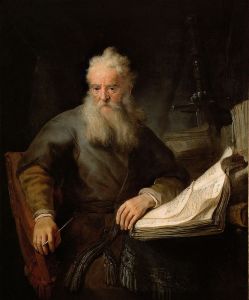
Saint Paul by
Guercino (1591–1666)

In Paul’s letter to the Romans, sin is once again being addressed. It’s important to read this passage through the eyes of those who were steeped in the laws of Judaism. As Dan Clendenin points out in a recent posting (Journey With Jesus, 3 September 2023), there are 613 commandments in the Torah (the first five books of the OT). Can you imagine attempting to follow that many commandments? An impossible task, for sure. The radical message of Jesus, as voiced by Paul in Romans 13, is simply this: by loving our neighbor as ourselves, all the commandments are fulfilled! The simplicity is both overwhelming and entirely liberating. This idea — loving our neighbor as ourselves — was not new within the Jewish community. In fact, it can be traced back 3,000 years (note Leviticus 19:18). What was NEW, as noted by Clendenin, was Jesus’ emphatic demonstration of God’s love, extending it to every person he met, including those wayward souls that so often accompanied him.     

Finally, Jesus’ words in Matthew’s Gospel reading address the issue of sin-driven conflict within the body of believers. This is one of those hard subjects that most of us would rather avoid. As I read (and reread) this passage, two things struck hard. First, verse 18 is truly thought provoking:  Truly I tell you, whatever you bind on earth will be bound in heaven, and whatever you loose on earth will be loosed in heaven. In other words, the relationships we have with other believers have an eternal quality to them — they matter and matter deeply! Second, Christ’s advice regarding handling conflict is deeply practical and matter of fact. Step One: If someone has sinned against me, point out the fault to them in private (verse 15). Step Two: If the person does not listen, take two or three people along as witnesses and have the discussion again (verse 16). Step Three: If the person still refuses to listen, point out the wrongdoing to the entire body of believers (verse 17). At that point, if they will not listen and accept fault, “let such a one be to you as a gentile and a tax collector” (verse 17). (Sidebar: this last statement by Jesus seems especially ironic due to the fact that he clearly spent time with gentiles and tax collectors!). 

There is much to unpack in this Gospel reading. Jesus offers a template for dealing with conflict that seems infused with love, respect, and the preservation of dignity. He prompts us to engage with those who may have harmed us with kindness and discretion, but also with firm honesty. He reminds us that relationships within the body of Christ matter and that something affecting a part of the body impacts the whole. We are one in Christ. He suggests that there may be conflicts that are beyond resolution, and that we may need to accept that. These are hard things, but powerful in application.

Finally, as an educator for all of my adult life, I have had to deal with my share of conflict. A significant mentor from my early years of teaching, helped me understand the difference between REACTING and RESPONDING in situations involving conflict with others. It is tempting to REACT quickly and emotionally to perceived harm, but it is much healthier, and perhaps more challenging, to take a breath, take a step back, and RESPOND with firm compassion (think “tough love”). My sense is that is what Jesus is telling us here. Would you agree with me that in our conflict-filled world of 2023 we could use more of that approach?        

Soli Deo Gloria

Prayer (inspired by Psalm 119:33-40):
Heavenly Father, we pray for a deeper understanding of your ways. Help us to get beyond our selfish approach to life, and to turn to you for direction. Lead us, Lord, on the path that is guided by your commandments. We ask this in your strong and loving name, Amen.   

A REMINDER about our next round Adult Education/Bible Study at ELC: 

What does it mean to be a disciple of Jesus Christ? Join us for an exploration of that question in September and October. We will read and discuss Michael Foss’s book, Real Faith for Real Life: Living the Six Marks of Discipleship. In his book’s introduction, Foss writes: “This book was written to help you grow deep. It was written to help you on your journey of spiritual discovery and renewal. So it’s more than a book; it is workbook or notebook for the soul. Its pages will invite you to be open to hear the greatest call on earth, the call to Jesus the risen Messiah.”     


Meeting Dates: Wednesdays at 6:30 (September 20, 27 and October 11, and 18)

I will be leading the study and all are welcome!  We will order several books, but you may want your own copy – available at a reasonable cost through Amazon. Feel free to contact me with any questions!   

3 September 2023: Pentecost 14

Faithful Conversations #27

Hope Soup Kitchen, Anchorage, Alaska

Introduction: Gratitude for a “Working Spiritual Retreat” 
MaryBeth and I enjoyed our mission trip to the 49th state and returned to Wisconsin thankful to have seen the miraculous beauty of the region, as well as the darker side of Alaska. The brokenness of many of those we encountered throughout the week was overwhelming, yet empowering at the same time. The Holy Spirit is truly at work within the lives of so many people who commit their time and energy to work with those whose lives are challenging day to day, and we were in awe of what we witnessed in that regard. It will take both of us more time to process the experience! 

And . . . a refresher on our approach to the Lectionary:
Each Wednesday since mid-February, I have been sending out the Revised Common Lectionary readings for the upcoming Sunday. The goal is to become familiar with the RCL by taking some time with our Bibles in hand, and to reflect on the readings prior to our Sunday worship experience, whatever that may look like. I also offer a short reflection on one or more of the readings. I am using a “word-alone” approach to the readings, and purposely not being over-reliant on commentaries (sidebar: I include the readings here that provide the basis for my reflections). The blog is a work-in-progress and, once again, thanks for your participation!     

Readings for Pentecost 14
Jeremiah 15:15-21
Psalm 26:1-8
Romans 12:9-21
Matthew 16:21-28

Psalm 26: 1-8: Plea for Justice and Declaration of Righteousness
Vindicate me, O Lord, for I have walked in my integrity,
and I have trusted in the Lord without wavering.
Prove me, O Lord, and try me; test my heart and mind.
For your steadfast love is before my eyes, and I walk in faithfulness to you.
I do not sit with the worthless, nor do I consort with hypocrites;
I hate the company of evildoers, and will not sit with the wicked.
I wash my hands in innocence, and go around your altar, O Lord,
singing aloud a song of thanksgiving, and telling all your wondrous deeds.
Lord, I love the house in which you dwell, and the place where your glory abides.

Gospel Reading: Matthew 16:21-28: Jesus Foretells His Death and Resurrection
21 From that time on, Jesus began to show his disciples that he must go to Jerusalem and undergo great suffering at the hands of the elders and chief priests and scribes and be killed and on the third day be raised. 22 And Peter took him aside and began to rebuke him, saying, “God forbid it, Lord! This must never happen to you.” 23 But he turned and said to Peter, “Get behind me, Satan! You are a hindrance to me, for you are setting your mind not on divine things but on human things.” 24 Then Jesus told his disciples, “If any wish to come after me, let them deny themselves and take up their cross and follow me. 25 For those who want to save their life will lose it, and those who lose their life for my sake will find it. 26 For what will it profit them if they gain the whole world but forfeit their life? Or what will they give in return for their life? 27 “For the Son of Man is to come with his angels in the glory of his Father, and then he will repay everyone for what has been done. 28 Truly I tell you, there are some standing here who will not taste death before they see the Son of Man coming in his kingdom.”

This Week’s Reflection: 
This week’s readings have prompted me to reflect on the practice of OBEDIENCE in our Christian journey. Derived from the Latin, “obedire,” to obey means to serve, pay attention to, to give ear.  My impression of OBEDIENCE is that the concept (perhaps) was more important — or more consistently present — to prior generations. We live in a culture that is obsessed with personal freedom on so many levels, and OBEDIENCE to a higher power, something outside of ourselves, flies in the face of that. Indeed, OBEDIENCE seems old-fashioned, too restrictive, and far too limiting. 

It’s hard to miss the emphasis on OBEDIENCE in this week’s readings. In Psalm 26, for example, David responds to God’s steadfast love for him by walking “in faithfulness” and “integrity” (I love the phrase, “walked in my integrity” in verse 1, suggesting living the life of faith). Read that portion of Psalm 26 again with that in mind. (And, by the way, the passage from Romans offers an excellent primer on what the Christian walk should look like!). 

Saint Peter (Italian 1650)
Artist: Guercino (1591–1666)

More dramatic, however, is the powerful exchange between Jesus and the disciples in Matthew’s Gospel. This episode comes after that lofty moment in which Peter identifies Jesus as the Messiah, followed by Jesus blessing Peter and foretelling the building of his church on earth (verses 16-20). Jesus then offers those harsh words regarding his future suffering and death, not something the disciples wanted to hear. The ever impulsive Peter rebukes Jesus and says that “must never happen” (verses 21-22). Then, in an unusually harsh tone, Jesus calls Peter out: “Get behind me Satan! You are a stumbling block to me; for you are setting your mind not on divine things but on human things” (verse 23). He then tells his band of followers they must “take up their cross” and be willing to lose their lives for the Messiah (verses 24-25). I must admit, I feel sympathy for Peter at this chilling moment. Like us, he was limited by the reality of his time, and he (and others) expected Christ to resemble an earthly king. They could not wrap their minds around this amazing companion of theirs suffering and dying in such a humiliating way — it didn’t fit with their worldview. And, I suspect, the message Jesus offered had not yet fully penetrated their hearts. As 21st Century Christians, we live with the benefit of hindsight, and it’s good to remind ourselves that the disciples were experiencing Christ in the flesh, in real time.  Unlike us, they did not know the end of the story of his earthly life yet, nor the miracle of his resurrection.

1568 Engraving by G.B. Cavalieri (1525-1601)

What lesson should we draw from this exchange and how should it inform our thinking in 2023? It is uncomfortable, to be sure, to contemplate “taking up the cross” and further, hard for me to grasp as one who lives in a society where I am not in danger of being persecuted for my faith (certainly, there are Christians around the globe who actually are!). Perhaps in our present context, “taking up the cross”  means OBEDIENCE to God, checking our own ego, being open to the word, and allowing the Holy Spirit to work in us, regardless of where that might take us. Perhaps “taking up the cross” means having a heart that is open to the pain of others, to those destitute and broken people in our midst who it is so easy to dismiss. Perhaps “taking up the cross” means to weep for the tragic divisions that continue to tear us apart and to be more deliberate and fearless about offering a Christian presence in our communities and in our world. The world desperately needs that presence. Let us “take up the cross” and walk forward in the light of Christ!

Soli Deo Gloria

Prayer (inspired by the horrific violence that has touched many communities this week):
Lord God, We pray for those that have suffered from gun violence in the past several days in our nation and around the world.  We pray for those who have been killed — may you guard their souls. We pray for those who have lost loved ones, been injured or traumatized — may you grant them healing and hope. We pray for those who perpetrate such violence — may you change their hearts and minds, and may you grant us the power to forgive these broken souls, as difficult as that may be. We ask this in your strong and loving name, Amen.    

Finally . . . a promo regarding our next round of Adult Education/Bible Study at ELC: 

What does it mean to be a disciple of Jesus Christ? Join us for an exploration of that question in September and October. We will read and discuss Michael Foss’s book, Real Faith for Real Life: Living the Six Marks of Discipleship. In his book’s introduction, Foss writes: “This book was written to help you grow deep. It was written to help you on your journey of spiritual discovery and renewal. So it’s more than a book; it is workbook or notebook for the soul. Its pages will invite you to be open to hear the greatest call on earth, the call to Jesus the risen Messiah.”     

Meeting Dates: Wednesdays at 6:30 (September 20, 27 and October 11, and 18)

I will be leading the study and all are welcome!  We will order several books, but you may want your own copy – available at a reasonable cost through Amazon. Feel free to contact me with any questions!

13 August 2023: Pentecost 11

Faithful Conversations #26

Introduction to Readers:
“I fear for our country right now — there is so much division!” A friend of mine offered this somewhat jarring statement in the course of a conversation this week. His words are on my mind as I experience Sunday’s readings, especially that grinding fear that often pervades our lives. Clearly, my friend simply has reached the point of fatigue with the drumbeat of the daily news (and obsessive focus on the things that divide us), and his anxiety level has risen off the charts. I’m sure many of us have experienced something similar in recent years. In fact, I have talked to many people who simply withdraw from the news, feeling exhausted by all of it. For over 40 years, I have walked young people into the world of history and current events, and there is no question that our current media environment can seem overwhelming. My admonition to them is that we have an obligation to be informed and reflectively engaged in our world, but need to be smart about HOW we are accessing the chaotic information environment — it’s a heavy lift for all of us! That said, I have included a link below that offers a great reflection on how to deal with “the news” from a Christian perspective — you may enjoy it!

One another note by way of introduction .  .  .  .   Beyond today’s blog posting, “Faithful Conversations” will take a pause and return on Wednesday, August 30th. My wife MaryBeth and I are enroute to Alaska later this week as part of a mission trip. We appreciate your prayers! As you will note, I did include the Lectionary Readings for Pentecost 12 and 13 and encourage you to keep going with the process. I also included a link to the Lectionary Blog that is part of the “Living Lutheran” Magazine (digital), that you may want to access for a change of pace!  As always, thanks for your continued interest in the Lectionary!      

Readings for Pentecost 11: 13 August 2023

1 Kings 19:9-18
Psalm 85:8-13
Romans 10:5-15
Matthew 14:22-33

Gospel Reading: Matthew 14:22-33: Jesus Walks on the Water

“Christ walking on the waters” by Virgilio Mattoni (Spanish 19th Century)

22 Immediately he made the disciples get into a boat and go on ahead to the other side, while he dismissed the crowds. 23 And after he had dismissed the crowds, he went up the mountain by himself to pray. When evening came, he was there alone, 24 but by this time the boat, battered by the waves, was far from the land, for the wind was against them. 25 And early in the morning he came walking toward them on the sea. 26 But when the disciples saw him walking on the sea, they were terrified, saying, “It is a ghost!” And they cried out in fear. 27 But immediately Jesus spoke to them and said, “Take heart, it is I; do not be afraid.” 28 Peter answered him, “Lord, if it is you, command me to come to you on the water.” 29 He said, “Come.” So Peter got out of the boat, started walking on the water, and came toward Jesus. 30 But when he noticed the strong wind, he became frightened, and, beginning to sink, he cried out, “Lord, save me!” 31 Jesus immediately reached out his hand and caught him, saying to him, “You of little faith, why did you doubt?” 32 When they got into the boat, the wind ceased. 33 And those in the boat worshiped him, saying, “Truly you are the Son of God.”

“Christ Walking on Water” by Sara Kirkeberg Raugland (Trefoldighed Church, Battle Lake, MN)

This Week’s Reflection: “Walking in Two Worlds” 

I have a vivid childhood memory of visiting a country church somewhere (although not Battle Lake) that featured the scene from this week’s Gospel on the front altar. It powerfully captured my childlike imagination, and, as they say, spoke “a thousand words.” The story of Christ walking on the water in the midst of a violent storm is found in two other Gospels (Mark 6 and John 6), but Peter’s attempt to do likewise is only chronicled in Matthew.

Remember the context. After the feeding of the five thousand (last week’s Gospel), Jesus goes into the mountains to pray (recall he wanted to do that earlier), sending the disciples across the Sea of Galilea in a boat. By nightfall, they are navigating a terrible storm, and at dawn’s light, with winds yet howling, see a figure walking toward them on the water. Not surprisingly, the disciples believe they are seeing a ghost. Jesus, however, identifies himself and utters that stirring line in verse 27, “Take heart, It is I; do not be afraid” (sidebar: according the Biblical scholars, the most commonly repeated phrase in the Bible is some version of “do not be afraid,” “fear not,” or “have no fear”). It’s at that point in the story that the ever impetuous Peter, wants proof of Jesus’ identity (verse 28). He challenges Jesus to enable him to walk on the water as well, and we know how that ended. Ultimately, Christ saves Peter, admonishes him for his doubt, and joins the disciples in the boat, at which point the storm ceases. Astonished by what they have witnessed, the disciples acknowledge Jesus as “Son of God” (verse 33), the first time that phrase is used by his followers. 

What are we to make of this head-spinning story? Let me offer two observations to consider. First, as Christians, we spend our days walking within two worlds simultaneously — our earthly life and God’s Kingdom (perhaps you have heard the statement, we “are in the world, but not of the world”). Fear is a palpable reality in our earthly lives, a truly human emotion — fear of dangerous situations, fear of health crises, fear of the unknown, fear of change, fear of failure, fear of success, fear of others who are not like us, fear of losing people who are close to us, fear of our own death, and fear of the future, just to name a few! Fear can so easily become a predicament, a trap. Like Peter, we want to step out of the boat and move with confidence through the perils of life, relying on God for strength. But, alas, our courage fails, we become distracted, and the choppy waters envelope us. In despair, we cry out, “Lord Save Me!”

Second, though we may falter in our “oh-so human” attempt to walk toward Jesus, he never stops moving in our direction, walking toward us in steadfast love. He continually reminds us of our place in his Kingdom, that we are already there. This powerful promise, sealed by our baptism, strengthens us to face our fears, not recklessly and without care, but with courage derived from our creator: “Take heart, it is I. Do not be afraid.” Let’s spread that message to those who need to hear it!          

Soli Deo Gloria

Prayer (inspired by Romans 10: 5-15)
Lord God, You assure us that if we call on your name and follow you, we will receive salvation, that your love is for all people, regardless of differences. Strengthen us to be fearless witnesses for you in our communities, enabling more people to hear of your great love for them. Amen. 

Postscript: Here’s the link I mentioned in the introduction today:  
Peggy Haslar: Books Before Newsbites: Curating the News with C.S. Lewis and Dorothy Day (“Sparrowfare” Blog) 

And . . . here are the readings for Pentecost 12 and 13:  

Readings for Pentecost 12: 20 August 2023

Isaiah 56: 1, 6-8
Psalm 67
Romans 11: 1-2a, 29-32
Matthew 15: (10-20) 21-28

Readings for Pentecost 13: 27 August 2023

Isaiah 51: 1-6
Psalm 138
Romans 12: 1-8
Matthew 16: 13-20

And, here is the link to the ELCA Lectionary Blog!

The most recent blog is located in the upper left, just below the big “Living Lutheran” sign.


6 August 2023: Pentecost 10

Faithful Conversations #25

Introduction to Readers: For those of us walking the Christian road in 2023, our current environment presents significant challenges. I stumbled on two articles in The Atlantic in the past week worth mentioning here. The first one, “Will the Christian Church Survive?”, caught my eye because it appeared (wait for it) in October of 1942 — 81 years ago! Concerns about the future of the church are apparently not new! And, a second one in the most recent edition of the magazine — “The Misunderstood Reason Millions of Americans Stopped Going to Church.” Within his compelling analysis, author Jake Meador makes the following assertion: “Contemporary America simply isn’t set up to promote mutuality, care, or common life. Rather, it is designed to maximize individual accomplishment as defined by professional and financial success. Such a system leaves precious little time or energy for forms of community that don’t contribute to one’s own professional life or, as one ages, the professional prospects of one’s children.” Meador’s comments focused on a recent book by Jim Davis and Michael Graham (“The Great Unchurching”), and his words remind me that we live and work within a faith experience that is counter-cultural to its core. Dwell on that idea as you work your way through this week’s readings! Thanks for your continued interest in the Lectionary! My reflections will focus on this week’s Gospel reading from Matthew.   

Readings for Pentecost 10
Isaiah 55:1-5
Psalm 145:8-9, 14-21
Romans 9:1-5
Matthew 14:13-21

The Gospel: Matthew 14:13-21: The Feeding of the Five Thousand
13 Now when Jesus heard this, he withdrew from there in a boat to a deserted place by himself. But when the crowds heard it, they followed him on foot from the towns. 14 When he went ashore, he saw a great crowd, and he had compassion for them and cured their sick. 15 When it was evening, the disciples came to him and said, “This is a deserted place, and the hour is now late; send the crowds away so that they may go into the villages and buy food for themselves.” 16 Jesus said to them, “They need not go away; you give them something to eat.” 17 They replied, “We have nothing here but five loaves and two fish.” 18 And he said, “Bring them here to me.” 19 Then he ordered the crowds to sit down on the grass. Taking the five loaves and the two fish, he looked up to heaven and blessed and broke the loaves and gave them to the disciples, and the disciples gave them to the crowds. 20 And all ate and were filled, and they took up what was left over of the broken pieces, twelve baskets full. 21 And those who ate were about five thousand men, besides women and children.

“The Miracle of Five Loaves and Two Fishes” by Anton Ritter von Perger (1838)

This Week’s Reflection: “The Centrality of Compassion” 
Miraculous stories of Jesus feeding large crowds appear throughout the Gospels. Beyond this week’s text, there is another such story in Matthew (15:32-39), and the Matthew stories are paralleled in Mark (6:32-44 and 8:1-10). Luke (9:10-17) and John (6:1-13) provide similar versions as well. Such stories echo earlier stories from the Jewish experience (see 1 Kings 17:8-16 and 2 Kings 4:42-44). Further, “breaking bread” with others is a common theme throughout Jesus’ first century ministry, and serve as a continual reminder of the Eucharist. 

There are three aspects of story of this week’s Gospel story that bring it alive in my mind. First, unlike the other Gospels, Matthew directly connects the death of John the Baptist (Matthew 14:1-12) with the story of the feeding of the 5,000 (note verse 13). Marilyn Salmon, Professor of New Testament at United Theological Seminary in St. Paul, provides this important insight in her analysis of this text. John’s death, understandably, impacts Jesus and he seeks sanctuary in a “deserted place,” something he often did (sidebar: I have more appreciation for the severity of the desert landscape after a recent visit with our son at Fort Irwin, located in the Mohave Desert!). Jesus needs solitude, but the crowds follow him into the wilderness for healing and hope. Can we see ourselves in that wilderness crowd, a metaphor, perhaps, for those times in our lives when we feel “lost in the desert?” Jesus’ response to the crowd is empowering beyond measure.     

And that leads to my second point.  When I read and reread this week’s Gospel, one phrase (in verse 14) — “he had compassion for them” — jumped out for me. To have compassion for another means to suffer with them, to actually feel their pain. Throughout his ministry, Jesus showed compassion for any and all who typically faced rejection, especially from those in power — children, women, those who were broken in body, mind, or spirit. His compassion was constantly on display (click here for examples). 

Finally, Jesus’ capacity for love and his compassion for the wilderness crowds, illustrates how God’s Kingdom breaks into this world — now! Christ’s example provides a model for us. Recall that when he was questioned by the Pharisees about the coming of the Kingdom, Jesus responded by saying, “The coming of the kingdom of God will not occur with signs that can be observed. Nor will people say, ‘Here it is,’ or ‘There it is.’ For the kingdom of God is in your midst.” (Luke 17:20-21). Yes, we live with the hope of entering God’s Kingdom in the future, but let us remind ourselves each day that the Kingdom is already here!  

Soli Deo Gloria

This Week’s Prayer (inspired by the poem, “Christ Has No Body” by Teresa of Avila (1515-1582):
Lord God, grant us the wisdom and strength to be your eyes and ears and your hands and feet within our communities. Give us eyes of compassion. Amen. 

And, here’s the poem — you can find it (and many others) at Journey With Jesus, a weekly webzine for the global church.  

Christ Has No Body

Christ has no body but yours,
No hands, no feet on earth but yours,
Yours are the eyes with which he looks
Compassion on this world,
Yours are the feet with which he walks to do good,
Yours are the hands, with which he blesses all the world.
Yours are the hands, yours are the feet,
Yours are the eyes, you are his body.
Christ has no body now but yours,
No hands, no feet on earth but yours,
Yours are the eyes with which he looks
compassion on this world.
Christ has no body now on earth but yours.

30 July 2023: Pentecost 9

Faithful Conversations #24

Introduction to Readers: 
Colleague Peter Bushman and I chatted this week about the sequence of readings that comprise the Revised Common Lectionary (RCL) and how those have been determined over time — such subjects come up in the balcony as we are working on tech delivery! Anyway, the Consultation of Common Texts Website is a good go-to for this question. It is wonky and may give you more information than you need, but helpful! Recall that our goal here is to build a greater understanding of the Lectionary and develop a regular engagement in scripture by working through these readings. My reflections this week will focus on the readings from 1 Kings and Romans. Thanks for your continued interest in the Lectionary! 

Readings for Pentecost 9

1 Kings 3:5-12
Psalm 119:129-136
Romans 8:26-39
Matthew 13:31-33, 44-52

“The Dream of Solomon” by Luca Giordano (Italian), 1694

First Reading: 1 Kings 3:5-12
At Gibeon the Lord appeared to Solomon in a dream by night, and God said, “Ask what I should give you.” And Solomon said, “You have shown great and steadfast love to your servant my father David because he walked before you in faithfulness, in righteousness, and in uprightness of heart toward you, and you have kept for him this great and steadfast love and have given him a son to sit on his throne today. And now, O Lord my God, you have made your servant king in place of my father David, although I am only a little child; I do not know how to go out or come in. And your servant is in the midst of the people whom you have chosen, a great people so numerous they cannot be numbered or counted. Give your servant, therefore, an understanding mind to govern your people, able to discern between good and evil, for who can govern this great people of yours?” 10 It pleased the Lord that Solomon had asked this. 11 God said to him, “Because you have asked this and have not asked for yourself long life or riches or for the life of your enemies but have asked for yourself understanding to discern what is right, 12 I now do according to your word. Indeed, I give you a wise and discerning mind; no one like you has been before you, and no one like you shall arise after you.

Second Reading: Romans 8:26-39
26 Likewise the Spirit helps us in our weakness, for we do not know how to pray as we ought, but that very Spirit intercedes with groanings too deep for words. 27 And God, who searches hearts, knows what is the mind of the Spirit, because the Spirit intercedes for the saints according to the will of God. 28 We know that all things work together for good for those who love God, who are called according to his purpose. 29 For those whom he foreknew he also predestined to be conformed to the image of his Son, in order that he might be the firstborn within a large family. 30 And those whom he predestined he also called, and those whom he called he also justified, and those whom he justified he also glorified. 31 What then are we to say about these things? If God is for us, who is against us? 32 He who did not withhold his own Son but gave him up for all of us, how will he not with him also give us everything else? 33 Who will bring any charge against God’s elect? It is God who justifies. 34 Who is to condemn? It is Christ who died, or rather, who was raised, who is also at the right hand of God, who also intercedes for us. 35 Who will separate us from the love of Christ? Will affliction or distress or persecution or famine or nakedness or peril or sword? 36 As it is written,

“For your sake we are being killed all day long;
    we are accounted as sheep to be slaughtered.”

37 No, in all these things we are more than victorious through him who loved us. 38 For I am convinced that neither death, nor life, nor angels, nor rulers, nor things present, nor things to come, nor powers, 39 nor height, nor depth, nor anything else in all creation will be able to separate us from the love of God in Christ Jesus our Lord.

J. Robert Oppenheimer (1904-1967)

This Week’s Reflection: “Decisions, Decisions!”
  
J. Robert Oppenheimer has been on my mind this week, in part, because I saw the new film. Roughly 78 years ago this month, President Truman and his national security team were in the throes of making the most difficult decision in modern history — whether or not to use the “once-tested” atomic bomb on civilian and military targets in Japan in pursuit of hastening the end of World War II in east Asia.  We live with the consequences of that decision every day in 2023. As the leader of the top-secret Manhattan Project in the 1940s, “Oppie,” as his friends knew him, was a central figure in the lead-up to that historic decision (sidebar: a renowned professor at Concordia College during my years there in the 1970s, Carl Bailey, worked on the Manhattan Project as a young man). A brilliant physicist and complex personality, Oppenheimer lived with the torturous ramifications of his work — a series of decisions on his part — until his death in 1967, something that is chronicled in the movie.  His story prompts me to think about the centrality of decision-making in our lives, a theme echoed in this week’s readings from 1 Kings and Romans. Young Solomon’s “dream conversation” with God and request for understanding and discernment, reminds us of the challenges leaders (and regular people!) face in making wise decisions.

“David and Solomon” by Gerard de Lairesse (Northern Netherlands), 1690

First, some backstory on Solomon’s epic life. Recall that he was the son of King David and further, the result of David’s adultery with Bathsheba, the wife of Uriah (if you want the complete story and sordid details on that, consult 2 Samuel, 11-12!). He became King of Israel in 970 BCE upon the death of his father, and ruled until 922. He is most remembered, perhaps, for the construction of the Temple in Jerusalem (completed in 957 BCE) and his great wisdom. In the Judeo-Christian tradition, we associate Solomon with three books of the Old Testament: Proverbs, Ecclesiastes, and Song of Solomon. He is also, by the way, considered a significant figure within Islam.  

Solomon’s request for discernment (verses 6-9) suggests maturity at a young age, and reflects his response to God’s steadfast love and notably, his dependence on God. That word — discernment — comes from the Latin discernēre, meaning to distinguish or judge, and is perhaps a not-so-common skill among those in leadership. It strikes me that discernment often goes hand in hand with humility, and perhaps this is why God was so pleased with Solomon’s request (verse 10)! 

St. Paul echoes Solomon’s dependence on God in his “pep talk” in Romans. We often confront decisions in life that leave us baffled, that require great discernment on our part. Paul reminds us that in those moments we may not even know how to talk to God or what to ask for —  that we may not even know our own minds — but that the Spirit will intercede for us (verse 26). That’s powerfully reassuring! In those moments, we must assume a posture of humility and rely on God. Further, we are guaranteed that “all things work together for good for those who love God” (verse 28), and that NOTHING can separate us from God’s love through Jesus Christ (verses 37-39). That’s a word that we need to hear today!        

Soli Deo Gloria

Prayer (inspired by Psalm 119:129-136)
Lord God, Your unfolding words light our path. In our weakness, you provide great understanding and give us steady steps as we make difficult decisions. We pray for discernment today, Lord. Shine on us with your love. Amen.