Faithful Conversations #30
Introduction to Readers:
By my count, we have 9 Sundays left in our current church year (Year A on the RCL calendar). Year B (2023-24) will start with the first Sunday in December (Advent). I mention this, in part, because as I get older, time flies.
I ran across this this statement from theologian Frederick Buechner (1926-2022) this week: “Don’t start looking in the Bible for the answers it gives. Start by listening for the questions it asks.” The readings this week center around the idea of “fairness,” and raise tough questions. Would you agree with me that we all seem to have an innate sense of fairness? As a teacher, for example, it is never good to be accused of being unfair — students and parents will pounce on that in a hurry. Anyway, keep “fairness,” and especially our human notions of it, on your radar screen as you walk through this week’s readings. My commentary will focus on the passage from Jonah. Thanks for your continued interest in Bible study!
Readings for Pentecost 17
Jonah 3:10-4:11
Psalm 145:1-8
Philippians 1:21-30
Matthew 20:1-16
First Reading: Jonah 3:10–4:11
10 When God saw what they did, how they turned from their evil ways, God changed his mind about the calamity that he had said he would bring upon them, and he did not do it. 4 But this was very displeasing to Jonah, and he became angry. 2 He prayed to the Lord and said, “O Lord! Is not this what I said while I was still in my own country? That is why I fled to Tarshish at the beginning, for I knew that you are a gracious and merciful God, slow to anger, abounding in steadfast love, and relenting from punishment. 3 And now, O Lord, please take my life from me, for it is better for me to die than to live.” 4 And the Lord said, “Is it right for you to be angry?” 5 Then Jonah went out of the city and sat down east of the city and made a booth for himself there. He sat under it in the shade, waiting to see what would become of the city. 6 The Lord God appointed a bush and made it come up over Jonah, to give shade over his head, to save him from his discomfort, so Jonah was very happy about the bush. 7 But when dawn came up the next day, God appointed a worm that attacked the bush, so that it withered. 8 When the sun rose, God prepared a sultry east wind, and the sun beat down on the head of Jonah so that he was faint and asked that he might die. He said, “It is better for me to die than to live.” 9 But God said to Jonah, “Is it right for you to be angry about the bush?” And he said, “Yes, angry enough to die.” 10 Then the Lord said, “You are concerned about the bush, for which you did not labor and which you did not grow; it came into being in a night and perished in a night. 11 And should I not be concerned about Nineveh, that great city, in which there are more than a hundred and twenty thousand persons who do not know their right hand from their left and also many animals?”
The Gospel Reading: The Laborers in the Vineyard
20 “For the kingdom of heaven is like a landowner who went out early in the morning to hire laborers for his vineyard. 2 After agreeing with the laborers for a denarius for the day, he sent them into his vineyard. 3 When he went out about nine o’clock, he saw others standing idle in the marketplace, 4 and he said to them, ‘You also go into the vineyard, and I will pay you whatever is right.’ So they went. 5 When he went out again about noon and about three o’clock, he did the same. 6 And about five o’clock he went out and found others standing around, and he said to them, ‘Why are you standing here idle all day?’ 7 They said to him, ‘Because no one has hired us.’ He said to them, ‘You also go into the vineyard.’ 8 When evening came, the owner of the vineyard said to his manager, ‘Call the laborers and give them their pay, beginning with the last and then going to the first.’ 9 When those hired about five o’clock came, each of them received a denarius. 10 Now when the first came, they thought they would receive more; but each of them also received a denarius. 11 And when they received it, they grumbled against the landowner, 12 saying, ‘These last worked only one hour, and you have made them equal to us who have borne the burden of the day and the scorching heat.’ 13 But he replied to one of them, ‘Friend, I am doing you no wrong; did you not agree with me for a denarius? 14 Take what belongs to you and go; I choose to give to this last the same as I give to you. 15 Am I not allowed to do what I choose with what belongs to me? Or are you envious because I am generous?’ 16 So the last will be first, and the first will be last.”

Hurlburt’s Bible Story Book
(First published in 1904)
This Week’s Reflection:
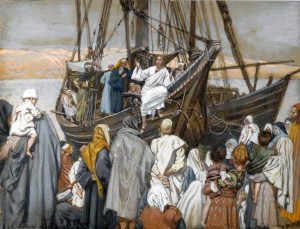
For many of us, Biblical stories from childhood are part of our faith formation. This week’s reading from Jonah triggered a memory of Hurlbut’s Story of the Bible, a staple in the Rykken household (sidebar: I have searched high and low for the book, but it must be packed away somewhere). I suspect the book was the source of many a bedtime story and the illustrations were especially intriguing to me. The story of Jonah being swallowed by the whale, of course, was a favorite and gripped my young imagination.

“Jonah and the Whale”
Carlo Antonio Tavella (1668–1738)
Flemish Artist
Here’s the backstory. Jonah lived in the 8th century BCE and was called by God to warn the people of Ninevah to repent for their wicked ways. Ninevah was the capital city of the powerful Assyrian Empire, mortal enemy of Israel, and Jonah wanted no part of this Godly calling. He attempted to flee from God by sailing off to the western Mediterranean city of Tarshish. In the course of the stormy voyage, however, Jonah is cast into the sea by his travel companions (at his request, no less) to appease God, and hopefully save the lives of his shipmates. Jonah, alas, is swallowed by a whale and survives for three days in the belly of the great fish, only to be “spewed” onto dry land, a reprieve for the reluctant prophet. The Lord then comes to Jonah a second time with His Ninevah challenge, and Jonah accepts. He walks into the great city, tersely proclaims the Lord’s judgement, and amazingly, the citizens of the ancient city, including the King, repent from their evil ways! This is where we pick up Jonah’s story this week.
The Lord’s mercy for the citizens of Ninevah is simply too much for Jonah — it was NOT FAIR that God would spare these evil enemies of the Jewish people (4:1-2). In fact, the prophet is so upset that he asks God to take his life (verse 3), a startling moment. God, then, challenges Jonah with one of those piercing questions: “Is it right for you to be angry?” What follows is a curious object lesson for the pouting prophet (verses 5-11) involving a shade bush, a worm, a penetrating east wind, and scorching sun. The Lord impresses on Jonah that he should not be angry over things which he cannot control (the life and death of the bush), and that God’s mercy for the Ninevites surpasses human understanding. Jonah wants justice and condemnation for the Assyrians, but God has other plans.
What is the message here for us? I suspect all of us want to see good people rewarded and bad people punished. When the opposite occurs, we throw up our hands in disgust. (I can hear my mother’s voice right now, “Life isn’t always fair, Paul!”). God’s compassion for the people of Ninevah (“who do not know their right hand from their left”) illustrates the restorative nature of His justice, and it challenges our sense of fairness. No one is beyond the reach of God’s love, not even those who rattle us to the core, whose lives seem contrary to everything we believe to be right and true. A hard truth, to be sure.
Soli Deo Gloria
A Prayer (inspired by Psalm 145: 1-8)
Lord, we come to you to offer special prayers today and bless your holy name. As we have benefitted from those who taught us the faith, may we declare your mighty acts to the next generation. We often struggle with that work, and we pray for creative insights and authentic motivation that we may bring to bear to that process in 2023 and beyond. You are gracious and merciful, Lord, and abounding and steadfast love — help us to feel that in our hearts. Amen.
Finally . . . a promo regarding Adult Education/Bible Study at ELC:
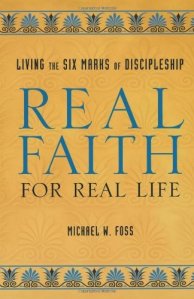 What does it mean to be a disciple of Jesus Christ? Join us for an exploration of that question in September and October. We will read and discuss Michael Foss’s book, Real Faith for Real Life: Living the Six Marks of Discipleship. In his book’s introduction, Foss writes: “This book was written to help you grow deep. It was written to help you on your journey of spiritual discovery and renewal. So it’s more than a book; it is workbook or notebook for the soul. Its pages will invite you to be open to hear the greatest call on earth, the call to Jesus the risen Messiah.”
Meeting Dates: Wednesdays at 6:30 (September 20, 27 and October 11, and 18) I will be leading the study and all are welcome! We will order several books, but you may want your own copy – available at a reasonable cost through Amazon. Feel free to contact me with any questions!



 There is much to unpack in this Gospel reading. Jesus offers a template for dealing with conflict that seems infused with love, respect, and the preservation of dignity. He prompts us to engage with those who may have harmed us with kindness and discretion, but also with firm honesty. He reminds us that relationships within the body of Christ matter and that something affecting a part of the body impacts the whole. We are one in Christ. He suggests that there may be conflicts that are beyond resolution, and that we may need to accept that. These are hard things, but powerful in application.