Faithful Conversations #20
Note to readers:
The Lectionary often presents us with passages that require more than a little background. In college days, my basketball teammates and I would pretend to pound on the glass if we encountered friends in conversation beyond our grasp (“Let me in! Let me in!”). That signaled the need for an explanation, and, of course, always brought a good laugh (so much of our humor was repetitive and it never seemed to get old!). I often find myself pounding on the glass when reading from the Old Testament prophets, and that certainly happened this week while wading through the strange encounter involving Jeremiah and Hananiah. I will drill down on that in my reflections, including a reference to the Gospel reading. Once again, “mange tak” for your continued interest in the spiritual discipline of exploring the Lectionary!
Readings for Pentecost 5:
Jeremiah 28:5-9
Psalm 89:1-4, 15-18
Romans 6:12-23
Matthew 10:40-42
The First Reading: Jeremiah 28:5-9
5Then the prophet Jeremiah spoke to the prophet Hananiah in the presence of the priests and all the people who were standing in the house of the Lord, 6 and the prophet Jeremiah said, “Amen! May the Lord do so; may the Lord fulfill the words that you have prophesied and bring back to this place from Babylon the vessels of the house of the Lord and all the exiles. 7 But listen now to this word that I speak in your hearing and in the hearing of all the people. 8 The prophets who preceded you and me from ancient times prophesied war, famine, and pestilence against many countries and great kingdoms. 9 As for the prophet who prophesies peace, when the word of that prophet comes true, then it will be known that the Lord has truly sent the prophet.”
The Gospel: Matthew 10:40-42
40 “Whoever welcomes you welcomes me, and whoever welcomes me welcomes the one who sent me. 41 Whoever welcomes a prophet in the name of a prophet will receive a prophet’s reward, and whoever welcomes a righteous person in the name of a righteous person will receive the reward of the righteous, 42 and whoever gives even a cup of cold water to one of these little ones in the name of a disciple—truly I tell you, none of these will lose their reward.”
This Week’s Reflection:
The prophetic books of the Old Testament are rich in history and mystery. First, some quick background. In the Judeo-Christian tradition, prophets served as messengers for God who offered warnings of impending doom in the face of idolatry and injustice, summoned people to repentance, and cried out for change. Based on length, there are four Major Prophets (Isaiah, Jeremiah, Ezekiel, and Daniel), and twelve Minor Prophets (Hosea, Joel, Amos, Obadiah, Jonah, Micah, Nahum, Habakkuk, Zephaniah, Haggai, Zechariah, and Malachi). The prophetic books were written over a period of three centuries (760-460 BCE), and centered on Israel’s exile and eventual restoration (click here for a good map if you want some geographic references for context).

“Jews Mourning the Babylonian Exile” by Bendemann, 1832
The prophet Jeremiah (c. 650-570 BCE) came of age in turbulent times, witnessing the fall of the Assyrian Empire and the rise of Babylonian King Nebuchadrezzar. Thousands of Jewish people living in Judah (the southern kingdom) experienced a series of deportations and exile known as the Babylonian Captivity (c. 598-538 BCE). Further, Nebuchadrezzar destroyed the temple in Jerusalem, the center of Israel’s spiritual life built by Solomon in 960 BCE. Ultimately, the surviving exiles were allowed to return to their homeland by the Persian King Cyrus, something prophesied by Jeremiah (you may want to look up Ezra 1:1-3 for a reference to that prophecy!).
Called by God before he was born (noted in Jeremiah 1:4), Jeremiah, a reluctant prophet, interpreted the chaos of these events as Israel’s punishment for unfaithfulness to God and called for repentance. In doing so, he experienced both isolation from family and peers, and derision by his contemporaries. This is the backdrop for this week’s fascinating exchange between Jeremiah and the false prophet, Hananiah.

“Cry of prophet Jeremiah on the Ruins of Jerusalem” by Ilya Repin (1870)
The opening scene in Chapter 28 takes place in 593 BCE, the beginning of the reign of King Zedekiah (c. 618-586 BCE), the last of the kings of Judah prior to the Babylonian Captivity. The prophet Hananiah has come forward to assure the king and other leaders that the captives will be returned within two years (verses 2-4), breaking Nebuchadrezzar’s rule. Jeremiah, in what seems to be a sarcastic tone, questions Hananiah (verses 6-7), while others welcome his prediction. Then, in what must have been an odd moment, Hananiah takes the yoke Jeremiah is wearing (symbolizing the Jewish captivity in Babylon), and breaks it, making the point that this is what God will do to Nebuchadrezzar (verses 10-11). Jeremiah then leaves the scene, but God confronts him, directing him to confront the false prophet Hananiah for his rebellion, foretelling his death (verses 15-16). In a chilling and terse line, we learn that Hananiah dies in a matter of months (verse 17).

The Yoke of Jeremiah — For further background on the symbolism of the yoke, see Jeremiah, Chapter 27.
What are we to make of this ancient story? What is its relevance in 2023? I’m still pounding on the glass, but let’s try these. First, though he takes us out of our comfort zone, we should heed Jeremiah’s words, especially concerning our relationship to God and neighbor (take a few moments and read from chapter 7:1-7, for example). Keeping God first in our lives is essential — idolatry is a serious matter (Jesus, in fact, references Jeremiah 7:11 when he throws the moneychangers out of the temple in Matthew 21). Repentance is required. Treating our neighbors with love and kindness, and pursuing justice for the oppressed — these are fundamental to our lives of faith. Second, there is clearly a lesson here regarding false prophets in our midst. Hananiah told the Jewish leaders what they wanted to hear, perhaps to gain their favor. He did not tell the truth. We live in an information-soaked and social media driven environment today that is rife with falsehoods. As Christians, it is critically important that we remain discerning consumers of the news of the day, and that is a big challenge! There are “Hananiahs” in our midst who assume the prophetic mantle, who cunningly mix religion with politics for their own ends — a not so subtle form of idolatry. And finally, a reminder that we keep Christ at the center as we explore the scriptures. Often misunderstood in their time, the mighty prophets of old, like Jeremiah, glimpsed the future and the coming of the Messiah (we will read more about that next week!). This was the throughline in history and is part of our heritage. That comes to mind as Jesus speaks to us across time in this week’s Gospel, reminding us of his eternal presence: “Whoever welcomes you welcomes me, and whoever welcomes me welcomes the one who sent me.”
Soli Deo Gloria.
Prayer (inspired by Psalm 89 and Matthew 10):
Lord, your steadfast love for us is unending, though we may not always feel deserving of it, and your faithfulness to your creation is as firm as the heavens. Grant us your grace, Lord, that we may courageously stand up for the most vulnerable in our midst with the same steadfast love you have shown us. Strengthen us as ambassadors for you within our communities. Amen.
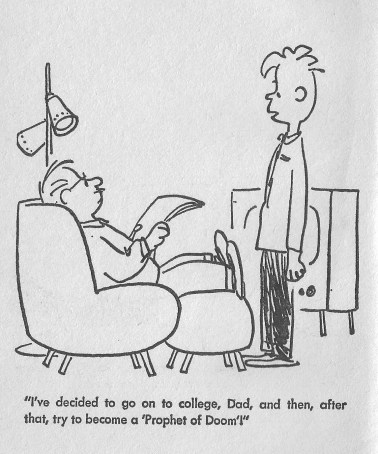
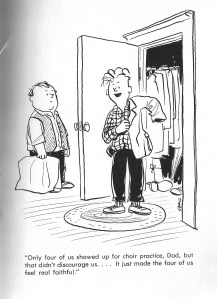
And . . . from my father’s library of humorous books from the 1950s and 60s, I can’t resist sharing this cartoon from Charles Schultz. Yes! The same guy that did Peanuts! This kid clearly has some big ambitions!