Faithful Conversations #10
Readings for the Third Sunday in Easter:
Acts 2: 14a, 36-41
Psalm 116:1-4, 12-19
1 Peter 1: 17-23
Luke 24: 13-35 (Below)
Sunday’s Gospel: Luke 24: 13-35 (On the Road to Emmaus)
13 Now on that same day two of them were going to a village called Emmaus, about seven miles from Jerusalem, 14 and talking with each other about all these things that had happened. 15 While they were talking and discussing, Jesus himself came near and went with them, 16 but their eyes were kept from recognizing him. 17 And he said to them, “What are you discussing with each other while you walk along?” They stood still, looking sad. 18 Then one of them, whose name was Cleopas, answered him, “Are you the only stranger in Jerusalem who does not know the things that have taken place there in these days?” 19 He asked them, “What things?” They replied, “The things about Jesus of Nazareth, who was a prophet mighty in deed and word before God and all the people, 20 and how our chief priests and leaders handed him over to be condemned to death and crucified him. 21 But we had hoped that he was the one to redeem Israel. Yes, and besides all this, it is now the third day since these things took place. 22 Moreover, some women of our group astounded us. They were at the tomb early this morning, 23 and when they did not find his body there they came back and told us that they had indeed seen a vision of angels who said that he was alive. 24 Some of those who were with us went to the tomb and found it just as the women had said, but they did not see him.” 25 Then he said to them, “Oh, how foolish you are and how slow of heart to believe all that the prophets have declared! 26 Was it not necessary that the Messiah should suffer these things and then enter into his glory?” 27 Then beginning with Moses and all the prophets, he interpreted to them the things about himself in all the scriptures.
28 As they came near the village to which they were going, he walked ahead as if he were going on. 29 But they urged him strongly, saying, “Stay with us, because it is almost evening and the day is now nearly over.” So he went in to stay with them. 30 When he was at the table with them, he took bread, blessed and broke it, and gave it to them. 31 Then their eyes were opened, and they recognized him, and he vanished from their sight. 32 They said to each other, “Were not our hearts burning within us while he was talking to us on the road, while he was opening the scriptures to us?” 33 That same hour they got up and returned to Jerusalem, and they found the eleven and their companions gathered together. 34 They were saying, “The Lord has risen indeed, and he has appeared to Simon!” 35 Then they told what had happened on the road and how he had been made known to them in the breaking of the bread.
Today’s Reflection (focusing on the Gospel)
Those of you that have been following the Lectionary Blog for a few weeks realize that I am intrigued with artistic interpretations of Biblical stories. Today’s Gospel, the encounter between Cleopas and an unnamed disciple and Jesus in that seven mile walk between Jerusalem and the village of Emmaus, remains one of my favorite passages in scripture. In part, this is due to an 1877 painting by the Swiss artist Robert Zund. This beautiful piece of artwork hung in one of the parishes my father served in his more than 50 years of ministry — Faith Lutheran Church in West Fargo, North Dakota. I’ll circle back to the painting.
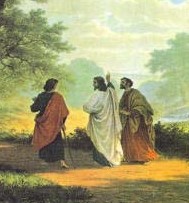 There are eight instances of Christ appearing to people in the forty days after his resurrection recorded in scripture, eight times where people on this earth saw and, in some cases, directly interacted with him. In this week’s Gospel reading, we are walking along a road with Cleopas and his friend, both of whom are feeling dejected and without hope (verse 21). It is Sunday evening, three days after the crucifixion, and they are headed out of Jerusalem to the village of Emmaus. They are attempting to sort out the climactic events of the past several days and we sense their despondency. Versed in the tradition of Judaism, they expected a different sort of Messiah. Jesus’ death, and the fact that they had not seen him, (though some had spoken of his miraculous resurrection) leaves them puzzled and without hope. Suddenly Jesus appears and joins them on the path, though they fail to recognize him. In fact, they are taken aback that this “stranger” has not heard about the dramatic events of recent days. Jesus listens. Then he confronts them with a powerful interpretation of the Hebrew prophecies, clearly identifying himself as the promised Messiah, but they still don’t get it (verses 25-27). As they reach their destination, they invite the stranger to join them since it is late. And, in one of the truly powerful moments in the post-resurrection period, Jesus breaks bread with them, then vanishes. They suddenly realize WHO he is (verse 31) and in their excitement, they rush back to Jerusalem and recount their experience to the eleven disciples. I suspect they covered that seven miles in a hurry!
 Now, back to Robert Zund’s interpretative artwork. Many commentators note that he got the flora and fauna all wrong here. Instead of a Middle Eastern scene, the road to Emmaus is set in what appears to be the countryside of Switzerland, his home. It is a gorgeous setting, and , in fact, resembles the place that you and I live. Perhaps the artist did this with intent. Encounters with Christ can happen anywhere and he meets people, often unexpectedly, wherever they are. (As a sidebar, I have talked with Native American people who have recounted stories of Christ appearing to their ancestors in North America, something that seems entirely plausible to me).
Beyond that, the special appeal of this painting for me is that we are witnessing Christ as teacher. We learn that Cleopas and his unnamed companion do not recognize him (verse 16). Cleopas, by the way, is identified in the Catholic and Eastern Orthodox traditions as the brother of Joseph, which adds an interesting dimension to the story — he is Jesus’ uncle! And, as my father once suggested to me, his companion remains unnamed, perhaps to invite us into the story. He represents us. Christ patiently joins their conversation and gradually leads them to the doorstep of a greater understanding. I’m reminded of that line from Zen philosophy, “When the pupil is ready, the teacher will appear.”
What lessons can we draw from the Emmaus story? Let me suggest three. First, as we walk the path of our lives, encounters with Christ may happen “out of the blue” and we need to be open to them. Second, such encounters happen when we explore and seek understanding of God’s word (remember, Jesus explained the Jewish prophecies) and when we experience Communion on Sunday mornings (remember, Jesus broke bread with them and their eyes were opened!). And third, encounters with Jesus motivate action. Like Cleopas and his friend, we need to share the story with those we encounter! Our eyes have been opened!
Prayer (inspired by 1 Peter 1: 17-23)
Heavenly Father, You are present in our world and have been since even before creation. You have shown us the path for trusting in God — it is clear. We thank you for the gift of faith and our new birth in Christ, and we pray for the insight and motivation to share your abiding love within our community and the wider world. Amen.
Soli Deo Gloria.
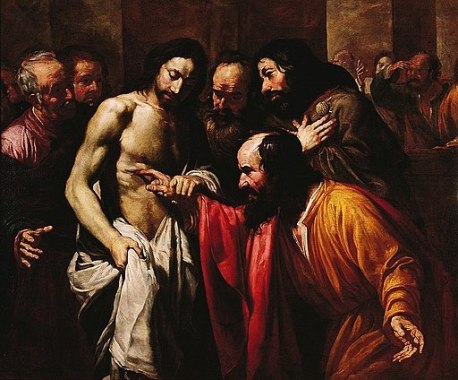

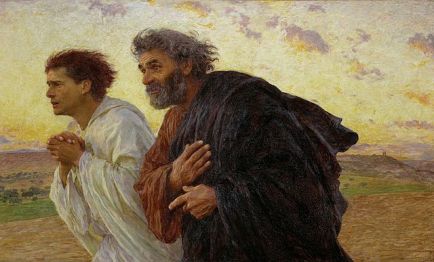

 “Displaying the corpus of Jesus on the cross is a stark visual aid that helps us to more easily focus on the very real sacrifice Jesus offered for us for our salvation . . . Our brothers and sisters of mainline Protestant and non-denominational traditions typically display an empty cross in recognition that Jesus died once and for all for us, and is now risen from the dead. The cross, like the tomb, is empty. We should see these not as opposing viewpoints, but as complimentary emphasis.”



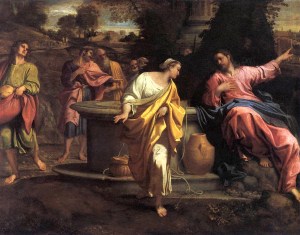 Back to the Samaritan woman. Among Eastern Orthodox churches, she is called by the name Photini and, in fact, is numbered among the Great Martyrs (you may want to explore more about her fascinating story). Though not named in John’s Gospel, her identity as a Samaritan is significant. Jesus and his disciples are traveling from Judea to Galilee and they chose to take the direct route through Samaria. The backdrop here is that Jews and Samaritans, though distant cousins ethnically, were enemies for a variety of reasons, but most notably their differences over the proper place to worship God. Jews viewed Jerusalem as the center of worship, while Samaritans believed it was Mount Gerizim. This argument among spiritual ancestors seems perplexing to us, but it was critically important two thousand years ago.
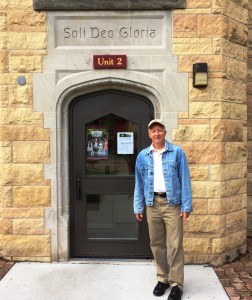 One other personal note about this week’s readings: Psalm 121 is my favorite. It is known as the “The Traveler’s Psalm” and I commend it to your reading this week. My father requested this Psalm for his funeral. He liked to say of this life, “we’re all just traveling through.” I learned after his death, that it had been read at his father’s funeral as well. It is a “tie that binds.”