15 September 2024: Pentecost 17

Faithful Conversations #81
Introduction to Readers:

John Wooden (1910-2010) and Kareem Jabbar
(formerly Lew Alcindor)

As a young basketball player, I was a great admirer of John Wooden — and, actually had the chance to meet him, including a 15-minute conversation in 1978 when he visited Concordia! One of my favorite quotes from Wooden (who was quoting Ghandi) is this: “Live as if you were to die tomorrow. Learn as if you were to live forever.” It seems to me, that’s a good way to think about our lives as Christians — and it applies to studying the Bible! My intention with the FC Lectionary Blog each week is to provide guidance for the four readings, and I do that with great humility. My understanding of scripture is limited, but I know that we need to be persistent about it. Like me, I hope you are not content with staying at a superficial level.

James is in the line-up again this week and I’m gaining more clarity on the epistle. His words do not need a whole lot of explanation, in my mind. This week’s passage, for example, hits hard and is exceedingly relevant in our current political environment! We will come back to James two more times between now and the end of September, so I included this week’s reading in full. My reflections, however, will focus on the passage from Isaiah. Once again, thanks for your visit this week!

The Readings for Pentecost 17
Isaiah 50: 4-9a
Psalm 116: 1-9
James 3: 1-12
Mark 8: 27-38

Common Themes in the Pentecost 17 Readings
The readings for Pentecost 17 emphasize themes of perseverance, humility, and the power of words. In Isaiah 50:4-9a, the prophet speaks of unwavering faith and endurance in the face of opposition, trusting God for vindication. Psalm 116:1-9 reflects a deep gratitude to God for deliverance and the importance of walking in His presence. James 3:1-12 warns about the destructive potential of the tongue, urging believers to speak wisely, while Mark 8:27-38 calls for self-denial, highlighting the cost of discipleship and the importance of aligning one’s life with Christ.

Old Testament Reading: Isaiah 50: 4-9a

The Lord God has given me
a trained tongue,
that I may know how to sustain
the weary with a word.
Morning by morning he wakens,
wakens my ear
to listen as those who are taught.
The Lord God has opened my ear,
and I was not rebellious;
I did not turn backward.
I gave my back to those who struck me
and my cheeks to those who pulled out the beard;
I did not hide my face
from insult and spitting.

The Lord God helps me;
therefore I have not been disgraced;
therefore I have set my face like flint,
and I know that I shall not be put to shame;
he who vindicates me is near.
Who will contend with me?
Let us stand in court together.
Who are my adversaries?
Let them confront me.
It is the Lord God who helps me;
who will declare me guilty?
All of them will wear out like a garment;
the moth will eat them up.

New Testament Reading: James 3: 1-12: Taming the Tongue
Not many of you should become teachers, my brothers and sisters, for you know that we who teach will face stricter judgment. For all of us make many mistakes. Anyone who makes no mistakes in speaking is mature, able to keep the whole body in check with a bridle. If we put bits into the mouths of horses to make them obey us, we guide their whole bodies. Or look at ships: though they are so large and are driven by strong winds, yet they are guided by a very small rudder wherever the will of the pilot directs. So also the tongue is a small member, yet it boasts of great exploits.

How great a forest is set ablaze by a such a small fire! And the tongue is a fire. The tongue is placed among our members as a world of iniquity; it stains the whole body, sets on fire the cycle of life, and is itself set on fire by hell. For every species of beast and bird, of reptile and sea creature, can be tamed and has been tamed by the human species, but no one can tame the tongue—a restless evil, full of deadly poison. With it we bless the Lord[d] and Father, and with it we curse people, made in the likeness of God. 10 From the same mouth comes a blessing and a curse. My brothers and sisters, this ought not to be so. 11 Does a spring pour forth from the same opening both fresh and brackish water? 12 Can a fig tree, my brothers and sisters, yield olives or a grapevine figs? No more can salt water yield fresh.

Soli Deo Gloria! 

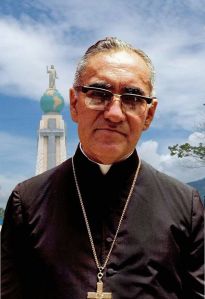
A PRAYER REFELCTION: Remembering Oscar Romero

Oscar Romero
(1917-1980)

A Future Not Our Own

It helps now and then to step back and take a long view.
The Kingdom is not only beyond our efforts,
it is beyond our vision.

We accomplish in our lifetime only a fraction
of the magnificent enterprise that is God’s work.
Nothing we do is complete, which is another way of
saying that the kingdom always lies beyond us.
No statement says all that could be said.
No prayer fully expresses our faith. No confession
brings perfection, no pastoral visit brings wholeness.
No program accomplishes the Church’s mission.
No set of goals and objectives include everything.

This is what we are about. We plant the seeds that one
day will grow. We water the seeds already planted
knowing that they hold future promise.
We lay foundations that will need further development.
We provide yeast that produces effects
far beyond our capabilities.

We cannot do everything, and there is a sense of
liberation in realizing this.
This enables us to do something, and to do it very well.
It may be incomplete, but it is a beginning,
a step along the way, an opportunity for the Lord’s
grace to enter and do the rest.
We may never see the end results, but that is the
difference between the master builder and the worker.

We are workers, not master builders, ministers, not
messiahs. We are prophets of a future not our own.

From Xavarian Missionaries:
Oscar A. Romero, Archbishop of San Salvador, in El Salvador, was assassinated on March 24, 1980, while celebrating Mass in a small chapel in a cancer hospital where he lived. He had always been close to his people, preached a prophetic gospel, denouncing the injustice in his country and supporting the development of popular and mass organizations. He became the voice of the Salvadoran people when all other channels of expression had been crushed by the repression. This poem was composed by Bishop Ken Untener on the anniversary of the martyrdom of Bishop Óscar Romero. 

Join us on Sundays at ELC after the 9:30 worship starting on 15 September for some in-person discussion of the week’s readings. We meet in the library and all are welcome! We learn from each other each week! 

8 September 2024: Pentecost 16

Faithful Conversations #80
Introduction to Readers:

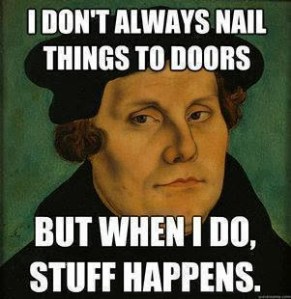
Some Reformation Humor!

Being raised by “cradle to grave” Lutherans (of the Norwegian Lutheran Church to American Lutheran Church to ELCA lineage), James has always inhabited a second-tier status among the New Testament books in my worldview. Luther, as is widely acknowledged, objected to James due to its lack of focus on Jesus Christ and emphasis on “works” righteousness. He referred to it as a “right strawy epistle,” and deemed it inappropriate for use in the religious schools of his day. Indeed, I remember an old religion professor of mine at Concordia getting downright worked up about James in one of his lectures! That said, between now and the end of September (including last Sunday), we encounter James five times in the Lectionary, so I hope to confront my Lutheran biases and give James another look!

Thanks for visiting this space again this week! I hope you feel as challenged as I do walking through the Lectionary! After providing a short summary of common themes among the Pentecost 16 readings, my reflections will focus on the passage from James. Beyond that, we will hear from Henri Nouwen again this week and conclude with a new interpretation of a familiar tune.

(Sidebar: Nikolai Frederik Severin Grundtvig is commemorated in the ELCA this week (2 September), and if you want some background on his life, here is a good link. My sense is that Rollie Lee will appreciate it!  You will find the calendar for “Lesser Festivals and Commemorations” in the ELW, pages 15-17. It’s quite a list!) 

The Readings for Pentecost 16
Isaiah 35: 4-7a
Psalm 146
James 2: 1-10 (11-13) 14-17
Mark 7: 24-37

Common Themes in the Pentecost 16 Readings
The readings for Pentecost 16 emphasize God’s justice, mercy, and the call to live out an inclusive and active faith. Isaiah 35:4-7a speaks of God’s promise to bring healing and transformation, offering hope to those who are weak and oppressed. Psalm 146 praises God as the one who upholds the marginalized, executes justice, and provides for those in need. James 2:1-17 and Mark 7:24-37 challenge believers to reject favoritism, live out their faith through compassionate actions, and recognize the expansive reach of God’s healing and love, which transcends social and cultural boundaries.

Note to Readers: 
I’m including the James reading from Pentecost 15 (last Sunday) to add context to this week’s focus reading from James. Here it is:  

17 Every generous act of giving, with every perfect gift, is from above, coming down from the Father of lights, with whom there is no variation or shadow due to change.18 In fulfillment of his own purpose he gave birth to us by the word of truth, so that we would become a kind of first fruits of his creatures. 19 You must understand this, my beloved brothers and sisters: let everyone be quick to listen, slow to speak, slow to anger, 20 for human anger does not produce God’s righteousness. 21 Therefore rid yourselves of all sordidness and rank growth of wickedness, and welcome with meekness the implanted word that has the power to save your souls. 22 But be doers of the word and not merely hearers who deceive themselves. 23 For if any are hearers of the word and not doers, they are like those who look at themselves in a mirror; 24 for they look at themselves and, on going away, immediately forget what they were like. 25 But those who look into the perfect law, the law of liberty, and persevere, being not hearers who forget but doers who act—they will be blessed in their doing. 26 If any think they are religious and do not bridle their tongues but deceive their hearts, their religion is worthless. 27 Religion that is pure and undefiled before God the Father is this: to care for orphans and widows in their distress and to keep oneself unstained by the world.

Focus Reading: James 2: 1-10 (11-13) 14-17: Warning Against Partiality
My brothers and sisters, do not claim the faith of our Lord Jesus Christ of glory while showing partiality. For if a person with gold rings and in fine clothes comes into your assembly, and if a poor person in dirty clothes also comes in, and if you take notice of the one wearing the fine clothes and say, “Have a seat here in a good place, please,” while to the one who is poor you say, “Stand there,” or, “Sit by my footstool,” have you not made distinctions among yourselves and become judges with evil thoughts? Listen, my beloved brothers and sisters. Has not God chosen the poor in the world to be rich in faith and to be heirs of the kingdom that he has promised to those who love him? But you have dishonored the poor person. Is it not the rich who oppress you? Is it not they who drag you into the courts? Is it not they who blaspheme the excellent name that was invoked over you? If you really fulfill the royal law according to the scripture, “You shall love your neighbor as yourself,” you do well. But if you show partiality, you commit sin and are convicted by the law as transgressors. 10 For whoever keeps the whole law but fails in one point has become accountable for all of it. {11 For the one who said, “You shall not commit adultery,” also said, “You shall not murder.” Now if you do not commit adultery but you murder, you have become a transgressor of the law. 12 So speak and so act as those who are to be judged by the law of liberty. 13 For judgment will be without mercy to anyone who has shown no mercy; mercy triumphs over judgment.} 14 What good is it, my brothers and sisters, if someone claims to have faith but does not have works? Surely that faith cannot save, can it? 15 If a brother or sister is naked and lacks daily food 16 and one of you says to them, “Go in peace; keep warm and eat your fill,” and yet you do not supply their bodily needs, what is the good of that? 17 So faith by itself, if it has no works, is dead.

“Saint James the Less”
Peter Paul Reubens
(1610-1612)

Often as I work on the blog, I am humbled by Alexander Pope’s (1688-1744) famous admonition, a little learning is a dangerous thing. The authorship of the book of James, for example, took me down a rabbit hole. Like other NT books, debates over the actual source have stirred for centuries, so likely I will not solve it here. There are several men named James referenced in the New Testament. Some believe the book was written by James, the brother of Jesus, while others believe a later author simply wrote “in the name of James,” a common practice of the time.

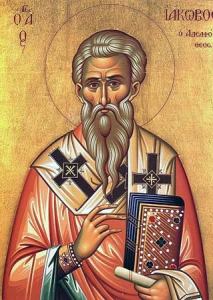
James the Just
Neo-Byzantine Icon
Russian Orthodox Church

And one more thing about his identity. I found this reference to James on the site of a Russian Orthodox Church:  “Saint James the Just, also called James Adelphos and James the Brother of Our Lord (died AD 62), was the first Bishop or Patriarch of Jerusalem. According to the Protoevangelion of James, James was the son of Joseph—along with the other ‘brethren of the Lord’ mentioned in the scripture—from a marriage prior to his betrothal to Mary (another theory! my emphasis). He wrote an epistle which is part of the New Testament. St. James is commemorated on October 23″ (and yes, we commemorate James the Martyr on that day in the ELCA!). 

Major Sidebar — I feel compelled to include this since I married a “Mary,” born to Catholic parents!): The question of whether Mary and Joseph had other children besides Jesus is interpreted differently across Christian traditions. The Catholic and Eastern Orthodox Churches teach that Mary remained a perpetual virgin, meaning she had no other children, and interpret references to Jesus’ “brothers” and “sisters” as either cousins or close relatives. In contrast, many Protestant denominations believe that Mary had additional children based on a literal reading of biblical passages that mention Jesus’ siblings. Luther, owing to his strong Catholic training, held to the perpetual virgin theory and referred to Mary as the “Queen of Heaven.” In fact, he included this statement regarding the “Hail Mary” in his Little Prayer Book: “Let not our hearts cling to her in faith, but through her penetrate to Christ and to God himself. Thus, what the Hail Mary says is that all glory should be given to God, using these words: ‘Hail, Mary, full of grace. The Lord is with you; blessed are you among women and blessed is the fruit of thy body, Jesus Christ. Amen.’ ” (Living Lutheran Magazine, 31 August 2018). I may never hear the “Hail Mary” the same way again after reading this!  

The ELCA, as far as I can tell, does not have an official doctrine on whether Mary had additional children besides Jesus, leaving the interpretation largely to individual belief. The ELCA tends to emphasize the centrality of Scripture and does not require adherence to the doctrine of Mary’s perpetual virginity. Therefore, many within the ELCA are open to the possibility that Mary had other children, interpreting biblical references to Jesus’ “brothers” and “sisters” as literal siblings. However, there is also room for diverse personal beliefs within the denomination, and members are not required to take a specific stance on this issue (not surprising!). 

Regardless of who authored James, the book offers sound advice for practical Christian living and is often compared to Proverbs. The Lutheran Study Bible identifies the following themes in the 108 verses of the book: joy, wisdom, creation, word, first fruits, faith, blessing, growth, and endurance. And I appreciate this sentence from that same introduction: “These themes give powerful encouragement for responsible Christian action amid the complex realities of daily life” (Lutheran Study Bible, page 1992). 

Finally! What about this week’s passage? What should we take away from that? Like so much of this book, it seems straightforward. If we claim to be Christians, and yet show partiality to those who hold power and wealth, we are missing the mark. If we talk a good game, but never show it with our actions, we are empty. So, where was Luther coming down on this? It seems to me, if we could talk to brother Martin, he would say, “Ah, but be careful that you don’t start thinking you can earn salvation by ‘doing this’ or ‘doing that’ — we simply cannot! We all sin and fall short of the Glory of God, and it happens to us every day!” I can see Luther’s point here, but also feel like the words from James could have come from Christ — reread the passage again with that in mind. It is this tension between “faith and works” that we must continually grapple with in our Christian journey. My interpretation of Lutheranism is simply this: I have been given the gift of faith and my salvation is settled — I did nothing to earn it. My response to that, however, is to share the gift, including a greater understanding of it!

Soli Deo Gloria! 

A PRAYER REFELCTION: Henri Nouwen
(Note: The spiritual connection to water referenced in this prayer really hit me — something we can all relate to. Perhaps it’s the river, or a beautiful lake, or “the sea.”) 

Today I thought of the words of Vincent van Gogh: “It is true there is an ebb and flow, but the sea remains the sea.” You are the sea. Although I experience many ups and downs in my emotions and often feel great shifts and changes in my inner life, you remain the same. Your sameness is not the sameness of a rock, but the sameness of a faithful lover. Out of your love I came to life, by your love I am sustained, and to your love I am always called back. There are days of sadness and days of joy; there are feelings of guilt and feelings of gratitude; there are moments of failure and moments of success; but all of them are embraced by your unwavering love. . . . O Lord, sea of love and goodness, let me not fear too much the storms and winds of my daily life, and let me know there is ebb and flow, but the sea remains the sea. Amen. (From the Henri Nouwen Society website’s Daily Meditation, 31 August 2024). 

The Doxology

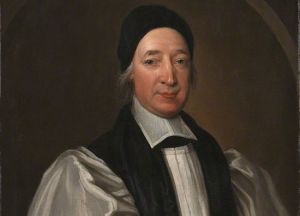
Thomas Ken
(1637-1711)
English Cleric

(Nostalgia Warning! This song takes me back to the many church basements of my youth, or family gatherings where people spontaneously broke into harmony! I found this description of the hymn’s background that you will appreciate. I also appreciate using the expression “Holy Ghost!” The version I posted takes an old hymn and puts a new twist on it — so heartfelt).

Thomas Ken (1637–1711), who crafted these plain and profound words in the late 1600s, wrote them as the final and “doxological” stanza of three hymns he published, first for students at Winchester College at Oxford University. Ken, who was an Anglican minister, royal chaplain, and eventually bishop, first penned verses for his students at Winchester to sing upon arising in the morning, and at bedtime each evening. Later he added a third hymn, to rehearse at midnight, were students to have trouble sleeping. Each hymn was a confession of faith, and an invocation of divine blessing, tailored to its particular moment of the day. And each hymn ended with the same 25-word doxological verse in praise of God, three in one.

Ken’s hymns have by no means been lost today. However, it is his final verse — our beloved “Doxology” — that has endured, so well-known is it that it needs no placeholder in our hymnbooks. Christians the world over simply know it, almost without fail — both Ken’s timeless words and the tune, which Ken did not write, but which much later began to accompany the song. The tune, called Old One-Hundredth, originally designed to accompany the singing of Psalm 134, and later Psalm 100, first appeared in the Geneva Psalter in 1551 and was written by Louis Bourgeois (1510–1561), who served as head of choirs and music, alongside famous pastor and theologian John Calvin.

(Source: desiringGod website: The Best Known Hymn in History)

Join us on Sundays at ELC after the 9:30 worship starting on 15 September for some in-person discussion of the week’s readings. We meet in the library and all are welcome! We learn from each other each week! 

1 September 2024: Pentecost 15

Faithful Conversations #79
Introduction to Readers:

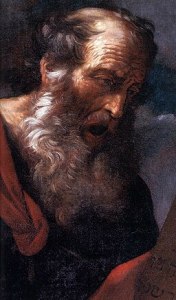
Moses by Italian Painter Guido Reni (1575-1642)

Moses is on my mind this week. The Deuteronomy passage reminded me of Israel’s 40-year desert journey from Egyptian slavery to the promised land. When I learned that story as a boy, it always bothered me that Moses was not allowed to enter! In fact, he was buried in an unmarked grave to eliminate the possibility that any of the Israelites might gather his bones and take them into Canaan (Deuteronomy 34: 5-6). It seemed so patently unfair. But I digress.

I suppose I had thousands of conversations with Unk (my father) while growing up, but certain ones have stayed with me (memory is such a random thing!). One I vividly recall was his explanation of why those Israelites — former slaves — wandered for 40 years — I must have been curious about that. After all, the Sinai Desert was only roughly 120 miles across. He explained to me that the enslaved generation disobeyed God and doubted his promises and therefore could not enter the promised land. They needed to pass away, being replaced by a purified generation with a new mindset. Further, he explained that the wandering was a metaphor for how change often happens in our world — old things must pass away and be replaced by new things, and that often takes a generation or more. As an elder historian fifty years later, that metaphor makes a lot of sense to me, and I will comment further on it in my reflections below.

Thanks for visiting this space again this week! After providing a commentary on the common themes found in the Pentecost 15 readings, I will offer some introduction to the Deuteronomy passage and share a compelling excerpt from a new book by John Philip Newell. I came across the excerpt in Diana Butler Bass’ “The Cottage” a weekly column (“Sunday Musings”) on the lectionary.

One other note: We will be dealing with the book of James five times between now and the end of September, and I plan to get started with that next week. James does not show up in the Lectionary often, so let’s challenge ourselves to learn more about this particular book!   

The Readings for Pentecost 15
Deuteronomy 4: 1-2, 6-9
Psalm 15
James 1: 17-27
Mark 7: 1-8, 14-15, 21-23

Mark the Evangelist by Frans Hals (1583-1666)

Common Themes in the Pentecost 15 Readings
The common themes among the readings for Pentecost 15 focus on the importance of living according to God’s commandments and embodying righteousness in daily life. Deuteronomy 4:1-2, 6-9 emphasizes the significance of observing God’s laws as a testament to wisdom and understanding, urging the Israelites to keep these statutes close to their hearts. Psalm 15 describes the qualities of those who may dwell in God’s sanctuary, highlighting the necessity of leading a blameless life marked by truthfulness, integrity, and justice. James 1:17-27 underscores that every good and perfect gift comes from God, calling believers to be doers of the word, not just hearers, and to practice true religion through care for others and personal purity. Finally, Mark 7:1-8, 14-15, 21-23 addresses the issue of external rituals versus inner purity, teaching that true defilement comes from within, from the evil thoughts and actions of the heart. Together, these readings encourage a faith that is both deeply rooted in God’s teachings and manifested through righteous living.

Focus Reading: Deuteronomy 4: 1-2, 6-9 (New Revised Standard Version)

“So now, Israel, give heed to the statutes and ordinances that I am teaching you to observe, so that you may live to enter and occupy the land that the Lord, the God of your ancestors, is giving you. You must neither add anything to what I command you nor take away anything from it but keep the commandments of the Lord your God with which I am charging you. . . You must observe them and perform them, for this will show your wisdom and discernment to the peoples, who, when they hear all these statutes, will say, ‘Surely this great nation is a wise and discerning people!’ For what other great nation has a god so near to it as the Lord our God is whenever we call to him? And what other great nation has statutes and ordinances as just as this entire law that I am setting before you today? “But take care and watch yourselves closely, so as neither to forget the things that your eyes have seen nor to let them slip from your mind all the days of your life; make them known to your children and your children’s children—

Reflections:  

The View from Mount Nebo
(Effi Schweizer)
Deuteronomy 34: 1-12

The Book of Deuteronomy is the fifth book of the Torah and the Old Testament, serving as a series of speeches by Moses to the Israelites before they enter the Promised Land. Written around 700-640 B.C.E., it reiterates and expounds upon the laws given in previous books, emphasizing the importance of obedience to God’s commandments. (Sidebar: Deuteronomy means Second Law or Repetition of the Law. The book focuses on Moses’ reaffirming and explaining God’s law one final time before his death). Moses reminds the Israelites of their covenant with God and warns them against idolatry and disobedience. The book concludes with Moses blessing the tribes of Israel and his death on Mount Nebo, overlooking the promised land. Prior to this transcendent moment, the Israelites wandered for 40 years in the Sinai Desert. Their wandering — their exile, if you will — perhaps mirrors our own time of transition and disruption within Christianity, something we have often discussed.

And that leads me to this. While researching this week, I stumbled on this excerpt from John Philip Newell’s new book, The Great Search: Turning to Earth and Soul in the Quest for Healing and Home. 

John Philip Newell
(born 1953)

What is the spiritual vision at the heart of our religious inheritance that we have forgotten or neglected? The Spirit is urging us to remember that we are to do to others, including Earth and every species, what we would most want done to us. This is the teaching of Jesus at the heart of our Christian inheritance, with its equivalent in the ‘Golden Rule’ of nearly every great spiritual tradition in the world. It is the teaching that can lead us into new beginnings. In our Great Search of today, we are searching for what will bring healing, not only for ourselves, whether as individuals or nations or races, but for all people and for every species. And it is for all things that we are seeking a new sense of home address, not only physically but spiritually. We are longing for a deeper sense of shared origin and spiritual kinship, including a sense of family responsibility for everything that has being. . . . 

During this time of transition, many of us, as we have been emphasizing, are in religious exile, whether that be literally as fugitives from our religious tradition or simply as dissatisfied members of it, longing for more depth and vision. The modern Scottish poet, Kenneth White, says that “exile is the mark of any deep and far-going creativity.” By this he means that leaving home, whether that be the home territory of our nation or race or religion, either willingly or by force, presents us with the possibility of expanding our vision beyond what it has been. His emphasis is not on what we are losing in exile, which may be painful and unsettling, but on what we are being invited to open to in exile in new and creative ways. And those who are in exile, he adds, will often take with them more of the essential vision of home than what is prevalent in the places they have left. Exile, therefore, whether individually or collectively, can be a time of great openness to new vision and creativity.

This time of spiritual exile in the Western world is a moment in which we are being invited to find relationship with Earth and one another in ways that surpass anything we have known. It is a time of opening to the Spirit in our own depths and the depths of every human being and lifeform. And it can be a time of liberation from the closed boundaries of nationhood or race or religion that have confined us in the past.  .  . Our cherished places of religious authority from the past, including our local churches or temples or mosques, can serve us at this moment in time but only if they remember that the centre of the divine is everywhere. It is deep in my soul and your soul, and it is deep in Earth’s soul and every soul….

Though I am still trying to absorb what Newell is saying here, it made me think that our experience in the Church today — the frustrations we have experienced with declining membership, the shortage of clergy, the various cultural pressures that seem to threaten the faith — is perhaps our “Sinai moment.” We are wandering, sometimes feeling adrift, but in that journey are moving toward something regenerative and exciting! May we continue to pray for insight as we share the story of Jesus with those around us!

Soli Deo Gloria! 

Dutch Theologian
Henri Nouwen
(1932-1996)

A PRAYER REFELCTION: OUR PILGRAMAGE
Detachment is often understood as letting loose of what is attractive. But it sometimes also requires letting go of what is repulsive. You can indeed become attached to dark forces such as resentment and hatred. As long as you seek retaliation, you cling to your own past. Sometimes it seems as though you might lose yourself along with your revenge and hate—so you stand there with balled-up fists, closed to the other who wants to heal you. . . . Praying means, above all, to be accepting of God who is always new, always different. For God is a deeply moved God, whose heart is greater than our own. The open acceptance of prayer in the face of an ever-new God makes us free. In prayer, we are constantly on our way, on a pilgrimage. On our way, we meet more and more people who show us something about the God whom we seek. We will never know for sure if we have reached God. But we do know that God will always be new and that there is no reason to fear.(Source: Daily Meditation, 15 August 2024. The Henri Nouwen Society).

Join us on Sundays at ELC after the 9:30 worship starting on 15 September for some in-person discussion of the week’s readings. We meet in the library and all are welcome! We learn from each other each week! 

25 August 2024: Pentecost 14

Faithful Conversations #78
Introduction to Readers:

Arthur C. Brooks

Spiritual Malaise refers to a deep sense of disconnection with one’s inner self, beliefs, or purpose, accompanied by feelings of emptiness or lack of meaning in life. This concept has been on my mind this week, prompted by Arthur Brooks’ recent article in The Atlantic titled, The Best Therapy for Our Anxiety Epidemic (sidebar: some of you participated in a book study at ELC on Brooks’ book Love Your Enemies). As one who has spent my adult life working with young people, the article is jarring. Let me start with two framing excerpts:

  • To note that a mental-health crisis is hitting American adolescents and young adults is hardly news—data to that effect emerge almost every day. The latest confirmation, in April, comes from a survey that I was grateful to help develop: This major survey, sponsored by the Walton Family Foundation and fielded by Gallup, revealed that some 38 percent of respondents aged 12 to 26 had received a formal diagnosis of anxiety or depression. That finding broke down by gender as 29 percent of young men and 45 percent of young women.
  • Among adolescents and young adults who spent more than 20 hours a week on social media, 65 percent said they felt anxiety “a lot of the day yesterday” (as opposed to 49 percent of those who spent 20 hours or less so engaged); 49 percent of the heavy social-media users felt sadness for a lot of the day before (versus 26 percent of non-heavy users); and 80 percent of them felt a lot of stress (against 59 percent of those other users).

Brooks then drills down on what he considers the central problem driving the anxiety epidemic. While social media is partially to blame, he argues that in a larger sense, young people (and perhaps older people too!) are not being prompted to explore deeper questions about their life’s purpose or meaning. He identifies two questions that he believes are fundamental for all of us to contemplate: Why am I alive? And for what would I give my life? A sustained effort to find answers to those will reveal your life’s coherence, purpose, and significance. Let that sink in. 

This circles me back to Spiritual Malaise. Is the sense of hopelessness apparent among so many in our culture, and notably by young people, related to a crisis of faith? Allow that question to stir your heart and mind as you observe the world around you this week.

Once again, thank you for visiting this space each week, and realize that I come at this process with humility. The more I learn, the more I am confronted by how much I do not know.   We remain in Ordinary Time, the longest phase of the Christian calendar (Good Shepherd Lutheran in Pearl River, New York offers a great explanation of the church calendar here, if you need a refresher). After pointing out common themes in this week’s readings, we will take one more walk into Psalm 34, including connections with the other readings. I have also included a terrific poem that seems especially fitting this week.

The Readings for Pentecost 14
Joshua 24: 1-2a, 14-18
Psalm 34: 15-22
Ephesians 6: 10-20
John 6: 56-69

Common Themes in the Pentecost 14 Readings
Look for these common themes as you work through the Pentecost 14 readings: faithfulness, commitment, and divine protection. In Joshua 24:1-2a, 14-18, the Israelites are called to choose whom they will serve, emphasizing the importance of loyalty to God. Psalm 34:15-22 highlights God’s attentiveness and deliverance for the righteous, reinforcing the theme of divine protection. Ephesians 6:10-20 and John 6:56-69 both focus on spiritual strength and perseverance in the face of challenges, with Ephesians encouraging believers to put on the armor of God and John emphasizing the sustaining power of Christ’s presence through faith.

Focus Reading: Psalm 34: 15-22 (New Revised Standard Version)

15 The eyes of the Lord are on the righteous,
    and his ears are open to their cry.
16 The face of the Lord is against evildoers,
    to cut off the remembrance of them from the earth.
17 When the righteous cry for help, the Lord hears
    and rescues them from all their troubles.
18 The Lord is near to the brokenhearted
    and saves the crushed in spirit.

19 Many are the afflictions of the righteous,
    but the Lord rescues them from them all.
20 He keeps all their bones;
    not one of them will be broken.
21 Evil brings death to the wicked,
    and those who hate the righteous will be condemned.
22 The Lord redeems the life of his servants;
    none of those who take refuge in him will be condemned.

 Reflections:

King David’s Tomb,
Mount Zion, Jerusalem

We have been working with Psalm 34 for three weeks. A quick recap: It is one of seventy-three Psalms attributed directly to King David (Psalm 23 is his most famous). He lived roughly ten centuries before the birth of Christ, and 34 appears to be rooted in a particular episode in David’s journey. The short statement of identification (“Of David, when he feigned madness before Abimelech, so that he drove him out, and he went away.”) references a harrowing story found in 1 Samuel 21 when David fled from Saul and took refuge with the Philistines. He was afraid of King Achish of Gath, pretended to be insane, and ultimately escaped (such a strange story!). In the Psalm, David expresses gratitude to God for deliverance from fear and enemies. He also emphasizes seeking the Lord for protection and sustenance, promising that those who trust in God will not lack any good thing. Finally, he also encourages righteousness, assuring that God is close to the brokenhearted and will ultimately save those who take refuge in Him.

Our focus this week is on verses 15-22. Verse 18, in particular, jumped out at me in light of the Brooks article mentioned in my introduction. Those experiencing anxiety and depression — a sense of spiritual malaise — are certainly “brokenhearted” and “crushed in spirit,” and it saddens me that so many of our young people are living in that space. In verse 17, however, we are assured that God hears us when we “cry for help,” and that he stays near to us — continues to love us — even if we drift apart from him, unable to articulate the cause of our separation. And we are all susceptible to drifting apart. Like those Israelites in dialogue with Joshua in this week’s first reading, we are confronted with numerous “gods” that vie for our attention in our techno-driven society. We may even aggressively walk away from the faith, as some of Jesus’ followers did in this week’s Gospel reading (note John 6:66). The radical nature of his teaching was simply too much for them. Yes, sometimes it’s just easier to walk away. Faith, in my experience, is not a linear journey, but rather is filled with peaks and valleys. It is a daily walk requiring certain disciplines, especially engagement in the Word and prayer, calling us to “be strong in the Lord and in the strength of his power” (Ephesians 6:10). That message needs to be shared and shared widely to a broken world! Keep your ears and eyes open in the days ahead — someone you know needs to hear this message!

Soli Deo Gloria! 
Prayer/ Reflection: “silent god” (edwina Gately)

This is my prayer—
That, though I may not see,
I be aware
Of the Silent God
Who stands by me.
That, though I may not feel,
I be aware
Of the Mighty Love
Which doggedly follows me.
That, though I may not respond,
I be aware
That God—my Silent, Mighty God,
Waits each day.
Quietly, hopefully, persistently.
Waits each day and through each night
For me.
For me—alone.

(Source: Dan Clendenin: dan@journeywithjesus.net, 18 August 2024)

If interested, join us after the 8:30 service at ELC on 25 August for some in-person discussion of this week’s readings. No special expertise or prior knowledge is necessary! all are welcome!

18 August 2024: Pentecost 13

Faithful Conversations #77
Introduction to Readers:

Yin Yang Symbol
The Principle of Balance

2024 is a significant year when it comes to global elections, and it is important to view our own elections in that context. The potential for political violence, as exhibited in our own campaign, remains a significant threat.  The day-to-day news cycle regarding this, prompts me to grapple with a couple questions: Do those of us who walk within a strong faith tradition have a special obligation to engage with the political process? If so, what should that look like? Of course, these are deeply personal questions prompting a range of views. History is filled with multiple examples of horrific episodes when those in political power usurp religion for selfish purposes, so I tend to be wary of that kind of language. On the other hand, as Christians, Jesus’ words and actions certainly should inform all parts of our lives, including our civic lives.  How do we find the balance? I continue to explore — as I have mentioned previously in this space — HOW, as Christians, we can provide another voice in our politics, a voice that needs to be heard.

As mentioned in several previous entries, the ELCA crafts social statements on many societal issues and these are all available for us to read and study. We certainly do not have uniformity of opinion on the various issues that are addressed, nor should we expect that. The social statements are not hastily constructed (in fact, clearly, we study things for a LONG TIME within our denomination — that’s part of our tradition!). This week, for those who are inclined, let me offer a timely resource which I found to be refreshing and hopefulthis article from this month’s Living Lutheran Magazine.  And a heads up, you will find a link to an excellent social message from 2020 included, along with a draft statement on civic life and faith that is being developed for action by the 2025 Churchwide Assembly. There is much to digest in both!

Thanks for visiting this space again this week! After providing a commentary on the common themes found in the Pentecost 13 readings, I will be revisiting Psalm 34 in my reflections (recall that we have three Sundays with this Psalm). I hope and pray that your scriptural exploration continues to go well!

The Readings for Pentecost 13
Proverbs 9: 1-6
Psalm 34: 9-14
Ephesians 5: 15-20
John 6: 51-58

Common Themes in the Pentecost 13 Readings
Look for these themes as you work your way through the Pentecost 13 readings: wisdom, righteous living, and spiritual nourishment. Proverbs 9:1-6 and Psalm 34:9-14 both call for a pursuit of wisdom and a life marked by reverence and moral integrity, suggesting that true understanding leads to fulfillment and peace. Ephesians 5:15-20 further elaborates on living wisely, urging believers to align their actions with divine principles and be filled with the Spirit. John 6:51-58 underscores the necessity of spiritual sustenance through communion with Christ, reinforcing the idea that wisdom and righteous living are sustained by a deep, life-giving relationship with Jesus.

Psalm 34: 9-14: Focus Reading (New Revised Standard Version)

    for those who fear him have no want.
10 The young lions suffer want and hunger,
    but those who seek the Lord lack no good thing.

11 Come, O children, listen to me;
    I will teach you the fear of the Lord.
12 Which of you desires life
    and covets many days to enjoy good?
13 Keep your tongue from evil
    and your lips from speaking deceit.
14 Depart from evil, and do good;
    seek peace and pursue it.

 Reflections: “Let us fear and love god”  

We’re continuing our walk with Psalm 34 this week. A quick recap from last week: Psalm 34 is attributed to King David and dates from roughly 1000 BCE and references a harrowing story found in 1 Samuel 21 when David fled from Saul and took refuge with the Philistines. He was afraid of King Achish of Gath, pretended to be insane, and ultimately escaped. In verses 1-8, David testifies to God’s power and invites the community to join him in praising God. 

This week’s passage (9-14) emphasizes that the fear of the Lord is the starting point for our faith lives. Deeply rooted in the Judeo-Christian tradition, this phrase is used roughly 300 times in the Bible (depending on the translation).  When we think of fear, being afraid — perhaps terrified — comes to mind. But the word has a different meaning in this context and refers to that sense of awe we have in God’s presence. The concept of REVERENCE captures the idea. (Sidebar: Can we all think of people that inspired that feeling in us in our formative years? My basketball coach at Concordia College — Sonny Gulsvig — and my father fit the bill for me in that regard. My respect for them made me want to imitate them, and I certainly never wanted to disappoint them in any way).

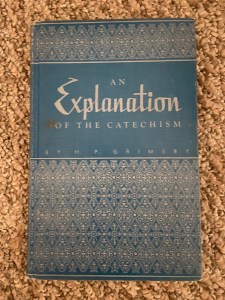
An Explanation of the Catechism
H.P. Grimsby
Augsburg Publishing House, 1941

The phrase also takes me back to my Confirmation days and my rough attempt at memorizing Luther’s Small Catechism. In revisiting some of that material this week, I was reminded that Luther presented the chief parts of the Catechism — the Ten Commandments, the Apostle’s Creed, and the Lord’s Prayer — in that order for a reason. I’m lifting this quote from a wonderful explanation of this in my Lutheran Study Bible: “In 1522, in the preface to the Personal Prayer Book, a forerunner of the Small Catechism, Luther compared this order to recovery from illness. First, one receives the diagnosis (the Ten Commandments), then one is told the source for God’s healing (God’s grace revealed in the Creed), and finally one calls the pharmacist to fill this gracious prescription (Lord’s Prayer).” 

Martin Luther
(1483-1546)

And, now back to that phrase, the fear of the Lord. It is notable that Luther started each of the explanations of the Commandments with the phrase, We are to fear and love God . . . and then offered what we SHOULD NOT DO, followed in each case by WHAT WE SHOULD DO. The explanation of the 8th Commandment, a personal favorite of mine, goes like this (the version I learned in Confirmation): We should fear and love God so that we do not deceitfully belie, betray, backbite, nor slander our neighbor, but apologize for him, speak well of him, and put the most charitable construction on all that he does. Those words have stayed with me for more than 50 years, and just imagine if we applied this approach to our political lives! The point Luther was making, it seems to me, is that the Commandments are not simply “the law,” but also provide a healthy path for living — a point that was brought home to me in one of our recent Sunday morning Lectionary discussions! And, yes, this all starts with our fear of the Lord.

Soli Deo Gloria! 

this week’s Prayer (by Thomas G. Pettepiece)

Note: This prayer jumped out at me during this political season, especially the line, “I need the vision that Jesus gives.” The prayer also fits well with Proverbs 9: 6: “Lay aside immaturity, and live, and walk in the way of insight.” I have added this prayer to my repertoire going forward!

On the Road to Emmaus

My God, thank you for the physical sight to see both light and darkness around me. Thank you too for insight that comes with the vision to tell the difference. I know that my perception of reality, my vision, determines my ability to respond to life, and that the greater my vision, the more fully alive and fully human I can be. Still, I confess that sometimes the smallness of my vision limits my perception of myself, my neighbors, and the world, so that I treat others as less than human and not fully alive — personally, politically, economically, and socially . . . I need the vision that Jesus gives, that sees no difference between sacred and secular, sexual identity and personhood, ethnic group and worth, economic position and dignity, education and value. I need the vision to ask the hard questions and to change my attitude and the structures of society where I can. Because of the sensitivity of sight you give, enable me to stand in awe and wonder at life and its possibilities. Help me kneel in humility to worship you and not myself. Lord, hear me as I say, “Let my eyes be opened.” Amen.

(From Thomas Pettepiece, Visions of a World Hungry. 1979)

If interested, join us after the 8:30 service at ELC on 18 August for some in-person discussion of this week’s readings. No special expertise or prior knowledge is necessary! all are welcome! 

11 August 2024: Pentecost 12

Faithful Conversations #76
Introduction to Readers:

Simone Biles
American Gymnast

Athletics has been an important part of my life since I was very young. Part of what I truly enjoy about the Olympics every four years are the stories of young men and women who overcome tremendous obstacles and persevere. Prompted, in part, by the inspiring story surrounding gymnast Simone Biles, I have been thinking this week about how we should face adversity as Christians. And also, how that becomes part of our Christian witness, or testimony to others.

Psalm 34 pointed me in that direction as well.  The author, King David, a central figure in the Old Testament, faced numerous challenges throughout his life. As a young shepherd, he was anointed by the prophet Samuel to be king, yet he had to contend with the reigning King Saul, who saw David as a threat and pursued him relentlessly. Despite these threats, David demonstrated remarkable resilience and faith. He endured hardships, including betrayal by allies and the challenge of uniting a fragmented kingdom. His trials were not only political but personal, marked by moral failures and family strife. Through it all, David’s unwavering faith in God and his leadership ultimately helped him build a united and prosperous kingdom, leaving a lasting legacy.

As always, thanks for visiting this space again this week and I hope that your Lectionary discipline is holding up. After offering a short summary of themes embodied in this week’s readings, my reflections will center on Psalm 34.

And . . a reminder about those four guiding questions:
What is something new you learned from the reading? (NEW)
What is something that caught your attention or made you think? (REFLECT)
What did you read that relates to other reading you have done? (RELATE)
What would you like to discuss from the reading? (DISCUSS)

The Readings for Pentecost 12
1 Kings 19: 4-8
Psalm 34: 1-8
Ephesians 4: 25 – 5: 2
John 6: 35, 41-51

Quick Take on This Week’s Readings
Listen for the following themes as you work through this week’s readings: divine sustenance, encouragement, and the call to embody Christ-like love. In 1 Kings 19:4-8, Elijah receives nourishment from an angel, allowing him to continue his journey, symbolizing God’s provision during times of despair. Psalm 34:1-8 praises the Lord’s deliverance and goodness, encouraging trust in God’s care. Ephesians 4:25 – 5:2 urges believers to live in truth, kindness, and forgiveness, mirroring God’s love and forgiveness in Christ. John 6:35, 41-51 emphasizes Jesus as the “bread of life,” offering eternal sustenance and the promise of resurrection to those who believe. Together, these passages highlight the importance of spiritual nourishment, trust in God’s providence, and the transformative power of living a life of love and compassion.

Psalm 34: 1-8: Praise for Deliverance from Trouble

Of David, when he feigned madness before Abimelech, so that he drove him out, and he went away.

I will bless the Lord at all times;
    his praise shall continually be in my mouth.
My soul makes its boast in the Lord;
    let the humble hear and be glad.
O magnify the Lord with me,
    and let us exalt his name together.

I sought the Lord, and he answered me
    and delivered me from all my fears.
Look to him, and be radiant,
    so your faces shall never be ashamed.
This poor soul cried and was heard by the Lord
    and was saved from every trouble.
The angel of the Lord encamps
    around those who fear him and delivers them.
O taste and see that the Lord is good;
    happy are those who take refuge in him.

 Reflections: “Adversity and witnessing”

“King David in Prayer”
by Pieter de Grebber
(1600-1653)

General Background: Because it is part of the Lectionary for the next three Sundays, I want to spend some quality time with Psalm 34. It is one of the seventy-three Psalms attributed directly to King David. He may have authored others as well. His authorship reflects his deep spiritual life and complex personal experiences including various trials, deep repentance, and faithfulness. David’s psalms are cherished for their theological depth and emotional authenticity, and they continue to be a source of inspiration and comfort for believers across generations (i.e. Psalm 23). One other point by way of introduction: Psalm 34 is an acrostic poem, a poetic form where each line or stanza begins with a successive letter of the Hebrew alphabet. This form highlights the psalmist’s devotion to God’s Word and served as a mnemonic device to aid in memorization and meditation. (Sidebar: Psalm 119, the longest Psalm, is the best example of this form in the Bible. In Psalm 119, the poem is divided into 22 sections, each corresponding to a letter of the Hebrew alphabet, and each section contains 8 verses that start with that particular letter). 

Historical Context of Psalm 34: David lived roughly ten centuries before the birth of Christ. Psalm 34 appears to be rooted in a particular episode in David’s journey. The short statement of identification (“Of David, when he feigned madness before Abimelech, so that he drove him out, and he went away.”) references a harrowing story found in 1 Samuel 21 when David fled from Saul and took refuge with the Philistines. He was afraid of King Achish of Gath, pretended to be insane, and ultimately escaped. 

Summary of verses 1-8: This section of Psalm 34 begins with David announcing to the reader that he intends to provide testimony concerning God’s power. The word testimony comes from the Latin derivative testis meaning “witness.” He also invites the community to join him in praising God (verses 1-3). In verses 4-6, David vaguely references WHEN he was saved (the Samuel story). In verses 7-8, he recaps God’s goodness for those who seek refuge in Him.

What should we take away from this reading? Let me return to the notion of overcoming adversity and sharing our story with others (witnessing). In my experience (and granted, it is my experience and may be limited or short-sighted), public testimony (witnessing) is not something we are used to doing within the Lutheran tradition. We tend to associate that more with Baptist-oriented denominations. Psalm 34, however, suggests to me that such testimony — particularly regarding powerful examples of God working in our lives, especially in guiding us through adversity — is deeply rooted in scripture. And it seems to me we need to get beyond our bashfulness about this and realize that BY NOT sharing our story of faith with others in an authentic fashion, we are depriving our brothers and sisters in the faith of good news they need to hear!

Soli Deo Gloria! 

** Note: I am indebted, in part, to Eric Mathis, Assistant Professor of Music and Worship at Samford University in Birmingham, Alabama for his interpretation of Psalm 34 this week.  

from henri nouwen: “let god love you the way god wants”

Dutch Theologian
Henri Nouwen
(1932-1996)

I know that true joy comes from letting God love me the way God wants, whether it is through illness or health, failure or success, poverty or wealth, rejection or praise. It is hard for me to say, “I shall gratefully accept everything, Lord, that pleases you. Let your will be done.” But I know that when I truly believe my Father is pure love, it will become increasingly possible to say these words from the heart. Charles de Foucauld once wrote a prayer of abandonment that expresses beautifully the spiritual attitude I wish I had.

Father, I abandon myself into your hands,
do with me what you will.
Whatever you may do, I thank you;
I am ready for all, I accept all.
Let only your will be done in me, and in all your creatures.
I wish no more than this, O Lord.
Into your hands I commend my soul;
I offer it to you with all the love of my heart,
for I love you, Lord, and so need to give myself,
to surrender myself into your hands without reserve,
and with boundless confidence, for you are my Father.

It seems good to pray this prayer often. These are words of a holy man, and they show the way I must go. I realize that I can never make this prayer come true by my own efforts. But the Spirit of Jesus given to me can help me pray it and grow to its fulfillment. I know that my inner peace depends on my willingness to make this prayer my own. (Drawn from the Henri Nouwen Society website: 3 August 2024).

and . . . A good thought regarding prayer this week: 

If you’re like me, it is often helpful to have a pattern for daily prayer. I lifted this from “God-Pause,” a daily reflection available through Luther Seminary (23 July 2024).

One model outline for prayer is the acronym ACTS—Adoration, Confession, Thanksgiving, Supplication. In reverse order: Supplication is easy for us. We have no shortage of wants to bring to God. Thanksgiving is not too difficult, as long as our lives are relatively smooth. Confession is sometimes more difficult for us, as the norm for many is to blame others and not acknowledge our own shortcomings. But, with a little self-awareness, we can take responsibility and admit our shortcomings. And then there is Adoration. It’s important to realize that our ever-present God is also always beyond us. 

we meet for a discussion of the lectionary after church on sundays, and all are welcome! No special expertise or prior knowledge is necessary!
Note: we will not be meeting this sunday, but will resume on 18 August at ELC at 9:40 in the Library! 

4 August 2024: Pentecost 11

Faithful Conversations #75
Introduction to Readers:

The rhythm of our spiritual lives has been on my mind this week, prompted by a couple things. First, in our Lectionary journey, we are eleven Sundays into the twenty-six that make up the season of Pentecost (which runs into late November). It’s a long stretch, and it’s easy to lose focus. And second, we have reached the “dog days of summer,” a phrase often associated with baseball, but with ancient origins. It’s a phase of the year when the heat and humidity run high in the north country, and life slows a bit. As Christians, how should we react when our faith hits a lull, feels distant, or trapped in routine? A good question to ponder.

My coaching background kicks in at this point. I have had the privilege of working with runners for over 40 years, and a favorite phrase within our fraternity is, “Trust the Process!” In other words, hold fast to the disciplines that help you grow as a runner, even when things don’t seem to be progressing. The same could be said about our Christian journey. Spiritual disciplines — prayer, interacting with scripture, communal worship experiences — these are ALL important and open us to the work of the Holy Spirit — and often, it seems, when we least expect it! I cannot tell you the number of times I have had an unexpected revelation on a Sunday morning or in the middle of praying, or when wading through a challenging passage of scripture! And, I might add, such spiritual disciplines are deeply rooted in the Lutheran experience! Keep that thought in mind this week and stay the course!
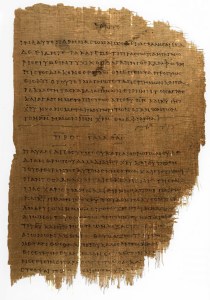
As always, thanks for visiting this space again today! After providing a brief summary of the readings, my reflections will focus on the Ephesians passage. Also, as a sidebar, let me share (again) a four-question approach to reading that can be beneficial (and widely applicable). Our son Jake learned this during his years at West Point in the early 2000s, and I have been utilizing it with my students ever since. It works well with the Lectionary readings — here are the questions: 

What is something new you learned from the reading? (NEW)
What is something that caught your attention or made you think? (REFLECT)
What did you read that relates to other reading you have done? (RELATE)
What would you like to discuss from the reading? (DISCUSS)

The Readings for Pentecost 11
Exodus 16: 2-4, 9-15
Psalm 78: 23-29
Ephesians 4: 1-16 (focus reading)
John 6: 24-35

Quick Take on This Week’s Readings
Look for the themes of divine provision, unity, spiritual nourishment, and faith in this week’s readings. In Exodus 16:2-4, 9-15, we witness God’s provision of manna to the Israelites, emphasizing His care and sustenance even in times of doubt and need. Psalm 78:23-29 recounts that miraculous event, celebrating God’s abundant generosity and faithfulness. Ephesians 4:1-16 calls for unity within the body of Christ, urging believers to live in humility, patience, and love, recognizing the diverse gifts that contribute to the church’s growth and maturity. John 6:24-35 presents Jesus as the true bread of life, inviting us to seek spiritual fulfillment in Him, contrasting the temporary satisfaction of physical hunger with the eternal nourishment He provides. Together, these readings highlight the interplay between physical and spiritual sustenance, God’s unwavering provision, and the call for a unified, faith-filled community.

The Second Reading: Ephesians 4:1-16 (Focus Passage)

Ephesians Manuscript
c. 150 CE

I, therefore, the prisoner in the Lord, beg you to walk in a manner worthy of the calling to which you have been called, with all humility and gentleness, with patience, bearing with one another in love, making every effort to maintain the unity of the Spirit in the bond of peace: there is one body and one Spirit, just as you were called to the one hope of your calling, one Lord, one faith, one baptism, one God and Father of all, who is above all and through all and in all.But each of us was given grace according to the measure of Christ’s gift. Therefore it is said,

“When he ascended on high, he made captivity itself a captive;
    he gave gifts to his people.”

(When it says, “He ascended,” what does it mean but that he had also descended into the lower parts of the earth? 10 He who descended is the same one who ascended far above all the heavens, so that he might fill all things.) 11 He himself granted that some are apostles, prophets, evangelists, pastors and teachers 12 to equip the saints for the work of ministry, for building up the body of Christ, 13 until all of us come to the unity of the faith and of the knowledge of the Son of God, to maturity, to the measure of the full stature of Christ. 14 We must no longer be children, tossed to and fro and blown about by every wind of doctrine by people’s trickery, by their craftiness in deceitful scheming; 15 but speaking the truth in love, we must grow up in every way into him who is the head, into Christ, 16 from whom the whole body, joined and knit together by every ligament with which it is equipped, as each part is working properly, promotes the body’s growth in building itself up in love.

 Reflections: “Growing in christ” 

Ephesians 4:1-16 is jam-packed! Paul calls for unity within the Christian community, emphasizing humility, gentleness, patience, and love. The passage encourages believers to maintain the unity of the Spirit through the bond of peace, recognizing the one body and Spirit they share (note the seven uses of “one” in the passage, representative of “completeness” in Christian theology). It highlights the diverse gifts given to each member of the community to build up the body of Christ. Ultimately, it underscores the goal of spiritual maturity and growth into Christ, who is the head of the church.

What should we take away from this powerful passage? One of the most appealing things to me is the language emphasizing both our UNITY in Christ and the DIVERSITY of our gifts (“he gave gifts to his people”). Talk about a relevant message for 2024! Within the horrible divisions we are experiencing in our civic lives, it is such a powerful reminder that as Christians we are called to UNITY and that our differences make us stronger.  A second feature of Paul’s message that stands out to me is that our lives are a process of becoming (“trust the process”). As cliche as it may sound, we are all a “work in progress.” Listen to what brother Martin, our forebear in the faith, had to say about that:

Martin Luther
(1483-1546)

This life, therefore, is not godliness but the process of becoming godly, not health but getting well, not being but becoming, not rest but exercise. We are not now what we shall be, but we are on the way. The process is not yet finished, but it is actively going on. This is not the goal but it is the right road.  (From “A Defense and Explanation of All the Articles.” Luther’s Works 32, p. 24. Edited by George Forell. Augsburg, 1958).

Excellent thoughts, Luther, for the “dog days” of summer!

Soli Deo Gloria! 
a reflection from henri nouwen: “God Stays with us”

Dutch Theologian
Henri Nouwen
(1932-1996)

I really don’t know if our civilization will survive the century. Considering the growing threat of nuclear holocaust there certainly is a reason to wonder. But important for me is not if our civilization will survive or not but if we can continue to live with hope, and I really think we can because our Lord has given us his promise that he will stay with us at all times. He is the God of the living. He has overcome evil and death and his love is stronger than any form of death and destruction. That is why I feel that we should continually avoid the temptation of despair and deepen our awareness that God is present in the midst of all the chaos that surrounds us and that that presence allows us to live joyfully and peacefully in a world so filled with sorrow and conflict. (Daily Meditation. The Henri Nouwen Society.  23 July 2024)

If interested, join us after the 8:30 service at ELC on 4 August for some in-person discussion of this week’s readings. No special expertise or prior knowledge is necessary! all are welcome! 

1960s Lutheran Humor
by Charles Schultz

28 July 2024: Pentecost 10

Faithful Conversations #74
Introduction to Readers:

Let me start with a quick reminder of where we are in Year B of our lectionary journey. We are ten Sundays into Ordinary Time in our church calendar, the longest phase of the Revised Common Lectionary. The term ordinary refers to the fact that these Sundays are numbered (think “ordinal”), not that they are unimportant.  We remain in Ordinary Time through November when we arrive at the first of five major liturgical seasons of the church year, starting with Advent (followed by Christmas, Epiphany, Lent, and Easter). Each season celebrates a particular aspect of the mystery of Christ. Here’s another thing. During each of the three years of the Lectionary Cycle, one of the Synoptic Gospels is highlighted (Year A = Matthew, Year B = Mark, and Year C = Luke). John’s Gospel is sprinkled in during each of the three years and for five Sundays (starting last week), we are reading from John. The full Lectionary Cycle, by the way, is located on pp. 18-53 of the ELW.

Mary of Magdala
(Modern Interpretation)

Another reminder: As part of our church calendar, we also designate various days each year as Lesser Festivals, Commemorations, and Occasions (similar to what our Roman Catholic friends refer to as Feast Days, and a reminder of aspects of our tradition that is rooted there). Monday, July 22nd, for example, is a Lesser Festival in the ELCA dedicated to Mary Magdalene, Apostle. (It also happens to be my birthday, which has nothing to do with the Lectionary, but I appreciate sharing that calendar date with Mary of Magdala, a fascinating individual!) Again, these days are all listed on pages 54-63 of the ELW, and you might want to take a look!

As always, thanks for visiting this space again this week! Allow yourself a time of contemplation as you read from the scriptures and pray for clarity of thinking — a practice I have begun to incorporate.  I will offer a short commentary on two major themes found in the four readings, along with some reflections on the Gospel story.

Before you read this week . . . A Quick Take on Sunday’s Lectionary:
Look for two major themes in the readings for Pentecost 10: divine provision and God’s boundless love. In 2 Kings 4:42-44, the miracle of feeding a hundred men with just a few loaves of bread demonstrates God’s ability to provide abundantly beyond human expectations. Similarly, John 6:1-21 highlights Jesus’ miraculous feeding of the 5,000 and walking on water, emphasizing His role as a provider and source of strength. Complementing these acts of provision, Psalm 145:10-18 and Ephesians 3:14-21 celebrate God’s immense and enduring love, reflecting His commitment to care for all creation and dwell within believers, revealing a divine presence that nurtures and sustains.

The Readings for Pentecost 10
2 Kings 4: 42-44
Psalm 145: 10-18
Ephesians 3: 14-21
John 6: 1-21

The Gospel Reading: John 6: 1-21 (Focus Passage)
After this Jesus went to the other side of the Sea of Galilee, also called the Sea of Tiberias. A large crowd kept following him because they saw the signs that he was doing for the sick. Jesus went up the mountain and sat down there with his disciples. Now the Passover, the festival of the Jews, was near. When he looked up and saw a large crowd coming toward him, Jesus said to Philip, “Where are we to buy bread for these people to eat?” He said this to test him, for he himself knew what he was going to do. Philip answered him, “Two hundred denarii would not buy enough bread for each of them to get a little.” One of his disciples, Andrew, Simon Peter’s brother, said to him, “There is a boy here who has five barley loaves and two fish. But what are they among so many people?” 10 Jesus said, “Make the people sit down.” Now there was a great deal of grass in the place, so they sat down, about five thousand in all. 11 Then Jesus took the loaves, and when he had given thanks he distributed them to those who were seated; so also the fish, as much as they wanted. 12 When they were satisfied, he told his disciples, “Gather up the fragments left over, so that nothing may be lost.” 13 So they gathered them up, and from the fragments of the five barley loaves, left by those who had eaten, they filled twelve baskets.

14 When the people saw the sign that he had done, they began to say, “This is indeed the prophet who is to come into the world.” 15 When Jesus realized that they were about to come and take him by force to make him king, he withdrew again to the mountain by himself. 16 When evening came, his disciples went down to the sea, 17 got into a boat, and started across the sea to Capernaum. It was now dark, and Jesus had not yet come to them. 18 The sea became rough because a strong wind was blowing. 19 When they had rowed about three or four miles, they saw Jesus walking on the sea and coming near the boat, and they were terrified. 20 But he said to them, “It is I; do not be afraid.” 21 Then they wanted to take him into the boat, and immediately the boat reached the land toward which they were going.

 Reflections: “Christ amidst the stormy seas” 

In her introduction to John in the Lutheran Study Bible, Professor Karoline M. Lewis of Luther Seminary, describes the book as a “spiritual account of Jesus’ life and teaching.” No doubt, John has a completely different feel than the Synoptic Gospels and has always been my favorite (I would urge you to spend some time with the book this week). Among other things, John includes the seven signs (or miracles) attributed to Christ and this week’s passage includes miracles number four and five — the feeding of the five thousand and Jesus walking on water (sidebar: the feeding of the five thousand is the only miracle found in all four Gospels, and Jesus walking on water is found in Matthew, Mark, and John but not in Luke. Matthew’s account includes Peter’s attempt to walk toward Christ on the water, and I’m partial to that one). Perhaps because the feeding of the five thousand was part of last week’s study, I am especially drawn to that fifth sign this week — the account of Jesus walking on water.

First, a quick summary. The story of Jesus walking on the water occurs after the feeding of the five thousand. There were those in the crowd, steeped in Jewish prophecy, who openly speculated that Jesus was the prophet/king as promised in the scriptures (verse 14). Sensing this, Jesus departs the scene and goes up the mountain to pray (verses 15-16). As evening falls, Jesus’ disciples set out across the Sea of Galilee (verses 16-17).  (Sidebar: is anyone else wondering why they did not wait for Jesus?). A strong wind stirs up the waters, making their journey challenging. Jesus approaches them, walking on the water, and reassures them with the words, “It is I; don’t be afraid” (verses 18-20). The disciples are amazed and want to take him into the boat, which then miraculously reaches the shore immediately (verse 21).

“Christ Walking on the Water,” c. 1880
Julius Sergius Von Klever (1850–1924)

This story — or image — of Jesus walking on the water has always been one of my favorite moments of his earthly journey. What are the takeaways? Let me offer two. First, I’m fascinated by the debates over Christ’s identity in the early centuries of Christianity — critically important debates that ultimately led to the formation of the three ecumenical creeds we follow within the ELCA (the Apostles’, Nicene, and Athanasian). Proof of his divine nature (and the Trinity) rested on the hundreds of prophecies found in the Old Testament and the miracle stories. And it strikes me that those debates continue into the present period. I have encountered my share of skeptics over the years who simply cannot accept the miracles and consider those of us that do as being naive and delusionary. As “people of the way,” however, we have been granted the gift of faith. We do not understand the full range of mysteries inherent in that faith — at least not yet!  And second, the episode on the Sea of Galilee also provides a powerful metaphor for our Christian journey. When we encounter darkness and stormy waters, Jesus appears to offer us the most powerful encounter imaginable — a sustaining and uplifting love — full stop. Echoing the words from Isaiah 43:2 — When you pass through the waters, I will be with you; and when you pass through the rivers, they will not sweep over you — we are charged with sharing this assurance with those in our midst who are living with despair today. Jesus affords us that opportunity!  

Soli Deo Gloria! 

a reflection from henri nouwen (posted 20 july 2024)

Henri Nouwen
(1932-1996)

God’s Heart Has Become One With Ours

When we say to people, “I will pray for you,” we make a very important commitment. The sad thing is that this remark often remains nothing but a well-meant expression of concern. But when we learn to descend with our mind into our heart, then all those who have become part of our lives are led into the healing presence of God and touched by him in the center of our being. We are speaking here about a mystery for which words are inadequate. It is the mystery that the heart, which is the center of our being, is transformed by God into his own heart, a heart large enough to embrace the entire universe. Through prayer we can carry in our heart all human pain and sorrow, all conflicts and agonies, all torture and war, all hunger, loneliness, and misery, not because of some great psychological or emotional capacity, but because God’s heart has become one with ours.

If interested, join us after the 8:30 service at ELC on 28 July for some in-person discussion of this week’s readings. No special expertise or prior knowledge is necessary! all are welcome! 

21 July 2024: Pentecost 9

Faithful Conversations #73
Introduction to Readers:

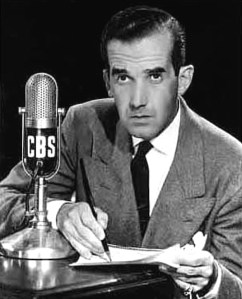
“We hardly need to be reminded that we are living in an age of confusion—a lot of us have traded in our beliefs for bitterness and cynicism or for a heavy package of despair, or even a quivering portion of hysteria. Opinions can be picked up cheap in the marketplace while such commodities as courage and fortitude and faith are in alarmingly short supply.”

Edward R. Murrow
(1908-1965)

Edward R. Murrow said that . . . in 1951! Seventy-three years later, his words ring true. My first political memory (a flashbulb memory) is from 22 November 1963. My first-grade teacher, Mrs. Larkin, stood in front of our class and told us school was letting out early because the President had been killed. I walked home on the cold autumn day and sat with my grim-faced father watching the news unfold on our small black and white TV. Sixty-one years later, it feels like an “end of innocence” moment in my young life.**

Saturday’s fearsome assassination attempt on former President Trump and heart-wrenching death of Corey Comperatore are but the latest chapter in our roller-coaster political world. As Christians, we may be shocked by such events, but we should never be surprised. There is an evil presence in our world. As Luther said, We need not invite the Devil to our table; he is too ready to come without being asked. The air all about us is filled with demons. So it is.

Do you see the old woman?
Or, do you see the young woman?

Brace up, my friends, and be reminded that for the next four months, we will be inundated with all-things election related. How should we handle that on our Christian journey? In a past life, I spent over forty years walking young people into their civic and political lives, and I often utilized the accompanying optical illusion as a way of illustrating the political world to them. In the binary political context of the United States, we are offered two competing (and plausible) versions of reality — two people can look at the same thing (person, issue, situation) and see something entirely different. It can be frustrating and aggravating. And, EXHAUSTING. My advice to you — and I offer this with humility — is to avoid the echo chambers of our politics. Vary your news sources, be willing to listen to contrary views, and pray for a discerning mind. As Christians, we cannot divorce ourselves from the political world, and we have an opportunity — and perhaps an obligation — to offer a different voice.

Josephine Larkin
(1916-2009)

**Before she died in 2009 at age 93, I visited Mrs. Larkin. She remains a hero in my life, in part, because she taught me to read! She had a remarkable memory and recounted the day of Kennedy’s assassination and also provided details about my class — amazing!

Beyond a short summary of this week’s readings, my short reflections will focus on the passage from Mark. Beyond that, take some time with a wonderful reflection from Henri Nouwen, and a gorgeous song based on Psalm 23. As always, MANGE TAK for visiting this space for a few minutes, and may God bless your journey!


Before you read this week . . . A Quick Take on Sunday’s Lectionary:
The readings for Pentecost 9 weave a rich tapestry of themes centered around divine guidance, restoration, and unity. Jeremiah 23:1-6 and Psalm 23 both highlight God as a shepherd who leads and cares for the people, promising safety and righteousness. Ephesians 2:11-22 continues this theme by emphasizing the breaking down of barriers and the creation of a unified spiritual community through Christ. Finally, Mark 6:30-34, 53-56 depicts Jesus as the compassionate shepherd who heals and guides the weary, underscoring the theme of Christ’s nurturing presence amid life’s challenges.

The Readings for Pentecost 9
Jeremiah 23: 1-6
Psalm 23
Ephesians 2: 11-22
Mark 6: 30-34, 53-56

The Gospel Reading: Mark 6: 30-34, 53-56
30The apostles gathered around Jesus and told him all that they had done and taught. 31He said to them, “Come away to a deserted place all by yourselves and rest a while.” For many were coming and going, and they had no leisure even to eat. 32And they went away in the boat to a deserted place by themselves. 33Now many saw them going and recognized them, and they hurried there on foot from all the towns and arrived ahead of them. 34As he went ashore, he saw a great crowd; and he had compassion for them, because they were like sheep without a shepherd; and he began to teach them many things.

53When they had crossed over, they came to land at Gennesaret and moored the boat. 54When they got out of the boat, people at once recognized him, 55and rushed about that whole region and began to bring the sick on mats to wherever they heard he was. 56And wherever he went, into villages or cities or farms, they laid the sick in the marketplaces, and begged him that they might touch even the fringe of his cloak; and all who touched it were healed.

 Reflections: finding the balance between compassion and rest  

Jesus Praying on the Mountain
James Tissot (1836–1902)

This week’s Gospel reading puzzled me at first. Abruptly following the death of Jesus’ cousin and friend, John the Baptist, the two unspectacular stories bracket better known and miraculous episodes in Christ’s journey — the feeding of the five thousand (35-44), Jesus going up the mountain to pray (45-46), and Jesus walking on water (47-52). In Mark 6:30-34, Jesus and His disciples seek a quiet place to rest, but a large crowd follows them, prompting Jesus to teach them with compassion as they are like sheep without a shepherd. In Mark 6:53-56, after crossing the sea, Jesus heals the sick and those in need as the people recognize Him and bring their loved ones to touch the hem of His garment, hoping for healing.

What should we take away from this reading? There are lessons here for us, and two things stand out to me. First, our Lord’s humanity is on full display here. He is tired, as are his disciples. They had just returned from missionary work, and he sensed both their excitement and fatigue. Jesus took them to a deserted place to rest (verse 31), but the crowds — those desperate crowds — followed quickly. And that leads me to the second observation. In spite of his exhaustion — and grief for his cousin John — he exhibits amazing patience and compassion for the people. These searching and excited people — our spiritual ancestors — were the first Christians and their hope rested on this young man from Nazareth. Two thousand years later in our exhausted world, may we continue to seek his healing presence!

Soli Deo Gloria! 

a nouwen moment: you do not belong to the world

Henri Nouwen
(1932-1996)

I think for peacemaking it is so important that we are home, that we know to whom we belong. Jesus says it very clearly; he says: “You do not belong to the world, just as I do not belong to the world. Therefore, I am sending you into the world as my Father has sent me into the world.” You have to catch the paradox: that we can really be in the world, involved in the world, and actively engaged in the world precisely because we do not belong to it, precisely because that is not where our dwelling place is. Precisely because our home is in God, we can be in the world, and speak words of healing, of confrontation, of invitation, and of challenge.
(From Nouwen Meditation, 15 July 2024)


and . . . the king of love my shepherd is (502 in the elw)

Psalm 23 remains the most popular of the 150 Psalms. Anglican Priest, Sir Henry Williams Baker (1921-1877), penned the words to the famous hymn in 1868, one of 33 hymns he wrote. His friend and fellow clergyman John Bacchus Dykes (1823-1876) composed the music that was based on an Irish tune. The version I’m offering here comes from the Concordia Choir (Moorhead, MN), my Alma Mater. Several of the ELCA affiliated universities and colleges are renowned for their music programs.

If interested, join us after the 8:30 service at ELC on 21 July for some in-person discussion of this week’s readings. No special expertise or prior knowledge is necessary! all are welcome! 

14 July 2024: Pentecost 8

Faithful Conversations #72

Introduction to Readers:

“History and memory share events; that is, they share time and space. Every moment is two moments.” 

Ann Michaels

This observation by Canadian poet and novelist Anne Michaels (b. 1958) beautifully captures the intricate relationship between history and memory. Every moment exists as both a historical event and a personal memory, intertwined in the fabric of time. This week’s readings reminded me of Michaels’ observation. And, I suppose, every time we’re in the scriptures, this dynamic is at play. WHAT actually happened? And HOW do we remember it? And further, WHY are we prompted to remember it? These are the operative questions — keep them in mind as you work your way through the readings this week. My reflections will focus on the passage from Ephesians. As always, thanks for visiting this space again this week! I’m honored by your presence.

Let’s Get Started!  A Quick Take on Sunday’s Lectionary:

The readings for Pentecost 8 share a common theme of prophetic call and divine purpose. Amos 7:7-15 highlights the unwavering commitment of prophets to convey God’s message despite adversity. Psalm 85:8-13 speaks of God’s steadfast love and righteousness, promising redemption and restoration to those who seek Him. Ephesians 1:3-14 underscores God’s predestined plan for salvation and adoption, emphasizing His grace and the spiritual blessings bestowed upon believers. Mark 6:14-29 recounts the tragic consequences of John the Baptist’s prophetic ministry, illustrating the cost of truth-telling and fidelity to God’s will. Together, these readings underscore the profound intersections of divine calling, justice, and the enduring promise of God’s grace throughout history.

The Readings for Pentecost 8
Amos 7: 7-15
Psalm 85: 8-13
Ephesians 1: 3-14 (Focus Reading)
Mark 6: 14-29

The New Testament Reading: Ephesians 1: 3-14 (Easy to Read Version)

Ephesus
Ruins of the Temple of Artemis

Praise be to the God and Father of our Lord Jesus Christ. In Christ, God has given us every spiritual blessing in heaven. In Christ, he chose us before the world was made. He chose us in love to be his holy people—people who could stand before him without any fault. And before the world was made, God decided to make us his own children through Jesus Christ. This was what God wanted, and it pleased him to do it. And this brings praise to God because of his wonderful grace. God gave that grace to us freely. He gave us that grace in Christ, the one he loves.

In Christ we are made free by his blood sacrifice. We have forgiveness of sins because of God’s rich grace. God gave us that grace fully and freely. With full wisdom and understanding he let us know his secret plan. This was what God wanted, and he planned to do it through Christ. 10 God’s goal was to finish his plan when the right time came. He planned that all things in heaven and on earth be joined together with Christ as the head.

11 In Christ we were chosen to be God’s people. God had already planned for us to be his people, because that is what he wanted. And he is the one who makes everything agree with what he decides and wants. 12 We Jews were the first to hope in Christ. And we were chosen so that we would bring praise to God in all his glory. 13 It is the same with you. You heard the true message, the Good News about the way God saves you. When you heard that Good News, you believed in Christ. And in Christ, God put his special mark on you by giving you the Holy Spirit that he promised. 14 The Spirit is the first payment that guarantees we will get all that God has for us. Then we will enjoy complete freedom as people who belong to him. The goal for all of us is the praise of God in all his glory.

Reflections: who are we?  

St. Paul in Prison

Thirteen letters from the New Testament are attributed to St. Paul. Seven of those are undisputed by scholars: Romans, 1 and 2 Corinthians, Galatians, Philippians, 1 Thessalonians, and Philemon. The remaining six are disputed — that is, Paul’s authorship is not universally accepted, including the tenth book of the New Testament, Ephesians. As noted in my Lutheran Study Bible, “it was not uncommon for a disciple of a famous teacher to write a letter in the name of the teacher,” and perhaps that is the case with Ephesians. Tradition holds (again, with conflicting claims) that Paul wrote to the Ephesians while in prison in Rome (c. 62), along with Colossians, Philemon, and Philippians.

Ancient Ephesus

First, some context for this powerful passage from the first chapter. Ephesus was an ancient Greek and Roman city on the west coast of Anatolia (present day Turkey). It was the third largest city in the Roman Empire, behind Rome and Alexandria and served as a major seaport and center of commerce. Known for the famed Temple of Artemis completed in 550 BCE and one of the Seven Wonders of the Ancient World, the church in Ephesus was also one of the seven cited in Revelation (chapter 2). Notably, the city became an important center for Christianity from 50 CE onward (intriguing to note that Mary, mother of Jesus, is believed to have settled there). Paul lived there from 53-56, working with a congregation and organizing missionary activity into the surrounding hinterlands. Among other things, he became embroiled in a dispute with artisans there whose livelihood depended on the sale of statuettes of Artemis (note Acts 19: 23-41 — a dramatic story!). He is writing to his former colleagues years later (perhaps from prison) to help them navigate various challenges they face.

What should we take away from this week’s passage? (Sidebar: To be honest, it is so packed with theology that I had to read it a number of times. I learned while researching these verses that in the original Greek, 3-14 is one sentence! This is reflected in the King James Version, which you can access here! I utilized the “Easy to Read” version in my posting). These things stand out to me: first, it is important to imagine how first-generation Christians may have read these words nearly 2,000 years ago. We know the letter was circulated among many of the earliest churches. They were experiencing the split between Jews and Gentiles, and that particular conflict is addressed throughout the letter (note verses 4-6 and 9-11, for example). In a larger sense, our spiritual ancestors lived in a polytheistic culture in the throes of a cosmic struggle — not unlike the world we inhabit! Paul is framing that world for them within the life, death, and resurrection of Jesus Christ (realize that the crucifixion occurred merely thirty years prior to this writing!).  And while he is speaking to them, he is also speaking to us.

Second, reread the full passage again, focusing on verses 11-14, with these two questions in mind: WHO AM I? WHO ARE WE? These verses are a great reminder of our Christian identity, that we are spiritual beings experiencing an earthly journey. We live within that great mystery and with the assurance that our story is eternal. Our Creator God loves us — imagine that! We do not understand it all today, but someday we will!

Soli Deo Gloria! 

and . . . a poem for today: “look again” by Gerhard frost

Gerhard Frost
(1909-1987)

Thorwald Ansgar Rykken
(1924-2013)

Note: My father, Thor Rykken (aka “Unk”) was born 100 years ago this Sunday (14 July), and I’m sharing this poem in his honor. A 1951 graduate of Luther Seminary, Unk was a huge fan of Gerhard Frost (1909-1987), Lutheran theologian, professor, and writer. I grew up OFTEN hearing references to Gerhard Frost! This was one of his favorites:

LOOK AGAIN 
“I’m of the old school
and I’m against it!”
She said it with a toss
of her proud gray head,
and I knew the discussion was over.
I wanted to say,
“But, friend, you forget.
School isn’t out yet.
Living is learning,
and learning is living.
It’s sad to see you hunker down
and burrow in
like a frightened little rabbit.
Our world is in trouble.
The good old days
weren’t good enough,
and now we must rethink
what we’ve thought,
reevaluate what we’ve treasured,
re-view what we’ve accepted as true.
Look again at all you’ve looked at;
there’s more to be and become.”

If interested, join us after the 8:30 service at ELC on 14 July for some in-person discussion of this week’s readings. No special expertise or prior knowledge is necessary! all are welcome!