18 February 2024: Lent 1

Faithful Conversations #51

Imposition of Ashes

Introduction to Readers: 
On Wednesday, millions of Christians across the globe will participate in the imposition of ashes. (And, by the way, Ash Wednesday coincides with Valentine’s Day this year, not a common thing! This last happened in 2018 and will next happen in 2029). This marks the beginning of Lent in our liturgical calendar, occurring 46 days before Easter Sunday. (Note the readings for Ash Wednesday listed below). The practice of marking foreheads with ashes in the shape of a cross symbolizing penance, humility, and mortality has its roots in early Christian history. Today, Ash Wednesday is observed by Catholics, Anglicans, Lutherans, and several other Protestant denominations. It’s interesting to note that Luther favored continuing the traditions of Ash Wednesday, though more radical Lutherans of the time did not, believing it to be too “Catholic.” (If you want a good primer on why Lutherans participate in this tradition, check out this excellent summary!) 

As we begin our journey through Lent, I hope to explore traditions associated with the time before Easter for a richer understanding of our heritage. Note that I occasionally offer links within my posts for further information (italicized and a different color). My reflections for Lent 1 will focus on the Gospel reading from Mark. I have also posted the New Testament reading from 1 Peter with corresponding questions drawn from resources provided by ELCA website. Thanks for your continued interest in Bible study! 

Readings for Ash Wednesday (14 February)
Joel 2: 1-2, 12-17 or Isaiah 58: 1-12

Psalm 51: 1-17
2 Corinthians 5: 20b-6:10
Matthew 6: 1-6, 16-21

Readings for Lent 1 (Sunday 18 February) 
Genesis 9: 8-17
Psalm 25: 1-10
1 Peter 3: 18-22
Mark 1: 9-15

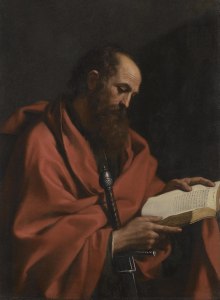
Saint Peter (Italian 1650)
Artist: Guercino (1591–1666)

The New Testament Reading for Lent 1: 1 Peter 3: 18-22
18 For Christ also suffered for sins once for all, the righteous for the unrighteous, in order to bring you to God. He was put to death in the flesh but made alive in the spirit, 19 in which also he went and made a proclamation to the spirits in prison, 20 who in former times did not obey, when God waited patiently in the days of Noah, during the building of the ark, in which a few, that is, eight lives, were saved through water. 21 And baptism, which this prefigured, now saves you—not as a removal of dirt from the body but as an appeal to God for a good conscience, through the resurrection of Jesus Christ, 22 who has gone into heaven and is at the right hand of God, with angels, authorities, and powers made subject to him.

Questions for Reflection:

  1. The book of 1 Peter was written to exiles (1 Peter 1:1) and aliens (1 Peter 2:11). These were people who were given only limited legal and social rights. They experienced discrimination and were viewed as strange or different. Who are the exiles and aliens in our society today?  What communities support them? 
  2. Being a Christian does not insulate us from suffering. Christ, the righteous one, also suffered (verses 18-19). The just Jesus, in fact, suffered for all, including the “spirits in prison” (verse 20). What do you think that phrase — “spirits in prison” — means?  
  3. Verse 21 is a good reminder of our baptism. If someone asked you to explain what your baptism means to you, how would you respond? (Here is a good refresher from the Small Catechism regarding the meaning of baptism). 

Christ in the Wilderness
by Ivan Kramskoi (1837–1887)

The Gospel Reading for Lent 1:
In those days Jesus came from Nazareth of Galilee and was baptized by John in the Jordan. 10 And just as he was coming up out of the water, he saw the heavens torn apart and the Spirit descending like a dove upon him. 11 And a voice came from the heavens, “You are my Son, the Beloved; with you I am well pleased.” 12 And the Spirit immediately drove him out into the wilderness. 13 He was in the wilderness forty days, tested by Satan, and he was with the wild beasts, and the angels waited on him.14 Now after John was arrested, Jesus came to Galilee proclaiming the good news of God 15 and saying, “The time is fulfilled, and the kingdom of God has come near; repent, and believe in the good news.”

This Week’s Reflection: “Momento mori” (remember death)     
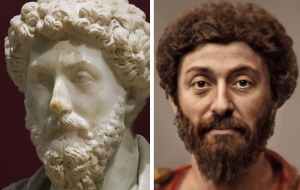
Marcus Aurelius
(121-180 CE)

Lent has always been my favorite season of the church year, a time to reset our spiritual practices. The famous admonition from Marcus Aurelius has been on my mind this week: “You could leave life right now. Let that determine what you do and say and think.” That’s powerful and seems entirely consistent with the Christian initiation of Lent drawn from Genesis 3:19: “Remember that you are dust, and to dust you shall return.” (Sidenote: Telling people that Lent, a period of time when we are encouraged to reflect on our mortality, is my favorite church season, reminds me that I was raised by a father who majored in Philosophy and a man who operated with a good deal of stoical thinking — maybe it started there. He often reminded me, “life is hard, it’s how you react to it that matters.” My mother, also a closet stoic loved to say “Well, it could have been worse,” when I came home complaining about some difficulty I encountered!). 

Why do we start the Lenten season by reflecting on our inevitable death? That seems dark, especially in a 21st Century culture obsessed with avoiding death and the pain associated with it. More and more, it seems to me in our secular age, people avoid funerals, for example, as too somber, too sad. That’s unfortunate and not in line with our theology. Our God liberates us from the fear of death, and allows us to live within that realization, and what a glorious thing that is! The story that unfolds over the next 40-plus days reminds us of that truth.  

The Gospel reading for Sunday is vintage Mark — he packs a lot into seven verses! In and through it all, we are reminded of Lent. We witness the baptism of Jesus, we hear the voice of God identifying His Son, and the coming of the Holy Spirit. We learn of Jesus’ 40-day trial in the wilderness, John’s arrest, and the start of our Lord’s ministry in Galilee. Like Jesus, in our baptism, we receive God’s Spirit and are liberated from sin and death (verses 9-10), though not from suffering. Like Jesus, we face trials and testing — we confront Satan but are attended to by angels! (verses 12-13). And we walk forward in ministry, deliberately and with courage, spreading the good news of Christ’s return (verses 14-15).

May God bless your Lenten journey in 2024!   

Soli Deo Gloria

Prayer (honoring martin luther who died in 1546) 

Note: 18 February is the day we commemorate Martin Luther (“Lesser Festivals and Commemorations” as found on pages 15-17 of the ELW (our hymnal since 2006). The suggested prayer for “Renewers of the Church” is found on page 60.   

Almighty God, we praise you for your servant Martin Luther, through whom you have called the church to its tasks and renewed its life. Raise up in our own day teachers and prophets inspired by your Spirit, whose voices will give strength to your church and proclaim the reality of your reign, through Jesus Christ, our Savior and Lord, who lives and reigns with you and the Holy Spirit, one God now and forever. Amen. 

Announcement Regarding Our Lectionary Discussions:

Please join us after church on Sundays (10:45-11:15) for some discussion of the week’s readings, and other topics. Invite a friend! No prior knowledge is necessary and you will not be put on the spot — just a simple and formal exchange among believers.  ALL ARE WELCOME! 

And . . . .

Update on “Faithful Conversations: Resilient Voices”

We are a church rooted in strong traditions, while at the same time, attempting to remain resilient and relevant in our ever-changing world. We feel strongly that we need to garner the wisdom of the older generation as we move forward and work to make cross-generational connections to strengthen our future. Starting in February of 2024, we initiated the “Resilient Voices” project as part of our Faithful Conversations adult education and Bible study initiatives. The purpose of Resilient Voices will be to document faith journeys or stories of many of our parishioners. Let me know if you are interested in participating! 

And, THANKS to Rollie Lee and Jerry Humphrey who shared some of their faith wisdom with our confirmands on Sunday 11 February! You planted seeds!   

11 February 2024: The Transfiguration of our Lord

Faithful Conversations #50

Introduction to Readers:   

1960s Lutheran Humor!

Intense battles over Biblical Interpretation!
(1960s Lutheran humor)

We’re nearing one year into this blogging experiment (hard to believe). From the start, the goals have been to learn more about the Revised Common Lectionary (RCL) and to encourage engagement with scripture in a more systematic way. If you’re like me, interpreting scripture is both challenging and exhilarating.! This week marks the end of the brief season of Epiphany and Ash Wednesday is just around the corner (14 February), at which point we begin to interact with the 40-day journey to Easter. My reflections this week focus on the readings from Elijah and Mark. As always, thanks for your interest in Bible study!       

Note: I do utilize various hyperlinks within the body here for further exploration! They are a different color and italicized. If you click out, simply click back to return to the blog. The images included, mostly, are from Wikimedia Commons, and therefore are in the public domain.   


Readings for The Transfiguration of our Lord  
2 Kings 2: 1-12 (focus)

Psalm 50: 1-6
2 Corinthians 4: 3-6
Mark 9: 2-9 (focus)

The First Reading: 2 Kings: 2: 1-12: Elijah Ascends to Heaven
Now when the Lord was about to take Elijah up to heaven by a whirlwind, Elijah and Elisha were on their way from Gilgal. Elijah said to Elisha, “Stay here, for the Lord has sent me as far as Bethel.” But Elisha said, “As the Lord lives and as you yourself live, I will not leave you.” So they went down to Bethel. The company of prophets who were in Bethel came out to Elisha and said to him, “Do you know that today the Lord will take your master away from you?” And he said, “Yes, I know; keep silent.”

Elijah and the Chariot of Fire
by Giuseppe Angeli (c. 1740)

Elijah said to him, “Elisha, stay here, for the Lord has sent me to Jericho.” But he said, “As the Lord lives and as you yourself live, I will not leave you.” So they came to Jericho. The company of prophets who were at Jericho drew near to Elisha and said to him, “Do you know that today the Lord will take your master away from you?” And he answered, “Yes, I know; keep silent.” Then Elijah said to him, “Stay here, for the Lord has sent me to the Jordan.” But he said, “As the Lord lives and as you yourself live, I will not leave you.” So the two of them went on. Fifty men of the company of prophets also went and stood at some distance from them, as they both were standing by the Jordan. Then Elijah took his mantle and rolled it up and struck the water; the water was parted to the one side and to the other, and the two of them crossed on dry ground. When they had crossed, Elijah said to Elisha, “Tell me what I may do for you before I am taken from you.” Elisha said, “Please let me inherit a double share of your spirit.” 10 He responded, “You have asked a hard thing, yet if you see me as I am being taken from you, it will be granted you; if not, it will not.” 11 As they continued walking and talking, a chariot of fire and horses of fire separated the two of them, and Elijah ascended in a whirlwind into heaven. 12 Elisha kept watching and crying out, “Father, father! The chariots of Israel and its horsemen!” But when he could no longer see him, he grasped his own clothes and tore them in two pieces.

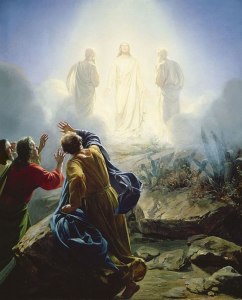
The Transfiguration
by Carl Heinrich Bloch (1834–1890)

The Gospel:  Mark 9: 2-9: The Transfiguration

Six days later, Jesus took with him Peter and James and John and led them up a high mountain apart, by themselves. And he was transfigured before them, and his clothes became dazzling bright, such as no one on earth could brighten them. And there appeared to them Elijah with Moses, who were talking with Jesus. Then Peter said to Jesus, “Rabbi, it is good for us to be here; let us set up three tents: one for you, one for Moses, and one for Elijah.” He did not know what to say, for they were terrified. Then a cloud overshadowed them, and from the cloud there came a voice, “This is my Son, the Beloved; listen to him!” Suddenly when they looked around, they saw no one with them any more, but only Jesus. As they were coming down the mountain, he ordered them to tell no one about what they had seen, until after the Son of Man had risen from the dead.

This Week’s Reflection: “Turning points!”    

David Blight
(b. 1949)

David Blight, a favorite historian of mine, once remarked, “History must be imagined before it can be understood.” A corollary to that assertion is that stories are central to our understanding of history, and I would argue that is also true regarding our engagement with scripture. The readings from Elijah and Mark for Transfiguration Sunday both pack powerful imagery and ignite our imaginations. 

First, the Old Testament story. Elijah is a significant figure in both Judaism and Christianity. Revered as a prophet and miracle worker and known for his unwavering commitment to the worship of the one true God, Elijah confronted the idolatrous practices of his time, notably during the reign of King Ahab and Queen Jezebel in ancient Israel (874-853 BCE). Elijah’s life was marked by his courage, faith, and eventual departure from earth in a chariot of fire, symbolizing his unique relationship with the divine. In the episode from this week’s reading, Elijah is about to be taken up to heaven, and his disciple Elisha accompanies him on his journey. As they travel from Gilgal to Bethel and then to Jericho, a group of prophets forewarn Elisha about Elijah’s imminent departure (verse 5). Despite these warnings, Elisha remains steadfast in his commitment to stay with Elijah. Eventually, as they reach the Jordan River, Elijah strikes the water with his cloak, causing the river to part, and they cross on dry ground (verse 8). Elijah then asks Elisha for his final request before his departure, and Elisha requests a double portion of Elijah’s spirit (verses 9-10). Witnessing Elijah being taken up in a whirlwind to heaven, Elisha inherits his mentor’s mantle and performs miracles with the power of the Spirit that rested on Elijah.

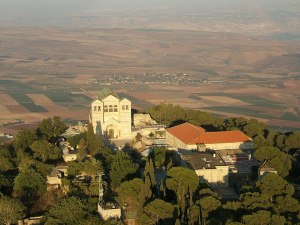
And, how about the Transfiguration moment? As a history teacher, this story has always been a favorite due to the three dimensions of time present in the mountaintop experience — past, present, and future. Jesus takes Peter, James, and John up Mount Tabor where he is transfigured before them (verse 2). His clothes become dazzling white, and Elijah and Moses appear, talking with Jesus (verses 3-4). Peter suggests building three shelters, but a cloud overshadows the scene, and the voice of God declares Jesus as His beloved Son, instructing the disciples to listen to Him (verses 5-7). The disciples are left in awe, and Jesus advises them to keep the event secret until after His resurrection (verse 9).  

What are we to make of these stunning and transcendent moments? Both involve themes of divine manifestation and the passing of spiritual authority. Further, both are distinct turning points. While reading the passage from 2 Kings, I was reminded of that disturbing — indeed heart-wrenching — moment when one realizes that a parent is dying. Elisha cannot face losing his mentor Elijah. His anguish runs through the entire passage. Nevertheless, he must go forward, and carry on the work of this man he so admired. Elisha’s story beyond that moment is powerful and inspirational.

The Franciscan Church of the Transfiguration of Jesus Christ
(Mount Tabor, Israel)

In Mark’s account of the transfiguration (also found in Matthew 17: 1-13 and Luke 9:28-36), we are again witnesses to an overpowering celestial moment. The presence of Moses (the lawgiver) and Elijah (the prophet) symbolizes continuity with the Old Testament tradition. Peter’s confused response is curious. His call for building three tents, as suggested by Biblical scholars, may hearken back to the Jewish tradition of a sacred space for the divine (i.e. the Tabernacle), as exemplified during the Exodus and wilderness wanderings. Or, he may simply have wanted to extend the experience, to stay within that miraculous space. Whatever the case, God clearly indicates the unique nature of Christ, His beloved Son. Let’s imagine what was going through the minds of the disciples as they descended the mountain in this “before and after” moment, this turning point! Their lives would never be the same.    

Soli Deo Gloria

Prayer (Inspired by Psalm 50: 1-6)

You, O Lord, are the Judge of all, from the rising to the setting sun. Your radiance illuminates the earth. In humility, we acknowledge that everything belongs to You. As we enter this sacred moment of prayer, may Your divine light shine upon us, revealing the path of righteousness that leads us closer to You. Grant us the wisdom to recognize Your presence in our lives and the grace to align our hearts with Your will.  Amen.

And, here is a WONDERFUL SONG that came to mind when reading the passage from 2 Corinthians this week. It comes from composer David Haas. You will appreciate the energy of these young people!     

Announcement Regarding Our Lectionary Discussions:

Please feel welcome to join us after church on Sundays (10:45-11:15) for some discussion of the week’s readings, and other topics. Invite a friend! ALL ARE WELCOME! 

And . . . .

Update on “Faithful Conversations: Resilient Voices”

Like other denominations in the first quarter of the 21st Century, the ELCA is navigating many challenges, and we clearly are in a time of transition. We are a church rooted in strong traditions, while at the same time, attempting to remain resilient and relevant in our ever-changing world. We feel strongly that we need to garner the wisdom of the older generation as we move forward and work to make cross-generational connections to strengthen our future. Starting in February of 2024, we initiated the “Resilient Voices” project as part of our Faithful Conversations adult education and Bible study initiatives. The purpose of Resilient Voices will be to document faith journeys or stories of many of our parishioners. Let me know if you are interested in participating!   

4 February 2024: Epiphany 5

Faithful Conversations #49

Introduction to Readers: 
Before getting into this week’s installment, let me double back on last week’s Gospel (Mark 1: 21-28), focusing on verses 23-24:  Just then a man in their synagogue who was possessed by an impure spirit cried out, “What do you want with us, Jesus of Nazareth? Have you come to destroy us? I know who you are—the Holy One of God!”  In her sermon at ELC on Sunday (Epiphany 4), Pastor Jen highlighted this exchange between Jesus and the man with the unclean spirit, and likened it to the cynical, worldly reaction we may face as Christians, a compelling and relevant interpretation for our time. I cannot remember a time in my life when toxic anger, negativity, and division were as prevalent, seemingly impacting all aspects of our lives. The opportunity for Christians, it seems to me, is to provide a healing counter-narrative in this environment. Keep that thought in mind as you walk through this week’s readings. My reflections will be primarily drawn from 1 Corinthians and Mark’s Gospel. As always, thanks for your continued interest in exploring the scriptures together!     

Note: I do utilize various hyperlinks within the body here for further exploration! They are a different color and italicized. If you click out, simply click back to return to the blog. The images included, mostly, are from Wikimedia Commons, and therefore are in the public domain.   

Readings for Epiphany 5 (4 February)
Isaiah 40: 21-31
Psalm 147: 1-11, 20c
1 Corinthians 9: 16-23 (focus)
Mark 1: 29-39 (focus)

Saint Paul by
Guercino (1591–1666)

The New Testament Reading: 1 Corinthians 9: 16-23
16 If I proclaim the gospel, this gives me no ground for boasting, for an obligation is laid on me, and woe to me if I do not proclaim the gospel! 17 For if I do this of my own will, I have a wage, but if not of my own will, I am entrusted with a commission. 18 What then is my wage? Just this: that in my proclamation I may make the gospel free of charge, so as not to make full use of my rights in the gospel. 19 For though I am free with respect to all, I have made myself a slave to all, so that I might gain all the more. 20 To the Jews I became as a Jew, in order to gain Jews. To those under the law I became as one under the law (though I myself am not under the law) so that I might gain those under the law. 21 To those outside the law I became as one outside the law (though I am not outside God’s law but am within Christ’s law) so that I might gain those outside the law. 22 To the weak I became weak, so that I might gain the weak. I have become all things to all people, that I might by all means save some. 23 I do it all for the sake of the gospel, so that I might become a partner in it.

The Gospel:  Mark 1: 29-39
29 As soon as they left the synagogue, they entered the house of Simon and Andrew, with James and John. 30 Now Simon’s mother-in-law was in bed with a fever, and they told him about her at once. 31 He came and took her by the hand and lifted her up. Then the fever left her, and she began to serve them. 32 That evening, at sunset, they brought to him all who were sick or possessed by demons. 33 And the whole city was gathered around the door. 34 And he cured many who were sick with various diseases and cast out many demons, and he would not permit the demons to speak, because they knew him.  35 In the morning, while it was still very dark, he got up and went out to a deserted place, and there he prayed. 36 And Simon and his companions hunted for him. 37 When they found him, they said to him, “Everyone is searching for you.” 38 He answered, “Let us go on to the neighboring towns, so that I may proclaim the message there also, for that is what I came out to do.” 39 And he went throughout all Galilee, proclaiming the message in their synagogues and casting out demons.

This Week’s Reflection: “healing in a divided world”     

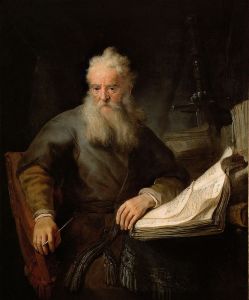
St. Paul by Rembrandt (1606-1669)

In his book, The Paul Quest: The Renewed Search for the Jew of Tarsus, author Ben Witherington III offers this less than flattering description of Saint Paul: “Most moderns, even most modern Western Christians, would have been taken aback by Paul. Certainly before his conversion, and probably after it as well, we would see him as a fanatic . . . We would also likely see Paul as too driven, too single-minded and single-purposed . . .” Paul’s zealotry is on display in this week’s reading from 1 Corinthians (verses 16-18). And though zealotry seems synonymous with rigidity, verses 19-23 offer a different perspective for us to consider. Again, to quote from Witherington, ” . . . the apostle appears to have been a remarkably flexible person in a very inflexible world. This is not to say that Paul does not have fixed and unalterable commitments to the gospel and its theological and ethical ramifications; but the way Paul theologizes and thinks ethically out of these commitments is remarkably adaptable to his audience’s situation.” The takeaway here for me is that as followers of Christ, it is vital that we are willing to interact with all people, even those that we may disagree with, for the furtherance of the Gospel! Again, this is our great opportunity, perhaps our special calling, in our deeply divided world.

Christ in the Wilderness
by Ivan Kramskoi (1837–1887)

Jesus, of course, interacted with people from all walks of life, and spent much of his time with those on the margins of society, the shunned outcasts of the world. In Mark’s crisp account from this week’s Gospel, we see our Lord in action and prayer. He brings miraculous healing to many and, as He often does, retreats early in the morning to pray in solitude. In these moments, we see His humanity and need for communion with God. We see Him in the world, offering hope to broken people without judgement or condemnation, while also remaining apart from the world, a perfect window into the Christian journey.  

Soli Deo Gloria

Prayer (based on Isaiah 40: 28-31)

Gracious Father,
We come before you, acknowledging your everlasting nature and infinite wisdom. In moments of weariness, we find comfort in your promise that you never grow tired or weary. Today, we surrender our fatigue to you and ask for the strength to endure. Renew us, Lord, as we place our hope in you. Grant us wings like eagles, that we may rise above the challenges we face. May we run without growing weary, walk without fainting, and find our strength in the assurance of your unfailing love. In the name of Jesus, our source of strength and hope, we pray. Amen.

And, here is a beautiful hymn inspired by Isaiah 40: 28-31. It comes from a UCC Church in Ashland, Oregon.

Announcement Regarding Our Lectionary Discussions:

We will resume our in-person meetings after church on Sunday (2.4) at 10:45 in the library. Invite a friend! ALL ARE WELCOME! 

And . . . .

update on “Faithful Conversations: Resilient Voices”

Like other denominations in the first quarter of the 21st Century, the ELCA has been navigating many challenges, and we are clearly in a time of transition. More than 60% of ELCA membership, for example, is age 50 or older – 31% are 65 or older. We feel strongly that we need to garner the wisdom of the older generation as we move forward and work to make cross-generational connections to strengthen our future. We are a church rooted in strong traditions, while at the same time, attempting to remain resilient and relevant in our ever-changing world. Starting in February of 2024, we are initiating the “Resilient Voices” project as part of our Faithful Conversations adult education and Bible study initiatives. The purpose of Resilient Voices will be to document faith journeys or stories of many of our parishioners.  We conducted our first two interviews this week! Thanks for Rollie Lee and Jerry Humphrey for their terrific participation! Also, a shout-out to Peter Bushman for his help with a couple new tech applications, and Lizzie as well!  

28 January 2024: Epiphany 4

Faithful Conversations #48

Introduction to Readers:

“The fear of the Lord is the beginning of wisdom.” (Psalm 111: 10)

How do we acquire knowledge? And further, how do we know if what we think we know is true? The readings for Epiphany 4 prompt these questions and seem especially relevant for those of us living in the information-saturated social media environment of 2024 where false information lurks around every corner. Dwell on these questions as you walk through this week’s lectionary and, as always, thanks for your ongoing desire to be challenged in your understanding and application of the scriptures!      

Note: I do utilize various hyperlinks within the body here for further exploration! They are a different color and italicized. If you click out, simply click back to return to the blog. The images included, mostly, are from Wikimedia Commons, and therefore are in the public domain.   

Readings for Epiphany 4 (28 January)
Deuteronomy 18: 15-20 (focus reading)
Psalm 111
1 Corinthians 8: 1-13
Mark 1: 21-28 (focus reading)

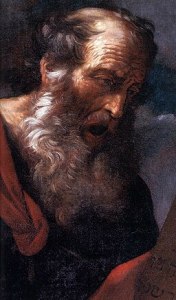
Moses by Italian Painter Guido Reni (1575-1642)

The First Reading: Deuteronomy 18: 15-20
15 “The Lord your God will raise up for you a prophet like me (Moses) from among your own people; you shall heed such a prophet. 16 This is what you requested of the Lord your God at Horeb on the day of the assembly when you said, ‘Let me not hear again the voice of the Lord my God or see this great fire anymore, lest I die.’ 17 Then the Lord replied to me, ‘They are right in what they have said. 18 I will raise up for them a prophet like you from among their own people; I will put my words in the mouth of the prophet, who shall speak to them everything that I command. 19 Anyone who does not heed the words that the prophet shall speak in my name, I myself will hold accountable. 20 But any prophet who presumes to speak in my name a word that I have not commanded the prophet to speak or who speaks in the name of other gods, that prophet shall die.’

The Face of Jesus (generated using A.I.)

The Gospel Reading: Mark 1: 21-28 
21 They went to Capernaum, and when the Sabbath came, he entered the synagogue and taught. 22 They were astounded at his teaching, for he taught them as one having authority and not as the scribes. 23 Just then there was in their synagogue a man with an unclean spirit, 24 and he cried out, “What have you to do with us, Jesus of Nazareth? Have you come to destroy us? I know who you are, the Holy One of God.” 25 But Jesus rebuked him, saying, “Be quiet and come out of him!” 26 And the unclean spirit, convulsing him and crying with a loud voice, came out of him. 27 They were all amazed, and they kept on asking one another, “What is this? A new teaching—with authority! He commands even the unclean spirits, and they obey him.” 28 At once his fame began to spread throughout the surrounding region of Galilee.

This Week’s Reflection: “Beware of false prophets!”   

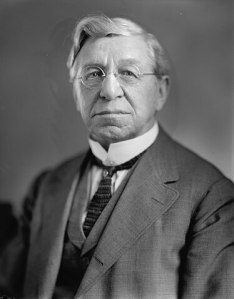
Jacob S. Coxey
(1854-1951)

Carl Browne
(1849–1914)

Carl Browne came to mind this week after reading the Deuteronomy passage. Unless you are an “in the weeds” American history buff, I suspect his name is not familiar. Here’s the backstory. The Panic of 1893 (think economic depression) scrambled our political landscape (sidebar: it was plenty rough on Black River Falls). A third-party movement known as Populism stormed across the Midwest raising the voices of desperate farmers and workers, demanding, among other things, the free and unlimited coinage of silver — something a little hard to grasp in 2024. It was in this volatile environment that cattle rancher, cartoonist, and journalist Carl Browne emerged. Part entertainer, part labor organizer, his story intersected with another quirky character, Jacob S. Coxey, best known for leading a motley crowd of desperate men, tagged “Coxey’s Army,” to march on the US Capitol in May of 1894. Beyond the silver issue, their radical demand for a mammoth public works program designed to employ thousands of hopeless workers appeared dangerous and out of bounds to the Cleveland administration. Where am I going with this, you might ask? Consider this. Browne, a sincere admirer of Coxey, was also a believer in the religion of theosophy, and, moreover, presented himself as a partial reincarnation of Jesus Christ (he also believed that Coxey was the reincarnation of Andrew Jackson!). Ultimately becoming Coxey’s right-hand man, Browne helped lead the disorganized and chaotic march. Hoping to storm the Capitol, the project fizzled in the end and both Coxey and Browne were prosecuted for trespassing.  

What are we to make of this strange episode from 130 years ago? What was the attraction of Carl Browne? To be charitable, he was an eccentric, and it is impossible to fully understand his psychology or motives. Portraying himself as the reincarnation of Jesus Christ, however, was misguided and dangerous, and smacks of the false prophecy spoken of in Deuteronomy 18. Tapping into the desperation and anger of those who shared his political views while coupling it with a spiritual undercurrent was a dangerous brew, though not necessarily unique in history. 

Martin Luther (1483-1546)

False prophets have been around throughout the centuries. There are dozens of references in the scriptures to false prophets. Jesus, in fact, spoke of false prophecy on more than one occasion, most notably in the Sermon on the Mount (specifically Matthew 7: 15-20).  Luther, who viewed this world as one of cosmic struggle between God and the devil, interpreted Christ’s warning, emphasizing (especially) the danger of false prophets who claim to be Christian, those who “grow up among you, bear and boast of your name” and “cunningly reach after the doctrine, that they may take the treasure itself out of my heart, namely, the dear word.”  In turn, he provided a road map for discerning false prophecy. Listen to Luther’s words here: But when a Christian is attentive, and has no more than the catechism, the Ten Commandments, the Creed, the Lord’s Prayer, the Word of the Lord, Baptism and the Sacrament of the Lord’s Supper, he can well defend and maintain himself against all heresies. For the Lord Christ here commands, and gives power to all Christians, to be judges over all doctrines, and enables them to understand what is right and wrong. For thou must be as sure as thou livest, that this is the word of God; yea, even more certain, or else it is not possible to holdout. But no man can judge false teaching, but the spiritual man.” As he often does, Luther takes us back to the basics. Be attentive. Be prepared to defend. Don’t get distracted by all the noise. Stay grounded. Yes, “the fear of the Lord is the beginning of wisdom,” empowering us to navigate our lives of faith. 

This week’s Gospel provides a window into the authority, wisdom, and disciplined confidence displayed by Jesus as he taught in the temple, a charismatic model for the Christian family. The reaction by those who witnessed these events is inspiring. Genuinely astounded by the young rabbi’s wisdom (verse 22), listeners were amazed when He dramatically confronted a demonic force (verses 24-25). For many, I suspect their lives were never the same.   

Soli Deo Gloria

And, here’s a powerful commentary From Henri Nouwen:

Henri Nouwen (1932-1996)

God cannot be understood: he cannot be grasped by the human mind. The truth escapes our human capacities. The only way to come close to it is by a constant emphasis on the limitations of our human capacities to “have” or “hold” the truth. We can neither explain God nor his presence in history. As soon as we identify God with any specific event or situation, we play God and distort the truth. We only can be faithful in our affirmation that God has not deserted us but calls us in the middle of all the unexplainable absurdities of life. It is very important to be deeply aware of this. There is a great and subtle temptation to suggest to myself or to others where God is working or where not, when he is present and when not; but nobody, no Christian, no priest, no monk, has any “special” knowledge about God. God cannot be limited by any human concept or prediction. He is greater than our mind and heart and perfectly free to reveal himself where and when he wants.

Announcement Regarding Our Lectionary Discussions:

We WILL NOT be meeting in person after church on Sunday (1.28) due to the Annual Meeting. We will gather again on  Sunday, 4 February at 10:45 in the library. Invite a friend! ALL ARE WELCOME! 

And . . . .

looking over the horizon . . . “Faithful Conversations: Resilient Voices”

We continue to “think digitally” and how we can share the Good News in our community and beyond. We have secured the various pieces of technology necessary to begin conducting interviews and developing podcasting capabilities.  Thanks to Peter Bushman for his excellent guidance with technology and to Pastor Jen for her ongoing conversations regarding new and different ways to approach adult education! Starting in February, we plan to do a series of interviews with members regarding their faith journeys. Stay tuned for further announcements!

21 January 2024: Epiphany 3

Faithful Conversations #47

Introduction to Readers: 
“A political campaign, like a religious revival, was in part a social event, an entertainment, and in part a crusade waged on high moral grounds with a strong emotional charge. In a scale of values, loyalty to one’s party, belief in its principles often ranked only slightly below devotion to one’s church and faith in its creed.” (Kenneth Stampp)

The vexing nature of politics has been on my mind this week due to both the lectionary readings and the drumbeat of campaign-related news. The eerily contemporary sounding quote noted above comes from a book I’m reading called, America in 1857: A Nation on the Brink. Noted Civil War historian, Kenneth Stampp (1912-2009) was describing election politics in 1857, a good reminder that we often see contemporary events as unique in the annals of time (“this has never happened before!”).  Any reading of our history indicates that fractured politics have been with us from the start. Sometimes it is important to take a breath, step back, and take the longer view. 

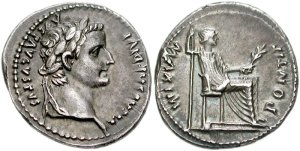
A denarius featuring Tiberius. The inscription on the obverse reads Ti[berivs] Caesar Divi Avg[vsti] F[ilivs] Avgvstvs (“Caesar Augustus Tiberius, son of the Divine Augustus”), and the reverse reads Pontif[ex] Maxim[us] (“Highest Priest”).

Since my youth, I have sought to navigate the intersection of history and politics with my faith journey. Regardless of where you identify on the political spectrum — and we certainly have legitimate disagreements within the Christian community — my sense is that as followers of Christ, our guiding principle — our liberating worldview, if you will — should be love of God and love of neighbor (Matthew 22: 38-39).  And, while it’s important to be actively involved in our civic lives, we also must recognize the inherent imperfections of political systems and leaders and avoid placing absolute trust in either. Our first century spiritual ancestors, people whose world we seek to understand every week in this space, walked within an empire that emphasized glorification of the leader. The phrase “Caesar is Lord!” was an expected pledge by those living under the empire, a feature reinforced on those ancient coins we see from time to time. Many Christians, of course, refused to accept such public allegiances, and evidence suggests that martyrdom often awaited those who refused. Anyway, let’s all brace ourselves for the 10-month roller coaster ride leading to November! Keep that in mind as you walk through the readings for Sunday and, as always, thanks for your continued interest in exploring the lectionary!  My reflections this week will focus on the passages from Mark and 1 Corinthians.      

Note: I do utilize various hyperlinks within the body here for further exploration on your  part if interested! They are a different color and italicized. If you click out to the supplemental information, simply click back to return to the blog. The images included, mostly, are from Wikimedia Commons, and therefore are in the public domain. As is often the case, this week I am indebted to Journey With Jesus, a weekly webzine, directed by theologian Dan Clenendin.   

Readings for Epiphany 3 (21 January)
Jonah 3: 1-5, 10
Psalm 62: 5-12
1 Corinthians 7: 29-31
Mark 1: 14-20

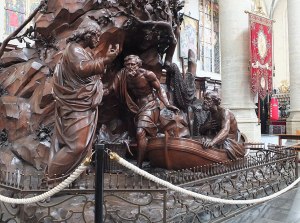
Sculpture in St Andrews’ Church, Antwerp (Belgium) by Jan-Baptist van Hool and Jan-Frans van Geel

The Gospel Reading: Mark 1: 14-20 
14 Now after John was arrested, Jesus came to Galilee proclaiming the good news of God 15 and saying, “The time is fulfilled, and the kingdom of God has come near; repent, and believe in the good news.”  16 As Jesus passed along the Sea of Galilee, he saw Simon and his brother Andrew casting a net into the sea, for they were fishers. 17 And Jesus said to them, “Follow me, and I will make you fishers of people.” 18 And immediately they left their nets and followed him. 19 As he went a little farther, he saw James son of Zebedee and his brother John, who were in their boat mending the nets. 20 Immediately he called them, and they left their father Zebedee in the boat with the hired men and followed him.

The Second Reading: 1 Corinthians 7: 29-31
29 I mean, brothers and sisters, the appointed time has grown short; from now on, let even those who have wives be as though they had none, 30 and those who mourn as though they were not mourning, and those who rejoice as though they were not rejoicing, and those who buy as though they had no possessions, 31 and those who deal with the world as though they had no dealings with it. For the present form of this world is passing away.

This Week’s Reflection: “The Time is Now!”  

Labels are often confusing. Our church is called the Evangelical Lutheran Church in America (ELCA), an entirely appropriate title based on our heritage and role in the world! Nevertheless, the word evangelical, can be problematic. It has come to mean different things to different people. Its roots are complex (explore further here if you wish!) Within our present media environment, for example, we often hear about the Evangelical Movement or who Evangelicals are supporting in an election — a sloppy shorthand for Christians who are considered to be politically conservative (although there is a problem with that word as well, but I digress), and from denominations considered fundamentalist in nature, who adhere to a strictly literal interpretation of scripture (i.e. Southern Baptists or Assemblies of God). Frankly, in the mind of many, especially those outside the Christian community, all Christians are put into that box (we do like to label people!). So, what does the word evangelical actually mean? Mark’s Gospel provides answers (sidebar: I’m gaining a greater appreciation for Mark, the highlighted Gospel in Year B).  

Take a look at the very first line in Mark — “The beginning of the good news (gospel) of Jesus Christ, the Son of God” (RSV). “Gospel” traces to the Old English, “godspel,” meaning good news.* If we were reading this line in the original Greek, we would see the word euangelion, meaning “good news.” Evangelism, in short, means “spreading the good news.” Luther, by the way, was taken by the Latin version of the word — evangelium — and considered it the best description of the religious changes sweeping through Europe in the 16th Century — in his language, the “evangelische kirche” (I feel I have used my quota of quotation marks in this paragraph!!).

In today’s gospel, Jesus bursts on the scene (verse 14) preaching the good news — He is evangelizing!). He then calls for repentance because the kingdom of God is near — the time is now! (verse 15). Again, specificity of language is important. The original Greek word for “time” as Jesus referenced it here is kairos, meaning a turning point or divine intervention of some kind (as opposed to chronos, meaning the time we understand by looking at our watch, if you wear one!). There is a sense of urgency here. The time is now! Repentance, fundamental to our lives as Christians, refers to an abrupt turnaround, a complete reorientation in our thinking (picture Jonah marching through the streets of Ninevah!).

Writing from Ephesus to the church in Corinth in the early 50s CE, Paul amplifies Christ’s words, emphasizing that as Christians, we walk in two worlds simultaneously** (again, remember the world these early Christians navigated!).  Phil Wold, pastor of Trinity Lutheran in Sheridan, Wyoming, offers the following commentary on these verses:  The Reformation tradition values deeply the insight that there is a “simul” quality to the Christian life. We are simultaneously saint and sinner. We are also—simultaneously—people with no concerns about daily troubles, and people immersed in life’s daily affairs. Paul’s other worldliness is balanced by deep love for the world God loves. “The present world is passing away,” Paul says, and our faith assures us that God is also working to make us and God’s world new.

In the swirl of the world of 2024, I find the passage from 1 Corinthians and Wold’s interpretation remarkably powerful and comforting!***

Soli Deo Gloria 

* Of the 64 translations of the Bible available on the Bible Gateway website, I note that 28 use the word “gospel” in Mark 1:1, including the King James version, the Bible that may have been utilized by many of our ancestors.

**We’re hearing a lot these days about Chat GPT and the increasing use of Artificial Intelligence (AI). I am confronting this new world with my students right now, and, as you might imagine, it is challenging. Just for fun, I went to Chat GPT and posed this prompt: Write a short paragraph about what it means for Christians to walk in two worlds. This is what I got: 

The phrase “Christians walk in two worlds” often refers to the dual nature of the Christian faith, emphasizing the believers’ simultaneous existence in both the earthly realm and the spiritual realm. On one hand, Christians navigate their daily lives in the tangible, material world, engaging with worldly responsibilities, relationships, and challenges. On the other hand, their faith teaches them to live according to spiritual principles, guided by religious teachings and a connection with the divine. This duality underscores the idea that Christians are called to integrate their faith into every aspect of their lives, striving to embody the values of love, compassion, and righteousness while participating in the complexities of the secular world. The concept highlights the balance between the earthly and the spiritual dimensions that Christians seek to maintain in their journey of faith.

Amazing, right? Just so you’re aware, I am writing the blog myself, although I borrow freely from multiple sources — people who are experts!    

***Wold’s interpretation is from God Pause, an excellent daily devotional provided by alumni of Luther Seminary in St. Paul, which you can subscribe to if interested! 

This Week’s Prayer Reflection (a poem):     

FOUND
Maybe it’s all utterly meaningless.
Maybe it’s all unutterably meaningful.
If you want to know which,
pay attention to
what it means to be truly human
in a world that half the time
we’re in love with
and half the time
scares the hell out of us…

The unexpected sound of your name on somebody’s lips.
The good dream.
The strange coincidence.
The moment that brings tears to your eyes.
The person who brings life to your life.

Even the smallest events hold the greatest clues.

Frederick Buechner (1926–2022)

(Accessed from Journey with Jesus website)

Announcement Regarding Our Lectionary Discussions:

Join us, if you can, for a free-wheeling discussion of this week’s readings after worship on Sunday (10:45) in the library. All are welcome! 

And . . . . 

looking over the horizon . . . “Faithful Conversations: Resilient Voices”  

We continue to “think digitally” and how we can share the Good News in our community and beyond. We have secured the various pieces of technology necessary to begin conducting interviews and developing podcasting capabilities.  Thanks to Peter Bushman for his excellent guidance with technology and to Pastor Jen for her ongoing conversations regarding new and different ways to approach adult education! Starting in February, we plan to do a series of interviews with members regarding their faith journeys. Stay tuned for further announcements! 

14 January 2024: Epiphany 2

Faithful Conversations #46

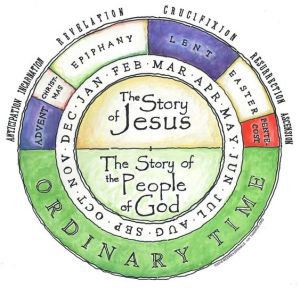
The Church Calendar

Introduction to Readers:

The season of Epiphany extends from 6 January through 13 February — the day before Ash Wednesday (within the ELCA). Epiphany means appearance or manifestation and its roots go deep into the 4th Century Eastern Orthodox Church. During this phase of the church year, we reflect on God’s revelation in His Son, including  the birth, the visit of the Magi to Bethlehem, His presentation in the Temple, and later, Jesus’ baptism by John. Recall that at Christ’s baptism, the Holy Trinity appeared — Father, Son, and Holy Spirit. If you are interested in the traditions surrounding Epiphany, click here for a good overview! 

Think about the concepts of “seeing and being seen” as you work through this week’s lectionary. How does God see us? How do we see others? My reflections this week will center on the Psalm, with references to the Gospel. As always, thanks for your continued journey through the scriptures!  

Note: I do utilize various hyperlinks within the body here for further exploration if interested! They are a different color and italicized. If you click out to the supplemental information, simply click back to return to the blog. 

Readings for Epiphany 2 (14 January)
1 Samuel 3: 1-10 (11-20)
Psalm 139: 1-6, 13-18
1 Corinthians 6: 12-20
John 1: 43-51

The Psalm for Epiphany 2: 139: 1-6, 13-18

“King David in Prayer” by Pieter de Grebber (1600-1653)
circa 1635-1640

You have searched me, Lord, and you know me.
You know when I sit and when I rise;
    you perceive my thoughts from afar.
You discern my going out and my lying down;
    you are familiar with all my ways.
Before a word is on my tongue
    you, Lord, know it completely.
You hem me in behind and before,
    and you lay your hand upon me.
Such knowledge is too wonderful for me,
    too lofty for me to attain.

For you created my inmost being;
    you knit me together in my mother’s womb.
14 I praise you because I am fearfully and wonderfully made;
    your works are wonderful,
    I know that full well.
15 My frame was not hidden from you
    when I was made in the secret place,
    when I was woven together in the depths of the earth.
16 Your eyes saw my unformed body;
    all the days ordained for me were written in your book
    before one of them came to be.
17 How precious to me are your thoughts, God!
    How vast is the sum of them!
18 Were I to count them,
    they would outnumber the grains of sand—
    when I awake, I am still with you.

Depiction of Nathanael:
St. John’s Anglican Church, New South Wales

The Gospel Reading:  John 1: 43-51
43 The next day Jesus decided to leave for Galilee. Finding Philip, he said to him, “Follow me.” 44 Philip, like Andrew and Peter, was from the town of Bethsaida. 45 Philip found Nathanael and told him, “We have found the one Moses wrote about in the Law, and about whom the prophets also wrote—Jesus of Nazareth, the son of Joseph.” 46 “Nazareth! Can anything good come from there?” Nathanael asked. “Come and see,” said Philip. 47 When Jesus saw Nathanael approaching, he said of him, “Here truly is an Israelite in whom there is no deceit.” 48“How do you know me?” Nathanael asked. Jesus answered, “I saw you while you were still under the fig tree before Philip called you.” 49 Then Nathanael declared, “Rabbi, you are the Son of God; you are the king of Israel.” 50 Jesus said, “You believe because I told you I saw you under the fig tree. You will see greater things than that.” 51 He then added, “Very truly I tell you, you will see ‘heaven open, and the angels of God ascending and descending on’ the Son of Man.”

This Week’s Reflection: 
The Season of Epiphany prompts me to think about those Aha! moments in our lives — moments of Epiphany that we experience from time to time (Pastor Jen alluded to this in her sermon last Sunday). Anna and Simeon said Aha! when Jesus was presented in the Temple. The Magi said Aha! as their camels sauntered into that stable in Bethlehem (my comic brain pictures Balthasar, Melchior, and Gaspar — yes, their names! — raising their fingers and saying Aha! in unison). And picture those witnessing Jesus’ baptism on the banks of the Jordan River and the appearance of the Holy Spirit looking at one another and saying, Aha!  (As a sidenote, I have always been fascinated by how people come to know things. We tend to think of knowledge acquisition as something that happens over time and with deliberation, but I’m convinced that much of what we know comes through Epiphany moments, but that’s another topic). 

Thomas Cranmer,
Archbishop of Canterbury
(1489 – 1556)

In turn, Epiphany moments remind me that God reveals Himself in our lives both persistently and surprisingly. The writer of this week’s Psalm (attributed to David), for example, in very personal and poetic language, describes God’s persistent revelation as he attempts to comprehend the Creator’s infinite knowledge of his inner thoughts, his actions, his life. Some may read Psalm 139 and feel suffocated by or afraid of such a God (do we really want God to know everything about us?). My sense, however, is that the Psalmist feels both comforted and liberated by this view of God’s all-encompassing wisdom and intervention in his life. In a recent post, theologian Dan Clendenin connects Psalm 139 to something called the Collect for Purity, a prayer dating back over a thousand years, and translated from Latin to English by Thomas Cranmer, Archbishop of Canterbury, during the time of the English Reformation (associate Cranmer with the reign of Henry VIII and all those difficult marital situations!). Cranmer (a Protestant) was responsible for publishing the Book of Common Prayer in 1549. Here is the prayer (it may seem familiar): 

The Evangelical Lutheran Worship (ELW) Hymnal (2006)

Almighty God, to whom all hearts are open, all desires known, and from whom no secrets are hid: Cleanse the thoughts of our hearts by the inspiration of your Holy Spirit, that we may perfectly love you, and worthily magnify your holy Name; through Jesus Christ our Lord. Amen.

Yes, the Collect for Purity shows up at the beginning of several worship settings in the front pages of the ELW (specifically in Settings 1 and 2 and the Service of the Word), a reminder that we draw from many traditions in the ELCA. Clendenin writes the following regarding this beautifully haunting prayer: The purpose of the “collect” is to summarize, focus, clarify and remind ourselves exactly what it is we hope to do in the service that follows .  .  .  At first glance, the Collect feels like a harsh exposure to guilt, fear, and shame — the terrifying realization that God knows all my distracted thoughts and disordered loves, my unruly desires and unwanted dreams. In fact, the exact opposite is true. Instead of judgment, the Collect expresses the paradoxical combination of human confession that brings liberation, and divine comfort that brings consolation. In other words, I am both nakedly revealed before the infinite God, and lovingly sheltered by his intimate love. Aha! God’s persistent revelation in our lives! 

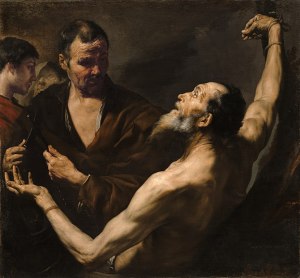
The Martyrdom of Saint Bartholomew (1634)
by Jusepe de Ribera

And then there are those surprising Epiphany moments when the truth is suddenly clear to us. In this week’s Gospel, Nathanael experienced such a moment. Jesus is in Galilee and calls Philip to follow him (verse 43). Philip, in turn, seeks out Nathanael and informs him that Jesus, the fulfillment of ancient prophecies, has arrived (verse 45). **Nathanael, though initially skeptical (verse 46), is greeted by Christ and immediately recognizes him as the Son of God (verses 48-49). Aha! God’s surprising revelation in our lives, forever changing our journey!

Soli Deo Gloria

** Nathanael is also identified as Bartholomew and shows up in the four “lists” of disciples in the New Testament: Matthew 10: 2-4, Mark 3: 16-19, Luke 6: 14-16, and Acts 1: 13. Not all scholars agree that Nathanael and Bartholomew were the same person, however. 

This Week’s Prayer (designated for Epiphany 2, Year B in the RCL):
Thanks be to you, Lord Jesus Christ, most merciful redeemer, for the countless blessings and benefits you give. May we know you more clearly, love you more dearly, and follow you more nearly, day by day praising you, with the Father and the Holy Spirit, one God, now and forever more. Amen. 

If you need a moment of uplift this week, here is a wonderful version of the hymn, The Summons. You are hearing from the Notre Dame Folk Choir and seeing images of Notre Dame University. Having visited there a number of times, I thoroughly enjoyed seeing the sites of the campus — brought back great memories. Though most commonly associated with the Catholic Church, this hymn is in the ELW (page 798). It is a suggested hymn for Epiphany 2, I believe, referencing the reading from 1 Samuel.   

Enjoy!  

Announcement Regarding Our Lectionary Discussions:

Join us, if you can, for a free-wheeling discussion of this week’s readings after worship on Sunday (10:45) in the library. Come to listen in or participate — you will not be put on the spot to exhibit your knowledge of the Lectionary! All are welcome!  

6-7 January 2024: Epiphany and Baptism of Our Lord

Faithful Conversations #45

Introduction to Readers:
David Brooks writes with precision and grace. Though I hesitate to recommend books due to my sense that reading is a highly personal endeavor, his most recent book, How to Know a Person is exceptional, and therefore, I recommend it with enthusiasm! At the outset, Brooks asserts the following: There is one skill that lies at the heart of any healthy person, family, school, community organization, or society: the ability to see someone else deeply and make them feel seen — to accurately know another person, to let them feel valued, heard, and understood. In turn, he suggests that, as a society in 2024, we are sorely lacking in this regard and the impact is exponentially harmful to us. Our political divide, for example, is one manifestation of our inability to “see” each other. Though not necessarily writing from a faith perspective (Brooks, by the way, is Jewish), he offers profound insights for those of us who walk as children of the light (1 Thessalonians 5:5). I will circle back to Brooks at the end of this week’s blog. 

You will note that I have listed the readings for Epiphany (Saturday), and I would urge you to walk through them prior to taking on the Sunday readings. Recall that Epiphany marks the visit of the Magi to Bethlehem. My reflections will focus on the Baptism of Our Lord, particularly the readings from Genesis and Mark. As always, mange tak for your continued interest in Bible study!   

Note: I do utilize various hyperlinks within the body here for further exploration on your  part if interested! They are a different color and italicized. If you click out to the supplemental information, simply click back to return to the blog. The images included, mostly, are from Wikimedia Commons, and therefore are in the public domain. 

Readings for Epiphany (6 January)
Isaiah 60: 1-6

Psalm 72: 1-7, 10-14
Ephesians 3: 1-12
Matthew 2: 1-12

Readings for the Baptism of Our Lord (7 January)
Genesis 1: 1-5
Psalm 29
Acts 19: 1-7
Mark 1: 4-11

The First Reading: Genesis 1: 1-5
When God began to create the heavens and the earth, the earth was complete chaos, and darkness covered the face of the deep, while a wind from God swept over the face of the watersThen God said, “Let there be light,” and there was light. And God saw that the light was good, and God separated the light from the darkness. God called the light Day, and the darkness he called Night. And there was evening and there was morning, the first day.

The Gospel: Mark 1: 4-11

The Baptism of Christ by Poussin (1594-1665)

so John the baptizer appeared in the wilderness, proclaiming a baptism of repentance for the forgiveness of sins. And the whole Judean region and all the people of Jerusalem were going out to him and were baptized by him in the River Jordan, confessing their sins. Now John was clothed with camel’s hair, with a leather belt around his waist, and he ate locusts and wild honey. He proclaimed, “The one who is more powerful than I is coming after me; I am not worthy to stoop down and untie the strap of his sandals. I have baptized you with water, but he will baptize you with the Holy Spirit.” In those days Jesus came from Nazareth of Galilee and was baptized by John in the Jordan. 10 And just as he was coming up out of the water, he saw the heavens torn apart and the Spirit descending like a dove upon him. 11 And a voice came from the heavens, “You are my Son, the Beloved; with you I am well pleased.”

This Week’s Reflection: “Life Giving Water”  

Genesis 1: 1-5 from the Hochungra Bible (1907)

Those first five verses of Genesis remind me that I have always struggled with the “science vs. religion” argument that ensnares many of our Christian sisters and brothers. Whatever processes led to the amazing world we daily experience, the essential point is that God created the universe, an awe-inspiring reality. As a sidebar, the image you’re seeing here is the Genesis passage from the Ho-Chunk Bible, a gift T.M. Rykken received in the 1921 while serving at Bethany Mission in Wittenberg, Wisconsin. John Stacy, the first Christian convert at the Mission east of Black River Falls, and Jacob Stucki of the German Reformed Church, translated portions of the Bible into Ho-Chunk in the early years of the 20th Century and one of them gave a copy to my grandfather (Hogusra translates as a place of creation). And, by the way, you may find the Ho-Chunk creation story compelling as a comparative exercise with our Judeo-Christian account, but I digress.   

Water, the elemental foundation of life, is present in each reading for Sunday. Water, in fact, was present before God spoke the light into existence in the Genesis passage (verse 2). Cory Driver poses the following thought-provoking question in his commentary in this week’s Living Lutheran: Where did the water come from? We just don’t know . . . We have the briefest poetic description of the formation of the deep, but a lot of creating is assumed to have happened before Genesis begins. Wow. 

And that mysterious, amazing water is present in Mark’s account of Jesus’ baptism, connecting our Lord to the creation moment and that “wind from God” — that Spirit descending in the form of a dove (verses 10-11). And, that same water, present in the moment of our baptism, connects us to Christ and the Holy Spirit. Let’s hear from Luther on this: “What then is the significance of such a baptism with water? It signifies that the old person in us with all sins and evil desires is to be drowned and die through daily sorrow for sin and through repentance, and on the other hand that daily a person is to come forth and rise up to live before God in righteousness and purity forever” (The Small Catechism).  Thank you brother Martin and thanks be to God! 

Soli Deo Gloria
 
This Week’s Prayer (inspired by David Brooks and Marty Haugen):  

Let us build a house where all are named,
their songs and visions heard.
And loved and treasured, taught and
claimed as words within the Word.
Built of tears and cries and laughter,
prayers of faith and songs of grace.
Let this house proclaim from floor to rafter;
All are welcome, all are welcome,
all are welcome in this place. Amen. 

Note: If you need a few moments of uplift today, check out this magnificent version of the above hymn. It speaks to the ability we have in our daily interactions with others — and certainly our ability as a church community — to SEE all people!  The congregation in the video is from The Collegiate Church of St. Mary (Anglican) in Warwick, England. The first time I heard this version, I was stuck by the wonderful sincerity of the congregants!    

Announcement Regarding Our Lectionary Discussions:

Join us, if you can, for a free-wheeling discussion of this week’s readings after worship on Sunday (10:45) in the library. All are welcome! 

31 December 2023: Christmas 1

Faithful Conversations #44

Introduction to Readers:

The March of the Wise Men by Leopold Kupelwieser, 1825

Renewal is on my mind this week, with 2024 just around the corner. What should I let go of in my life that is holding me back? What should I embrace going forward? As Christians, these are good questions for all of us to consider. Christmas Day marked the start of “Twelvetide,” or the Twelve Days of Christmas, leading to the Epiphany, which marks the visit of the Magi — those wise men from the east — to Bethlehem. I suspect this language conjures up images and music for many of us (Is anyone hearing “We Three Kings” and/or “The Twelve Days of Christmas?”). Guided by a star, they felt compelled to see this child, born “King of the Jews” (their story is found in Matthew 2 — one of my favorite musicians, James Taylor, even wrote a song about their journey!). The Magi brought gifts to Jesus: gold (the symbol of kings), frankincense (a perfume representing divinity), and myrrh (an embalming oil that symbolized death). Intriguing characters, those Magi! As we move toward the New Year, and beyond, to Epiphany, let’s imagine that world and their amazing journey. As always, thanks for your continuing interest in studying the Bible!      

Note: I do utilize various hyperlinks within the body here for further exploration on your  part if interested! They are a different color and italicized. If you click out to the supplemental information, simply click back to return to the blog. The images included, mostly, are from Wikimedia Commons, and therefore are in the public domain. 

Readings for Christmas 1
Isaiah 61:10 – 62:3
Psalm 148
Galatians 4:4-7
Luke 2:22-40

Galatians 4: 4-7
But when the fullness of time had come, God sent his Son, born of a woman, born under the law, in order to redeem those who were under the law, so that we might receive adoption as children. And because you are children, God has sent the Spirit of his Son into our hearts, crying, “Abba! Father!” So you are no longer a slave but a child, and if a child then also an heir through God. 

The Gospel: Luke 2: 22-40: Jesus is Presented in the Temple
22 When the time came for their purification according to the law of Moses, they brought him up to Jerusalem to present him to the Lord 23 (as it is written in the law of the Lord, “Every firstborn male shall be designated as holy to the Lord”), 24 and they offered a sacrifice according to what is stated in the law of the Lord, “a pair of turtledoves or two young pigeons.”

Simeon and Anna by Rembrandt (1606-1669)

25 Now there was a man in Jerusalem whose name was Simeon; this man was righteous and devout, looking forward to the consolation of Israel, and the Holy Spirit rested on him. 26 It had been revealed to him by the Holy Spirit that he would not see death before he had seen the Lord’s Messiah. 27 Guided by the Spirit, Simeon came into the temple, and when the parents brought in the child Jesus to do for him what was customary under the law, 28 Simeon took him in his arms and praised God, saying,

29 “Master, now you are dismissing your servant in peace,
    according to your word,
30 for my eyes have seen your salvation,
31     which you have prepared in the presence of all peoples,
32 a light for revelation to the gentiles
    and for glory to your people Israel.”

33 And the child’s father and mother were amazed at what was being said about him. 34 Then Simeon blessed them and said to his mother Mary, “This child is destined for the falling and the rising of many in Israel and to be a sign that will be opposed 35 so that the inner thoughts of many will be revealed—and a sword will pierce your own soul, too.”

Church of Simeon and Anna (Orthodox)
Located in Sysert, Russia

36 There was also a prophet, Anna the daughter of Phanuel, of the tribe of Asher. She was of a great age, having lived with her husband seven years after her marriage, 37 then as a widow to the age of eighty-four. She never left the temple but worshiped there with fasting and prayer night and day. 38 At that moment she came and began to praise God and to speak about the child to all who were looking for the redemption of Jerusalem.

39 When they had finished everything required by the law of the Lord, they returned to Galilee, to their own town of Nazareth. 40 The child grew and became strong, filled with wisdom, and the favor of God was upon him.

This Week’s Reflection: “Waiting and Hoping” 
For this week’s reflection, I will defer to Cory Driver who authors the Lectionary Blog in Living Lutheran, the ELCA’s monthly magazine (25 December 2023). He provides an excellent commentary on the story from Luke.  Click here to access the blog.

Also, note, the questions at the end of the blog related to the readings I included here from Luke and Galatians. We will use those for discussion on Sunday.  

Soli Deo Gloria
 
This Week’s Prayer (inspired by Psalm 148): 
Lord God, our prayers are so often self-absorbed due to our selfish nature. We ask forgiveness for our short sightedness. Open our hearts, Lord, to praise you to the heights, to praise you for your magnificent creation, to praise you for your awesome presence in our lives. We see you in nature, we feel your Spirit all around us. As we stand on the doorstep of a New Year, help us to walk humbly and rest in your powerful love. Amen.  
Announcement Regarding Our Lectionary Discussions:

We will resume our post-worship discussion of the Lectionary this week after worship (10:45) in the library. All are welcome! Here are two questions that we will discuss (among others, I’m sure!):

  1. How do you interpret the phrase, “in the fullness of time” in Galatians 4:4?  What do you think Paul meant by that? 
  2.  If you had the opportunity, what questions would you want to ask Simeon, based on the account from Luke?  How about Anna? And, what about Mary? 
Again, we will discuss these in our in-person meeting after worship on Sunday, but FEEL FREE TO RESPOND HERE ALSO! (And, certainly, feel free to offer any other comments as well!).  

24 December 2023: Advent 4

Faithful Conversations #43

Introduction to Readers:

Marty Haugen, Christian Composer (b. 1950)

During our Advent midweek services, we utilize the Holden Evening Prayer Service written by Marty Haugen. A bit of research informs me that Haugen composed this beautiful service setting in 1986 while at Holden Village in Washington, a Lutheran retreat center. An artistic  and gifted individual (who hails from Wanamingo, MN), Haugen was influenced by music of the Taize Community, a monastic order located in Bergundy, France that embodies both Protestant and Catholic traditions. The style emphasizes simple phrases that reference scripture and are repeated many times. The Gospel and the alternative to the Psalm for the 4th week of Advent connect to the Holden service and I’m focusing my reflections there this week. I copied those readings with their Holden Service below. Also, for this week’s prayer, I linked a beautiful version of the service if you care to listen. As always, thanks for your ongoing interest in studying the Bible!

Note: I do utilize various hyperlinks within the body here for further exploration on your  part if interested! They are a different color and italicized. If you click out to the supplemental information, simply click back to return to the blog. The images included, mostly, are from Wikimedia Commons, and therefore are in the public domain.  *Of Note: The first image of Mary you see below (accompanying the Magnificat) was generated by yours truly using A.I. We truly live in amazing times.  

Readings for the Fourth Sunday in Advent

2 Samuel 7: 1-11, 16
Psalm 89: 1-4, 19-26 (or Luke 1: 46b-55)
Romans 16: 25-27
Luke 1: 26-38

The Gospel: Luke 1: 26-38: “The Annunciation”  26 In the sixth month the angel Gabriel was sent by God to a town in Galilee called Nazareth, 27 to a virgin engaged to a man whose name was Joseph, of the house of David. The virgin’s name was Mary. 28 And he came to her and said, “Greetings, favored one! The Lord is with you.” 29 But she was much perplexed by his words and pondered what sort of greeting this might be. 30 The angel said to her, “Do not be afraid, Mary, for you have found favor with God. 31 And now, you will conceive in your womb and bear a son, and you will name him Jesus. 32 He will be great and will be called the Son of the Most High, and the Lord God will give to him the throne of his ancestor David. 33 He will reign over the house of Jacob forever, and of his kingdom there will be no end.” 34 Mary said to the angel, “How can this be, since I am a virgin?” 35 The angel said to her, “The Holy Spirit will come upon you, and the power of the Most High will overshadow you; therefore the child to be born will be holy; he will be called Son of God. 36 And now, your relative Elizabeth in her old age has also conceived a son, and this is the sixth month for her who was said to be barren. 37 For nothing will be impossible with God.” 38 Then Mary said, “Here am I, the servant of the Lord; let it be with me according to your word.” Then the angel departed from her. Holden Evening Prayer Service Application of this text: An angel went from God, to a town called Nazareth, to a woman whose name was Mary. The angel said to her, “Rejoice, O highly favored, for God is with you. You shall bear a child, and his name shall be Jesus, the Chosen One of God Most High.” And Mary said, “I am servant of my God, I live to do your will.”

Luke 1: 46b-55: “The Magnificat”

Virgin Mary
(A.I. Generated)

46 And Mary said, “My soul magnifies the Lord, 47 and my spirit rejoices in God my Savior, 48 for he has looked with favor on the lowly state of his servant. Surely from now on all generations will call me blessed, 49 for the Mighty One has done great things for me, and holy is his name; 50 indeed, his mercy is for those who fear him from generation to generation. 51 He has shown strength with his arm; he has scattered the proud in the imagination of their hearts. 52 He has brought down the powerful from their thrones and lifted up the lowly; 53 he has filled the hungry with good things and sent the rich away empty. 54 He has come to the aid of his child Israel, in remembrance of his mercy, 55 according to the promise he made to our ancestors, to Abraham and to his descendants forever.”

Holden Prayer Service Application of this Text: My soul proclaims your greatness, O God, and my spirit rejoices in your, You have looked with love on your servant here, and blessed me all my life through. Great and mighty are you, O Holy One, strong is your kindness evermore. How you favor the weak and lowly one, humbling the proud of heart. You have cast the mighty down from their thrones, and up lifted the humble of heart, you have filled the hungry with wondrous things, and left the wealthy no part. Great and mighty are you, O Faithful One, strong is your justice strong your love. As you promised to Sarah and Abraham, kindness forevermore. My soul proclaims your greatness, O God, and my spirit rejoices in your, You have looked with love on your servant here, and blessed me all my life through.
 
This Week’s Reflection: “A Radical Ancient Prayer”
 
One thing I learned early on as a history teacher was that stories bring history to life, and that revisiting the same story time and again allows us to see it from different perspectives and with richer meaning. In this 4th week of Advent, we are revisiting a familiar story, embodied in the two passages from Luke’s Gospel, the Annunciation, the angel Gabriel’s announcement to young Mary, and the Magnificat, her prayerful response. I have heard these stories any number of times in my life but am seeing them in a new light in 2023, especially the Magnificat. Let me explain.

Young Mary and the Annunciation

First, let’s consider Mary and her world, especially from our vantage point in December of 2023, amidst the troubling events surrounding the Israel-Hamas War. Though I have heard about her from a young age, especially at this time of year, I must admit not engaging more fully in her story. This Judean teenage girl (perhaps only 13!), swept into history by miraculous forces, lived a life like no other. From lowly circumstances, and a virgin, she learns in a spiritual encounter with Gabriel, that she will bear a son destined to be the Messiah for her people, and far beyond. Can we even imagine how her mind must have been racing at this moment? In what can only be described as a depth of faith that dwarfs anything I can understand, she responds with a calm and submissive courage (verse 38). And second, what of this dramatic prayer, the Magnificat (Latin for “magnify”)?  As Debi Thomas, Minister of Formation and Discipleship at St. Mark’s Episcopal Church in Palo Alto, California points out in a 2020 essay on these texts points out, Mary’s prayer “comprises the longest set of words spoken by a woman in the New Testament.” Further, that the prayer was “soaked in Jewish women’s history, echoing the words and stories of Miriam, Hannah, Judith, and Deborah” (Note “Hannah’s Prayer” in 1 Samuel 2: 1-10). Most astonishing, however, is the radical and subversive nature of the prayer, what Thomas calls “Mary’s fiery justice song.” Read it again focusing on the highlighted verses (51-53). Our friend Dietrich Bonhoeffer, called the Magnificat “the most passionate, the wildest, one might even say the most revolutionary hymn ever sung.” Oscar Romero, Salvadoran Catholic Priest, murdered in 1980, later canonized, drew comparisons between Mary and the poor and powerless in his community. Indeed, the Magnificat has been banned more than a few times by those in power who fear its message. As we move toward the celebration of our Lord’s birth, we would do well to hear and reflect on his mother’s fervent prayer with fresh insight. As scholar Kenneth Craycraft asserts, “A lowly birth to a lowly woman ushers in the magnificent fulfillment of God’s offer and promise of salvation.” Soli Deo Gloria This Week’s Prayer: The Holden Evening Prayer Service (The Annunciation Starts at 6:57)
Announcement Regarding Our Lectionary Discussions: We will resume our post-worship discussion of the Lectionary on Sunday, 31 December at 10:45 in the church library! All are welcome!    

17 December 2023: Advent 3

Faithful Conversations #42

Charity Thunder (1947-2018)
“Ho-homp-gi-ka re-wi” (she lights up the earth)

Introduction to Readers:
I have referenced her in a prior post, but former colleague Charity Thunder crossed my mind again this week. In a memorable conversation with her many years ago, I asked her a question regarding some aspect of Ho-Chunk culture, and she responded, “I’m not old enough to know that yet.” I’m certain she was in her sixties at the time, and her response was indicative of both her humility and the respect afforded elders within her culture. As I approach this Lectionary challenge each week, I echo her response. Spiritual wisdom, in my estimation, can happen at any age, but for the most part, it seems to continually unfold over time — it is truly a brick-by-brick process. The words of Paul in 1 Corinthians 13:12 come to mind:  “For now we see only a reflection, as in a mirror, but then we will see face to face. Now I know only in part; then I will know fully, even as I have been fully known.”

One other thought before starting this week: on Sunday, a few of us gathered in the library after worship, something we will continue to do, for some free-flowing discussion of the readings — no particular agenda, just talk. An important part of that discussion, and a reiteration on my part, is that I’m following the Revised Common Lectionary (RCL) in the blog, and that may not always match with what Pastor Jen is doing on Sunday (and may not match what some of you that outside ELC are hearing in your home churches). For example, in Advent Pastor Jen is doing a preaching series (“Do not be afraid”) that centers on Luke’s Gospel. Clergy, of course, have a variety of options for preaching, including something called the “Narrative Lectionary,” and the RCL is not required by the ELCA. Our initial goal in launching Faithful Conversations was to grow in our understanding of the RCL and to utilize it as an anchor for further study. If you want to more information regarding the denominations that utilize the RCL and its global reach, check out this site. Thanks for your continued interest! In this week’s reflection, I will be focusing on Psalm 126 and the passage from 1 Thessalonians.   

Note: I do utilize various hyperlinks within the body here for further exploration on your part if interested! They are a different color and italicized. If you click out to the supplemental information, simply click back to return to the blog. The images included, mostly, are from Wikimedia Commons, and therefore are in the public domain.  

Readings for the Third Sunday in Advent
Isaiah 61: 1-4, 8-11
Psalm 126
1 Thessalonians 5: 16-24
John 1: 6-8, 19-28

Psalm 126: A Song of Ascents 
 When the Lord restored the fortunes of Zion, we were like those who dream.
Then our mouth was filled with laughter and our tongue with shouts of joy;
then it was said among the nations, “The Lord has done great things for them.”
The Lord has done great things for us, and we rejoiced.

Restore our fortunes, O Lord, like the watercourses in the Negeb.
May those who sow in tears reap with shouts of joy.
Those who go out weeping, bearing the seed for sowing,
shall come home with shouts of joy, carrying their sheaves.

The Second Reading: 1 Thessalonians 5: 16-24
16 Rejoice always, 17 pray without ceasing, 18 give thanks in all circumstances, for this is the will of God in Christ Jesus for you. 19 Do not quench the Spirit. 20 Do not despise prophecies, 21 but test everything; hold fast to what is good; 22 abstain from every form of evil. 23 May the God of peace himself sanctify you entirely and may your spirit and soul and body be kept sound and blameless at the coming of our Lord Jesus Christ. 24 The one who calls you is faithful, and he will do this.

This Week’s Reflection: “Psalms That Speak to Us Across Time”
Martin Luther loved the Psalms. He often commented on that, including a quote that sounds so Lutheran: “Komm, lass uns einen Psalm singen und den Teufel vertreiben!” (Come, let us sing a psalm, and drive away the devil!). Let’s do some theater of the mind and picture what it might have been like to join Luther and his wife Katie around their kitchen table, discussing Psalm 126. 

For purposes of context, the Psalm likely refers to the period after the Babylonian Captivity and the return of the Jewish exiles to Zion (6th Century BCE). It is a “communal” Psalm — a prayer for help. As Wartburg Professor Samantha Gilmore suggests in a recent commentary, Psalm 126 can be interpreted in two ways: “The psalmist may be 1) remembering with joy what God has done for God’s people in the past or 2) anticipating with joy what God will do to restore God’s people in the (hopefully near) future.” In either case, the psalmist reveals a strong faith “in the power of God to radically change people’s circumstances and the goodness of God to do so in a life-giving way.”

Ah, isn’t it a marvel how these words transcend time and speak to us as we walk the Advent journey? That poetic line in verse 1 — we were like those who dream — reminds me of one of the fundamental questions posed to me and my classmates by Martin Lutter (yes, that was his name, not a typo), a history professor at Concordia in the late 1970s: “Can we use history to imagine a better future?” What an important question! Churches across the ELCA, it seems to me, are in the throes of grappling with that question in 2023, a time of exciting and often painful transition. Individually and collectively, can we remember when our mouths were “filled with laughter” as we contemplate a future filled with “shouts of joy?” This is our challenge.

And the short passage from 1 Thessalonians, it seems to me, offers a timeless playbook, an approach for Christians experiencing difficult times. Those three words in verse 17 — pray without ceasing — offer a powerful reminder for all of us. Lutheran theologian and martyr, Dietrich Bonhoeffer, wrote the following commentary on this verse, offering a great description of the power of prayer and its transformative effect in our lives. 

Bonhoeffer and Confirmands 1932

The unity of prayer and work, the unity of the day, is found because finding the You of God behind the It of the day’s work is what Paul means by his admonition to “pray without ceasing” (1 Thessalonians 5:17). The prayer of the Christian reaches, therefore, beyond the time allocated to it and extends into the midst of work. It surrounds the whole day, and in so doing, it does not hinder the work; it promotes work, affirms work, gives work great significance and joyfulness. Thus every word, every deed, every piece of work of the Christian becomes a prayer, not in the unreal sense of being constantly distracted from the task that must be done, but in the real breakthrough from the hard It to the gracious You.


Bonhoeffer! Once again, you have given us something to think about! May we take your words to heart. 

Soli Deo Gloria!  

Prayer (Inspired by Isaiah 61: 1-4, 8-11)

Note: I found this prayer on-line, but there was no author attribution. It is an example, however, of “praying through the Bible,” a technique that I have been introduced to before, and would like to further explore.  

Sovereign Lord, Your Spirit rested on the prophets of the Old Testament. Your Spirit filled John the Baptist before he was born. Your Spirit anointed Your Son when John baptized Him, and He manifested that fact throughout His servant ministry and preaching. As believers in Jesus as our Lord and Savior, we praise You and thank You that this same Holy Spirit indwells us and enables us to do many of the things Jesus did. Empower us, guide us, and help us meet the needs of others as Jesus showed us how when He blessed and taught Your people on earth. Sovereign Lord, Supreme Ruler over all creation, many of Your people are mourning today because of abuse and affliction, disease and death, unjust punishments and evil persecutions. Comfort all who mourn and make us instruments of Your peace. Lord Jesus, come again quicklyand make all thing s right in Your sight. Sovereign Lord, we have seen many of Isaiah’s prophecies fulfilled in history. Through Your Son, establish justice on earth according to the Scriptures. Inspire us to love justice as You do and also hate all unrighteousness. May we see many of the fruits of the new covenant that Jesus Christ established through His blood, and may many people turn to Him in faith and repentance in order to live a new life in Your presence forever.Sovereign Lord, King of the universe, we delight and rejoice in You and Your salvation, even as we continue to  struggle in this broken world. Thank You for clothing us in the righteousness of Jesus Christ so we can stand unashamed in Your presence before a watching world ever ready to condemn us for the slightest failings. We pray that through our faithfulness and Your gracious work through us that Your righteousness will spring up before all nations and justice will prevail in all human endeavors and relationships. Come quickly, Lord Jesus. Amen.

AND, THIS REMINDER!   We are extending our Faithful Conversation with some in-person discussion on Sunday mornings after our worship experience (10:45-11:30). Join us for our informal discussion of the Lectionary readings — no preparation is necessary — simply bring your Bible and be open to sharing and listening! All our welcome! Unless we need more room, we will gather in the library.