10 December 2023: Advent 2


Faithful Conversations #41

Introduction to Readers: 

The Wilderness of Virginia

The notion of the wilderness has been on my mind this week owing to the readings from Isaiah and Mark. The word derives from the Middle English and means uninhabited, uncultivated, or wild territory; desolate land or desert. We run into the wilderness frequently in scripture, often as a backdrop to significant events — God appearing to Abraham, the 40-year journey of the Israelites as they fled Egypt, and Jesus’ grueling 40 days of testing, just to name three. I will explore the idea of wilderness further in my reflections this week. Mark, by the way, is featured in Year B of the Lectionary, so we will visit him many times. Thanks for your continued interest in exploring the Bible!        

Note: I do utilize various hyperlinks within the body here for further exploration on your part if interested! They are a different color and italicized. If you click out to the supplemental information, simply click back to return to the blog. The images included, mostly, are from Wikimedia Commons, and therefore are in the public domain.  

Readings for the Second Sunday in Advent

Isaiah 40: 1-11
Psalm 85: 1-2, 8-13
2 Peter 3: 8-15a
Mark 1: 1-8

Mosaic of the prophet Isaiah in the Dome of Immanuel in St Mark’s Basilica (Venice)

First Reading: Isaiah 40: 1-11

Comfort, O comfort my people,
    says your God.
Speak tenderly to Jerusalem,
    and cry to her
that she has served her term,
    that her penalty is paid,
that she has received from the Lord’s hand
    double for all her sins.

A voice cries out:
“In the wilderness prepare the way of the Lord;
    make straight in the desert a highway for our God.
Every valley shall be lifted up,
    and every mountain and hill be made low;
the uneven ground shall become level,
    and the rough places a plain.
Then the glory of the Lord shall be revealed,
    and all flesh shall see it together,
    for the mouth of the Lord has spoken.”

A voice says, “Cry out!”
    And I said, “What shall I cry?”
All flesh is grass;
    their constancy is like the flower of the field.
The grass withers; the flower fades,
    when the breath of the Lord blows upon it;
    surely the people are grass.
The grass withers; the flower fades,
    but the word of our God will stand forever.
Get you up to a high mountain,
    O Zion, herald of good news;
lift up your voice with strength,
    O Jerusalem, herald of good news;
    lift it up, do not fear;
say to the cities of Judah,
    “Here is your God!”
10 See, the Lord God comes with might,
    and his arm rules for him;
his reward is with him
    and his recompense before him.
11 He will feed his flock like a shepherd;
    he will gather the lambs in his arms
and carry them in his bosom
    and gently lead the mother sheep.

Mark the Evangelist by Frans Hals (1583-1666)

Gospel: Mark 1: 1-8
The beginning of the good news (gospel) of Jesus Christ. As it is written in the prophet Isaiah,

“See, I am sending my messenger ahead of you,
    who will prepare your way,
the voice of one crying out in the wilderness:
    ‘Prepare the way of the Lord;
    make his paths straight,’ ”

so John the baptizer appeared in the wilderness,proclaiming a baptism of repentance for the forgiveness of sins. And the whole Judean region and all the people of Jerusalem were going out to him and were baptized by him in the River Jordan, confessing their sins. Now John was clothed with camel’s hair, with a leather belt around his waist, and he ate locusts and wild honey. He proclaimed, “The one who is more powerful than I is coming after me; I am not worthy to stoop down and untie the strap of his sandals. I have baptized you with water, but he will baptize you with the Holy Spirit.”

This Week’s Reflection: “Confronting the Wilderness”

As metaphors go, the wilderness can symbolize many things: a fearful place, a place of testing, a place of transformation, a place where we confront God. Isaiah voiced such sentiments six centuries before Christ walked the earth. The second part of this grand book (chapters 40-55), takes place after Babylon rose to power, destroyed Jerusalem, and took thousands of the Jewish people prisoner and away from their home — into the wilderness of a foreign land. The prophet assures the people of their future liberation from Babylon, voicing words of hope (verses 3-5, and 11).
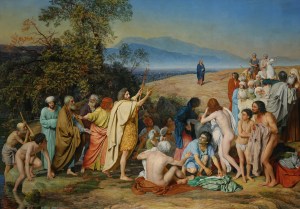
The Appearance of Christ Before the People, by Ivanov, (1837-1857)

More than five hundred years later, Mark, the evangelist, after succinctly proclaiming the good news  of Jesus Christ (verse 1), draws his first-generation Christian readers back to Isaiah (40:3) and Malachi (3:1), announcing John the Baptist’s arrival on the scene. In crisp and clear language, Mark connects his Jewish audience to the unfolding story of Jesus Christ. Throngs of people come to meet John in the wilderness. And like those earliest nascent Christians, this “wilderness man,” ignites our imaginations. But the story is not about John. Rather, it is about the arrival of Jesus and the powerful moment of his baptism (note verses 9-11, beyond today’s reading). 

What are we to make of all this? Both Isaiah and Mark provide us with Advent moments — assurances of God’s presence in our world, moments of energetic hope. In August, Mary Beth and I witnessed an Advent moment in Anchorage, Alaska. First, some context. The city of Anchorage has roughly 300,000 people, 40% of Alaska’s total population. Surprisingly (or not), more than 3,000 residents are homeless. While many are hiding in the shadows, others occupy a visible and extensive tent city. Let’s imagine their situation as we head into the winter months! Further, while Indigenous people make up 15% of Alaska’s overall population, they account for 40% of those who are unhoused. We spent Friday of our mission week at the Hope Soup Kitchen in downtown Anchorage. We helped prepare and serve the noon meal, interacting with the workers, other volunteers, and those who came for the meal. Around 11:00, hundreds and hundreds of people started streaming into the area, most of them people of color. Each had a unique story of how they landed in this space. Picture them walking out of the wilderness of their world to a place of sanctuary, a place where they might encounter God’s powerful presence in the form of a meal and fellowship. And here’s the grand and humbling revelation. In my clumsy attempts to converse with many, it became crystal clear they were ministering to me. I saw Jesus in their faces and heard his voice in their stories. An Advent moment.  

Soli Deo Gloria    
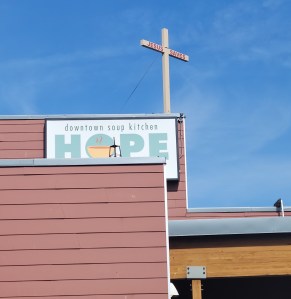
Hope Soup Kitchen, Anchorage, Alaska

Prayer (Inspired by the Hope Soup Kitchen experience): 
Lord God, we pray for people near and far who are experiencing the grim reality of poverty, hunger, and homelessness. May you strengthen them and provide them with hope. We pray also, Lord, that you be with those who take on the work of assisting them day to day — leaders, volunteers, clergy, and social workers. May your compassion for our world — and especially those who are suffering — continue to be present in their efforts. We pray in the name of Jesus Christ. Amen. 

AND, A SPECIAL ANNOUNCEMENT TODAY!  

Let’s extend our Faithful Conversation with some in-person discussion on Sunday mornings after our worship experience (10:45-11:30). Join us for our informal discussion of the Lectionary readings — no preparation is necessary — simply bring your Bible and be open to sharing and listening! All our welcome! Click here or on my mugshot for a short screencast with details! 



3 December 2023: Advent 1

Faithful Conversations #40

Introduction to Readers: Welcome back to Faithful Conversations! We have arrived at the start of the new liturgical church year. To reiterate, the lectionary is arranged in a three-year cycle and each year features a different synoptic Gospel (Matthew, Mark, or Luke — called synoptic because they are similar and can be viewed side by side). John’s Gospel, different in both content and style, is interspersed throughout all three years. We are now in Cycle B and Mark is featured in 2023-24. If you’re like me, an occasional reboot is necessary when it comes to spiritual disciplines, and I encourage you to pray about your daily faith practices. Now might be a good time, for example, to experiment with different approaches.

This week marks the start of the Season of Advent. The word Advent derives from the Latin, adventus meaning “coming.” And while we tend to emphasize the birth of Jesus (looking back), Advent also boldly reminds us of Christ’s second coming (looking forward), as noted in this week’s Gospel. Amidst the stress foisted upon us by the overt consumerism and rush that infuses this time of year, Advent calls Christians to pause, to wake-up, to focus on Christ’s presence in our lives — and to seek God amidst the chaos that surrounds us. The readings for this week project themes of lamentation, anticipation, and hope. Keep those ideas in mind as you work through them.

Note: I do utilize various hyperlinks within the body here for further exploration on your part if interested! They are a different color and italicized. 

Readings for the First Sunday in Advent
Isaiah 64:1-9
Psalm 80:1-7, 17-19
1 Corinthians 1:3-9
Mark 13: 24-37

Mosaic of the prophet Isaiah in the Dome of Immanuel in St Mark’s Basilica (Venice)

First Reading: Isaiah 64:1-9: O that you would tear open the heavens and come down, so that the mountains would quake at your presence— as when fire kindles brushwood and the fire causes water to boil— to make your name known to your adversaries, so that the nations might tremble at your presence! When you did awesome deeds that we did not expect, you came down; the mountains quaked at your presence. From ages past no one has heard, no ear has perceived, no eye has seen any God besides you, who works for those who wait for him. You meet those who gladly do right, those who remember you in your ways. But you were angry, and we sinned; because you hid yourself we transgressed. We have all become like one who is unclean, and all our righteous deeds are like a filthy cloth. We all fade like a leaf, and our iniquities, like the wind, take us away. There is no one who calls on your name or attempts to take hold of you, for you have hidden your face from us and have delivered us into the hand of our iniquity. Yet, O Lord, you are our Father; we are the clay, and you are our potter; we are all the work of your hand. Do not be exceedingly angry, O Lord, and do not remember iniquity forever.     Now consider, we are all your people. Second Reading: 1 Corinthians 1: 3-9 Grace to you and peace from God our Father and the Lord Jesus Christ.I give thanks to my God always for you because of the grace of God that has been given you in Christ Jesus, for in every way you have been enriched in him, in speech and knowledge of every kind— just as the testimony of Christ has been strengthened among you— so that you are not lacking in any gift as you wait for the revealing of our Lord Jesus Christ. He will also strengthen you to the end, so that you may be blameless on the day of our Lord Jesus Christ. God is faithful, by whom you were called into the partnership of his Son, Jesus Christ our Lord. The Gospel Reading:  Mark 13: 24-37 24 “But in those days, after that suffering, the sun will be darkened, and the moon will not give its light, 25 and the stars will be falling from heaven, and the powers in the heavens will be shaken.

26 “Then they will see ‘the Son of Man coming in clouds’ with great power and glory. 27 Then he will send out the angels and gather the elect from the four winds, from the ends of the earth to the ends of heaven. 28 “From the fig tree learn its lesson: as soon as its branch becomes tender and puts forth its leaves, you know that summer is near. 29 So also, when you see these things taking place, you know that he is near, at the very gates. 30 Truly I tell you, this generation will not pass away until all these things have taken place. 31 Heaven and earth will pass away, but my words will not pass away. 32 “But about that day or hour no one knows, neither the angels in heaven nor the Son, but only the Father. 33 Beware, keep alert, for you do not know when the time will come. 34 It is like a man going on a journey, when he leaves home and puts his slaves in charge, each with his work, and commands the doorkeeper to be on the watch. 35 Therefore, keep awake, for you do not know when the master of the house will come, in the evening or at midnight or at cockcrow or at dawn, 36 or else he may find you asleep when he comes suddenly. 37 And what I say to you I say to all: Keep awake.”

This Week’s Reflection: “From Despair to Hope”

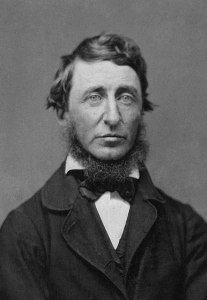
Henry David Thoreau
(1817-1862)

“Most men lead lives of quiet desperation.” Thoreau’s famous line from Walden (1854) came to mind this week, prompted by a dread-filled conversation with a friend — a stark reminder that too many in our midst are gripped with cynicism about the future.  I must admit, standing on the doorstep of December 2023, the world “out there” seems plenty grim. Wars in Ukraine and the Middle East, coupled with political divisions at home and abroad prompt a soul-crushing uncertainty and darkness within our hearts. This week’s ancient text from Isaiah rings modern and captures our deep longing for God’s presence in this place and at this time — O that you would tear open the heavens and come down, so that the mountains would quake at your presence . . .  And so we begin the Advent journey.
 
Isaiah 64 is raw and dark, reflecting a turbulent period in Jewish history — and it feels personal. The context is this: many Israelites returned from their long captivity in Babylon (with Persian help — remember Cyrus?) and rejoined others who had not been displaced. Tensions arose between various factions (note the prayer of penitence in Isaiah 63:15-19 that precedes today’s reading). The anguished prophet voices desperation, calling out for a God who seems absent (verses 5-6). And he pleads with God to return and forgive and to Now consider, we are all your people.
 
The counterpoint to this language of despair, it seems to me, is found in Paul’s pep talk to the Corinthian believers, words that resonate two thousand years later. Through the life, death, and resurrection of his son, God strengthens us for this world, granting us the spiritual tools we need and, indeed, liberating us from sin and the fear of death. (Luther, by the way, described our relationship with Christ as the “happy exchange,” an intriguing notion that you may want to explore further).
 
And finally, we have the words of Jesus himself as recorded in Mark, a powerful reminder in this first week of Advent, of his Second Coming. As we embark on the journey to Bethlehem over the next several weeks, as we once again explore the birth and early years of the Savior of Humanity, our God prompts us to keep alert, to stay awake — to have a sense of urgency as we navigate these lives we have been given. And so we begin the Advent journey, replacing despair with hope.
 
Soli Deo Gloria!
 
Closing Prayer (Inspired by Psalm 80): “Restore us, O God; let your face shine that we may be saved.” We are troubled, Lord, our world is troubled.  “Restore us, O God; let your face shine that we may be saved.” You help us to walk from dark despair into a life of hope.   “Restore us, O God; let your face shine that we may be saved.” Amen.

 
And, something to think about . . . .   
 

Dietrich Bonhoeffer
(1906-1945)

These words from one of the great heroes of Lutheranism, Dietrich Bonhoeffer, executed at age 39 for resisting Nazism in Germany. “The celebration of Advent is possible only to those who are troubled in soul, who know themselves to be poor and imperfect, and who look forward to something greater to come.”