Faithful Conversations #108
Introduction to Readers

The older I get, the more I realize that life is a constant dialogue between what was and what is. In my more anxious moments, for example, I struggle with the state of the Christian church in our society in 2025. What is our future?As part of the boomer generation (b. 1943-1960) I now realize that my formative years intersected with a high-water mark when it came to church attendance in the post-war era. And while we might argue that many attended during those years because it was the “thing to do,” current trends do cause concern. The decline in church membership and attendance within the mainline Protestant denominations in the last quarter century (often referred to as the “Seven Sisters”) receives a good bit of attention and the data is overwhelming. The ELCA, for example, has lost roughly 2 million members since 2000 (5.1 million to 3 million).**
This week’s second reading has prompted me to reflect on the oft-repeated presence of the wilderness in our faith tradition, both physically and metaphorically. In the Old Testament, for example, the Israelites wandered in the wilderness for 40 years before reaching the promised land (Exodus 15-17) and the prophet Elijah had a dramatic encounter with God in the wilderness near Mount Sinai (1 Kings 19). In the New Testament, John the Baptist emerged from the wilderness of Judea proclaiming repentance (Matthew 3) and Jesus spent 40 excruciating days in the wilderness in a face-off with Satan (Matthew 4). Based on these episodes, the wilderness metaphor suggests a period of spiritual testing, transformation, and growth, an encounter with hardship and renewal. Perhaps Christians are experiencing such a moment in 2025. More on that in my reflections. I also have included two music selections this week (I recommend the use of headphones if you have them, if you enjoy rich harmony!).

As always, thanks for your continued interest in exploring the Lectionary! Monday marks DAY 13 of this year’s Lenten Journey (40 days from Ash Wednesday to Easter, not counting Sundays). We have three commemorations on our church calendar this week. Monday, we honor St. Patrick in our tradition (he died on 17 March 461). Patrick, notably, had a dramatic wilderness experience in his life, something he describes in his famous Confession. We also commemorate Joseph, the Guardian of Jesus on 19 March, Thomas Cranmer, the Bishop of Canterbury on 21 March (d. 1556), and Jonathan Edwards, teacher and missionary to the Stockbridge people (d. 1758) on 22 March. And here’s a connection: the Stockbridge-Munsee Band of Mohican Indians in Wisconsin are descended from the people Edwards worked among.
And one further note concerning St. Patrick’s Day: 46 years ago — March 17, 1979 — I asked a wonderful person if she would be my wife. Mary Beth said yes, and the rest is history! And yes, I do have Irish heritage — those Vikings traveled!
** This link will take you to a summary of the most recent Pew Survey on Religion in America if you want to explore further. You may find the information compelling!
Common Themes
3 Lent Readings
Isaiah 55: 1-9
Psalm 63: 1-8
1 Corinthians 10: 1-13
Luke 13: 1-9
The common themes among these readings for the third Sunday in Lent revolve around repentance, divine mercy, and the human longing for God.
Isaiah 55:1-9 emphasizes God’s invitation to seek Him while He may be found, highlighting His boundless mercy and the need for turning away from sin. Psalm 63:1-8 conveys a deep yearning for God’s presence, portraying Him as the ultimate source of satisfaction and strength in times of need. Meanwhile, 1 Corinthians 10:1-13 warns against complacency and urges believers to learn from past mistakes, while Luke 13:1-9 calls for repentance and growth, using the parable of the fig tree to underscore the urgency of bearing fruit in response to God’s patience.
Focus Passage: 1 Corinthians 10: 1-13
10 I do not want you to be ignorant, brothers and sisters, that our ancestors were all under the cloud, and all passed through the sea, 2 and all were baptized into Moses in the cloud and in the sea, 3 and all ate the same spiritual food, 4 and all drank the same spiritual drink. For they drank from the spiritual rock that followed them, and the rock was Christ. 5 Nevertheless, God was not pleased with most of them, and they were struck down in the wilderness.
6 Now these things occurred as examples for us, so that we might not desire evil as they did. 7 Do not become idolaters as some of them did, as it is written, “The people sat down to eat and drink, and they rose up to play.” 8 We must not engage in sexual immorality, as some of them did, and twenty-three thousand fell in a single day. 9 We must not put Christ[a] to the test, as some of them did, and were destroyed by serpents. 10 And do not complain, as some of them did, and were destroyed by the destroyer. 11 These things happened to them to serve as an example, and they were written down to instruct us, on whom the ends of the ages have come. 12 So if you think you are standing, watch out that you do not fall. 13 No testing has overtaken you that is not common to everyone. God is faithful, and he will not let you be tested beyond your strength, but with the testing he will also provide the way out so that you may be able to endure it.
TRY LUTHER’S METHOD!
Luther’s Revision of the Lectio Divina
(Three Steps)
Oratio (Prayer): This is the starting point, where one humbly prays for the Holy Spirit’s guidance to understand God’s Word. Luther emphasized that prayer prepares the heart and mind to receive divine wisdom.
Meditatio (Meditation): This involves deeply engaging with Scripture, not just reading it but reflecting on it repeatedly. Luther encouraged believers to “chew on” the Word, allowing its meaning to sink in and shape their thoughts and actions.
Tentatio (Struggle): Often translated as “trial” or “temptation,” this refers to the challenges and spiritual battles that arise as one seeks to live according to God’s Word. Luther saw these struggles as a way God refines faith, making it more resilient and authentic.
Reflections: Speaking Across Time
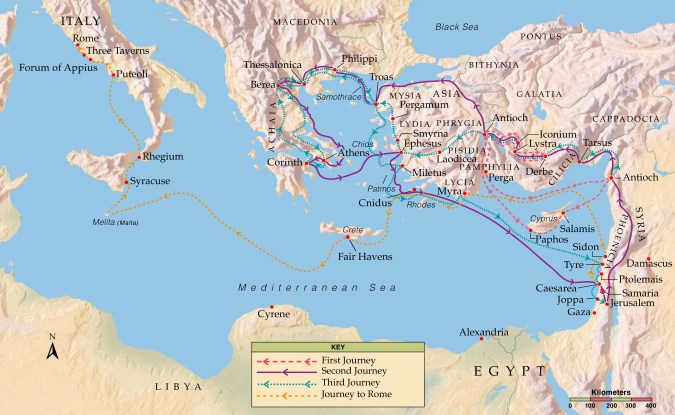
We’re back with the Apostle Paul this week, and here is some backstory. Paul had a significant connection to Corinth as founder of the Christian church there during his second missionary journey in the early 50s CE. For some context, realize that the crucifixion and resurrection of Jesus occurred approximately 20 years before that journey and that Paul’s conversion to Christianity happened roughly 4 years after the resurrection of Jesus. These events were still fresh on his mind. He spent 18 months in Corinth, preaching the Gospel and establishing a community of believers in this bustling, cosmopolitan city. Corinth’s diverse and morally complex environment posed challenges for the new Christians, prompting Paul to write letters like 1 and 2 Corinthians to address issues of unity, morality, and faith. These letters reveal Paul’s deep care for the Corinthian church and his commitment to guiding them in their spiritual growth.

In 1 Corinthians 10:1-13, believed to have been written sometime in 53-55 CE, Paul reminds the Corinthians of the lessons from Israel’s history, emphasizing that their ancestors experienced God’s blessings yet fell into sin and faced judgment. He uses examples of idolatry, immorality, and grumbling to warn against overconfidence and disobedience. Paul highlights that these stories serve as warnings for believers, urging them to remain steadfast in their faith and avoid temptation. He reassures them, however, that God is faithful and will not allow them to be tempted beyond what they can endure, always providing a way out.
What should we take away from this exchange? I’m struck by three things. First, I’m intrigued by his use of history. The people of Corinth during Paul’s time were a diverse lot, consisting of Greeks, Romans, and Jews. While there was a Jewish community in Corinth, evidenced by the presence of a synagogue where Paul preached (Acts 18:4), the majority of the population was likely Gentile. Paul’s letters to the Corinthians address a predominantly Gentile audience, as he often discusses issues like idolatry and pagan practices, which were more relevant to non-Jewish converts to Christianity. In spite of that, he frames their experience within the context of Jewish history. He emphasizes the presence of Jesus Christ in that story (verse 4), reinforcing the belief that the Triune God has been present from the very beginning of time. Second, Paul’s message is simultaneously a scolding (v. 7-13) and pep talk (v 13). (Sidebar: The “pep talk” aspect becomes even clearer if you read chapter 9 — verses 24-27 have always been a favorite of mine!) He is calling these nascent believers to shape up! He seems to be especially concerned about their overconfidence in the face of temptation, their complacency perhaps. And finally, Paul reminds the Corinthian Christians of God’s overwhelming faithfulness.
And let me circle back to my sense that Christians are in the wilderness of anxiety in 2025. St. Paul’s words feel remarkably relevant two thousand years later — read them again as if he is talking directly to you. Placing ourselves within the grand story of Christianity — recalling the struggles that so many have endured for centuries — balancing accountability with encouragement and continually reminding ourselves of God’s faithfulness in a broken world — these things are vital for us in this third week of Lent!
Soli deo Gloria!
Prayer: The Prayer of St. Patrick
The Prayer of St. Patrick, also known as St. Patrick’s Breastplate, is a powerful Christian hymn attributed to St. Patrick, the 5th-century missionary who brought Christianity to Ireland. It is a prayer of protection, invoking the strength of God and the Trinity to shield the believer from harm. Here are the lyrics to accompany John Rutter’s gorgeous rendition. The full prayer is much longer. YOU CAN ACCESS IT HERE.
Christ be with me, Christ within me
Christ behind me, Christ before me
Christ beside me, Christ to win me
Christ to comfort and restore me
Christ above me, Christ beneath me
Christ in quiet, Christ in danger
Christ in hearts of all that love me
Christ in mouth of friend and stranger
A Lenten Hymn: “My Song is Love Unknown”
My Song Is Love Unknown (ELW 343) was written in 1664 by Samuel Crossman, originally as a devotional poem reflecting on Christ’s love and sacrifice. The poem was later set to music by John Ireland in 1918—allegedly in just 15 minutes! The hymn poignantly captures the events of Holy Week, focusing on the paradox of Christ’s rejection and ultimate sacrifice for humanity. It remains a cherished piece in Christian worship, especially during Lent and Holy Week, for its timeless message and moving melody. It is a difficult hymn, but handled beautifully by the Choir of King’s College in Cambridge. Enjoy!
My song is love unknown
My Savior’s love to me
Love to the loveless shown
That they might lovely be
Oh, who am I that for my sake
My Lord should take frail flesh and die?
He came from his blest throne
Salvation to bestow
The world that was his own
Would not its Savior know
But, oh, my friend
My friend indeed
Who at my need his life did spend!
Sometimes we strew his way
And his sweet praises sing
Resounding all the day
Hosannas to our king
Then, “Crucify!” is all our breath
And for his death we thirst and cry
We cry out, we will have
Our dear Lord made away
A murderer to save
The prince of life to slay
Yet cheerful he to suff’ring goes
That he his foes from thence might free
In life no house, no home
My Lord on earth might have
In death no friendly tomb
But what a stranger gave
What may I say? Heav’n was his home
But mine the tomb wherein he lay
Here might I stay and sing
No story so divine!
Never was love, dear King
Never was grief like thine
This is my friend, in whose sweet praise
I all my days could gladly spend!
Faithful Conversations on Sunday
Join us on Sunday 23 March at 10:45 in the church library. We talk through the readings (some or all) in an informal setting — no prior preparation is necessary and all are welcome! Come and help us deepen our understanding of the readings!
