Faithful Conversations #127
Introduction to Readers
Teacher: Life is fleeting, like a passing mist. It is like trying to catch hold of a breath; All vanishes like a vapor; everything is a great vanity. (Ecclesiastes 1:2, The Voice translation)

This week’s haunting passage from Ecclesiastes brought back a memory that still lingers. A few years ago, I spoke with a former colleague—a thoughtful educator and friend—whose unexpectedly bleak outlook left me deeply unsettled. His tone was heavy with resignation, almost sorrowful, as if despair itself had been granted voice. That word, despair, from the Latin desperare—de, meaning “down from,” and sperare, “to hope”—captures what I heard: a jarring erosion of hope. The moment stayed with me because it reflected a quiet cynicism that seems to have settled into many lives in 2025. It’s a heaviness people carry just beneath the surface—rarely spoken, but always close at hand. Politically, culturally, and spiritually, we do seem to be drifting. The daily headlines point to conflict, division, and uncertainty. Even in our churches, fewer people attend, and the familiar communal patterns that once grounded generations now feel fractured. Is our despair new—or merely newly felt? The ancient text of Ecclesiastes, likely composed around 935 BCE, reminds us that seasons of sorrow, perplexity, and drift are not singular to our time. There is nothing new under the sun, declares the Teacher. The language, though distant, remains remarkably relevant, and it is perhaps comforting to realize we are not alone among the generations. And yet, what troubles me most isn’t just the state of the world—it’s the spiritual malaise — or disconnection — among our rising generations. Maybe that’s the teacher in me speaking. They grow up surrounded by noise—so many voices vying for their attention, so many versions of truth—yet few guiding anchors. Without a steady framework, philosophical or spiritual, they wander. Like the Teacher said, All is vanity. They face life’s questions with no compass, no inheritance of wisdom passed down through scripture or sacred tradition. A tough challenge we all need to consider.
Thanks for checking in again this week! The scripture readings for Pentecost 8 speak to each other in striking ways, and I’ll focus on Ecclesiastes in my reflection, drawing a connection with Psalm 49. Ecclesiastes, by the way, rarely shows up in the RCL, so I feel compelled to dive into it (I heartily recommend viewing the short video I posted at the bottom of the reading). I also am including a prayer reflection for countering anxiety, a familiar and fitting musical offering, and some updates regarding Faithful Conversations at ELC.
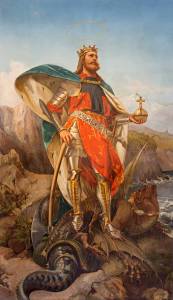
Our church calendar marks several commemorations this week: on July 28th, we remember Johann Sebastian Bach, Heinrich Schutz, and George Frederick Handel. On July 29th, we honor Mary, Martha, and Lazarus of Bethany—and Saint Olaf, a figure especially meaningful to me given my Nordic roots and his tie to one of the ELCA’s premier colleges in the Upper Midwest. Some quick background: Olaf II Haraldsson of Norway, later Saint Olaf, was born around 995. He began as a Viking warrior, but after converting to Christianity in Normandy, he returned home and became king in 1015. He worked to unify Norway through church-building, legal reform, and spreading the Christian faith, despite resistance from pagan leaders. Olaf died in 1030 at the Battle of Stiklestad while trying to regain his throne after exile. His death came to be seen as martyrdom, and miracles reported at his grave led to his recognition as Norway’s patron saint. The accompanying image is a painting from 1893 by Pius Adamowitsch Welonsky (1849-1939), now housed on an altar in the San Carlo al Corso Basilica in Rome.
** Note 1: Links to outside references are bolded and italicized and are meant for further reading or research on your part. While the text I am including in the blog is my own, I am pulling from a multitude of sites for ideas and connections.
** Note 2: In my increasing use of A.I. (Copilot), I will cite sourcing of how I am using the tool, if necessary. I don’t want that to be overly cumbersome, but I am gradually incorporating more tools. I am exploring the A.I. world this summer prior to my next teaching semester. As you can imagine, it is a great challenge right now and will forever change the face of education!
** Note 3: The images I include in the blog are drawn from Wikimedia Commons to the fullest extent possible.
Common Themes Among the Readings
Pentecost 8 Readings
Ecclesiastes 1:2, 12-14; 2:18-23
Psalm 49: 1-12
Colossians 3: 1-11
Luke 12: 13-21
My source for the Bible readings each week is the Bible Gateway website. I generally use the NRSVUE translation.
The readings for Pentecost 8 (Year C) share a sobering reflection on the futility of placing ultimate trust in wealth, possessions, or earthly accomplishments. Ecclesiastes and Psalm 49 both confront the transience of life and the inability of riches to secure lasting meaning or escape death. Luke’s parable of the rich fool echoes this warning, challenging the illusion that abundance equals security and urging a posture of being “rich toward God.” Colossians reframes the conversation by calling believers to set their minds on things above, putting to death earthly desires—especially greed, which is named as idolatry. Together, these texts invite a reorientation of values: from accumulation to generosity, from anxiety to trust, and from self-centered striving to a life hidden in Christ.
“Describe the common themes among the readings for Pentecost 8.” Copilot, 25 July 2025, Copilot website.
Psalm 49: 1-12
Hear this, all you peoples;
give ear, all inhabitants of the world,
2 both low and high,
rich and poor together.
3 My mouth shall speak wisdom;
the meditation of my heart shall be understanding.
4 I will incline my ear to a proverb;
I will solve my riddle to the music of the harp.
5 Why should I fear in times of trouble,
when the iniquity of my persecutors surrounds me,
6 those who trust in their wealth
and boast of the abundance of their riches?
7 Truly, no ransom avails for one’s life;
there is no price one can give to God for it.
8 For the ransom of life is costly
and can never suffice,
9 that one should live on forever
and never see the Pit.
10 When we look at the wise, they die;
fool and dolt perish together
and leave their wealth to others.
11 Their graves are their homes forever,
their dwelling places to all generations,
though they named lands their own.
12 Mortals cannot abide in their pomp;
they are like the animals that perish.
LUTHER’S METHOD OF BIBLE READING
GIVE IT A TRY!
A Revision of the Lectio Divina, a method he learned in his Augustinian training
Three Steps
Oratio (Prayer): This is the starting point, where one humbly prays for the Holy Spirit’s guidance to understand God’s Word. Luther emphasized that prayer prepares the heart and mind to receive divine wisdom.
Meditatio (Meditation): This involves deeply engaging with Scripture, not just reading it but reflecting on it repeatedly. Luther encouraged believers to “chew on” the Word, allowing its meaning to sink in and shape their thoughts and actions.
Tentatio (Struggle): Often translated as “trial” or “temptation,” this refers to the challenges and spiritual battles that arise as one seeks to live according to God’s Word. Luther saw these struggles as a way God refines faith, making it more resilient and authentic.
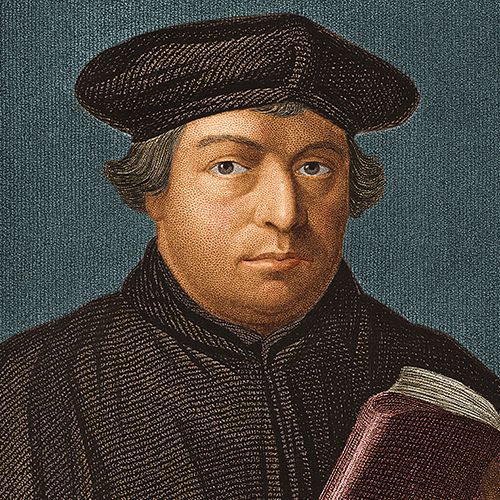
(1483-1546)
Ecclesiastes 1:2, 12-14; 2:18-23
2 Vanity of vanities, says the Teacher,
vanity of vanities! All is vanity.
12 I, the Teacher, was king over Israel in Jerusalem. 13 I applied my mind to seek and to search out by wisdom all that is done under heaven; it is an unhappy business that God has given to humans to be busy with. 14 I saw all the deeds that are done under the sun, and see, all is vanity and a chasing after wind.
18 I hated all my toil in which I had toiled under the sun, seeing that I must leave it to my successor, 19 and who knows whether he will be wise or foolish? Yet he will be master of all for which I toiled and used my wisdom under the sun. This also is vanity. 20 So I turned and gave my heart up to despair concerning all the toil of my labors under the sun, 21 because sometimes one who has toiled with wisdom and knowledge and skill must leave all to be enjoyed by another who did not toil for it. This also is vanity and a great evil. 22 What do mortals get from all the toil and strain with which they toil under the sun? 23 For all their days are full of pain, and their work is a vexation; even at night their minds do not rest. This also is vanity.
Source: The Bible Project
Reflection: ““Chasing the Wind, Trusting the Spirit”
In her introduction to Ecclesiastes in the Lutheran Study Bible (Updated Edition, 2025), Dr. Diane Jacobson of Luther Seminary, includes the following quote from Martin Luther: Ecclesiastes is a . . . “very beautiful and useful book . . . which on many counts deserves to be in everyone’s hands and to be familiar to everyone.” Luther, it seems, viewed the book as a profound reflection on human failings and divine grace (he lectured on it in 1526 and published his commentary in 1532). For Luther, the Preacher’s voice in Ecclesiastes (his interpretation of the Hebrew word Qoheleth) was honest about the futility of human striving when disconnected from God.

Here’s a quick summary of the passages in front of us this week (traditionally attributed to King Solomon, but there are debates about that): The Teacher in Ecclesiastes opens with a striking claim: Vanity of vanities! All is vanity, suggesting that life is as fleeting as smoke. (Sidebar: The word “vanity” appears roughly 38 times in the book of Ecclesiastes, making it one of the most defining terms of the text. It translates the Hebrew word hevel, which means breath, vapor, or mist—a metaphor for life’s fleeting, elusive nature). He surveys human activity and finds it to be mostly a meaningless pursuit—like chasing the wind—with no lasting impact. Though he labors with wisdom and skill, he’s troubled that all he’s worked for will pass to someone else after his death, who will not value it. The emotional toll of his work weighs heavily on him: restless nights, sorrow, and lingering anxiety. In the end, even the most diligent work offers no lasting satisfaction—only more evidence that this too is vanity.
Although I didn’t initially share Luther’s enthusiasm for Ecclesiastes, its message has begun to resonate—especially when read alongside Psalm 49. What should we take away from these passages? First, we live in a world enamored with achievement, intellect, and legacy — these things are rooted in our culture. This voice from two thousand years ago bristles with countercultural wisdom: life’s deepest truths are found not in permanence, but in impermanence. The Teacher’s sadness over fleeting labor, the limits of wisdom, and the futility of legacy (Ecclesiastes 1:2, 12–14; 2:18–23) echoes the psalmist’s sober reminder that wealth cannot redeem a soul, and that all—rich or poor, wise or foolish—are united in mortality (Psalm 49:1–12). Yes, death is the great equalizer. (Sidebar: both these passages are echoed by Jesus in this week’s Gospel). And second, these texts remind us to walk humbly, to accept the mystery woven into each moment, and to invest in people rather than possessions. They urge us to entrust our days to God—days often filled with striving and distraction—and seek the kind of wisdom that endures beyond our fleeting plans. In a world clouded by cynicism and despair, these words come as a quiet and piercing light. They speak into August 2025 with clarity and challenge: turn from noise, lean into relationship, and let grace guide us. And for those of us who carry God’s Kingdom in our hearts, this is not a passive calling. We are called to share it—freely, boldly, and with those in our midst!
Soli Deo Gloria!
Prayer Reflection: Hannah Whitall Smith

Hannah Whitall Smith (1832–1911) was a Quaker-born American evangelist, author, and reformer who became a leading voice in the Holiness and Higher Life movements. She gained international recognition for her spiritual classic The Christian’s Secret of a Happy Life (1875), which emphasized joyful surrender and practical sanctification. Active in the women’s suffrage and temperance movements, she helped found the Woman’s Christian Temperance Union and advocated for women’s education and leadership. Below is a favorite excerpt of mine from the book mentioned. Her words remind us that taking action is the great antidote to the sense of helplessness we may experience in our lives!
“Describe the life and background of Hannah Whitall Smith” Copilot, 26 July 2025, Copilot website.
“We are the agents of the Creative Spirit in this world. Real advance in the spiritual life, then, means accepting the vocation with all it involves. Not merely turning over the pages of an engineering magazine and enjoying the pictures but putting on overalls and getting on with the job. The real spiritual life must be horizontal as well as vertical; spread more and more as well as aspire more and more.“
A Musical Offering: “Turn, Turn, Turn” (Pete Seeger)
In the category of “songs that made it seem cool to be a Christian” from my formative years, this one stands out. Folk icon Pete Seeger supposedly came up with the tune in fifteen minutes and off it went. I have included an interview with Pete, if you want some further background. There are many great versions of the song out there — the one posted features The Byrds.
Seeger composed Turn! Turn! Turn! in 1959 by adapting Ecclesiastes 3:1–8, adding only six original words to its biblical text. After initial recordings by The Limeliters and Judy Collins, The Byrds released their electrified version in 1965, propelling it to #1 on the Billboard chart and embedding it in the cultural memory of the 1960s and beyond. The song’s timeless message of seasons and peace resonated deeply with both protest movements and spiritual seekers, appearing in films, memorials, and worship services across generations. Seeger, committed to the song’s pacifist roots, donated portions of the royalties to peace organizations and continued performing it as a witness to the enduring relevance of Scripture in public life. Enjoy!
Faithful Conversations: Three Updates

The 2025 ELCA Churchwide Assembly will convene July 28–August 2 at the Phoenix Convention Center in Arizona, gathering voting members from across the country for worship, discernment, and decision-making. This occurs once every three years and this year will include the election of a new Presiding Bishop and Secretary, as well as votes on key issues such as civic engagement, Indigenous justice, and church structure. Pastor Jen will be attending as a representative of the Northwest Synod of Wisconsin and let’s pray for everyone involved this week!
Our regular gatherings for discussing the weekly lectionary are on a pause. Summer worship at ELC is at 8:30 in town and 10:15 at Hatfield by the lake. The 8:30 service will be streamed. Please stay in touch!
📖 Ready to read the Bible in a year?
Starting this September, join our Bible 365 Challenge—a yearlong journey through Scripture for individuals, families, and groups. As Lutherans, we know God’s Word shapes our lives and deepens our faith. Luther once said, “The Bible is alive… it lays hold of me.” Whether you choose the print path or go digital, we’ll grow together—with daily readings, mutual support, and spiritual connection. Details are coming soon. Let’s dive in, walk together, and let the Word come alive in us!
