“Character building begins in our infancy and continues until death.” – Eleanor Roosevelt
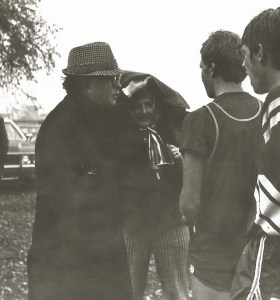
Character has been on my mind this week, stirred by Paul’s words in Romans for Trinity Sunday. The word immediately brings my mother, Cathy, to mind. Let me explain. For 60 years, I have immersed myself in athletics, either as a competitor or a coach. This particular photo—one of the few I have from my athletic days—captures a moment in 1974. My parents stood on the sidelines, enduring brutal weather to watch me compete in a Cross Country race during my senior year at West Fargo High School. Cathy never missed a chance to cheer me on, but beneath her unwavering support ran a fierce competitive streak. If she sensed I wasn’t pushing hard enough or thought I had slipped into self-pity, she wasted no time in setting me straight — she pushed me to persevere. My coaches appreciated her enthusiasm, I have no doubt! She would have wholeheartedly agreed with Eleanor Roosevelt, as she prepared me to face a challenging world. And, incidentally, wisdom often appears in Scripture as a personified woman—this week’s passage from Proverbs is an example. That image, much like the concept of character itself, reminds me of my mother. As part of my reflections this week, I’ll delve into how Paul frames character and how this applies to our lives as Christians.
As always, thanks for your continued interest in exploring the scriptures! And, a shout-out this week to all the fathers or father-figures in our lives. Thanks for everything that you do! We are now beyond the half-year of seasons (Advent, Christmas, Epiphany, Lent, and Easter) and are on the front end of the long season of Pentecost with this question guiding our reading: What does it mean to live out Jesus’ teachings in our chaotic and turmoil-filled world? The blog this week includes some thoughts on the Holy Trinity, Luther’s Trinitarian Prayer, and a joyful organ selection of a Trinity-inspired hymn. And one note: I sprinkle in a few hyperlinks throughout the blog if you care to do further reading — there are italicized and bolded.
The readings for Holy Trinity Sunday emphasize God’s wisdom, majesty, and relational nature. Proverbs 8 presents wisdom as an eternal presence with God, rejoicing in creation and calling humanity to understanding. Psalm 8 marvels at God’s grandeur, questioning humanity’s place in the cosmos while affirming human dignity as stewards of creation. Romans 5 highlights the transformative power of faith, where suffering leads to hope through the love of God poured out by the Holy Spirit. John 16 reveals the Spirit’s role in guiding believers into truth, glorifying Christ, and deepening the connection between the Father, Son, and Holy Spirit.
Romans 5: 1-5 5 Therefore, since we have been justified through faith, we have peace with God through our Lord Jesus Christ, 2 through whom we have gained access by faith into this grace in which we now stand. And we boast in the hope of the glory of God. 3 Not only so, but we also glory in our sufferings, because we know that suffering produces perseverance; 4 perseverance, character; and character, hope.5 And hope does not put us to shame, because God’s love has been poured out into our hearts through the Holy Spirit, who has been given to us.
Check out this introductory segment on Romans for background on this week’s passage. This comes from our friends at the Bible Project. There is a segment on Romans 5-16 as well, if you’re interested. You can find that here, along with many other guides.
TRY LUTHER’S METHOD OF BIBLE READING
A Revision of the Lectio Divina, a method he learned in his Augustinian training (Three Steps)
Oratio (Prayer): This is the starting point, where one humbly prays for the Holy Spirit’s guidance to understand God’s Word. Luther emphasized that prayer prepares the heart and mind to receive divine wisdom.
Meditatio (Meditation): This involves deeply engaging with Scripture, not just reading it but reflecting on it repeatedly. Luther encouraged believers to “chew on” the Word, allowing its meaning to sink in and shape their thoughts and actions.
Tentatio (Struggle): Often translated as “trial” or “temptation,” this refers to the challenges and spiritual battles that arise as one seeks to live according to God’s Word. Luther saw these struggles as a way God refines faith, making it more resilient and authentic.
Luther’s Seal
Reflections (Part 1): “The Holy Trinity”
Almighty Creator and ever-living God: we worship your glory, eternal Three-in-One, and we praise your power, majestic One-in-Three. Keep us steadfast in this faith, defend us in all adversity, and bring us at last into your presence, where you live in endless joy and love, Father, Son, and Holy Spirit, one God, now and forever. Amen.
Here are a few things to think about this week regarding the Holy Trinity. Many Christian traditions follow a structured liturgy, shaping worship through prayers and rituals passed down over generations. Some parts of the liturgy, known as Propers, change based on the calendar, aligning with the Revised Common Lectionary and marking special observances like Epiphany or Pentecost. The Prayer of the Day for Holy Trinity Sunday (above), found on page 37 of the ELW(Evangelical Lutheran Worship hymnal), continues a tradition that traces back to the 16th-century Book of Common Prayer. I included this prayer to encourage reflection on the Holy Trinity, often called “the central mystery of the Christian faith and life.”
Martin Marty (1928-2025)
Many volumes explore the Trinity, but words alone struggle to capture its full meaning. Still, as theologian Martin Marty suggests, the Trinity teaches us about relationship—not just between God and humanity, but in how we interact with each other. He writes: “The Trinity is the model of the relational life, and invoking the Trinity draws us into thinking and experiencing divine-human relations that we can then carry into human-to-human relations . . . God. Father. Creator. Son. Redeemer. Savior. Spirit. Advocate. Comforter . . . the Trinity opens the door of imagination and the focusing power of prayer to much more than if we do not invoke the Trinity” (Lutheran Questions, Lutheran Answers, p. 42).
The discussion around the Trinity isn’t just a relic of history. I learned this week, for example, that The Lutheran World Federation (LWF), which includes our church, continues theological dialogues with Roman Catholic and Orthodox traditions, working toward greater understanding and unity. Decades of conversation with the Catholic Church led to the Joint Declaration on the Doctrine of Justification, a major step in bridging doctrinal differences. Likewise, dialogues with Orthodox churches have addressed topics such as the Holy Spirit, the nature of the Church, and historical disputes like the Filioque controversy. These ongoing conversations remind us that the doctrine of the Trinity remains deeply relevant in shaping faith today. Check out this joint statement from June 2025.
Reflections (Part 2): “Character Forged in Faith”
Like many passages in Romans, this week’s second reading packs a punch. Paul proclaims a bold truth: through faith, we stand justified and reconciled with God. Christ grants us access to grace, and we rejoice in the hope of His glory. But our confidence is not limited to moments of triumph—we find glory even in suffering, knowing it refines us. Hardships build endurance, endurance shapes character, and character fuels unwavering hope. This hope never fails us because God has poured His love into our hearts through the Holy Spirit, His gift to us. We are strengthened, sustained, and assured by the power of divine love.
Seminary Professor Chrystal Halloffers a compelling interpretation of this passage, highlighting how Paul grapples with integrating vastly different peoples—Gentiles and Jews—into the church despite their cultural, legal, and religious differences. Even in 2025, unity remains a challenge for the Christian community. Hall also emphasizes the Trinity’s presence in this passage, showing how its three Persons intertwine in relationship. Followers of the Anointed One experience God’s peace through Jesus and receive God’s love through the Holy Spirit, who pours that love into their hearts. This interdependence reflects our own relationship with one another and with God—a model suggested by Martin Marty (note Part 1 of my Reflections).
Finally, as alluded to in my blog introduction this week, I’ve always been struck by the language in verses 3-4: “suffering produces perseverance; perseverance, character; and character, hope.” The Greek word for “endurance” conveys resilient perseverance, while “character” implies steadfast reliability, especially in God’s eyes. These words resonate deeply in 2025, reminding us to remain strong as we navigate a challenging world. May the Holy Spirit inscribe them on our hearts!
Soli Deo Gloria!
Prayer Reflection: “Trinitarian Prayer and Blessing” (Martin Luther)
O God the Father, graciously give us all that we need for body and soul.
O Son of God, deliver us from sin, be gracious to us, and give us your Spirit.
O God, Holy Spirit, heal, comfort and strengthen us against the devil, and give us endless victory and resurrection from death. Amen.
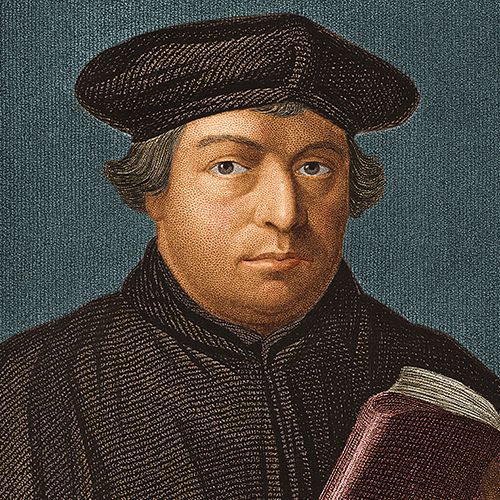
Martin Luther (1483-1546)
A Musical Offering: “Come, Join the Dance of Trinity” (412, ELW)
Come, Join the Dance of Trinity
Come, join the dance of Trinity, before all worlds begun– the interweaving of the Three, the Father, Spirit, Son. The universe of space and time did not arise by chance, but as the Three, in love and hope, made room within their dance.
Come, see the face of Trinity, newborn in Bethlehem; then bloodied by a crown of thorns outside Jerusalem. The dance of Trinity is meant for human flesh and bone; when fear confines the dance in death, God rolls away the stone.
Come, speak aloud of Trinity, as wind and tongues of flame set people free at Pentecost to tell the Savior’s name. We know the yoke of sin and death, our necks have worn it smooth; go tell the world of weight and woe that we are free to move!
Within the dance of Trinity, before all worlds begun, we sing the praises of the Three, the Father, Spirit, Son. Let voices rise and interweave, by love and hope set free, to shape in song this joy, this life: the dance of Trinity.
“Come, Join the Dance of Trinity” is a hymn written by Richard Leach, known for his ability to craft texts that are both biblically grounded and theologically rich. The hymn draws on the ancient concept of perichoresis, an early theological term describing the interrelationship of the Father, Son, and Holy Spirit—often likened to a divine dance. The hymn’s four stanzas explore the Trinity’s role in creation, redemption, and the Spirit’s ongoing work, culminating in an invitation for believers to join in the dance of faith. It is commonly set to the KINGSFOLD tune, a melody with medieval roots that has been adapted for various hymns. The organist you’re hearing is Jeffrey Dexter of Zion Lutheran Church in Ohio. The visuals are interesting throughout the song.
Zion is a congregation of the Evangelical Lutheran Church in America (ELCA), part of the Northeastern Ohio Synod of the ELCA, founded in 1840 and located in downtown Wooster.
Update on “Faithful Conversations”
Our regular gatherings for discussing the weekly lectionary are on a pause. Summer worship at ELC is at 8:30 in town and 10:15 at Hatfield by the lake. The 8:30 service will be streamed. Please stay in touch!
Recent News Regarding the Lutheran Study Bible!
This is something you may be interested to know. In 2009, the Lutheran Study Bible was published by Augsburg Fortress. It featured the New Revised Standard Version (NRSV) translation and included introductions, notes, and articles written by ELCA Lutheran pastors and theologians. It provided historical and cultural context, theological insights, and faith reflection prompts to help readers engage deeply with Scripture. I have used if for a number of years. A second edition, featuring the NRSV Updated Edition (NRSVue), is set to release in July 2025, expanding on the original with contributions from over seventy Lutheran scholars. If you’re looking for a Bible that connects well with the ELCA, check it out.
Augsburg Fortress is the publishing branch of the Evangelical Lutheran Church in America (ELCA). It creates resources for worship, music, faith education, and church life, including hymnals, theological books, and study materials. It also runs Fortress Press, which publishes academic and theological works for pastors, educators, and general readers. Over the years, Augsburg Fortress has shaped Lutheran teaching and provided essential materials for churches.
On February 3, 1943, a German torpedo struck the SS Dorchester, a U.S. Army transport ship, in the icy North Atlantic. Four chaplains—Alexander D. Goode (Jewish rabbi), George L. Fox (Methodist), Clark V. Poling (Dutch Reformed), and John P. Washington (Catholic)—guided soldiers to safety, handed out life jackets, and offered prayers. When the life jackets ran out, they gave up their own and remained aboard, linked arm in arm, praying and singing hymns as the ship sank—a lasting testament to unity and courage.
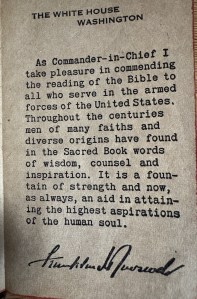
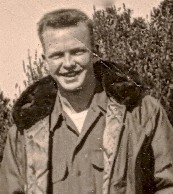
As Memorial Day weekend and the 6th Sunday in Easter intersect, the story of the four chaplains feels especially poignant. My father, Thor—aka “Unk”—joined the Army at 19 in 1943, flying 49 missions as a tail-gunner on a B-25 Mitchell in the Italian Theater. His pocket New Testament, inscribed by the Commander-in-Chief, remains a cherished possession, and his dog tags bore his Lutheran identity. Among other things, World War II reshaped interfaith relations, uniting Protestant, Catholic, and Jewish communities under a shared identity, with freedom of religion standing among the FOUR FREEDOMS that defined the war effort. Unk often said military service expanded his world beyond his northern small-town roots. This week, take time to pray for those who serve and honor those whose lives ended on some distant field of battle. I’ve included a haunting piece of music in my blog that I believe you’ll find moving.
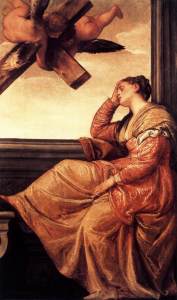
“The Dream of St. Helena” by Paolo Veronese (1528 – 1588)
Monday marks day 29 of Eastertide, meaning the celebration of Pentecost (8 June) is 21 days away. We have three commemorations noted in our calendar this week (pages 14-17 of the ELW): Helena, mother of Constantine (died on 21 May c. 330), and scientists Nicolaus Copernicus and Leonhard Euler (both died on 24 May 1543 and 1783 respectively). Emperor Constantine’s conversion to Christianity in 312 CE led to the Edict of Milan in 313, granting religious tolerance to Christians. He actively supported the Church, commissioning Christian buildings, including the original St. Peter’s Basilica and convening the Council of Nicaea in 325 to address theological disputes and establish foundational doctrines. If interesting, read more about his mother, SaintHelena here! And, as always, thanks for visiting this space again this week. I consider each blog entry an unfinished dialogue, and my hope is that you read them in that spirit. I offer them with humility — the more I learn, the more I understand how much I do not know! My reflection this week will focus on the story of Lydia’s conversion as recounted in Acts 16.
The readings for the sixth Sunday in Easter emphasize divine guidance, inclusion, and peace. In Acts 16, Paul follows a vision that leads him to Lydia, whose open heart exemplifies God’s call to all people. Psalm 67 echoes this theme, celebrating God’s blessings reaching every nation, while Revelation 21 paints a vision of a radiant, welcoming city where God’s presence illuminates all. John 14 reinforces this promise, as Jesus assures his followers of the Spirit’s guidance and the peace that transcends earthly troubles.
Focus: Acts 16: 9-15: Lydia’s Conversion
9 During the night Paul had a vision: there stood a man of Macedonia pleading with him and saying, “Come over to Macedonia and help us.” 10 When he had seen the vision, we immediately tried to cross over to Macedonia, being convinced that God had called us to proclaim the good news to them. 11 We therefore set sail from Troas and took a straight course to Samothrace, the following day to Neapolis, 12 and from there to Philippi, which is a leading city of the district of Macedonia and a Roman colony. We remained in this city for some days. 13 On the Sabbath day we went outside the gate by the river, where we supposed there was a place of prayer, and we sat down and spoke to the women who had gathered there. 14 A certain woman named Lydia, a worshiper of God, was listening to us; she was from the city of Thyatira and a dealer in purple cloth. The Lord opened her heart to listen eagerly to what was said by Paul. 15 When she and her household were baptized, she urged us, saying, “If you have judged me to be faithful to the Lord, come and stay at my home.” And she prevailed upon us.
“The Lord opened her heart to listen eagerly to what was said by Paul.“
TRY LUTHER’S METHOD OF BIBLE READING
A Revision of the Lectio Divina, a method he learned in his Augustinian training (Three Steps)
Oratio (Prayer): This is the starting point, where one humbly prays for the Holy Spirit’s guidance to understand God’s Word. Luther emphasized that prayer prepares the heart and mind to receive divine wisdom.
Meditatio (Meditation): This involves deeply engaging with Scripture, not just reading it but reflecting on it repeatedly. Luther encouraged believers to “chew on” the Word, allowing its meaning to sink in and shape their thoughts and actions.
Tentatio (Struggle): Often translated as “trial” or “temptation,” this refers to the challenges and spiritual battles that arise as one seeks to live according to God’s Word. Luther saw these struggles as a way God refines faith, making it more resilient and authentic.
Luther’s Seal
Reflections: “Divine Guidance”
Several women in the New Testament make short, seemingly random appearances, yet profoundly speak to us across time. Three examples (among many others) are Anna the prophetess (Luke 2:36–38) who recognizes Jesus as the Messiah when he is presented at the temple, the unnamed woman (Mark 5:25–34) who reaches out in faith to touch Jesus’ cloak, demonstrating the power of belief and healing, and Pilate’s wife (Matthew 27:19) who warns her husband about condemning Jesus, offering a rare glimpse of moral insight in the trial narrative. And let’s add the intriguing encounter between Lydia and Paul to that list.
THE CONTEXT: Paul’s second missionary journey (49–52 CE) helped spread Christianity into Europe for the first time. He traveled through Greece, preaching in cities like Philippi, Thessalonica, Athens, and Corinth, where he gained converts but also faced opposition. In Philippi, he baptized Lydia and was miraculously freed from prison, while in Athens, he debated Greek philosophers about faith. His journey relied on Roman roads and sea routes, making travel easier despite frequent conflicts over Gentile believers. Lasting about three years, this trip built strong Christian communities that later received his letters of guidance and encouragement.
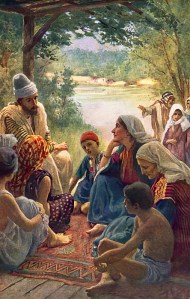
Lydia of Thyatira by Harold Copping (1863-1932)
THE STORY: Acts 16:9-15 describes a pivotal moment in Paul’s missionary journey, where he receives a vision of a man from Macedonia pleading for help. This vision leads Paul and his companions to change course and travel to Macedonia, marking the spread of Christianity into Europe. Upon arriving in Philippi, a Roman colony, Paul and his group seek out a place of prayer and encounter Lydia, a merchant dealing in purple cloth. Lydia is described as a worshiper of God, and as she listens to Paul’s message, her heart is opened by the Lord. She and her household are baptized, and she offers hospitality to Paul and his companions. (Postscript: Acts 16: 16-40 is worth a few moments of your time — a crazy story! Paul and Silas got thrown into prison for ruining a lucrative fortune-telling business, but instead of sulking, they turned the jail into a midnight worship concert—which was so powerful that an earthquake broke open the doors. The terrified jailer, ready to end it all, was stopped by Paul, who instead converted him and his entire household on the spot. By morning, the magistrates tried to quietly dismiss them, but Paul pulled the “I’m a Roman citizen” card, forcing them into an awkward public apology before strolling out of town like a seasoned evangelist with diplomatic immunity. And where did they go? Back to Lydia’s home!).
WHO WAS LYDIA? Lydia is primarily known by her given name, but she has been referred to by a few descriptive titles, notably “The Woman of Purple.” Some traditions, including the ELCA, honor here due to her important role in early Christianity (we commemorate her as a “witness to the faith,” along with Phoebe and Dorcas, on 27 January). Lydia was a successful merchant of purple cloth, a luxury item associated with wealth and royalty, and she likely held considerable influence in her trade. Originally from Thyatira, a city known for its dye industry, she emigrated to Philippi, where she became a God-fearer, meaning she worshiped the God of Israel without fully converting to Judaism. When Paul met her by the riverside, she listened intently, and God opened her heart to receive the Gospel, leading to her baptism along with her household. She then offered hospitality to Paul and his companions, making her home a center for early Christian gatherings, possibly the first church in Europe (sidebar: The church of Thyatira is mentioned in Revelation 2:18-29, where Jesus addresses it as one of the seven churches of Asia Minor. Thyatira was a small but prosperous city, known for its trade guilds, including those involved in dyeing fabrics—possibly linking it to Lydia, the seller of purple cloth from Acts).
WHAT SHOULD WE TAKE AWAY FROM THE LYDIA STORY? Two things stand out to me. First, there is the issue of divine guidance. Paul’s nighttime vision (verse 9) directs him to Macedonia, no small matter. Paul often comes across to me as an anxious (even tortured) soul, but when something became clear to him, he proceeded with great courage and intensity. Much will come from that trip for Paul, his companions, and the people they encounter. Second, we learn that God opened Lydia’s heart (verse 14), a reminder of the notion of what some in the faith community refer to as Effectual Calling, the irresistible work of God in drawing people to salvation—it’s not just an invitation, but a divine summons that guarantees a response.** Lydia’s example is important for us to think about. Do we leave ourselves open to God’s call to spread the Gospel? Lydia’s openness to Paul’s message and her willingness to support his mission reflect the transformative power of faith and generosity, a timeless lesson for all of us!
Soli Deo Gloria!
Martin Luther
(1483-1546)
** For futher discussion: Calvinism, for example, places great emphasis on effectual calling. As Lutherans, the notion of “being called” is central, and we certainly emphasize God’s role in salvation. Luther taught that humans are bound by sin and cannot choose God on their own, aligning with the idea that faith is a gift. However, he focused more on vocation, believing that God calls people to serve Him in all aspects of life, not just in salvation. While he affirmed that God initiates faith, he didn’t frame it in the strict irresistible grace model found in Calvinism. He was more about God’s calling in daily work and service, rather than a predetermined, irresistible summons to salvation.
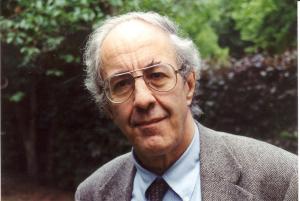
Prayer Reflection: “Living in the Light” (Henri Nouwen)
Dutch Theologian
Henri Nouwen
(1932-1996)
Lord Jesus, I come to you to enter into the mystery of your way – the way of discipleship, the way that leads from the cross to new life. It is not an easy way, but it is a way of peace and joy. Help me to be here with a heart open to suffering, a mind open to understanding, and a will ready to follow. There are many struggles and I will always have many struggles, but with you, O Lord, I am living in the Light. With you, O Lord, I am moving more and more toward life. With you, O Lord, I know I am safe. Let me celebrate my life in a spirit of gratitude. Grateful that I am here and grateful you are my God. Amen.
Lyrics: Mansions of the Lord To fallen soldiers let us sing, Where no rockets fly nor bullets wing, Our broken brothers let us bring To the Mansions of the Lord
No more bleeding, no more Fight No prayers pleading through the night Just Divine embrace, Eternal light, In the Mansions of the Lord
Where no mothers cry And no children weep, We will stand and guard Though the angels sleep, All through the ages safely keep The Mansions of the Lord
“Mansions of the Lord” is a solemn hymn honoring fallen soldiers. It was written by Randall Wallace and composed by Nick Glennie-Smith for the 2002 film We Were Soldiers, which told the story of the Battle of Ia Drang in Vietnam. The use of the term “mansions” in the title is clearly a reference to John 14:2 (King James version): “In my Father’s house are many mansions: if it were not so, I would have told you. I go to prepare a place for you.”
During our son Jake’s time at West Point (2004-2007), we had the opportunity to worship there in a couple of settings and had the privilege of hearing great music!
Update on “Faithful Conversations”
Our regular gatherings for discussing the weekly lectionary are on a pause. Memorial Day weekend will be the kick-off for our Hatfield Services and there will be no in-town service this weekend! Join us at the lake!
Introduction to Bible Study
A few weeks back, I shared this link to the on-line class I put together and am reposting now as we get into the summer phase of the Lectionary. If you’re looking for a “reboot” on how to approach Bible study, take a look! Click on the photo for access!
It’s been quite a week in the world of Christendom! After two days and four ballots, Cardinal Robert Prevost was selected as the 267th Pope, the first time an American has held the position (he is also a citizen of Peru). Of the roughly 2.6 billion Christians worldwide, 1.2 billion (48%) are Catholic, making Leo instantly the most identifiable Christian leader in the world. Globally, 619 million Christians are in the Protestant camp, including 110 million who call ourselves “Lutherans” (To put that in perspective, the ELCA represents slightly more than 2.5% of the global Lutheran population). To further explore numbers, there are 5.3 million Lutherans in the United States, and roughly 3 million of them are members of an ELCA congregation.
My sense over the past few days is that Pope Leo’s first moments presented a joyful and ecumenical aura. Regular blog readers will note that my father’s example is ever-present for me and a defining mark of his 50-year ministry was a commitment to ecumenical efforts within Christianity. Unk enjoyed healthy dialogue with colleagues across denominations in every community he served, and especially Catholic priests. As a tag-along, I witnessed so many interesting conversations in that regard. His impulses reflected the traditions of what became the ELCA in 1988, and we should celebrate that more than we do. We currently share communion, for example, with the following bodies: the Presbyterian Church (USA), the Reformed Church in America, the United Church of Christ, The Episcopal Church, The Moravian Church, and the United Methodist Church. Beyond that, the ELCA has an important global reach.**
We are three weeks into the period of Eastertide, the 50 days between Easter (April 20) Pentecost (June 8). Acts, Revelation, and John’s Gospel are receiving much attention in the Year C readings, giving us a great opportunity to learn more about each book. My reflections this seek will focus on the Revelation passage and included a video for some background on that. In addition, I’m including a poem/prayer from Jane Joyce Wilson and a rich musical piece called Earth Song. As always, thanks for your continued interest in exploring the Lectionary readings each week!
“Therefore, without fear, united hand in hand with God and among ourselves, we move forward. We are disciples of Christ. Christ precedes us. The world needs his light. Humanity needs him as the bridge to allows it to be reached by God and by his love.”
Cardinal Robert Prevost in his first speech as Pope Leo XIV
The leader of the ELCA, Bishop Elizabeth Eaton, joined other Christians leaders in welcoming the new Pontiff: “We pray that the Holy Spirit will sustain Pope Leo XIV for the ministry to which he has been called, and will strengthen us all in our vocations as bridge-builders and as witnesses to God’s love for all people and creation.”
Look for the following themes in the Easter 5 Readings: inclusion, renewal, and love. In Acts 11, Peter learns that God’s grace extends beyond traditional boundaries, welcoming all people into faith. Revelation 21 speaks of a new creation, where God dwells among humanity, bringing healing and restoration. Psalm 148 and John 13 reinforce the call to praise and love, reminding believers that God’s presence transforms the world through unity and compassion.
Focus: Revelation 21: 1-6
Then I saw a new heaven and a new earth, for the first heaven and the first earth had passed away, and the sea was no more. 2 And I saw the holy city, the new Jerusalem, coming down out of heaven from God, prepared as a bride adorned for her husband. 3 And I heard a loud voice from the throne saying,
“See, the home of God is among mortals. He will dwell with them; they will be his peoples, and God himself will be with them and be their God; 4 he will wipe every tear from their eyes. Death will be no more; mourning and crying and pain will be no more, for the first things have passed away.”
5 And the one who was seated on the throne said, “See, I am making all things new.” Also he said, “Write this, for these words are trustworthy and true.” 6 Then he said to me, “It is done! I am the Alpha and the Omega, the Beginning and the End. To the thirsty I will give water as a gift from the spring of the water of life.
For the context of this passage, take time to watch this excellent background video!
TRY LUTHER’S METHOD OF BIBLE READING
A Revision of the Lectio Divina, a method he learned in his Augustinian training (Three Steps)
Oratio (Prayer): This is the starting point, where one humbly prays for the Holy Spirit’s guidance to understand God’s Word. Luther emphasized that prayer prepares the heart and mind to receive divine wisdom.
Meditatio (Meditation): This involves deeply engaging with Scripture, not just reading it but reflecting on it repeatedly. Luther encouraged believers to “chew on” the Word, allowing its meaning to sink in and shape their thoughts and actions.
Tentatio (Struggle): Often translated as “trial” or “temptation,” this refers to the challenges and spiritual battles that arise as one seeks to live according to God’s Word. Luther saw these struggles as a way God refines faith, making it more resilient and authentic.
Luther’s Seal
Reflections: “I am making all things new”
Johann Georg Rapp
Let me start with a quick story. Johann Georg Rapp (1757-1847) was no ordinary preacher—he was a spiritual disruptor, shaking off Lutheranism in Germany like dust from his feet, convinced it had lost its way and fallen into the grip of state control. With his eyes set on prophecy, he led his devoted flock across the Atlantic in 1803, carving out a New Jerusalem in the American wilderness. The Harmony Society was no half-hearted congregation—it was a self-sufficient, celibate, fiercely disciplined movement, grinding out industry and waiting for the heavens to split open with Christ’s return. Rapp’s take on Revelation 20-21 was pure pre-millennial urgency—his people weren’t making casual predictions, they were living on the edge of eternity on the American frontier. Though he never thundered in revival tents, his movement pulsed with the raw energy of the Second Great Awakening, blending faith, prophecy, and industry into a bold experiment in millennial expectation. (Sidebar: Rapp’s Harmony Society, rooted in Germany, and Han Nielson Hauge’s revival movement in Norway both fostered self-sufficient communities, though Rapp’s followers embraced communal living and celibacy, while Haugeans focused on lay preaching and social reform. Both were rooted in pietism. Our parish — ELC in Black River Falls — had Haugean influence in its early years).
Any number of spiritual movements across the centuries have predicted (and they have all been wrong) that Christ’s return is imminent, and in fact, can be pegged to a specific date. George Rapp is one such example. He and his fervid followers believed Christ would return before the Millennium—a thousand-year reign—to establish His kingdom on earth, with a period of tribulation coming first. (Post-millennialists, both in Rapp’s time and today, believe Christ will return after the Millennium, seeing it as an era of spiritual progress where society improves through the Gospel before Christ comes for the final judgment).
And therein lies one of the great challenges prompted by the book of Revelation. Those of us reared within the ELCA tradition most likely did not have a lot of exposure to the book of Revelation growing up. The symbolic imagery, apocalyptic themes, and complex structure are challenging. And, you might wonder, where does the ELCA fit into the pre vs. post-millennialism argument? We have been described as embracing amillennialism (sorry for all the jargon!), which interprets the Millennium in Revelation symbolically rather than as a literal thousand-year reign. Amillennialists believe that Christ is already reigning spiritually through His Church and that His Second Coming will bring about the final judgment and the new creation, rather than a distinct millennial kingdom on earth. With that as a backdrop, let’s take on this week’s Revelation passage. (Sidebar: I can never read 21:1 without recalling a paper I wrote in a religion class as a freshman in college. The topic of the paper was comparing millennial movements, and I was trying to swim in water that was way over my head! The paper was returned to me with a large red “D” on it and one comment from the tough professor: “This is not a good paper.” I had to go in and meet with him on it — not a pleasant experience!)
A quick summary. Revelation 21: 1-6 describes a vision of a renewed creation, where God establishes a new heaven and earth and brings forth the holy city, the New Jerusalem, as a symbol of divine restoration. In this new reality, God dwells among humanity, offering comfort and ending sorrow, death, and pain, marking the fulfillment of His promise to redeem and renew. The passage concludes with God’s declaration—He is the Alpha and the Omega, the source of all life, and He freely gives the water of life to those who seek Him.
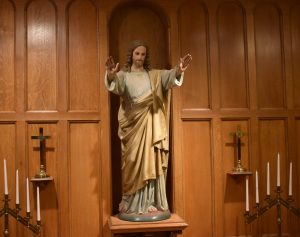
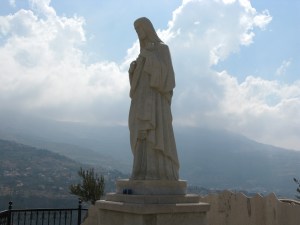
Statue of Jesus Christ in Bcharre, Lebanon
What should we take away from these verses? First, it is tempting with the state of our world, I must admit, to cling to the idea that at some point God is simply going to wipe everything out and start over. There is some appeal to that. But, as theologian Anna M.V. Bowden asserts in her commentary on this passage, the original language John used in verse one suggests, not the destruction of the world, but rather a departure. The first heaven and first earth have departed and a new heaven and earth are arriving. As Bowden asserts, “This scene from Revelation images heaven coming down to earth. Despite popular depictions of heaven, God comes to us. God chooses to join us. It isn’t the other way around. God, it seems, isn’t in the business of starting over.” Second, verses 3-4 offer a beautiful reminder for us. Our lives are intertwined with God. He is with us. In fact, he mourns with us. Let that sink in especially when you are carrying grief in your heart. Again, from Anna Bowden, “What God offers in this moment is not a one-way ticket out of Dodge. God offers care. God does more than simply rescue God’s people. God joins God’s people in their pain and suffering and expresses sympathy and concern for them. Just as they see God, God sees them.”
Finally, in our despairing world, verses 5-6 powerfully resonate. We have a compassionate God who is in charge and continually makes all things new. We are called to join Him in that work. Yes, the Kingdom of God is here!
Soli Deo Gloria!
Prayer Reflection and Poem:Crazy Quilt (Jane Joyce Wilson)
The Liberty Bell in Philadelphia is cracked. California is splitting off. There is no East or West, no rhyme, no reason to it. We are scattered. Dear Lord, lest we all be somewhere else, patch this work. Quilt us together, feather-stitching piece by piece our tag-ends of living, our individual scraps of love.
Jane Wilson Joyce (PhD University of Texas, Austin) retired in 2012 as Luellen Professor Emerita of Classics at Centre College in Kentucky. A classical scholar with wide-ranging interests, This poem comes from her book The Quilt Poems (1984). Retrieved from JourneywithJesus.net, 11 May 2025.
A Musical Offering: Earth Song
Lyrics: Earth Song
Sing, be, live, see This dark stormy hour The wind, it stirs The scorched Earth cries out in vain Oh war and power, you blind and blur The torn heart cries out in pain But music and singing have been my refuge And music and singing shall be my light A light of song, shining strong Hallelujah, hallelujah Through darkness and pain and strife I’ll sing, I’ll be, live, see Peace
Frank Ticheli is an American composer known for his orchestral, choral, and concert band works. Born in Monroe, Louisiana in 1958, he studied composition at Southern Methodist University before earning his master’s and doctoral degrees from the University of Michigan.
Earth Song is a deeply personal reflection on the turmoil and violence he witnessed in the world, particularly during the Iraq War. The piece serves as a quiet yet powerful response to conflict, offering a sense of refuge and hope through its serene melody and uplifting message. It fits well with this week’s Revelation passage and more broadly, with the tumultuous world of 2025!
Mount Royal Kantorei is an award winning mixed-voice auditioned choir based in Calgary, Alberta, affiliated with Mount Royal University’s Conservatory. Established in 1995, the choir has built a reputation for exceptional choral performances, blending traditional and contemporary classical music.
Update on “Faithful Conversations”
Join us on Sunday 18 May for informal conversation regarding the Sunday readings after church in the library — no prior preparation is necessary. This will be our last meeting until we gather again in September!
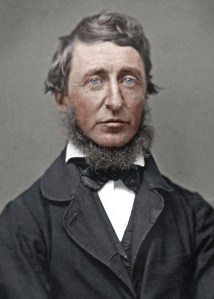
“The mass of men lead lives of quiet desperation.”(Henry David Thoreau, Walden)
Thoreau’s famous line from his 1854 book resonates in 2025. Though harsh, his suggestion that many people — indeed, more than we may want to admit — settle into unfulfilled lives, accepting their circumstances rather than seeking deeper meaning or change, is worth exploring. Thoreau came to mind this week, in part, because I stumbled on a compelling essay from Arthur Brooks in The Atlantic Magazine (1 May 2025). The gist of Brooks’ message is this: Young Americans are becoming less happy, and studies show it’s a global trend, especially in wealthier nations. Traditionally, happiness dips in young adulthood and rises later in life, but now it starts low and stays low longer. A big factor is lack of strong social connections—young people with more friends tend to follow a healthier happiness curve. Another key factor is declining religious participation, which is linked to a loss of meaning in life. Wealth may reduce reliance on religion, but data suggests that faith still plays a strong role in well-being, particularly in rich societies. The solution? Prioritizing real-life relationships, seeking deeper purpose, and remembering that money alone won’t bring happiness — ideas that should resonate with those of us who walk the Christian path!
Thanks for visiting this space again this week! We are two weeks into the 50-day journey of Eastertide, the time period between the Resurrection of Christ and the coming of the Holy Spirit on Pentecost (8 June). In Year C of the Revised Common Lectionary (RCL), Eastertide readings emphasize themes of resurrection, transformation, and the mission of the early Church. The Acts of the Apostles takes center stage, replacing Old Testament readings to highlight the spread of the Gospel and the work of the Holy Spirit. The Gospel readings often come from John and Luke, focusing on Christ’s post-resurrection appearances and teachings. Beyond my reflections this week’s Gospel, I will offer information related to the ELCA connection to the issue of missing and murdered Indigenous women and share a musical prayer song inspired by Psalm 23, a favorite of mine that will be familiar to many.
We have several recent or upcoming days of commemoration in our church calendar (all can be located on pages 14-17 of the ELW). One I would like to highlight here is Saint Monica, the mother of Augustine (d. 4 May 387). The painting to the left is from 1846 and the Dutch-French romantic artist Ary Scheffer, titled Saint Augustine and his mother, Saint Monica. Click here If you would like to further explore this intriguing and important woman from Christian history.
The readings for the Fourth Sunday of Easter converge on the theme of Christ as the Good Shepherd, offering guidance, protection, and life-giving care. Acts 9:36-43 illustrates this through Peter’s miraculous restoration of Tabitha, reflecting Christ’s power to bring renewal and hope. Psalm 23 and Revelation 7:9-17 emphasize God’s provision and comfort, assuring believers that they are sustained and sheltered even in times of trial. John 10:22-30 reinforces this imagery, as Jesus declares that his sheep hear his voice and cannot be taken from his hand, affirming the security and eternal care found in him.
Focus Passages: John 10: 22-30 and Psalm 23
22 At that time the Festival of the Dedication took place in Jerusalem. It was winter, 23 and Jesus was walking in the temple, in the portico of Solomon. 24 So the Jews gathered around him and said to him, “How long will you keep us in suspense? If you are the Messiah, tell us plainly.” 25 Jesus answered, “I have told you, and you do not believe. The works that I do in my Father’s name testify to me, 26 but you do not believe because you do not belong to my sheep. 27 My sheep hear my voice. I know them, and they follow me. 28 I give them eternal life, and they will never perish. No one will snatch them out of my hand. 29 My Father, in regard to what he has given me, is greater than all, and no one can snatch them out of the Father’s hand. 30 The Father and I are one.”
TRY LUTHER’S METHOD!
Luther’s Revision of the Lectio Divina (Three Steps)
Oratio (Prayer): This is the starting point, where one humbly prays for the Holy Spirit’s guidance to understand God’s Word. Luther emphasized that prayer prepares the heart and mind to receive divine wisdom.
Meditatio (Meditation): This involves deeply engaging with Scripture, not just reading it but reflecting on it repeatedly. Luther encouraged believers to “chew on” the Word, allowing its meaning to sink in and shape their thoughts and actions.
Tentatio (Struggle): Often translated as “trial” or “temptation,” this refers to the challenges and spiritual battles that arise as one seeks to live according to God’s Word. Luther saw these struggles as a way God refines faith, making it more resilient and authentic.
The Lord is my shepherd; I shall not want. 2 He makes me lie down in green pastures; he leads me beside still waters; 3 he restores my soul. He leads me in right paths for his name’s sake. 4 Even though I walk through the darkest valley, I fear no evil, for you are with me; your rod and your staff, they comfort me. 5 You prepare a table before me in the presence of my enemies; you anoint my head with oil; my cup overflows. 6 Surely goodness and mercy shall follow me all the days of my life, and I shall dwell in the house of the Lord my whole life long.
Reflections: “Who will hear His voice?”
Titus Flavius Clemens (Clement of Alexandria)
Clement of Alexandria (c. 150-215 CE), an early church father, described John’s Gospel as a spiritual account of Jesus’ life and teaching (The Lutheran Study Bible, p. 1752). Traditionally attributed to the apostle John, it was likely composed between 90–110 CE, reflecting a later theological perspective distinct from the Synoptic Gospels (Matthew, Mark, and Luke). It emphasizes Jesus’ divine nature, portraying him as the eternal Word (Logos) and focusing on his spiritual teachings rather than a chronological account of his ministry. Scholars debate its authorship, but it is clear that it was written for Jewish Christians who faced hostility within their communities.
Here is a quick summary of this week’s reading from chapter 10. During the Festival of Dedication (Hanukkah), Jesus is confronted in the temple by those demanding a clear declaration of his identity as the Messiah. (Sidebar: this is the fourth episode in John centering on Jewish festivals and Jesus’ identity). He responds by affirming that his works testify to his divine authority, but their unbelief stems from their not belonging to his flock. Jesus then assures his followers of eternal security, declaring his unity with the Father, emphasizing that no one can snatch them away from God’s protection.
What should we take away from intriguing exchange between Jesus and those Jewish listeners in the temple? Here are three things that stand out. First, the imagery of Jesus as our shepherd (verses 26-27) and also one with the father is powerful and is rooted in the Old Testament writings that would have been meaningful to the Jewish crowd (note this week’s Psalm, for example).
Second, as Jennifer Garcia Bashaw of Campbell University in North Carolina aptly asserts in a recent commentary, Jesus’ dialogue regarding “life and eternal life” is critical to understanding this exchange. Hear what she has to say on this: “The final theme John has masterfully stitched into this passage is the most identifiable of the Gospel and the most misinterpreted. When Jesus says of his sheep, ‘I give them eternal life, and they will never perish’ (10:28), he is elaborating on the theme of life and eternal life that saturates John” (what we might think of as heaven and hell). She further explains that,“In the first century, hearers of the Gospel did not have developed concepts of heaven and hell (as places where people go when they die). Instead, they would more likely think of ‘perishing’ as the present, evil age they lived in and ‘eternal life’ as an image for the age to come, or what the Synoptic Gospels call the kingdom of God. Jesus is speaking of the kind of life believers lead now as they hear the Shepherd’s voice and follow him. This is a quality of life, not a place in the clouds where we go when we die.” In other words, the Kingdom of God is among us, here and now. Let that sink in for a few moments.
Finally, Jesus is explicit about humanity: some will hear His voice and others will not. And though forever a mystery to me, faith is a gift. Why do some hear this voice while others are seemingly deaf or distant from it? I cannot explain that. What we do know is this: Jesus the Shepherd seeks after us in spite of our failings, in spite of our doubts. He persistently seeks our hearts. And that brings me back to those in our midst experiencing quiet desperation. Perhaps you know someone like that? How will they come to hear the Shepherd’s voice? What is our role in that? May we have the strength, courage, and wisdom to tell them about Jesus Christ and invite them into “life and eternal life!”
Soli Deo Gloria!
**Note: As is so often the case, the interpretation I am offering here was inspired by someone with much more theological training than I have! In this case, Jennifer Garcia Bashaw helped me understand this passage from John and I thank her! I am continually amazed by the incredible information we have available to us in 2025, reaffirming my belief: the more I learn, the more I realize I do not know!
Prayer Reflection: Remembering the Plight of MMIW
The crisis of Missing and Murdered Indigenous Women (MMIW) remains a deeply troubling issue, with Indigenous women facing disproportionately high rates of violence, disappearance, and homicide. In some tribal communities, Native women are murdered at rates more than ten times the national average. Efforts to raise awareness, such as the National Week of Action for MMIW, aim to honor victims and push for systemic change. This thoughtful and informative message from Vance Blackfox is worth your time!
Our hearts are heavy as we come to you, God, seeking your mercy and grace for the Indigenous women and girls who have been taken from us too soon. Provide the families and communities with comfort and peace. We pray for guidance and strength as we fight for justice on their behalf. We will not forget those who have lost their lives or the love that remains in their wake. Today, we honor their memory in prayer, grateful for the hope you provide in times of heartache and injustice. Here us as we offer our prayers and plea for justice. Amen. Source: Candlelight Vigil for Murdered and Missing Women by Kelly Sherman-Conroy (Oglala-Lakota)
A Musical Prayer: “The King of Love”
Lyrics: The King of Love My Shepherd Is (Hymn 502, ELW)
1 The King of love my shepherd is, whose goodness faileth never. I nothing lack if I am his, and he is mine forever.
2 Where streams of living water flow, my ransomed soul he leadeth; and where the verdant pastures grow, with food celestial feedeth.
3 Perverse and foolish, oft I strayed, but yet in love he sought me; and on his shoulder gently laid, and home, rejoicing, brought me.
4 In death’s dark vale I fear no ill, with thee, dear Lord, beside me; thy rod and staff my comfort still, thy cross before to guide me.
5 Thou spreadst a table in my sight; thy unction grace bestoweth; and oh, what transport of delight from thy pure chalice floweth!
6 And so through all the length of days, thy goodness faileth never; Good Shepherd, may I sing thy praise within thy house forever.
Composed in 1868 by Sir Henry Williams Baker, “The King of Love My Shepherd Is” is a hymn based on Psalm 23. Baker, an Anglican priest and hymn writer, was deeply involved in the production of Hymns Ancient & Modern, a landmark hymnal in English hymnody. The hymn is most commonly sung to the tune Dominus Regit Me, composed by John Bacchus Dykes, though it has also been paired with other melodies, including the Irish tune St. Columba. Baker’s final words before his death were reportedly from the third stanza of this hymn, reflecting its deep personal and theological significance.
I have included the text of all the verses here, although the version you will hear includes verses 1, 2, and 6. My mother, Cathryn Wambheim Rykken, sang this hundreds of times and I hear her voice in the music!
The Concordia Choir of Moorhead, Minnesota, is widely recognized as one of America’s premier a cappella choirs, known for its exceptional artistry and rich tradition. Founded in 1920, the choir consists of 72 voices and has performed in prestigious venues such as Carnegie Hall and the Kennedy Center, as well as internationally in Germany and Italy. The choir is a central part of Concordia College’s musical life, contributing to the Emmy-winning Concordia Christmas Concerts, which are broadcast nationally. Under the direction of Dr. Michael Culloton, only the fourth conductor in its century-long history, the choir continues to uphold its legacy of excellence through national and international tours, recordings, and collaborations with renowned musicians.
There are 27 private liberal arts colleges and universities affiliated with the Evangelical Lutheran Church in America (ELCA), all of which are part of the Network of ELCA Colleges and Universities (NECU). These institutions uphold a commitment to Lutheran higher education, emphasizing vocation, service, and intellectual curiosity. You can find a full list of the colleges and universities here.
Update on “Faithful Conversations”
Thanks to this fine group of people who bring their voices to this endeavor each week! Join us on Sunday 11 May at 10:45 in the church library. We talk through the readings (some or all) in an informal setting — no prior preparation is necessary and all are welcome! Come and help us deepen our understanding of the readings!
And, on the horizon . . . . Pastor Jen and I are working to develop a series of podcasts that will be made available on various venues, short conversations on a variety of topics related to the faith journey. Our first series will explore the history of Lutheranism in general, the background to our local parish, how we translate our faith traditions and core values in our community, and how people can become a member of our church. Look for these later this spring!
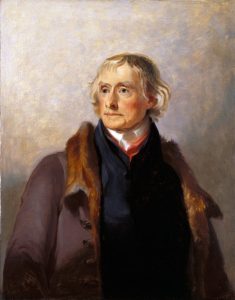
” . . . of this band of dupes and impostors, Paul was the great Coryphaeus (leader of the chorus), and first corrupter of the doctrines of Jesus. These palpable interpolations and falsifications of his doctrines led me to try to sift them apart.” (Thomas Jefferson writing to William Short, 13 April 1820).
Our third President was no fan of Saint Paul, and across the centuries, any number of prominent thinkers and theologians have agreed with Jefferson. In their eyes, Paul introduced theological complexities and doctrines that corrupted the simplicity of Jesus’ original message (think, justification by faith alone — a big debate, complex attitudes about women and slavery, and questions about Paul’s apostolic authority, just to name a few). Volumes have been written on such topics. As one named for him (and Stephen), I have been grappling with this guy for many years. My father explained the contradictory name choice to me on more than one occasion — the first Christian martyr and the zealot who approved his death (note Acts 7: 54-60 – 8:1). Bottom line: he wanted me to understand the power of conversion. The fact that Paul was such a hero to Unk (my father) makes the controversies surrounding him all the more interesting to me, I suppose. After all, of the twenty-seven documents comprising the New Testament, thirteen are letters attributed to this first century Greek man. His conversion story, this week’s first reading, is therefore a powerful moment in Christian history. Further reflections this week will focus on Paul’s conversion, including an excellent discussion by noted Anglican Bishop, N.T. Wright, who has written extensively on the life of Paul. It should be noted, curiously, that the conversion story from Acts shows up only once (Year C) in the three-year cycle of the Revised Common Lectionary!
St. Catherine of Siena by Franceschini (17th century)
Thanks for visiting this space again this week! We are roughly eight days into the season of Eastertide (the fifty days between Easter Sunday and Pentecost). As theologian Diana Butler Bass suggests, the central question for us during this part of our church calendar is: What does Jesus’ resurrection mean for our lives in the world? (Sunday Musings, 27 April 2025). Keep that in mind as you explore this week’s readings. We have one commemoration on our calendar this week: Catherine of Siena (1347-1380), Italian mystic and theologian known for her advocacy for church reform (died 29 April 1380).
Beyond Paul’s conversion story, I will offer an inspirational passage from Pope Francis aimed at young people, and a musical selection I hope you will appreciate.
The readings for the Third Sunday in Easter explore themes of transformation, restoration, and worship in response to encounters with the risen Christ. In Acts, Saul’s conversion showcases the radical change brought by Christ’s call, while in John, Peter’s reinstatement demonstrates forgiveness and renewal. Psalm 30 reflects the joy and gratitude that emerge from being delivered from despair, echoing the personal restoration seen in Acts and John. Finally, Revelation exalts the Lamb who was slain, inviting all creation to worship, uniting the readings in their celebration of Christ’s victory and its transformative power.
Focus Passage
Acts 9: 1-6 (7-20)
9 Meanwhile Saul, still breathing threats and murder against the disciples of the Lord, went to the high priest 2 and asked him for letters to the synagogues at Damascus, so that if he found any who belonged to the Way, men or women, he might bring them bound to Jerusalem. 3 Now as he was going along and approaching Damascus, suddenly a light from heaven flashed around him. 4 He fell to the ground and heard a voice saying to him, “Saul, Saul, why do you persecute me?” 5 He asked, “Who are you, Lord?” The reply came, “I am Jesus, whom you are persecuting. 6 But get up and enter the city, and you will be told what you are to do.” 7 The men who were traveling with him stood speechless because they heard the voice but saw no one. 8 Saul got up from the ground, and though his eyes were open, he could see nothing; so they led him by the hand and brought him into Damascus. 9 For three days he was without sight and neither ate nor drank. 10 Now there was a disciple in Damascus named Ananias. The Lord said to him in a vision, “Ananias.” He answered, “Here I am, Lord.” 11 The Lord said to him, “Get up and go to the street called Straight, and at the house of Judas look for a man of Tarsus named Saul. At this moment he is praying, 12 and he has seen in a vision a man named Ananias come in and lay his hands on him so that he might regain his sight.” 13 But Ananias answered, “Lord, I have heard from many about this man, how much evil he has done to your saints in Jerusalem, 14 and here he has authority from the chief priests to bind all who invoke your name.” 15 But the Lord said to him, “Go, for he is an instrument whom I have chosen to bring my name before gentiles and kings and before the people of Israel; 16 I myself will show him how much he must suffer for the sake of my name.”17 So Ananias went and entered the house. He laid his hands on Saul and said, “Brother Saul, the Lord Jesus, who appeared to you on your way here, has sent me so that you may regain your sight and be filled with the Holy Spirit.” 18 And immediately something like scales fell from his eyes, and his sight was restored. Then he got up and was baptized, 19 and after taking some food, he regained his strength. For several days he was with the disciples in Damascus, 20 and immediately he began to proclaim Jesus in the synagogues, saying, “He is the Son of God.”
TRY LUTHER’S METHOD!
Luther’s Revision of the Lectio Divina (Three Steps)
Oratio (Prayer): This is the starting point, where one humbly prays for the Holy Spirit’s guidance to understand God’s Word. Luther emphasized that prayer prepares the heart and mind to receive divine wisdom.
Meditatio (Meditation): This involves deeply engaging with Scripture, not just reading it but reflecting on it repeatedly. Luther encouraged believers to “chew on” the Word, allowing its meaning to sink in and shape their thoughts and actions.
Tentatio (Struggle): Often translated as “trial” or “temptation,” this refers to the challenges and spiritual battles that arise as one seeks to live according to God’s Word. Luther saw these struggles as a way God refines faith, making it more resilient and authentic.
Luther’s Seal
Reflections: “Who are you Lord?”
The Conversion of St. Paul by Michelangelo (1660)
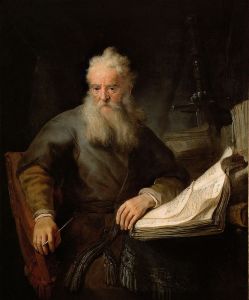
Saint Paul by Rembrandt
Few moments in Christian history rival the dramatic and transformative encounter on the road to Damascus, where a zealous persecutor named Saul was radically reshaped into Paul, the tireless apostle of Christ. The story is recounted multiple times in the New Testament, mainly in Acts. The initial narrative is this week’s first reading as noted above. Paul later shares his conversion story in a speech to a crowd in Jerusalem (Acts 22: 3-16) and retells the story a final time before King Agrippa (Acts 26: 9-20). Beyond these three accounts, the Apostle refers to his conversion within his letters (Galatians 1: 11-17, Philippians 3: 4-11, 1 Corinthians 15: 8-10, and 2 Corinthians 4:6), in each case reflecting on the transformative experience and its implications for his ministry and theology.
Martin Luther
(1483-1546)
Derived from the Latin convertere, meaning to turn around, to transform, CONVERSION is central to our journeys of faith and a life-long process. Martin Luther, our spiritual ancestor, famously recounted his conversion experience, and we operate within a faith community derived, in part, from his experience (sidebar: Luther in his typically brusque style, also offered this quote regarding conversion: “People go through three conversions: The conversion of their head, their heart, and their pocketbook. Unfortunately, not all at the same time”). Though I was born into Christianity, I am convinced that I have experienced conversions on more than one occasion — forks in the road where faith was questioned and ultimately deepened. The Spirit showed me a new way. That famous question raised by Paul on the road to Damascus — Who are you Lord? — has been changing lives for centuries. Yes, conversions are before and aftermoments. Conversions are powerful. Conversions bring change. Throughout the coming week, I urge you to think about conversion stories you may have encountered in your life, personally or in others.
Soli deo Gloria!
And for a further take on the conversion story . . . .
N.T. Wright, also known as Nicholas Thomas Wright, is a prominent Anglican bishop, theologian, and New Testament scholar. Wright’s work often challenges traditional views, offering fresh perspectives on theology and practical Christian living. Listen to what he has to say about this transformative moment in Christian history!
The Voice of a Christian Leader: Pope Francis’ Message to Young People in 2023
Pope Francis’ death in recent days brought forth an outpouring of remembrances. These words, spoken during a vigil with youth in 2023, seem especially fitting in our times. (Photo Source: Catholic News World, 19 November 2019).
World Youth Day: 5 August 2023 “I leave you with these thoughts. Carry on; if you fall, get back up; walk with a goal in mind, and train each day of your lives. Nothing is free in life, everything has to be paid for. Only one thing is free: the love of Jesus! So, with this free gift that we have – the love of Jesus – and with the desire to carry on the journey, let us walk in hope, let us be mindful of our roots, and move forwards, without fear. Do not be afraid.”
A Musical Prayer: “Grace Before Sleep”
Lyrics: Grace Before Sleep
How can our minds and bodies be grateful enough that we have spent, here in this generous room… This evening of content? Each one of us has walked through storm and fled the wolves along the road; but here the hearth is wide and warm. And for this shelter and this light Accept, O Lord, our thanks tonight.
“Grace Before Sleep” by Sara Teasdale is a reflective poem of gratitude, often interpreted as a meditation on finding solace and thankfulness amidst life’s challenges. Teasdale, a Pulitzer Prize-winning poet, frequently explored themes of beauty, resilience, and the human spirit in her work. This particular poem has inspired musical adaptations, such as Susan LaBarr’s choral setting, which emphasizes its themes of thanksgiving and quiet reflection.
The Luther College Choirs are renowned for their exceptional artistry and dedication to the choral tradition. Among them, the Nordic Choir stands out as the principal ensemble, celebrated for its national and international performances and innovative repertoire.
Update on “Faithful Conversations”
Join us on Sunday 4 May at 10:45 in the church library. We talk through the readings (some or all) in an informal setting — no prior preparation is necessary and all are welcome! Come and help us deepen our understanding of the readings!
And, on the horizon . . . . Pastor Jen and I are working to develop a series of podcasts that will be made available on various venues, short conversations on a variety of topics related to the faith journey. Our first series will explore the history of Lutheranism in general, the background to our local parish, how we translate our faith traditions and core values in our community, and how people can become a member of our church. Look for these later this spring!
“Be patient toward all that is unsolved in your heart and try to love the questions themselves, like locked rooms and like books that are now written in a very foreign tongue. Do not now seek the answers, which cannot be given you because you would not be able to live them. And the point is, to live everything. Live the questions now. Perhaps you will then gradually, without noticing it, live along some distant day into the answer.“
One of my father’s oft-repeated lines — “There has always been plenty of sin in the world!” — has been ringing in my ears lately. Unk had a way of helping me realize that the disorder of our world and the anxiety it stirs is part of a larger context that Christians, of all people, should understand. That said, as human beings, we crave certainty in our lives, a sense of security that feels precarious in 2025. I stumbled upon the opening quote from Austrian poet and novelist Rainer Maria Rilke this week, an encouragement to embrace uncertainty and the process of growth. Rilke suggests that instead of rushing to find answers to life’s complexities, we should learn to live fully in the present moment—even when it means dwelling in the questions themselves. Whether he was commenting on the faith journey or not, I don’t know, but his advice seems especially fitting for Christians. Week to week, the lectionary readings provide flashes of insight and a sense of certainty, while raising questions we must learn to embrace. By living authentically and with patience, the answers will naturally unfold over time, often without conscious realization. More on that in my reflections this week.
As always, thanks for visiting this space again this week! Next Sunday is Palm/Passion Sunday, which combines two key themes. Palm Sunday celebrates Jesus’ triumphant entry into Jerusalem, where crowds greeted Him as King and Messiah by waving palms and shouting “Hosanna” (picture a processional at church at the start of the service). Passion Sunday then shifts the focus to Jesus’ suffering and death, as churches reflect on His arrest, trial, crucifixion, and burial. This combination provides a deeper spiritual experience, moving from joy to solemn reflection in preparation for Holy Week and Easter. Historically, these were separate observances. Before the Second Vatican Council (1962–1965), Passion Sunday was the fifth Sunday of Lent, starting “Passiontide,” a focus on Christ’s suffering, while Palm Sunday came a week later. Vatican II reforms merged these into Palm Sunday of the Lord’s Passion, emphasizing the Passion narrative for Holy Week while simplifying the Church calendar. Recall that the Revised Common Lectionary (RCL) we follow in the ELCA flowed from those 1960s changes.
Welcome new members! A couple notes for the benefit of our newest blog members: “Faithful Conversations” was prompted by a Bible study we did in early 2023 and has been going strong for more than two years. It is designed to help you frame the readings for next Sunday. It is best to approach it with an open Bible in front of you. My commentary usually focuses on one of the readings. I do provide some references throughout the blog, links out for further information — they are bold and italicized. The format of the blog works best on a larger screen, but if you are on your phone, I suggest reading it horizontally. Also, you can find all the blog entries on the Lectionary homepage which is accessible from my main site. I welcome feedback or comments, of course!
Common Themes Among the Readings
Passion/Palm Sunday
Isaiah 50: 4-9a Psalm 31: 9-16 Philippians 2: 5-11 Luke 22:14-23:56 Luke 23: 1-49 (alternate)
Look for the convergence of the following themes as you explore the readings for Passion/Palm Sunday: steadfast faith in the face of suffering and the humility of Christ’s sacrificial love. Isaiah 50:4-9a depicts the servant’s unwavering trust in God despite mockery and persecution. Psalm 31:9-16 echoes this reliance on God’s mercy and deliverance during moments of deep anguish. Philippians 2:5-11 and Luke 22:14-23:56 exalt Christ’s humility and obedience, culminating in His Passion, revealing the transformative power of self-giving love and God’s redemptive plan.
Focus Passage: Philippians 2: 5-11
5 Let the same mind be in you that was in Christ Jesus, 6 who, though he existed in the form of God, did not regard equality with God as something to be grasped, 7 but emptied himself, taking the form of a slave, assuming human likeness. And being found in appearance as a human, 8 he humbled himself and became obedient to the point of death— even death on a cross. 9 Therefore God exalted him even more highly and gave him the name that is above every other name, 10 so that at the name given to Jesus every knee should bend, in heaven and on earth and under the earth, 11 and every tongue should confess that Jesus Christ is Lord, to the glory of God the Father.
TRY LUTHER’S METHOD!
Luther’s Revision of the Lectio Divina (Three Steps)
Oratio (Prayer): This is the starting point, where one humbly prays for the Holy Spirit’s guidance to understand God’s Word. Luther emphasized that prayer prepares the heart and mind to receive divine wisdom.
Meditatio (Meditation): This involves deeply engaging with Scripture, not just reading it but reflecting on it repeatedly. Luther encouraged believers to “chew on” the Word, allowing its meaning to sink in and shape their thoughts and actions.
Tentatio (Struggle): Often translated as “trial” or “temptation,” this refers to the challenges and spiritual battles that arise as one seeks to live according to God’s Word. Luther saw these struggles as a way God refines faith, making it more resilient and authentic.
Luther’s Seal
Reflections: The Christ Hymn
Sunday’s second reading fits beautifully with the Passion Gospel. The context of Philippians 2:5-11 lies within Paul’s letter to the church in Philippi, written during his imprisonment, likely in Rome. The passage is part of Paul’s exhortation to the Philippians to live in unity, humility, and selflessness, imitating the mindset of Christ. He is addressing a community that faced external pressures, likely from Roman authorities or societal opposition, as well as internal challenges with potential discord. In this setting, Paul emphasizes living a life worthy of the Gospel through humility and mutual care, rooting this exhortation in the example of Christ. What should we take away from this passage, especially when reading it alongside this week’s Gospel reading from Luke?
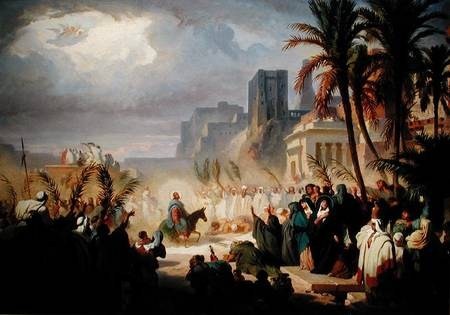
The Entry of Christ into Jerusalem by Leullier, Louis Felix (1811-82)
A couple things stand out to me. First, Paul’s use of the so-called Christological Hymn is worth noting (verses 6-11). Scholars debate the origin of this hymn. Some think Paul used an existing hymn from early Christian worship, supported by its poetic structure, which is different from his usual writing style. Others believe Paul wrote it himself, reflecting key Christian beliefs about Jesus’ birth, humility, and exalted nature. Regardless, the hymn resonated powerfully with Paul’s listeners and offers a window into the mind of those early Christians, our spiritual ancestors. Second, Paul’s admonition that we adopt Jesus’ mindset (verse 5) is a reminder of the counter-cultural nature of our faith. This is a recurring theme in Philippians, referenced by Paul five times in the letter (1:27, 2:2, 2:5, 3:15, and 4:2). The Philippian Christians Paul addressed lived in a world dominated by Rome and infused with Greco-Roman values — power, strength, fortitude, and self-reliance. And, of course, those with great wealth held positions of power within society. Not much has changed! Think of how we glorify those attributes in 2025! Our God paraded into Jerusalem on a donkey, preaching and modeling profound empathy with the outcasts of society. Sit with that for a few minutes as we begin the journey into Holy Week. The truths emanating from this journey continue to unfold. We have a story to tell and good news to share!
Soli deo Gloria!
Poem Reflection: Chesterton’s The Donkey
Poet and literary critic G.K.Chesterton’s 1927 poem provides a unique perspective on Jesus’ triumphal entry into Jerusalem. He uses the donkey’s voice to explore the idea that even the humblest and most scorned beings can hold extraordinary purpose and meaning in God’s plan. Enjoy!
G.K. Chesterton (1874-1926)
The Donkey
When fishes flew and forests walked And figs grew upon thorn, Some moment when the moon was blood Then surely I was born; With monstrous head and sickening cry And ears like errant wings, The devil’s walking parody On all four-footed things. The tattered outlaw of the earth, Of ancient crooked will; Starve, scourge, deride me: I am dumb, I keep my secret still. Fools! For I also had my hour; One far fierce hour and sweet: There was a shout about my ears, And palms before my feet.
Musical Offering: Lord Whose Love in Humble Service (ELW, 712)
The hymn Lord, Whose Love in Humble Service was written by Albert F. Bayly (1901-1984), an English Congregational minister and hymn writer. It was chosen as the theme hymn for the Second National Conference on the Churches and Social Welfare held in Cleveland, Ohio in 1961. It first appeared in the Lutheran Book of Worship (the green hymnal used from 1978 to 2006). The lyrics seems especially fitting with the passage from Philippians in this week’s readings. Enjoy the hymn and sing along if moved to do so!
Update on “Faithful Conversations”
Join us on Sunday 13 April at 10:45 in the church library. We talk through the readings (some or all) in an informal setting — no prior preparation is necessary and all are welcome! Come and help us deepen our understanding of the readings!
And . . I can’t resist! 1960s Lutheran Humor!
From the mind of Charles Schultz, the creator of “Peanuts,” who grew up in Minneapolis and was an active layperson with a heart for the foibles of the church. He did a series of books focusing on teenagers in the late 1950s and early 60s. Clearly, this young man missed the point of this week’s readings!
“The communion of saints celebrates how God has created each of us for a purpose, one we cannot fulfill without each other; how God loves us all equally yet loves each one of us as if we were the only one.” (Samuel Wells)
Who am I and why am I here? We spend lifetimes chasing after these two fundamental questions — think identity and purpose. Anglican Vicar Sam Wells’ article in April’s Christian Century Magazine (“The Grace of Identity,” p. 39) reminded me of this. Wells asserts that people tend to understand identity in one of two ways. One is by discovery—seeing identity as something fixed from our past, shaped by upbringing and experiences, and uncovered over time. The other is by construction—viewing identity as something we create through choices and commitments, continually evolving over time. In discovery, identity is inherited; in construction, it’s built (perhaps both are true). Wells, however, suggests that as Christians, our identity is both bestowed and revealed by a God who chose us. In other words, we had no control over that part of the equation. As mysterious as this is, it is fundamental to our faith journey. Further, Wells posits that identity is not about isolating one’s uniqueness (self-centered). Instead, it’s about joining others in believing there is a role for each one of us in the body of Christ — in other words, our identity is fostered in community. Aha! The answer to the two basic questions! These insights were front of mind for me this week as I worked through the passages from Isaiah and Philippians.
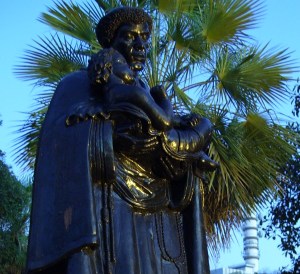
Thanks for visiting this space again this week! We are 18 days out from Good Friday and experiencing the vicissitudes of March weather in the upper midwest. As one who has been coaching track and field for a long, long time, such weather is like the return of an old friend! We venerate two individuals this week on the Lutheran calendar. The English poet John Donne (d. 31 March 1631) and Benedict the Moor (d. 4 April 1589), also known as Benedict the African. His statue pictured here adorns the Church of Our Lady of the Rosary and Saint Benedict, Cuiabá, Mato Grosso, Brazil. Both men have fascinating stories and their connection to church history is worth exploring!
Look for the convergence of the following themes as you explore the readings for the 5th Sunday in Lent: renewal, transformation, and pressing forward with hope and faith. In Isaiah 43:16-21, God promises to make a way in the wilderness, symbolizing new beginnings and divine provision. Psalm 126 rejoices in the restoration of fortunes, expressing the joy that follows God’s intervention in times of despair. Philippians 3:4b-14 emphasizes leaving behind the past and striving toward the future, while John 12:1-8 highlights the sacrificial act of love and devotion, foreshadowing the transformative power of Christ’s death and resurrection.
Focus Passages from Isaiah 43 and Philippians 3
Isaiah 43: 16-21
Thus says the Lord, who makes a way in the sea, a path in the mighty waters, 17 who brings out chariot and horse, army and warrior; they lie down; they cannot rise; they are extinguished, quenched like a wick: 18 Do not remember the former things or consider the things of old. 19 I am about to do a new thing; now it springs forth; do you not perceive it? I will make a way in the wilderness and rivers in the desert. 20 The wild animals will honor me, the jackals and the ostriches, for I give water in the wilderness, rivers in the desert, to give drink to my chosen people, 21 the people whom I formed for myself so that they might declare my praise.
Here’s an excellent video with backround on Isaiah 40-66
Luther’s Seal
TRY LUTHER’S METHOD!
Luther’s Revision of the Lectio Divina (Three Steps)
Oratio (Prayer): This is the starting point, where one humbly prays for the Holy Spirit’s guidance to understand God’s Word. Luther emphasized that prayer prepares the heart and mind to receive divine wisdom.
Meditatio (Meditation): This involves deeply engaging with Scripture, not just reading it but reflecting on it repeatedly. Luther encouraged believers to “chew on” the Word, allowing its meaning to sink in and shape their thoughts and actions.
Tentatio (Struggle): Often translated as “trial” or “temptation,” this refers to the challenges and spiritual battles that arise as one seeks to live according to God’s Word. Luther saw these struggles as a way God refines faith, making it more resilient and authentic.
Philippians 3: 4b-14
If anyone else has reason to be confident in the flesh, I have more: 5 circumcised on the eighth day, a member of the people of Israel, of the tribe of Benjamin, a Hebrew born of Hebrews; as to the law, a Pharisee; 6 as to zeal, a persecutor of the church; as to righteousness under the law, blameless. 7 Yet whatever gains I had, these I have come to regard as loss because of Christ. 8 More than that, I regard everything as loss because of the surpassing value of knowing Christ Jesus my Lord. For his sake I have suffered the loss of all things, and I regard them as rubbish, in order that I may gain Christ 9 and be found in him, not having a righteousness of my own that comes from the law but one that comes through faith in Christ, the righteousness from God based on faith. 10 I want to know Christ and the power of his resurrection and the sharing of his sufferings by becoming like him in his death, 11 if somehow I may attain the resurrection from the dead. 12 Not that I have already obtained this or have already reached the goal,nbbut I press on to lay hold of that for which Christ has laid hold of me. 13 Brothers and sisters, I do not consider that I have laid hold of it, but one thing I have laid hold of: forgetting what lies behind and straining forward to what lies ahead, 14 I press on toward the goal, toward the prize of the heavenly call of God in Christ Jesus.
Reflections: God’s Purpose and Our Identity
This week’s first and second readings focus on our Christian identity. Isaiah 43 reminds us of God’s power, recalling the Exodus from Egypt as proof of His might (16-17). It then shifts to a “new thing” God is doing—bringing renewal, like creating a path in the wilderness and rivers in the desert (19). God’s faithfulness is shown as He calls His people to praise Him, demonstrating His ability to bring hope and restoration, even in hard times (20-21). In Philippians 3, Paul reflects on his past achievements (4-6), calling them worthless compared to knowing Christ (7-8). He highlights righteousness through faith in Christ, not by the law, and his desire to share in Christ’s sufferings and resurrection (9-11). Paul concludes by urging us to press on toward the goal of eternal life, striving to fulfill our calling in Christ Jesus (12-14).
Moses and the Children of Israel Crossing the Red Sea Henri Schopin (1904-1880)
What do these readings say to us in 2025? I’m struck by how each author addresses the nature of history in shaping our identity. Speaking for the Lord, Isaiah hearkens back to a triumphant moment in Jewish history — the crossing of the Red Sea recounted in Exodus 14, a cultural touchstone for the people. We might imagine young Jewish children hearing this story multiple times as they absorb their worldview (did they get tired of hearing it?). Likewise, Paul references his past life — his history as an ardent Jew — as a window into his identity. In stunning reversals, however, both authors suggest that God liberates us from our past — “that was then, this is now!” In other words, our identities transcend what we may have inherited. Whatever has happened, whatever we have experienced, God is about to do a new thing. In the case of the Israelites, their journey to the promised land meant hope in the midst of despair. In Paul’s case, his Jesus moment on the road to Damascus changed everything. Likewise, our Christian identities, both bestowed and revealed by a loving God, remain forever a work in progress. Whatever chaos we may be experiencing, whatever turmoil we may confront, this is good news to share!
Soli deo Gloria!
(I am indebted to Samuel Wells, as noted, regarding the interpretation of the readings. Also, Paul’s writings provided inspiration, especially these passages: 2 Corinthians 5:17, Galatians 6:15, Ephesians 4:24, Colossians 3:10, and Romans 6:4. You may want to look those up!)
Prayer Reflection: Spiritual Maturity
Dear Lord, We humbly seek Your guidance as we strive for spiritual maturity. Help us to deepen our faith, cultivate wisdom, and embrace Your teachings. May we grow in love, patience, and understanding, reflecting Your light in our lives. Strengthen our hearts and minds, that we may walk in Your ways and bear fruit for Your kingdom. Amen.
(Note: The inspiration for this prayer is Colossians 2: 6-7. Retrieved from God’s Blessing prayer site, 30 March 2025)
Musical Offering: Lux Aeterna (Eternal Light)
Lux Aeterna is an enchanting piece of music that has roots deep in Christian history. This version by VOCES8 features great harmony. The Latin lyrics center around themes of eternal light and rest for departed souls — the communions of saints — those who helped shape our identities. Here’s a translation:
May light eternal shine upon them, O Lord, with Thy saints forever, for Thou art kind. Eternal rest give to them, O Lord, and let perpetual light shine upon them.
Update on “Faithful Conversations”
Two years ago, we offered “Journey Into the Bible,” a class which inspired the Lectionary Blog experiment. A digital version of the class is now ready for launch. We hope it can be useful for new members or anyone seeking to get started with Bible study. Special thanks to Pastor Jen Hatleli and the Lectionary Small Group for their support and inspiration throughout! Click on the image of the ELC Sanctuary to access the class.
And . . . Join us on Sunday 30 March at 10:45 in the church library. We talk through the readings (some or all) in an informal setting — no prior preparation is necessary and all are welcome! Come and help us deepen our understanding of the readings!
“The task of the modern educator is not to tear down jungles, but to irrigate the deserts.” (C.S. Lewis)
Last week I shared information with you about the state of the Christian Church in 2025, a somewhat dire situation based on the increasing secularization of our world. One of the troubling aspects of our present circumstances, in my estimation, is that the population cohort most conspicuously absent from our pews are the young men in our midst — specifically those from the Millennial and Gen Z generations (born 1981-2012). This is a challenge we need to reflect on and pray about. And though the state of the modern church is troubling, the C.S. Lewis quote shared on the front-end this week helps me reframe the challenge. I grew up with C.S. Lewis books scattered around our house due to my father’s interest in him. Mere Christianity, for example, was a favorite, as was The Abolition of Man. The quote I shared here is from a sermon-turned-essay by Lewis delivered in 1939 at Oxford University amidst the outbreak of World War II called Learning in Wartime. Among other things, Lewis talked to the students about keeping a proper perspective and combatting distractions (fear, anxiety, urgency) and staying focused on one’s calling. (Sidebar: After reading this, it is ever more clear to me why Lewis appealed to Unk who enlisted in the Army Air Corps in 1943). Lewis’ words remain remarkably relevant for our time!
Thanks for visiting this space again this week — I so appreciate your continued interest in exploring the Scriptures! Monday is Day 19 of the Lenten Journey, so we have nearly reached the half-way mark. We have three important Commemorations on our church calendar this week. On Monday (24 March) we remember Oscar Romero (1917-1980), Bishop of El Salvador who was murdered on this day in 1980. Tuesday is the Annunciation of our Lord (Isaiah 7:14 and Luke 1: 26-38). Note the prayer included this week regarding that event. And finally, on Saturday (29 March) we remember Hans Nielson Hauge (1771-1824), renewer of the church. Hauge’s story is integral to our Norwegian Lutheran heritage and specifically to the story of the early Lutherans in Jackson County! My reflections this week will focus on the passages from Joshua and 2 Corinthians.
Look for these themes as you work your way through the readings for the 4th Sunday in Lent: RENEWAL and RECONCILIATION. In Joshua 5:9-12, the Israelites celebrate their liberation from Egypt and begin a new chapter by eating the produce of the Promised Land. Psalm 32 emphasizes the joy and restoration that come from confessing sins and receiving God’s forgiveness. Similarly, 2 Corinthians 5:16-21 speaks of being reconciled to God through Christ, while Luke 15:1-3, 11b-32 recounts the parable of the prodigal son, illustrating the transformative power of forgiveness and a return to the Father’s embrace.
Focus Passages from Joshua and 2 Corinthians
Joshua 5: 9-12 9 The Lord said to Joshua, “Today I have rolled away from you the disgrace of Egypt.” And so that place is called Gilgal[a] to this day. 10 While the Israelites were camped in Gilgal, they kept the Passover in the evening on the fourteenth day of the month in the plains of Jericho. 11 On the day after the Passover, on that very day, they ate the produce of the land, unleavened cakes and roasted grain. 12 The manna ceased on the day they ate the produce of the land, and the Israelites no longer had manna; they ate the crops of the land of Canaan that year.
Check out this excellent background video on the book of Joshua!
TRY LUTHER’S METHOD!
Luther’s Revision of the Lectio Divina (Three Steps)
Oratio (Prayer): This is the starting point, where one humbly prays for the Holy Spirit’s guidance to understand God’s Word. Luther emphasized that prayer prepares the heart and mind to receive divine wisdom.
Meditatio (Meditation): This involves deeply engaging with Scripture, not just reading it but reflecting on it repeatedly. Luther encouraged believers to “chew on” the Word, allowing its meaning to sink in and shape their thoughts and actions.
Tentatio (Struggle): Often translated as “trial” or “temptation,” this refers to the challenges and spiritual battles that arise as one seeks to live according to God’s Word. Luther saw these struggles as a way God refines faith, making it more resilient and authentic.
2 Corinthians 5: 16-21 16 From now on, therefore, we regard no one from a human point of view; even though we once knew Christ from a human point of view, we no longer know him in that way. 17 So if anyone is in Christ, there is a new creation: everything old has passed away; look, new things have come into being! 18 All this is from God, who reconciled us to himself through Christ and has given us the ministry of reconciliation; 19 that is, in Christ God was reconciling the world to himself, not counting their trespasses against them, and entrusting the message of reconciliation to us. 20 So we are ambassadors for Christ, since God is making his appeal through us; we entreat you on behalf of Christ: be reconciled to God. 21 For our sake God made the one who knew no sin to be sin, so that in him we might become the righteousness of God.
Reflections: The “Happy Exchange”
Often, though not always, the Lectionary readings fit together beautifully. Such is the case with this week’s first and second readings. In Joshua 5:9-12, God declares to Joshua that He has removed the “disgrace of Egypt” from the Israelites, symbolizing their liberation from past shame and their renewed identity as God’s people. The Israelites celebrate Passover in the promised land, marking a significant moment of renewal and gratitude. In 2 Corinthians 5:16-21, Paul emphasizes the transformation brought by Christ, urging believers to see people not by worldly standards but through the lens of spiritual renewal. He explains that in Christ, we become new creations, reconciled to God and entrusted with the ministry of reconciliation. Paul concludes by highlighting the profound exchange of righteousness, where Christ bore our sins so that we might become righteous before God. Luther referred to this as the “Happy Exchange,” (noted in 1 Corinthians 1:9), a phrase he borrowed from Bernard of Clairvaux (1090-1153), abbot and co-founder of the Knights Templar (a controversial figure as well!). I have always appreciated the use of that phrase!
What should we discern from these two readings? As always, these words from scripture remain remarkably relevant to our time — and to my recent obsessing about the state of the church. First, the Israelites left the wilderness and stepped into the Promised Land — a new start with new opportunities. Similarly, in Paul’s letter to the Corinthians, he reminds them (and us) that in Christ we are a new creation — our old identity is transformed! Second, when God removed the “disgrace of Egypt” from His people, they were reconciled to their promised identity as a people — freed from their past. Likewise, Paul’s discussion of reconciliation extends beyond our relationship with God and flows into how we relate to others. We are called to be “ambassadors for Christ” in our communities, an awesome identity that we carry. Each of us is called in some manner in this regard and this is good, exciting news. Let us together strive to “irrigate the deserts!”
Soli deo Gloria!
Prayer of the day for Annunciation (ELW, p. 55)
Pour your grace into our hearts, O God, that we who have known the incarnation of your Son, Jesus Christ, announced by an angel, may by his cross and passion be brought to the glory of his resurrection; for he lives and reigns with you, in the unity of the Holy Spirit, one God, now and forever. Amen.
Prayer: A Prayer for Protection (Luther)
Lord God, heavenly Father, you know that we are set in the midst of so many and great dangers, that by reason of the frailty of our nature we cannot always stand upright: Grant us such strength and protection, to support us in all danger, and carry us through all temptations; through your Son, Jesus Christ our Lord. Amen.
From the Archives: 1960s Lutheran Humor!
Charles Schulz, born on November 26, 1922, in Minneapolis, Minnesota, was the creator of the beloved comic strip Peanuts. Known for characters like Charlie Brown and Snoopy, Schulz’s work reflected his personal experiences and philosophical musings. Raised in a Lutheran household, Schulz later became a Methodist and even taught Sunday school for a decade.
Update on “Faithful Conversations”
For several weeks, I have been developing a class titled, “Journey Into the Bible,” a digital version of an in-person study that we did two years ago. The project evolved along the way, and the idea is that it can be utilized by new members or anyone seeking to grow in their Biblical understanding. The hope is to roll this out soon. Thanks to Pastor Jen Hatleli and the Lectionary Small Group that meets on Sundays for inspirational support in this process!
And . . . Join us on Sunday 30 March at 10:45 in the church library. We talk through the readings (some or all) in an informal setting — no prior preparation is necessary and all are welcome! Come and help us deepen our understanding of the readings!