“Think for a moment how, across the world, someone’s life just changed – irrevocably and permanently – and everything that once was so steady, so reliable, must now find a new way of unfolding.” (John O’Donohue)**
Celtic mystic John O’Donohue’s opening quote reminded me that liminal moments forever fascinate me — those times when we are “here” but will soon be “there” — in a different space. Richard Rohr, Franciscan priest, defines those moments as “any hiatus between stages of life, faith, jobs, loves, or relationships. It is that graced time when we are not certain or in control, when something genuinely new can happen … it is the ultimate teachable space.” As I look back on over four decades of teaching and coaching, it is clear to me that has always been the hook — the opportunity to work with young people in a liminal moment when hope and exciting possibility are “unfolding.” What a great privilege that is.
The Gospel for Christ the King Sunday brings us into the ultimate liminal moment. At Golgotha, Jesus enters the remarkable threshold—suspended between heaven and earth, life and death. Time slows as eternity draws near. Between two criminals, one mocks while the other sees clearly and pleads, “Jesus, remember me.” In that moment, Jesus responds with grace: “Today you will be with me in paradise.”The cross becomes a doorway, not just to death, but to redemption. Here, God meets us in our suffering, not from above but within it, offering not just forgiveness, but presence. This liminal moment reveals the heart of the gospel—mercy at the edge of death, hope rising in the shadow of despair. It makes perfect sense to me that the authors of the Lectionary would choose this moment for the final Sunday in our church year.
The Liturgical Calendar
Thanks for your visit here again this week! As mentioned, we mark the end of the Lectionary cycle (Year C) during these late days of November. Christ the King Sunday was established by Pope Pius XI in 1925 as a response to the chaos of post–World War I Europe, where secularism, fascism, and communism were on the rise; the Pope’s encyclical Quas Primas proclaimed Christ’s reign as a source of peace, justice, and unity beyond political power — a timeless affirmation. Originally observed in October, Pope Paul VI moved the feast to the final Sunday of the liturgical year in 1969 to highlight Christ’s cosmic sovereignty (in line with changes brought by the Second Vatican Council). In the 1980s and 1990s, many Protestant churches—including the ELCA after its 1988 formation—adopted Christ the King Sunday through the Revised Common Lectionary, which placed it just before Advent. This shift marked a move toward greater ecumenical unity and theological emphasis on Christ’s reign as the culmination of the church’s annual journey. My reflections this week will focus on the Colossians passage, with a musical offering inspired by the Gospel, and a contemporary prayer of confession written for Christ the King Sunday.
** Note 1: Links to outside references are bolded and italicized and are meant for further reading or research on your part. While the text I am including in the blog is my own, I am pulling from a multitude of sites for ideas and connections. ** Note 2: In my increasing use of A.I. (Copilot), I will cite sourcing of how I am using the tool, if necessary. I don’t want that to be overly cumbersome, but I am gradually incorporating more tools. I am exploring the A.I. world this summer prior to my next teaching semester. As you can imagine, it is a great challenge right now and will forever change the face of education!
** Note 3: The images I include in the blog are drawn from Wikimedia Commons to the fullest extent possible.
My source for the Bible readings each week is the Bible Gateway website. I generally use the NRSVUE translation.
The readings for Christ the King Sunday proclaim a vision of divine kingship rooted in justice, mercy, and cosmic reconciliation. Jeremiah foretells a righteous king who will gather and shepherd the scattered, embodying wisdom and justice. Psalm 46 declares God as a steadfast refuge amid chaos, while Colossians exalts Christ as the cosmic center—through whom all things were created and reconciled. In Luke’s Gospel, Christ reigns paradoxically from the cross, offering forgiveness and welcoming the repentant thief into paradise, revealing a kingdom founded not on domination but on sacrificial love.
“Describe the common themes among the readings for Pentecost 23.” Copilot, 13 November 2025, Copilot website.
Lectio Divina is a quiet, thoughtful way of reading the Bible to connect with God. It grew out of early Christian traditions and was shaped by thinkers like Augustine, who believed Scripture speaks to the heart. Augustine didn’t invent the practice, but his ideas helped form its spirit—listening deeply and responding with love. Later, others gave it a clear structure, but its roots go back to that longing for God’s voice.
LUTHER’S METHOD OF BIBLE READING A Revision of the Lectio Divina (Augustinian)
Three Steps
Oratio (Prayer): This is the starting point, where one humbly prays for the Holy Spirit’s guidance to understand God’s Word. Luther emphasized that prayer prepares the heart and mind to receive divine wisdom.
Meditatio (Meditation): This involves deeply engaging with Scripture, not just reading it but reflecting on it repeatedly. Luther encouraged believers to “chew on” the Word, allowing its meaning to sink in and shape their thoughts and actions.
Tentatio (Struggle): Often translated as “trial” or “temptation,” this refers to the challenges and spiritual battles that arise as one seeks to live according to God’s Word. Luther saw these struggles as a way God refines faith, making it more resilient and authentic.
Focus Passage: Colossians 1: 11-20
11 May you be made strong with all the strength that comes from his glorious power, so that you may have all endurance and patience, joyfully 12 giving thanks to the Father, who has enabled you to share in the inheritance of the saints in the light.13 He has rescued us from the power of darkness and transferred us into the kingdom of his beloved Son, 14 in whom we have redemption, the forgiveness of sins.
15 He is the image of the invisible God, the firstborn of all creation, 16 for in him all things in heaven and on earth were created, things visible and invisible, whether thrones or dominions or rulers or powers—all things have been created through him and for him. 17 He himself is before all things, and in him all things hold together. 18 He is the head of the body, the church; he is the beginning, the firstborn from the dead, so that he might come to have first place in everything. 19 For in him all the fullness of God was pleased to dwell, 20 and through him God was pleased to reconcile to himself all things, whether on earth or in heaven, by making peace through the blood of his cross.
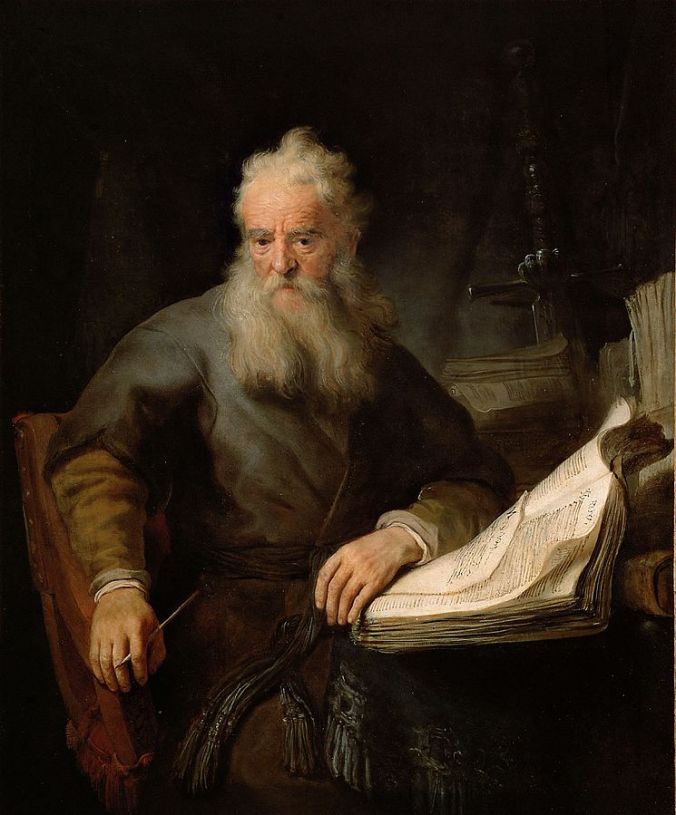
Saint Paul Rembrandt (1606-1669)
Check out this overview of Colossians from the Bible Project!
Reflection: “Christ in All: A Colossian Prelude to Advent”
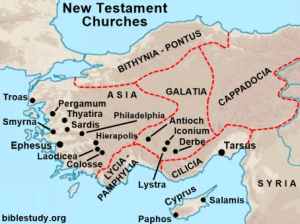
Ancient Turkey
A fascinating window into the world of the first-generation Christians, Colossians was written by the Apostle Paul (or a disciple of his) in c. 60–62 CE during his imprisonment in Rome, addressing a young church in Colossae facing theological confusion and turmoil.
Traders and travelers shaped Colossae — a small city in Asia Minor (modern-day Turkey) — into a diverse hub, blending pagan beliefs, Jewish legalism, and emerging mystical philosophies. Though Paul had not personally visited the Colossae Christians, he was responding to reports from Epaphras, a local leader and companion of Paul’s, who warned of false teachings — later termed the Colossian Heresy — that threatened the community’s understanding of Christ. (Sidebar: Epaphras is mentioned three times in the New Testament: Colossians 1:7-8, 4: 12-13, and Philemon 1:23 and is an intriguing character in his own right).
Paul writing from Prison (A.I. generated)
This week’s reading from the first portion of the letter is a remarkable passage that stopped me in my tracks — and is entirely fitting for Christ the King Sunday. In verses 11-14 Paul urges the Colossians to draw strength from God’s glorious power so they can endure with patience and joy. He calls them to live in gratitude, knowing God has qualified them to share in the inheritance of the saints. God has rescued them from the grip of darkness and placed them firmly in the kingdom of his beloved Son. In Christ, they don’t just find comfort—they receive full redemption and the radical forgiveness of sins. This truth anchors their identity and equips them to stand firm against every false teaching (the Colossian heresy). Good words for us to hear this week.
And then we arrive at this extraordinary piece of prose from the pen of Paul — verses 15-20. As noted by New Testament scholar Jennifer S. Wyant in her 2022 commentary on this passage, “These verses contain some of the highest Christology in the whole New Testament.” Think of Christology as the study of Christ’s divine and human nature, along with an exploration of how he reveals God, fulfills the role of Savior, and reconciles creation through his life, death and resurrection. Biblical scholars, in fact, assert that these verses contain an early creedal statement voiced by first-generation Christians, and provide a window into the evolution into their understanding of Christ’s identity. Can we possibly improve on it?
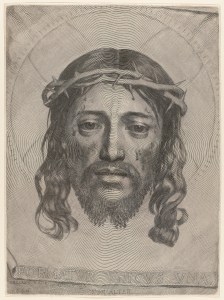
Face of Christ Claude Mellon, 1649
Finally, Wyant makes an important observation as to WHY these words from more than two thousand years ago instruct and inspire us in 2025 — that is, Paul’s near rhythmic use of the word ALL within the nine verses (I marked them in the passage above). This “creates a deep sense of confidence in who Christ is,” she says. “Nothing is outside of Christ. There is no situation that the Colossians might face that Christ is not already there . . . And so over and over again, we see Paul assure this congregation: Christ is in all. All has been forgiven. All will be well. Forever.” Sit with those words for a few minutes. What a beautiful close to our Lectionary readings for this church year — good words for us to carry into Advent! We have arrived at a liminal moment.
Soli Deo Gloria!
As noted above, I am indebted to Jennifer Wyant for her analysis of Colossians 1: 11-20. You may read that in full at here. Her commentary is among those found at the Working Preacher site sponsored by Luther Seminary in St. Paul, MN.
A Musical Connection: “Jesus Remember Me”
“Jesus, Remember Me” emerged from the Taizé Community in France, an ecumenical monastic movement founded by Brother Roger to promote reconciliation and peace. Composed by Jacques Berthier in 1978, the chant reflects Taizé’s commitment to simple, meditative prayer that transcends language and denomination. Its text—drawn from the words of the penitent thief in Luke 23:42 — embodies the community’s focus on mercy, humility, and hope. Designed for repetition, the chant invites worshippers into a shared contemplative silence, often sung in candlelit gatherings. As with many Taizé songs, it fosters unity through music that is both accessible and spiritually profound.
The chant “Jesus, Remember Me” by Jacques Berthier is known for its simplicity and meditative repetition. The lyrics are:
“Jesus, remember me when you come into your kingdom.”
This line is sung repeatedly, often in a Taizé-style prayer setting, allowing worshippers to enter a contemplative rhythm.
A Prayer of Confession for Christ the King Sunday
Jesus said, “My realm is not of this world.”
And yet, we confess, sometimes we still get seduced by the values of empire: wealth and power and glory.
Loving God, you see us as we are. You know our secret battles and all the ways in which we fail to live out your call upon our lives.
Never give up on us, God. Use us, even in our brokenness. Forgive us and renew us. Help us to enthrone you in our lives. Amen.
Source: Confession for Christ the King Sunday by Cara Heafy, an ordained Minister in the United Reformed Church, UK.
Jesus Statue in Świebodzin, Western Poland
Faithful Conversations Updates
Join us for some free-flowing conversation about the Lectionary readings each Sunday. We meet from 10:45-11:30 in the church library each week, with some exceptions. No prior knowledge is necessary! ALL ARE WELCOME!
QUESTIONS FOR DISCUSSION THIS WEEK (and anything else you care to discuss from the readings):
1. How does Paul’s repeated use of the word “all” in Colossians 1:11–20 shape our understanding of Christ’s cosmic role and presence in everyday life?
2. Why is a high Christology—emphasizing Christ’s divinity, creative power, and reconciling work—essential for grounding Christian identity, especially in times of transition like Advent?
3. In what ways does the cultural and religious diversity of Colossae mirror the complexities of our own communities today—and how might Paul’s message guide us through theological confusion or competing worldviews?
One more thing . . . .
Check out this story from the Lutheran World Federation regarding the Lutheran Church in Myanmar.
The Bible 365 Challenge! More than 60 members of our faith community have committed to the Bible 365 Challenge—a shared journey of reading through the entire Bible in one year. Each day, we engage with selected passages weaving together stories of faith, struggle, grace, and redemption. This challenge isn’t just about completing a task; it’s about deepening our spiritual roots, building community, and discovering how scripture speaks into our lives today.
“If you hear the dogs, keep going. If you see the torches in the woods, keep going. If there’s shouting after you, keep going. Don’t ever stop. Keep going. If you want a taste of freedom, keep going.” (Harriet Tubman)
Jesus’ words in verse 19 of this week’s Gospel ignite the memory of Harriet Tubman—a woman whose fierce endurance forged legend. Born into slavery in 1822, she escaped at 27 and refused to walk free alone; instead, she returned again and again, guiding over 70 enslaved people to freedom with unshakable courage and razor-sharp cunning. The 2019 film Harriet captures just a glimpse of her fire—well worth your time. Tubman’s deep Christian faith fueled her mission; she trusted divine guidance and moved with conviction. During the Civil War, she served the Union as a scout, nurse, and spy, and shattered precedent as the first woman to lead a U.S. military raid. After the war, she championed women’s suffrage and cared for the elderly, embodying justice until her final breath. Our church calendar honors both her and Sojourner Truth on March 11—a fitting tribute to lives that refused to bend. I’ll return to the theme of endurance later in the blog.
Martin, Bishop of Tours
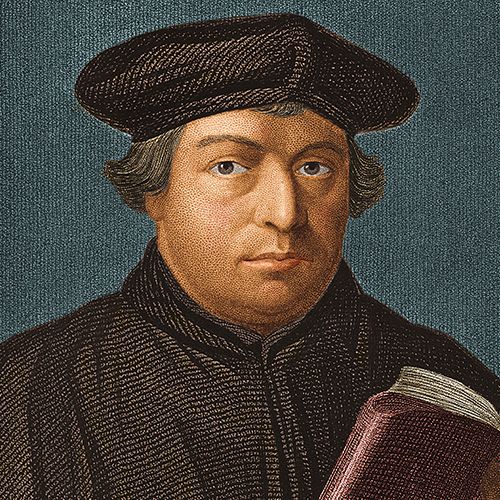
Thanks for visiting this space again this week! Next Sunday, believe it or not, is the final Sunday of the Year C of the Revised Common Lectionary! (30 November will be the first Sunday of Advent). Two commemorations are on this week’s ELCA calendar, both falling on Tuesday. It was on 11 November in 397 that Martin, Bishop of Tours died. Hungarian born in 336, Martin was a 4th-century Roman soldier who converted to Christianity and became one of the first non-martyr saints widely venerated in Western Europe. Renowned for his humility and compassion, he famously cut his military cloak in half to share with a beggar during a snowstorm—a gesture that became emblematic of Christian charity. As bishop, he opposed violence and paganism while promoting monasticism and pastoral care, leaving a legacy that shaped medieval Christian identity. And interestingly, Martin Luther was named for Martin of Tours because he was baptized on 11 November in 1483 when he was two days old! (There’s some good Lutheran trivia for you). And we also mark the passing of Soren Kierkegaard (1813-1855) on Tuesday who died in 1855. It was Kierkegaard, Danish philosopher and theologian, who pioneered Christian Existentialism, emphasizing personal experience, choice, and the inner struggle of faith. He deeply influenced 20th Century theologians like Paul Tillich and Reinhold Niebuhr.
My reflections this week focus on the Malachi and Luke readings (influenced by the ongoing dialogue found in 2 Thessalonians). I also offer a musical connection to Psalm 98 that I hope you will enjoy.
** Note 1: Links to outside references are bolded and italicized and are meant for further reading or research on your part. While the text I am including in the blog is my own, I am pulling from a multitude of sites for ideas and connections. ** Note 2: In my increasing use of A.I. (Copilot), I will cite sourcing of how I am using the tool, if necessary. I don’t want that to be overly cumbersome, but I am gradually incorporating more tools. I am exploring the A.I. world this summer prior to my next teaching semester. As you can imagine, it is a great challenge right now and will forever change the face of education!
** Note 3: The images I include in the blog are drawn from Wikimedia Commons to the fullest extent possible.
My source for the Bible readings each week is the Bible Gateway website. I generally use the NRSVUE translation.
The readings for Pentecost 23 share themes of divine justice, perseverance, and hope rooted in God’s faithfulness. Malachi 4:1–2a warns of a coming day of judgment, yet promises healing for those who revere the Lord. Psalm 98 celebrates God’s righteous rule and salvation, calling all creation to rejoice in His just governance. In 2 Thessalonians 3:6–13, Paul urges believers to live diligently and not grow weary in doing good, trusting in the Lord’s steadfastness. Luke 21:15–19 assures disciples that even in the face of persecution, God will grant wisdom and endurance, and not a hair of their head will perish.
“Describe the common themes among the readings for Pentecost 23.” Copilot, 7 November 2025, Copilot website.
Lectio Divina is a quiet, thoughtful way of reading the Bible to connect with God. It grew out of early Christian traditions and was shaped by thinkers like Augustine, who believed Scripture speaks to the heart. Augustine didn’t invent the practice, but his ideas helped form its spirit—listening deeply and responding with love. Later, others gave it a clear structure, but its roots go back to that longing for God’s voice.
LUTHER’S METHOD OF BIBLE READING A Revision of the Lectio Divina (Augustinian)
Three Steps
Oratio (Prayer): This is the starting point, where one humbly prays for the Holy Spirit’s guidance to understand God’s Word. Luther emphasized that prayer prepares the heart and mind to receive divine wisdom.
Meditatio (Meditation): This involves deeply engaging with Scripture, not just reading it but reflecting on it repeatedly. Luther encouraged believers to “chew on” the Word, allowing its meaning to sink in and shape their thoughts and actions.
Tentatio (Struggle): Often translated as “trial” or “temptation,” this refers to the challenges and spiritual battles that arise as one seeks to live according to God’s Word. Luther saw these struggles as a way God refines faith, making it more resilient and authentic.
Focus Passages: Malachi and Luke
First Reading: Malachi 4: 1-2a
4 See, the day is coming, burning like an oven, when all the arrogant and all evildoers will be stubble; the day that comes shall burn them up, says the Lord of hosts, so that it will leave them neither root nor branch. 2 But for you who revere my name the sun of righteousness shall rise, with healing in its wings. You shall go out leaping like calves from the stall.
The Gospel: Luke 21: 15-19
15 for I will give you words and a wisdom that none of your opponents will be able to withstand or contradict. 16 You will be betrayed even by parents and siblings, by relatives and friends, and they will put some of you to death. 17 You will be hated by all because of my name. 18 But not a hair of your head will perish. 19 By your endurance you will gain your souls.
Reflection: A Theology of Endurance
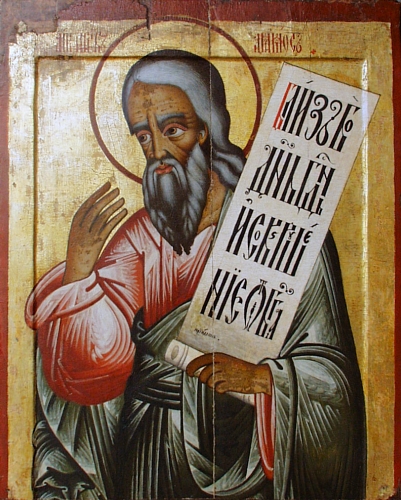
The Prophet Malachi Russian Orthodox
Starting with the celebration of Pentecost (8 June), we are now in the 23rd week of Ordinary Time, the longest season of the church year. As Professor Fred Gaiser of Luther Seminary pointed out in a commentary on the Malachi reading, we are “inundated” with several texts concerning the end times in the latter weeks of the Lectionary cycle, including the passages highlighted here. Let’s start with some historical context.
Malachi appears only a few times in the Revised Common Lectionary, most notably on the Presentation of Our Lord (Malachi 3:1–4) and in Year C’s late autumn readings (Malachi 4:1–2a). Both passages highlight themes of purification, judgment, and the promise of a coming messenger—threads that tie the Old Testament’s final words to the hope of Advent. The book was written between 460 and 400 BCE, during a time when the people of Judah had returned from exile but were disillusioned by unmet expectations of renewal. Though the temple had been rebuilt, spiritual apathy and social injustice plagued the community. Malachi confronted corrupt priests, broken relationships, and a lack of trust in God’s promises. His message, delivered in a series of dialogues, called the people back to covenant faithfulness and sincere worship. As the final book of the Old Testament, Malachi bridges the prophetic tradition with the hope of a coming messenger who would prepare the way for the Lord.
St. Luke the Evangelist
Luke 21, written four centuries later, speaks directly into the chaos following Rome’s destruction of the Jerusalem Temple in 70 CE — a seismic blow to Jewish and early Christian identity. Writing decades after Jesus’ apocalyptic warnings (between 80-90 CE), Luke channels the urgency and unrest of first-century Palestine, where Roman oppression and religious conflict threatened survival. In Luke’s recounting, Jesus foretells persecution and collapse yet promises divine wisdom and endurance to those who remain faithful. For Luke’s audience, still reeling from the Temple’s fall, these words reframed suffering as a path toward redemption. (Sidebar: We have to consider that Luke would be writing for some who had a living memory of Jesus, similar to how we might think about events from the mid-1970s).
A.I. Generated Image
In this anxious first third of the 21st century, what can Christians draw from these ancient texts? Many lessons, but let me offer two challenges. First, Malachi urges us to rekindle faith in an age of apathy. He calls us to examine our spiritual integrity, confront institutional corruption, and renew our trust in God’s promises—not passively, but as active covenant partners. In a culture steeped in cynicism and consumerism, this summons demands sincerity and ethical courage. Second, Jesus’ words in Luke challenge us to pair endurance with wisdom in times of upheaval—whenever they arise. Early Christians faced violence, division, and cultural fragmentation (sound familiar?), yet they found hope, resilience, and salvation in Christ. Their faith was forged in fire. As we navigate our own storms, let us draw strength from their example—and follow with a quiet, fierce endurance.
Soli Deo Gloria!
A Musical Connection: “Earth and All Stars” (Brokering)
Herbert Brokering (1926-2009)
Psalm 98 calls all creation to sing a new song to the Lord—a summons that inspired (at least) two familiar hymns: Joy to the World and Earth and All Stars. Both echo the psalm’s vision of joyful, universal praise for God’s saving acts. Herbert Brokering wrote Earth and All Stars in 1964 to mark the 90th anniversary of St. Olaf College. He wove together the wonders of nature and human achievement — “loud rushing planets,” “classrooms and labs” — into a single chorus of praise. The refrain, “He has done marvelous things,” quotes Psalm 98:1 directly, anchoring the hymn in scriptural celebration. I had the privilege of meeting Brokering when he spoke at Concordia during my student years. He addressed us in Chapel and in a religion class—an unforgettable presence.
Enjoy this interpretation of the song from the St. Olaf Choir — the organist is having some fun with it — my friend, Rollie Lee will enjoy this!
A note from a commentary on Psalm 98 (J. Clinton McCann, Jr.) “Psalm 98 is an extraordinarily important psalm. Along with the similar Psalm 96, it anchors the collection of YHWH-mlk (“the LORD reigns,” or “the LORD is king”; see verse 6) psalms, or enthronement psalms, that many commentators view as “the theological ‘heart’”1 of the book of Psalms. Furthermore, it is likely that Psalm 98 has been sung over the past 250 years as much as or more than any other psalm. This is due, of course, to the popularity of Isaac Watts’s metrical version of Psalm 98, ‘Joy to the World.’”
Earth and all stars, loud rushing planets, sing to the Lord a new song! O victory, loud shouting army, sing to the Lord a new song! He has done marvelous things. I, too, will praise him with a new song!
Hail, wind, and rain, loud blowing snowstorms, sing to the Lord a new song! Flowers and trees, loud rustling dry leaves, sing to the Lord a new song! He has done marvelous things. I, too, will praise him with a new song!
Trumpet and pipes, loud clashing cymbals, sing to the Lord a new song! Harp, lute, and lyre, loud humming cellos, sing to the Lord a new song! He has done marvelous things. I, too, will praise him with a new song!
Knowledge and truth, loud sounding wisdom, sing to the Lord a new song! Daughter and son, loud praying members, sing to the Lord a new song! He has done marvelous things. I, too, will praise him with a new song.
Note: There are several variations of the song lyrics. These are from Augsburg Fortress Publishing, 1968.
Psalm 98
O sing to the Lord a new song, for he has done marvelous things. His right hand and his holy arm have gotten him victory. 2 The Lord has made known his victory; he has revealed his vindication in the sight of the nations. 3 He has remembered his steadfast love and faithfulness to the house of Israel. All the ends of the earth have seen the victory of our God.
4 Make a joyful noise to the Lord, all the earth; break forth into joyous song and sing praises. 5 Sing praises to the Lord with the lyre, with the lyre and the sound of melody. 6 With trumpets and the sound of the horn make a joyful noise before the King, the Lord.
7 Let the sea roar and all that fills it, the world and those who live in it. 8 Let the floods clap their hands; let the hills sing together for joy 9 at the presence of the Lord, for he is coming to judge the earth. He will judge the world with righteousness and the peoples with equity.
Prayer Reflection: A Fearless Space (Nouwen)
Henri Nouwen speaks to something deep and true here: the kind of home we build when we’re anchored in God’s love — a fearless space. In a world full of wounds, only God offers a space free from fear—a place where we can be honest, stay faithful, and grow together. This reminds me of Paul’s words in 2 Thessalonians 3:6–13. He calls us to live responsibly, to keep working, and not to grow weary in doing good. It’s a call to community that’s grounded in grace, not perfection. When we confess our weaknesses and lean into prayer, we begin to reflect the unbroken love of God—even in our brokenness.
God alone is free enough from wounds to offer us a fearless space. In and through God we can be faithful to each other: in friendship, marriage, and community. This intimate bond with God, constantly nurtured by prayer, offers us a true home. We can live together in this home without asking for much more than a willingness to constantly confess our weaknesses to each other. We can only stay together when the “staying power” comes from the One who comes to stay. When we know ourselves to be deeply anchored in that divine covenant, we can build homes together. Only then can our limited and broken love reflect the unlimited and unbroken love of God.Amen.
Dutch Theologian Henri Nouwen
Henri Nouwen (1932–1996) was a priest, professor, and spiritual writer. He authored over 40 books on the spiritual life and spent his final years at L’Arche Daybreak, a community for people with intellectual disabilities. Drawing from his own journey of vulnerability and faith, he invites seekers into deeper intimacy with God, themselves, and others.
Join us for some free-flowing conversation about the Lectionary readings each Sunday. We meet from 10:45-11:30 in the church library each week, with some exceptions. No prior knowledge is necessary! ALL ARE WELCOME!
QUESTIONS FOR DISCUSSION THIS WEEK (and anything else you care to discuss from the readings):
1. What does “rekindling faith in an age of apathy” look like in our own community?
2. How can we cultivate endurance and wisdom in the face of modern upheaval?
And one more thing . . . . a notable event from the Lutheran World Federation:
On Reformation Day 2025, the Nepal Evangelical Lutheran Church (NELC) made history by ordaining its first two women pastors—Rev. Rinki Rachel Soren and Rev. Sushila Murmu. More than 325 people gathered in Laxmipur, Morang, to witness this powerful step toward greater inclusion in ministry. Read the full article here.
The Lutheran World Federation (LWF) is a global communion of Lutheran churches committed to faith, justice, and service. Founded in 1947, it brings together over 150 member churches in more than 99 countries. The Evangelical Lutheran Church in America (ELCA) is one of its largest members, actively participating in LWF’s global mission, humanitarian efforts, and ecumenical dialogue. Through this connection, the ELCA joins a worldwide network of Lutherans working together for peace, reconciliation, and shared witness.
The Bible 365 Challenge! More than 60 members of our faith community have committed to the Bible 365 Challenge—a shared journey of reading through the entire Bible in one year. Each day, we engage with selected passages weaving together stories of faith, struggle, grace, and redemption. This challenge isn’t just about completing a task; it’s about deepening our spiritual roots, building community, and discovering how scripture speaks into our lives today.
“It appears to me as if the world itself were approaching its end and, as the Psalmist says, is waxing old. … So there is nothing to hope for, except the day of our great God.”(Martin Luther, 1544)
This week’s lectionary readings—especially Jesus’ bold affirmation that God is “not of the dead, but of the living,” and Paul’s steadying words to the Thessalonians—draw us into the deep waters of eschatology, that rich and unsettling branch of theology that ponders the ending days. Martin Luther, like many before and after him, felt the tremors of history and believed Christ’s return was near. In fact, in the late 1520s, as the Ottoman Empire pressed into Europe, he feared he might not even finish translating the Old Testament before the world unraveled! This foreboding seemed to stay with him for his remaining years, as noted in the opening quote. I remember my own brush with apocalyptic awareness: eighth grade, 1970, a classroom moment when I learned the U.S. had over 30,000 nuclear weapons—enough to erase the Soviet Union several times over, and they could do the same to us (I remember thinking, “why do we need to be able to destroy them many times?”). Today, the specter of Artificial Intelligence has taken up residence in our cultural imagination, whispering new versions of the old fear: that we may be the architects of our own undoing. As always, there is much to fear in our stormy times!
Many who are reading this were born and raised in the Lutheran tradition. The ELCA — our particular branch of this tradition — invites us to live with bold hope, trusting that Christ’s resurrection is not just a past event but the heartbeat of God’s future for the world. Instead of fear or speculation, we’re called to see the end as a horizon of justice, peace, and renewal—where God’s promises come alive. Scripture’s visions of the last things aren’t blueprints to decode but poetic truths that shape how we walk through uncertainty with courage. This eschatology doesn’t pull us away from the world—it sends us into it, grounded in grace and ready to embody the reign that’s already breaking in. It’s a lot to think about.
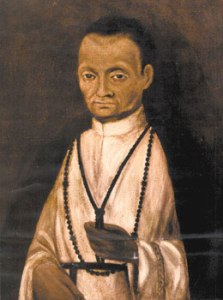
San Martin de Porres (1579-1839)
Thanks for your visit to this space again this week! Your interest in using the Revised Common Lectionary as a means of exploring scripture inspires me. And notably, November has been deemed Global Bible Month by three leading Bible Apps, including YouVersion which many of us are using with our Bible 365 Challenge. We have three Sundays remaining in Year C (through 23 November) and this week, among others, we commemorate Martin de Porres, renewer of society, who died on 3 November 1639. His story is powerful. And, as I’m writing this, I’m reflecting on a tremendous worship experience that we shared on Sunday with the Ho-Chunk UCC, Little Norway, and Spirit Creek. It is truly humbling and empowering to use the language of faith as a means of healing centuries of brokenness with our Indigenous brothers and sisters! Thanks to all involved!
My reflections this week will focus on the 2 Thessalonians passage, continuing the theme of our view of the final days.
** Note 1: Links to outside references are bolded and italicized and are meant for further reading or research on your part. While the text I am including in the blog is my own, I am pulling from a multitude of sites for ideas and connections. ** Note 2: In my increasing use of A.I. (Copilot), I will cite sourcing of how I am using the tool, if necessary. I don’t want that to be overly cumbersome, but I am gradually incorporating more tools. I am exploring the A.I. world this summer prior to my next teaching semester. As you can imagine, it is a great challenge right now and will forever change the face of education!
** Note 3: The images I include in the blog are drawn from Wikimedia Commons to the fullest extent possible.
My source for the Bible readings each week is the Bible Gateway website. I generally use the NRSVUE translation.
The readings for Pentecost 22 share a deep longing for resurrection, justice, and divine presence amid suffering and uncertainty. Job declares hope in a living Redeemer, while the psalmist seeks refuge in God’s face and protection from harm. Paul urges steadfastness in the face of confusion about the end times, and Jesus affirms that God is the God of the living, not the dead. Together, these texts invite believers to trust in a future shaped by divine faithfulness, even when the present feels fractured or unclear.
“Describe the common themes among the readings for Pentecost 22.” Copilot, 1 November 2025, Copilot website.
Lectio Divina is a quiet, thoughtful way of reading the Bible to connect with God. It grew out of early Christian traditions and was shaped by thinkers like Augustine, who believed Scripture speaks to the heart. Augustine didn’t invent the practice, but his ideas helped form its spirit—listening deeply and responding with love. Later, others gave it a clear structure, but its roots go back to that longing for God’s voice.
LUTHER’S METHOD OF BIBLE READING A Revision of the Lectio Divina (Augustinian)
Three Steps
Oratio (Prayer): This is the starting point, where one humbly prays for the Holy Spirit’s guidance to understand God’s Word. Luther emphasized that prayer prepares the heart and mind to receive divine wisdom.
Meditatio (Meditation): This involves deeply engaging with Scripture, not just reading it but reflecting on it repeatedly. Luther encouraged believers to “chew on” the Word, allowing its meaning to sink in and shape their thoughts and actions.
Tentatio (Struggle): Often translated as “trial” or “temptation,” this refers to the challenges and spiritual battles that arise as one seeks to live according to God’s Word. Luther saw these struggles as a way God refines faith, making it more resilient and authentic.
Focus Passage: 2 Thessalonians 2: 1-5, 13-17
Concerning the coming of our Lord Jesus Christ and our being gathered to him, we ask you, brothers and sisters, 2 not to become easily unsettled or alarmed by the teaching allegedly from us—whether by a prophecy or by word of mouth or by letter—asserting that the day of the Lord has already come. 3 Don’t let anyone deceive you in any way, for that day will not come until the rebellion occurs and the man of lawlessness is revealed, the man doomed to destruction. 4 He will oppose and will exalt himself over everything that is called God or is worshiped, so that he sets himself up in God’s temple, proclaiming himself to be God. 5 Don’t you remember that when I was with you I used to tell you these things?
13 But we ought always to thank God for you, brothers and sisters loved by the Lord, because God chose you as firstfruits to be saved through the sanctifying work of the Spirit and through belief in the truth. 14 He called you to this through our gospel, that you might share in the glory of our Lord Jesus Christ. 15 So then, brothers and sisters, stand firm and hold fast to the teachings we passed on to you, whether by word of mouth or by letter. 16 May our Lord Jesus Christ himself and God our Father, who loved us and by his grace gave us eternal encouragement and good hope, 17 encourage your hearts and strengthen you in every good deed and word.
Reflection: “Echoes from the Via Egnatia”
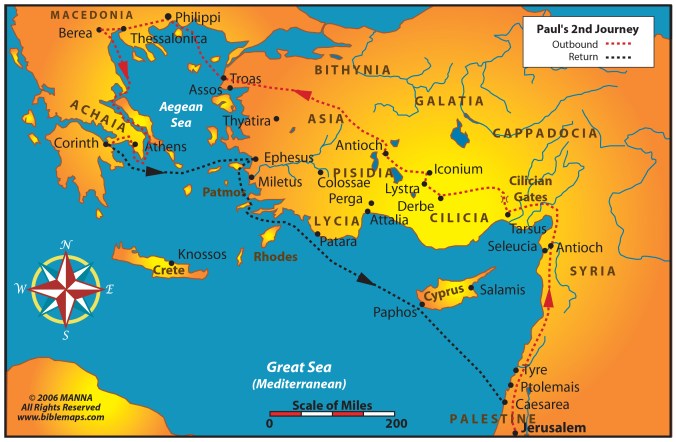
Paul’s Second Missionary Journey, 49 CE
Thessalonica was a thriving port city in Macedonia, strategically located along the Via Egnatia—the major Roman road linking east and west—which made it a hub of commerce, culture, and political influence. As a Roman provincial capital with a diverse population of Greeks, Romans, and Jews, it was an ideal place for Paul to plant a church during his second missionary journey (49-52 CE). He preached in the synagogue for three Sabbaths, and despite facing opposition, his message took root among both Jews and Gentiles. Forced to leave prematurely, Paul later wrote 1 and 2 Thessalonians while in Corinth (50-51 CE) to encourage the fledgling community, clarify teachings about Christ’s return, and strengthen their faith amid persecution. (Sidebar: Paul’s authorship of 2 Thessalonians is disputed and it could have been written by one of his co-workers, Timothy or Silvanus). The city’s vibrancy and volatility made it a powerful setting for Paul’s eschatological reflections and pastoral care.
As pointed out in the Lutheran Study Bible, a good framework for understanding the correspondence between Paul and the Thessalonian believers is to realize that in his absence, three questions seemed to be swirling and remain relevant in 2025: “Can we trust this guy? If God is truly Lord of all, why are we who worship this God still suffering? Why is Christ’s return taking so long, and what will happen to those who die before he comes?”(LSB, page 1842). That third question seems to be at the center of 2 Thessalonians.
Via Egnatia (Roman Road utilized by Paul)
In 2 Thessalonians 2:1–5, Paul urges believers not to be shaken or alarmed by claims that the Day of the Lord has already come. He explains that certain events—like the rebellion and the revealing of the “man of lawlessness”—must happen first and reminds them that he had already taught them this. Then, in verses 13–17, Paul shifts to encouragement, thanking God for choosing them for salvation through the Spirit and truth. He calls them to stand firm, hold fast to his teachings, and be strengthened in every good word and deed, offering comfort and hope in the face of confusion and fear.
What should we take away from this portion of the letter? First, it is clear that we should not be shaken by false claims about the timing of Christ’s return. The author suggests that certain events (a rebellion, a revelation of a “man of lawlessness,” both rather vague and applicable to many situations!) must precede the Day of the Lord. People have twisted themselves into knots over these kinds of predictions throughout history, and we can get caught up in that as well. Second, the author reminds the community that they are chosen by God and called through the gospel to share in Christ’s glory, affirming their identity and purpose. As spiritual descendants, this is WHO we are and WHY we are! Rather than spending our time fretting over the end times, a healthier approach to life is to do what we can right here and right now — a practical approach to justice. Action is a great counter to anxiety about the future. Finally, there are great words of encouragement for believers in the final verses — one of many pep talks we find in Paul’s letters — check out Romans 8:18, 2 Corinthians 4:17, 1 Thessalonians 4: 13-18, and Galatians 6:9 if you need a lift today!
Soli Deo Gloria!
A Musical Connection: The End of the World As We Know It (And I Feel Fine)
While preparing this week’s blog, I stumbled on a commentary on the passage from 2 Thessalonians by Nijay Gupta. In it, he referenced R.E.M.’s It’s the End of the World As We Know It (And I Feel Fine), a 1987 offering that feels like a snapshot of late-1980s chaos—fast, fragmented, and overloaded with pop culture. Hearing the song took me back to that period and my students from those days. The lyrics come at you fast and the ironic “I feel fine” tag line offers a sense of “shrug” in the face of a world that seems to be coming apart. I post it here as an example of the post-modern angst that many seem to feel in our own time — and is played out in so many ways.
R.E.M. emerged from Athens, Georgia in the early 1980s and quickly became one of the defining bands of alternative rock. Known for their jangly guitar sound, cryptic lyrics, and Michael Stipe’s distinctive voice, they blended post-punk energy with Southern introspection. Their early albums like Murmur and Reckoning built a cult following, while later releases such as Out of Time and Automatic for the People brought mainstream success with hits like “Losing My Religion.” R.E.M.’s music often wrestled with themes of identity, politics, and existential angst, making them both a voice of their generation and a bridge between underground authenticity and global influence.
(Information garnered from Co-Pilot, 1 November 2025)
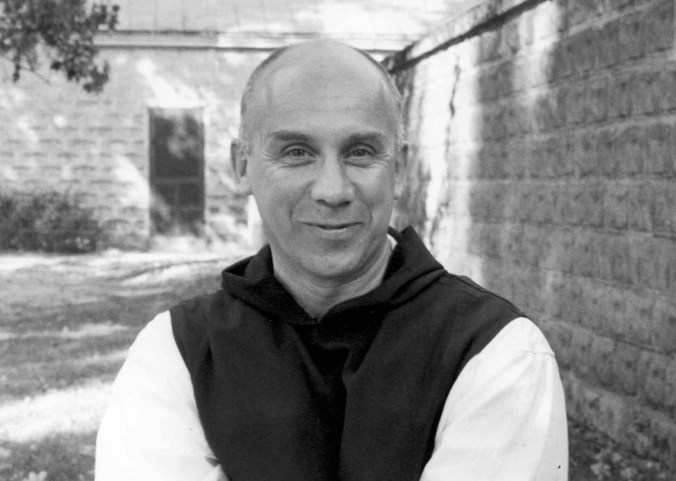
Prayer Reflection: Merton’s “Prayer of Trust”
Thomas Merton’s Prayer of Trust is included in his 1956 book, Thoughts In Solitude, and is a heartfelt confession that he doesn’t know where he’s going, but he’s trying to follow God anyway. It’s honest, raw, and speaks to that deep uncertainty so many of us feel in a world that often seems disconnected and chaotic. In the postmodern era, where truth feels slippery and meaning gets drowned out by noise, Merton’s words remind us that even the desire to please God is enough. His prayer offers a kind of spiritual anchor—a quiet trust that cuts through the confusion and says, “You’re not alone in this.” I offer it as a counter to the sentiments expressed in the R.E.M. song.
My Lord God, I have no idea where I am going. I do not see the road ahead of me. I cannot know for certain where it will end. Nor do I really know myself, and the fact that I think I am following your will does not mean that I am actually doing so. But I believe that the desire to please you does in fact please you. And I hope I have that desire in all that I am doing. I hope that I will never do anything apart from that desire. And I know that if I do this you will lead me by the right road, though I may know nothing about it. Therefore, will I trust you always though I may seem to be lost and in the shadow of death. I will not fear, for you are ever with me, and you will never leave me to face my perils alone. Amen.
Thomas Merton (1915-1968)
Faithful Conversations Updates
Join us for some free-flowing conversation about the Lectionary readings each Sunday. We meet from 10:45-11:30 in the church library each week, with some exceptions. No prior knowledge is necessary! ALL ARE WELCOME! And, let’s discuss the Gospel reading for Sunday (Luke 20: 27-38) alongside the Second Reading from 2 Thessalonians — why are they offered together in the RCL readings for Sunday?
The Bible 365 Challenge! More than 60 members of our faith community have committed to the Bible 365 Challenge—a shared journey of reading through the entire Bible in one year. Each day, we engage with selected passages weaving together stories of faith, struggle, grace, and redemption. This challenge isn’t just about completing a task; it’s about deepening our spiritual roots, building community, and discovering how scripture speaks into our lives today.
“Thus a Christian man is righteous and a sinner at the same time, holy and profane, an enemy of God and a child of God.”(Martin Luther)
All Saints Day may have had roots in a pre-Christian Celtic festival honoring the dead, held in early November as autumn fades into winter. For the ancient Celts, a liminal time was a sacred threshold—when the veil between worlds grew thin and the ordinary gave way to the mysterious. These moments, like the shift from harvest to winter, were seen as openings for spiritual encounter, transformation, and ancestral connection. Early Christians honored unnamed martyrs whose faithful witness shaped the Church and by the 4th century, regional communities set aside days to remember the departed. In the 9th century, Pope Gregory IV designated November 1 as All Saints Day in the Western Church. Over time, the celebration grew to include all believers whose lives reflected God’s grace. Lutheran and Anglican traditions preserved the observance, emphasizing the **communion of saints as a living fellowship that spans generations. When we confess this in the Apostles’ Creed, we affirm a spiritual bond rooted not in perfection but in grace—a truth Martin Luther captured in his 1535 Commentary on Galatians with the phrase simul justus et peccator: simultaneously justified and sinner.
Luther honored saints as examples of faith but rejected the Catholic practice of invoking them for intercession. He insisted that Christ alone mediates between God and humanity, and warned that praying to saints or venerating relics distracted from the gospel. For Luther, saints belonged to the body of Christ—not as intermediaries, but as fellow witnesses whose lives point us back to God’s mercy. His theology redirected Christian devotion toward Scripture and the sufficiency of Christ, shaping worship and doctrine for generations. All Saints Sunday, in this light, becomes not a celebration of spiritual elites, but a remembrance of grace at work in ordinary lives.
Virgin and Child with Saints Simon and Jude (Barocci, c. 1567)
Thanks for your visit to this space again this week! It’s hard to imagine that beyond All Saints Sunday we have three Sundays remaining in the church year! Time flies. This week we do commemorate the Apostles Simon and Jude (28 October) and Reformation Day on Friday, as you know. Pastor Jen and Patti Whitworth will be traveling back from Malawi in the early part of the week, and we pray for a safe journey. Also, a reminder that on All Saints Sunday, ELC will have a joint worship experience with our neighbors from the United Church of Christ at the Ho-Chunk Nation District 1 Community Center at the Mission at 2:00. This builds on our collaboration started four years ago. All are welcome!
My reflections this week will focus on the passage from the Sermon on the Plain and its connection to our understanding of sainthood. I’m also sharing a song and prayer that seem especially fitting for All Saints Sunday.
** The “communion of saints” is part of the Third Article of the Apostles Creed. For a good explanation of the history of the Creed and also Luther’s commentary on it, go to this link.
** Note 1: Links to outside references are bolded and italicized and are meant for further reading or research on your part. While the text I am including in the blog is my own, I am pulling from a multitude of sites for ideas and connections. ** Note 2: In my increasing use of A.I. (Copilot), I will cite sourcing of how I am using the tool, if necessary. I don’t want that to be overly cumbersome, but I am gradually incorporating more tools. I am exploring the A.I. world this summer prior to my next teaching semester. As you can imagine, it is a great challenge right now and will forever change the face of education!
** Note 3: The images I include in the blog are drawn from Wikimedia Commons to the fullest extent possible.
Common Themes Among the Readings
All Saints Readings
Daniel 7: 1-3, 15-18 Psalm 149 Ephesians 1: 11-23 Luke 6: 20-31
My source for the Bible readings each week is the Bible Gateway website. I generally use the NRSVUE translation.
The readings for All Saints Sunday highlight God’s promise to the faithful, who receive and inherit the kingdom. Daniel envisions holy ones triumphing over chaos, while Psalm 149 celebrates God’s delight in the humble and victorious. Ephesians reminds believers they are marked by the Spirit and destined for a glorious inheritance. Luke’s Beatitudes flip worldly values, blessing the poor and warning the comfortable, showing how saints live by grace, not status. Together, these texts call us to live with hope, humility, and courage as part of God’s unfolding story.
“Describe the common themes among the readings for All Saints Sunday.” Copilot, 24 October 2025, Copilot website.
Lectio Divina is a quiet, thoughtful way of reading the Bible to connect with God. It grew out of early Christian traditions and was shaped by thinkers like Augustine, who believed Scripture speaks to the heart. Augustine didn’t invent the practice, but his ideas helped form its spirit—listening deeply and responding with love. Later, others gave it a clear structure, but its roots go back to that longing for God’s voice.
LUTHER’S METHOD OF BIBLE READING A Revision of the Lectio Divina (Augustinian)
Three Steps
Oratio (Prayer): This is the starting point, where one humbly prays for the Holy Spirit’s guidance to understand God’s Word. Luther emphasized that prayer prepares the heart and mind to receive divine wisdom.
Meditatio (Meditation): This involves deeply engaging with Scripture, not just reading it but reflecting on it repeatedly. Luther encouraged believers to “chew on” the Word, allowing its meaning to sink in and shape their thoughts and actions.
Tentatio (Struggle): Often translated as “trial” or “temptation,” this refers to the challenges and spiritual battles that arise as one seeks to live according to God’s Word. Luther saw these struggles as a way God refines faith, making it more resilient and authentic.
Focus Passage: Luke 6: 20-31
20 Then he looked up at his disciples and said: “Blessed are you who are poor, for yours is the kingdom of God. 21 “Blessed are you who are hungry now, for you will be filled. “Blessed are you who weep now, for you will laugh. 22 “Blessed are you when people hate you and when they exclude you, revile you, and defame you[a] on account of the Son of Man. 23 Rejoice on that day and leap for joy, for surely your reward is great in heaven, for that is how their ancestors treated the prophets. 24 “But woe to you who are rich, for you have received your consolation. 25 “Woe to you who are full now, for you will be hungry. “Woe to you who are laughing now, for you will mourn and weep. 26 “Woe to you when all speak well of you, for that is how their ancestors treated the false prophets. 27 “But I say to you who are listening: Love your enemies; do good to those who hate you; 28 bless those who curse you; pray for those who mistreat you. 29 If anyone strikes you on the cheek, offer the other also, and from anyone who takes away your coat do not withhold even your shirt. 30 Give to everyone who asks of you, and if anyone takes away what is yours, do not ask for it back again. 31 Do to others as you would have them do to you.
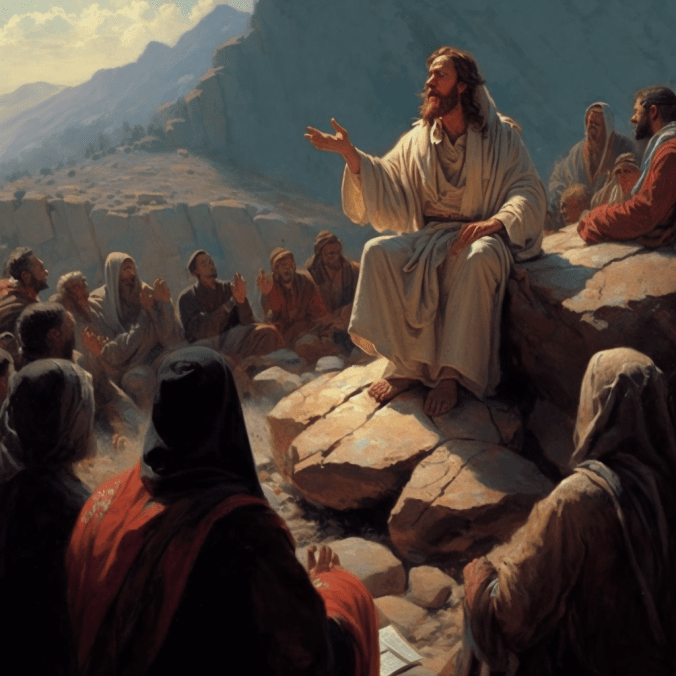
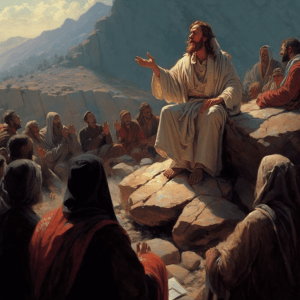
Jesus Teaching in Galilee (A.I. Generated, 2023)
Reflection: Grace and Grit and the Courage to Love
Protestant Theologian Karl Paul Reinhold Niebuhr (1892-1971)
Reinhold Niebuhr (1892–1971) was a towering figure in 20th-century American theology, ethics, and public thought—a Protestant theologian rooted in the Evangelical and Reformed tradition, yet unafraid to wrestle with the messiness of modern life. He’s best known for developing Christian Realism, a framework that confronts the persistent tension between moral ideals and political necessity, between the call to justice and the reality of sin. I first encountered Niebuhr’s writings in a religion class as a college student in the 1970s — a time when questions of war, civil rights, and institutional power pressed hard on my conscience. His voice—clear-eyed, unsentimental, and deeply faithful—helped me navigate the uneasy terrain where religion and politics meet. He taught me that faith is not an escape from complexity but a lens through which to engage it with humility and courage. As I reflect on this week’s Gospel reading, Niebuhr’s realism echoes: the saints we honor are not plaster-perfect, but those who dared to love in a broken world, trusting that grace can do what idealism alone cannot. Niebuhr once quipped that he didn’t much care for saints—at least not the kind who seemed too perfect, too pious, too removed from the grit of real life. Yet even Niebuhr, with his sharp theological realism, recognized the quiet heroism of those who live faithfully in the tension between ideal and reality (“the impossible possibility,” in his words).
The Sermon on the Plain in Luke 6 marks a defining moment early in Jesus’ ministry, delivered just after he calls the twelve apostles. Unlike Matthew’s mountaintop sermon, Luke places Jesus on “a level place,” symbolizing his solidarity with the crowd—poor, sick, and marginalized. This sermon lays out the ethical heart of the kingdom: blessings for the suffering, woes for the comfortable, and a radical call to love enemies and live mercifully. It’s a manifesto for discipleship in the real world. On All Saints Sunday, this passage reminds us that sainthood is not about moral perfection or spiritual polish. It’s about showing up in the mess, loving enemies, giving generously, and trusting that mercy matters more than merit. Saints are those who, by grace, live into the golden rule with courage and compassion. As we remember the great cloud of witnesses, we’re invited not to admire from afar, but to join them—ordinary people responding to an extraordinary call. Niebuhr put it this way: “The cross symbolizes a cosmic as well as historic truth. Love conquers the world, but its victory is not an easy one.”
Soli Deo Gloria!
A Musical Connection: Let My Love Be Heard (Jake Runestad)
Jake Runestad’s Let My Love Be Heard is a poignant choral setting of Alfred Noyes’ brief poem “A Prayer,” composed in 2014 for Choral Arts Northwest. The piece gained emotional resonance in 2015 when students at Cal State Long Beach performed it in memory of Nohemi Gonzalez, a classmate killed in the Paris terrorist attacks. The performance, shared widely online, transformed the work into a communal expression of grief and hope. Musically, the piece builds from a quiet invocation to a soaring climax, with layered harmonies that evoke angels carrying love and longing heavenward. The repeated plea—“Let my love be heard”—offers a sacred echo of remembrance, making it especially fitting for All Saints Sunday, when we honor those whose love still whispers in our lives.
‘A Prayer’ by Alfred Noyes
Angels, where you soar Up to God’s own light, Take my own lost bird On your hearts tonight; And as grief once more Mounts to heaven and sings, Let my love be heard Whispering in your wings.
The Grammy-nominated British vocal ensemble VOCES8 is proud to inspire people through music and share the joy of singing. Touring globally, the group performs an extensive repertoire both in its a cappella concerts and in collaborations with leading orchestras, conductors and soloists. Versatility and a celebration of diverse musical expression are central to the ensemble’s performance and education ethos which is shared both online and in person.
Prayer Reflection: Remembering Those We Carry With Us
“God of the generations, when we set our hands to labor, thinking we work alone, remind us that we carry on our lips the words of prophets, in our veins the blood of martyrs, in our eyes the mystics’ visions, in our hands the strength of thousands.” Amen.
Source: “God of the generations” by Jan Richardson, in “Inspired: On the Feast of All Saints,” The Painted Prayerbook (Oct. 29, 2011); originally published in Jan Richardson, In Wisdom’s Path: Discovering the Sacred in Every Season (Orlando: Wanton Gospeller, 2012)
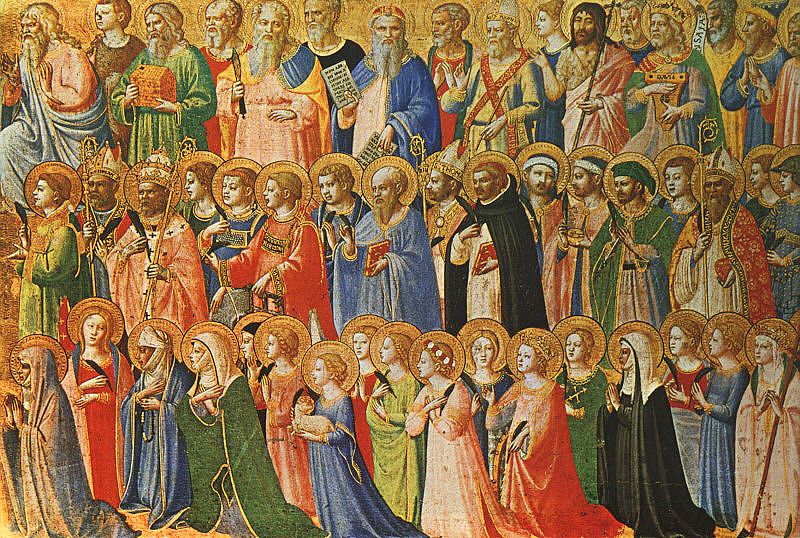
The Forerunners of Christ With Saints and Martyrs by Fra Angelico (circa 1395–1455)
Faithful Conversations Updates
Join us for some free-flowing conversation about the Lectionary readings each Sunday. We meet from 10:45-11:30 in the church library each week, with some exceptions. No prior knowledge is necessary! ALL ARE WELCOME! And, let’s discuss these questions when we gather (or any other questions you would like to raise for the group!):
1. Niebuhr spoke of the “impossible possibility” of living faithfully in a broken world. How does this idea challenge or affirm your understanding of sainthood, especially in light of Luke 6:20–31?
2. Luke’s Beatitudes offer a reversal of worldly values. How might this challenge our assumptions about success, holiness, and who we honor in our communities?
More than 60 members of our faith community have committed to the Bible 365 Challenge—a shared journey of reading through the entire Bible in one year. Each day, we engage with selected passages weaving together stories of faith, struggle, grace, and redemption. This challenge isn’t just about completing a task; it’s about deepening our spiritual roots, building community, and discovering how scripture speaks into our lives today.
“This message is not a novel invention of ours but the very ancient, approved teaching of the apostles brought to light again. Neither have we invented a new Baptism, Sacrament of the Altar, Lord’s Prayer, and Creed; nor do we desire to know or to have anything new in Christendom. We only contend for, and hold to, the ancient: that which Christ and the apostles have left behind them and have given to us.”(Luther, Exposition on John, 1537)
“Holy Hill” in Black River Falls, Wisconsin
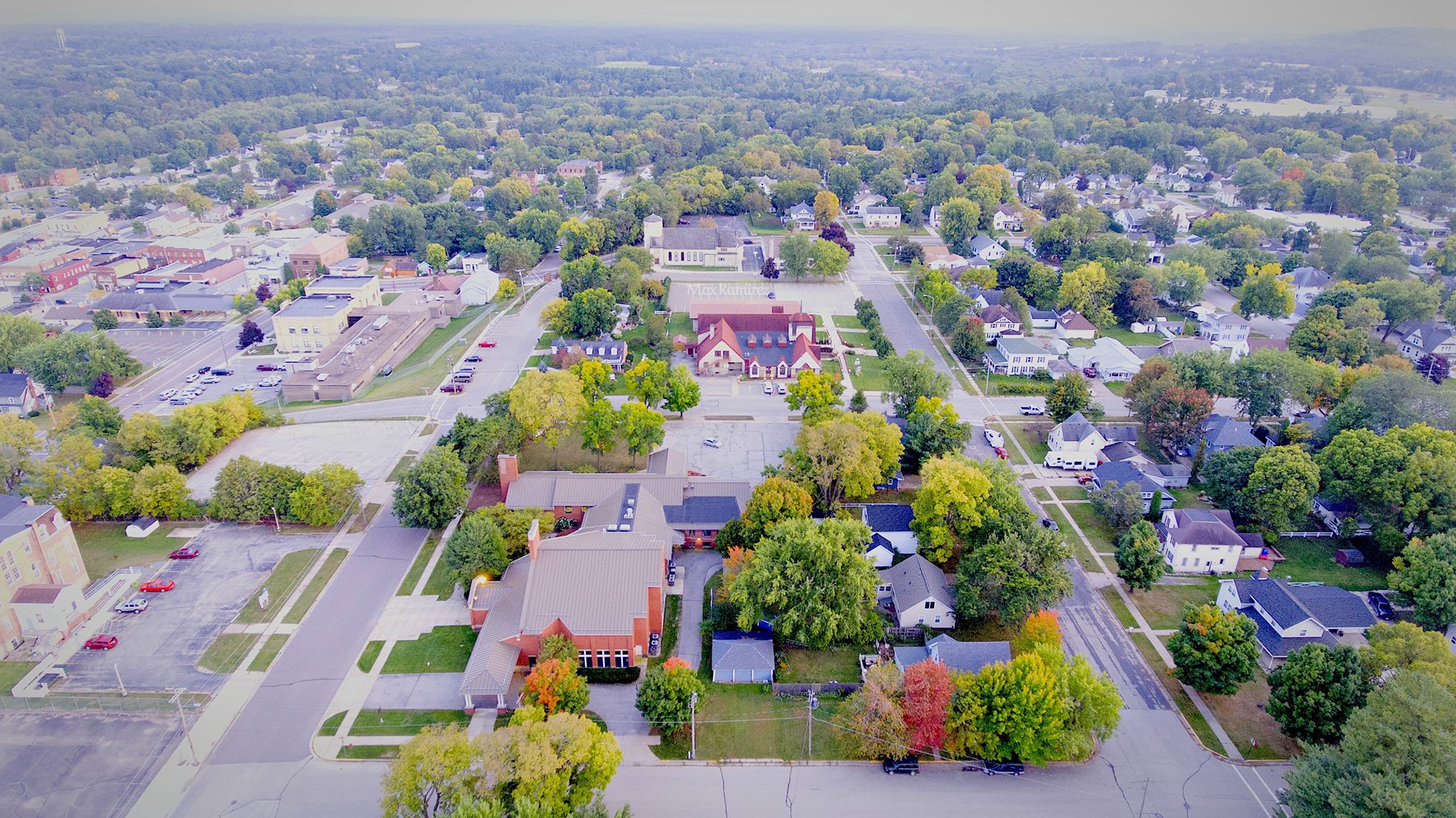
At the top of Main Street in Black River Falls — locals call it “Holy Hill” — three churches stand like sentinels: St. Joseph Catholic to the south, Evangelical Lutheran in the center, and United Methodist to the north. This quiet stretch holds echoes of five centuries of history. And Luther is a connecting rod in many respects. His bold actions in 1517 lit a fire. And, interestingly, it was Luther’s writing on Romans—his preface to Paul’s letter—that later stirred John Wesley’s heart in 1738, sparking the Methodist movement. On this hill, three traditions meet, each rooted in a story of reform, renewal, and the search for grace.
Katie Luther (1499-1552)
Wartburg Castle in Eisenach, Thuringia, Germany
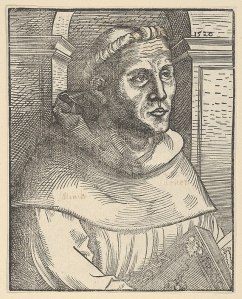
Reformation Sunday brings to mind both the power of tradition and the need for renewal. It was on 31 October 1517, 508 years ago, that a 33-year-old Augustinian monk, sent a list of 95 propositions to Archbishop Albrecht of Mainz challenging the Catholic Church’s practice of selling indulgences and calling for theological debate on repentance and grace (sidebar: there is no direct evidence that Luther personally nailed the 95 theses to the church door in Wittenberg, although it very well could have happened). His actions and what followed set in motion the Protestant Reformation. By 1519, followers of Luther were negatively labeled as “Lutherans” (picture opponents sneering) by those opposed to what Luther was doing — a name that eventually stuck. Luther preferred the term “Evangelical” to describe the movement. A few more details for background: Luther’s act of conscience challenging church doctrine led to his eventual excommunication by Pope Leo X (1513-1521) after his refusal to recant his positions at a meeting known as the Diet of Worms four years after his initial actions. Further, he was declared a heretic and outlaw by Charles V, Holy Roman Emperor, meaning anyone could legally capture or kill him without consequence. Protected by Elector Frederick of Saxony, Luther was spirited away to Wartburg Castle where he began translating the New Testament into German. In 1525, Luther married Katharina von Bora (1499-1552), a Cistercian nun who fled the convent. Talk about a rebellious power couple!
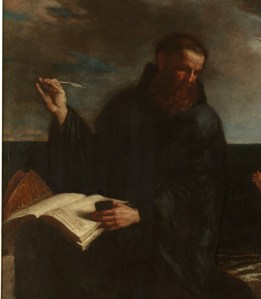
“Augustine Meditating on the Trinity” by Guercino (1663)
How should we view all of this from our 21st Century vantage point? It’s important to realize that Luther did not set out to break with Roman Catholicism. In fact, one can argue that he saw his actions as returning the Church to its ancient roots, as noted in the introductory quote. After all, Luther was steeped in the writings of Augustine (354-430), especially on sin, grace, predestination, and faith. He cited Augustine more than any other non-biblical source and even annotated Augustine’s texts by hand. Most notably, Luther fiercely rejected Pelagianism, believing that human will was bound by sin and incapable of choosing God without divine grace. His stance was shaped by his Augustinian training, which emphasized the total dependence of the soul on God’s mercy. Luther taught that salvation comes not through effort or merit, but through faith alone—a gift initiated by God, not earned by humans. In this view, Pelagianism was not just error but spiritual pride, denying the depth of human need and the power of grace. As Lutherans, we can summarize Luther’s theology with the following phrases: Sola Fide(faith alone), Sola Scriptura(scripture alone), Sola Gratia (grace alone), Solus Christus(Christ alone), and Soli Deo Gloria(To God alone be the glory). To use a football analogy — ala Vince Lombardi — this is the “power sweep” of Lutheranism.
Thanks for visiting this space again this week! We have four Sundays remaining in the church year and next Sunday — All Saints Sunday — is another important milestone. Also, on 26 October, the ELCA commemorates Philipp Nicolai, Johann Heermann, and Paul Gerhardt—three towering figures in Lutheran hymnody whose work gave voice to faith amid suffering. Nicolai, writing during a devastating plague, offered hope through majestic chorales like “Wake, Awake” and “O Morning Star.” Heermann, shaped by personal illness and the ravages of the Thirty Years’ War, penned hymns of tender devotion and theological depth. Gerhardt, enduring profound personal loss and political exile, composed over 130 hymns that blend confessional clarity with heartfelt piety, securing his place as one of Lutheranism’s greatest poets. (Research drawn from Co-Pilot, 19 October 2025).
My reflections this week will focus on the Reformation texts within the theme of tradition and renewal. And, in keeping with the Luther focus, I’m offering one of his hymns and his morning prayer for your interest. In addition, I will be offering a homily on Sunday at ELC related to the Reformation.
** Note 1: Links to outside references are bolded and italicized and are meant for further reading or research on your part. While the text I am including in the blog is my own, I am pulling from a multitude of sites for ideas and connections. ** Note 2: In my increasing use of A.I. (Copilot), I will cite sourcing of how I am using the tool, if necessary. I don’t want that to be overly cumbersome, but I am gradually incorporating more tools. I am exploring the A.I. world this summer prior to my next teaching semester. As you can imagine, it is a great challenge right now and will forever change the face of education!
** Note 3: The images I include in the blog are drawn from Wikimedia Commons to the fullest extent possible.
My source for the Bible readings each week is the Bible Gateway website. I generally use the NRSVUE translation.
The readings for Reformation Sunday center on God’s liberating promise of renewal, righteousness, and truth. Jeremiah proclaims a new covenant written on the heart, where intimate knowledge of God replaces external law. Psalm 46 celebrates God as a refuge and strength amid chaos, echoing the reformers’ trust in divine sovereignty. Romans and John together affirm that true freedom and justification come not through human effort but by grace through faith in Christ, who makes us free indeed.
“Describe the common themes among the readings for Reformation Sunday.” Copilot, 17 October 2025, Copilot website.
Lectio Divina is a quiet, thoughtful way of reading the Bible to connect with God. It grew out of early Christian traditions and was shaped by thinkers like Augustine, who believed Scripture speaks to the heart. Augustine didn’t invent the practice, but his ideas helped form its spirit—listening deeply and responding with love. Later, others gave it a clear structure, but its roots go back to that longing for God’s voice.
LUTHER’S METHOD OF BIBLE READING A Revision of the Lectio Divina (Augustinian)
Three Steps
Oratio (Prayer): This is the starting point, where one humbly prays for the Holy Spirit’s guidance to understand God’s Word. Luther emphasized that prayer prepares the heart and mind to receive divine wisdom.
Meditatio (Meditation): This involves deeply engaging with Scripture, not just reading it but reflecting on it repeatedly. Luther encouraged believers to “chew on” the Word, allowing its meaning to sink in and shape their thoughts and actions.
Tentatio (Struggle): Often translated as “trial” or “temptation,” this refers to the challenges and spiritual battles that arise as one seeks to live according to God’s Word. Luther saw these struggles as a way God refines faith, making it more resilient and authentic.
Focus Passages: Jeremiah, Romans, and John
Jeremiah 31: 31-34
31 The days are surely coming, says the Lord, when I will make a new covenant with the house of Israel and the house of Judah. 32 It will not be like the covenant that I made with their ancestors when I took them by the hand to bring them out of the land of Egypt—a covenant that they broke, though I was their husband, says the Lord. 33 But this is the covenant that I will make with the house of Israel after those days, says the Lord: I will put my law within them, and I will write it on their hearts, and I will be their God, and they shall be my people. 34 No longer shall they teach one another or say to each other, “Know the Lord,” for they shall all know me, from the least of them to the greatest, says the Lord, for I will forgive their iniquity and remember their sin no more.
Romans 3: 19-28
19 Now we know that, whatever the law says, it speaks to those who are under the law, so that every mouth may be silenced and the whole world may be held accountable to God. 20 For no human will be justified before him by deeds prescribed by the law, for through the law comes the knowledge of sin. 21 But now, apart from the law, the righteousness of God has been disclosed and is attested by the Law and the Prophets, 22 the righteousness of God through the faith of Jesus Christ[a] for all who believe. For there is no distinction, 23 since all have sinned and fall short of the glory of God; 24 they are now justified by his grace as a gift, through the redemption that is in Christ Jesus, 25 whom God put forward as a sacrifice of atonement by his blood, effective through faith. He did this to demonstrate his righteousness, because in his divine forbearance he had passed over the sins previously committed; 26 it was to demonstrate at the present time his own righteousness, so that he is righteous and he justifies the one who has the faith of Jesus. 27 Then what becomes of boasting? It is excluded. Through what kind of law? That of works? No, rather through the law of faith. 28 For we hold that a person is justified by faith apart from works prescribed by the law.
John 8: 31-36
31 Then Jesus said to the Jews who had believed in him, “If you continue in my word, you are truly my disciples, 32 and you will know the truth, and the truth will make you free.” 33 They answered him, “We are descendants of Abraham and have never been slaves to anyone. What do you mean by saying, ‘You will be made free’?” 34 Jesus answered them, “Very truly, I tell you, everyone who commits sin is a slave to sin. 35 The slave does not have a permanent place in the household; the son has a place there forever. 36 So if the Son makes you free, you will be free indeed.
Reflection: “Renewal Grounded in Tradition”
Among the many bold things that marked Martin Luther’s journey, his work in translating the Bible into German made scripture accessible to ordinary people. He began with the New Testament in 1522, completing the full Bible by 1534, using a vivid, earthy style that reflected the spoken language of his time. Luther’s translation drew on Hebrew and Greek sources, emphasizing clarity and theological precision (sidebar: he actually worked with a team, nicknamed the “Sanhedrin” including Philipp Melanchthon, a scholar of Greek and Matthäus Aurogallus, an expert in Hebrew, among others — I cannot imagine how difficult that work was!). By empowering laypeople to read the Bible themselves, Luther’s translation became a cornerstone of Protestant thought and literacy — he would greatly appreciate our “Bible 365” Project! In the Lutheran Study Bible, now in a second edition, there is an excellent section documenting Luther’s approach to the Bible. Notably, he believed that certain parts of the Bible were “more important and/or clear than others,” and suggested that we devote ourselves “especially to John’s Gospel, Paul’s epistles (especially Romans), and 1 Peter.” We also know he held the Psalms in high esteem, calling them “the little Bible.” He read from the Psalms daily and completed the Psalter every two weeks (Psalm 118 was his favorite). And, one last point regarding his view of the Bible (again, from the Lutheran Study Bible): Luther believed the Bible has “a universal and immediate sense, granted by the Holy Spirit and recognized by the eyes of faith that rises above historical conditions and events. Luther heard biblical texts as speaking both to the time in which they were written and to his own time.” Let that observation sink in.
After reading the Reformation texts, here are a few reflections. We’re not the first to face fear, division, or the need for deep renewal—and we won’t be the last. The Israelites in exile, the early Christians under Roman rule, and Martin Luther during the upheaval of the 16th century all struggled with uncertainty and felt the call to return to God’s Word. On Reformation Sunday, we hear Jeremiah’s promise of a new covenant written on the heart—spoken centuries before Christ—and we see it echoed in Paul’s message in Romans: we are justified by faith, not by works. Jesus adds in John’s Gospel that abiding in His Word brings true freedom.
Jesus’ words in John invite us to go deeper—not just to hear the truth, but to live it.Peter Claver Ajer, New Testament professor at Bexley Seabury Seminary in Chicago, offered this powerful insight on John 8:31–32 and Jesus’ teaching on discipleship: “First, it begins with belief. Second, it requires constant remaining in the word of Jesus—listening to the words of Jesus, learning from Jesus, constantly penetrating the truth that the words of Jesus bear, and obeying the words of Jesus. Third, discipleship ushers in knowledge of the truth. To learn from Jesus is to learn the truth. What is that truth? The fundamental truth that Jesus brings shows us the actual values of life and makes each one ask: To what should I give my life? Fourth, discipleship results in freedom: freedom from fear because we are not walking alone, freedom from self because our own self is often the most significant handicap, and freedom from other people since we often fear what other people will say.”
These ancient voices speak with fresh relevance today. The Church faces shrinking membership, cultural division, and a flood of misinformation that distorts truth and erodes trust. Many feel uncertain—about the future of the world, the Church, and their own place in it. But Scripture reminds us that renewal isn’t about creating something new; it’s about returning to what’s true. As we move through 2025 and beyond, we’re called to walk in grace, stay rooted in the living Word, and trust that God still writes hope into human hearts.
Soli Deo Gloria!
Note: My reflections drew heavily on a commentary on John 8 by Professor Peter Ajer, accessed in Working Preacher, part of Luther Seminary’s many resources. In addition, I utilized information from the Lutheran Study Bible (First Edition), pages 1521-1524).
A Musical Connection: “Lord Keep Us Steadfast in Your Word”
Martin Luther wrote roughly 35 hymns, using music as a powerful tool for teaching theology and nurturing faith. Many of his compositions became central to Lutheran worship. “A Mighty Fortress is our God” is perhaps his most famous (and is based on Psalm 46). He believed deeply in music’s spiritual power, famously stating, “Next to the Word of God, music deserves the highest praise.”
Here is some background on another of his well-known hymns: Luther wrote “Lord, Keep Us Steadfast in Your Word” in 1541 during a time of political and spiritual danger, especially from the Pope and the advancing Ottoman Turks. Originally intended for children’s choirs, the hymn was a plea for divine protection and faithfulness to the Gospel. Its three stanzas address each person of the Trinity, asking for strength, peace, and unity. Though later softened in translation, the hymn reflects Luther’s deep conviction that God’s Word must be defended against all threats. This version of the hymn is by Chant Claire, a notable choir from the Milwaukee area. Luther’s hymns always have a “medieval” feel to me, heavy and majestic. You will note some variation in the lyrics here.
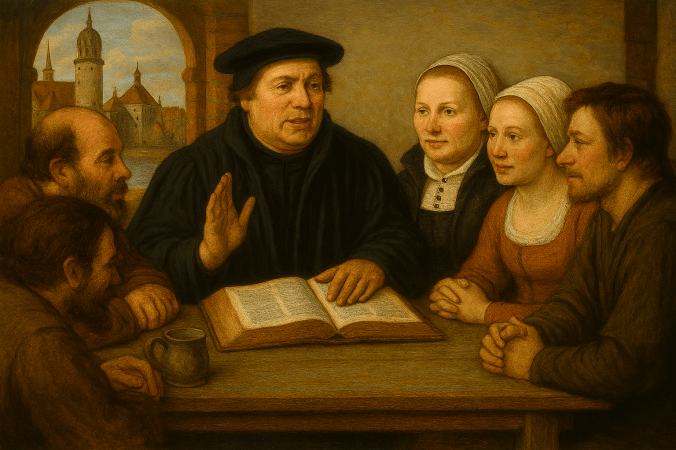
Martin and Katie Luther Engaged in Bible Study (A.I. generated image)
The Lyrics
1 Lord, keep us steadfast in your Word; curb those who by deceit or sword would seek to overthrow your Son and to destroy what he has done.
2 Lord Jesus Christ, your pow’r make known, for you are Lord of lords alone; defend your Christendom that we may sing your praise eternally.
3 O Comforter of priceless worth, send peace and unity on earth; support us in our final strife and lead us out of death to life.
Prayer Reflection: Luther’s Morning Prayer
In the morning when you get up, make the sign of the holy cross and say:
In the name of the Father and of the + Son and of the Holy Spirit. Amen.
Then, kneeling or standing, repeat the Creed and the Lord’s Prayer. If you choose, you may also say this little prayer:
I thank You, my heavenly Father, through Jesus Christ, Your dear Son, that You have kept me this night from all harm and danger; and I pray that You would keep me this day also from sin and every evil, that all my doings and life may please You. For into Your hands I commend myself, my body and soul, and all things. Let Your holy angel be with me, that the evil foe may have no power over me. Amen.
Then go joyfully to your work, singing a hymn, like that of the Ten Commandments, or whatever your devotion may suggest.
Martin Luther’s Small Catechism, published in 1529, includes a series of simple, heartfelt prayers designed to guide daily Christian life. Among them are morning and evening prayers, as well as blessings before and after meals, each emphasizing gratitude, trust in God’s protection, and humble dependence on divine mercy. These prayers reflect Luther’s pastoral concern for households, encouraging parents to teach their children not only doctrine but also devotional practice. Rooted in Scripture and accessible language, they remain enduring tools for spiritual formation across generations.
Luther’s Seal
Faithful Conversations Updates
Join us for some free-flowing conversation about the Lectionary readings each Sunday. We meet from 10:45-11:30 in the church library each week, with some exceptions. No prior knowledge is necessary! ALL ARE WELCOME! And, let’s discuss these questions when we gather (or any other questions you would like to raise for the group!):
1. Luther believed some parts of Scripture speak more clearly than others—why do you think he was partial to John’s Gospel, Romans, and 1 Peter?
2. Peter Claver Ajer describes discipleship as a journey from belief to freedom—how do you personally experience “remaining in the Word” in your daily life, and what kind of freedom has it brought or could bring?
3. Luther heard the Bible as speaking both to its original context and to his own time—how do you hear Scripture speaking into our current cultural and spiritual challenges in 2025?
More than 60 members of our faith community have committed to the Bible 365 Challenge—a shared journey of reading through the entire Bible in one year. Each day, we engage with selected passages weaving together stories of faith, struggle, grace, and redemption. This challenge isn’t just about completing a task; it’s about deepening our spiritual roots, building community, and discovering how scripture speaks into our lives today.
“A Christian is never in a state of completion but always in a process of becoming.”(Luther)
This week, the theme of journey—both physical and spiritual—guides my reflections. Several threads converge: the Genesis reading from Bible 365, the unfolding news from the Middle East, the comforting cadence of Psalm 121, and the approach of Reformation Sunday on October 26. Genesis invites us into the lives of Abraham, Sarah, Hagar, Ishmael, and Isaac. Their stories remind us that the ancient paths of that distant land still echo in our present. The Twenty-Point Gaza Peace Plan, though just the first step on a long and uncertain road, offers a breath of hope. We lift prayers for all who walk that path—especially those whose journeys carry unimaginable pain.
As I reflect on the journey of our church—the Evangelical Lutheran Church in America, born in 1987 through the merger of the ALC, LCA, and AELC—I find myself drawn back to 1517. Our spiritual forbear Martin Luther ignited a movement that reshaped the Christian world. The Reformation was not an endpoint, but the beginning of a pilgrimage—not toward a sacred place, but toward the unearned gift of grace. Luther’s insight that we are simul justus et peccator—both saint and sinner—captures the paradox at the heart of this journey. It’s a truth that continues to shape our communal and personal journeys with honesty, humility, and hope. And so is every step we take in faith. I’ll be sharing more of this history at ELC on Reformation Sunday.
And, speaking of journeys, Pastor Jen and Patti Whitworth from ELC, along with Deacon Laura Ramlow and Pastor Randy Olson from the Northwest Synod of Wisconsin, are traveling in Malawi for the next two weeks, visiting members of our companion synod there (ELCM). This partnership dates back to 1999. We wish them Godspeed as they engage with our sisters and brothers in Africa!
We have arrived at Pentecost 19 and have five Sundays remaining in the church year. Three commemorations are marked on the ELCA calendar this week: Teresa of Avila, teacher and renewer of the church (d. 15 October 1582), Ignatius, Bishop of Antioch, martyr (d. 17 October 115), and Luke the Evangelist (18 October). Thanks for your visit to this space again this week and for your continued interest in exploring the Lectionary. My reflections will focus on Psalm 121, including a musical selection and prayer that highlight our Christian journey.
** Note 1: Links to outside references are bolded and italicized and are meant for further reading or research on your part. While the text I am including in the blog is my own, I am pulling from a multitude of sites for ideas and connections. ** Note 2: In my increasing use of A.I. (Copilot), I will cite sourcing of how I am using the tool, if necessary. I don’t want that to be overly cumbersome, but I am gradually incorporating more tools. I am exploring the A.I. world this summer prior to my next teaching semester. As you can imagine, it is a great challenge right now and will forever change the face of education!
** Note 3: The images I include in the blog are drawn from Wikimedia Commons to the fullest extent possible.
My source for the Bible readings each week is the Bible Gateway website. I generally use the NRSVUE translation.
The readings for Pentecost 19 share a powerful theme of perseverance in the face of struggle, grounded in divine faithfulness. In Genesis 32, Jacob wrestles through the night and emerges transformed, a metaphor for spiritual striving and blessing through endurance. Psalm 121 offers assurance that God watches over the pilgrim’s journey, providing protection and guidance amid uncertainty. Paul’s words to Timothy urge steadfastness in Scripture and ministry, even when the path is difficult and the truth contested. Jesus’ parable in Luke 18 affirms that persistent prayer and faith will be met with justice, reminding believers that God honors those who do not lose heart.
“Describe the common themes among the readings for Pentecost 19.” Copilot, 11 October 2025, Copilot website.
LUTHER’S METHOD OF BIBLE READING A Revision of the Lectio Divina (Augustinian)
Three Steps Oratio (Prayer): This is the starting point, where one humbly prays for the Holy Spirit’s guidance to understand God’s Word. Luther emphasized that prayer prepares the heart and mind to receive divine wisdom.
Meditatio (Meditation): This involves deeply engaging with Scripture, not just reading it but reflecting on it repeatedly. Luther encouraged believers to “chew on” the Word, allowing its meaning to sink in and shape their thoughts and actions.
Tentatio (Struggle): Often translated as “trial” or “temptation,” this refers to the challenges and spiritual battles that arise as one seeks to live according to God’s Word. Luther saw these struggles as a way God refines faith, making it more resilient and authentic.
1960s Lutheran Humor, ala Charles Schultz
Psalm 121 A Song of Ascents.
1 I lift up my eyes to the hills— from where will my help come? 2 My help comes from the Lord, who made heaven and earth.
3 He will not let your foot be moved; he who keeps you will not slumber. 4 He who keeps Israel will neither slumber nor sleep.
5 The Lord is your keeper; the Lord is your shade at your right hand. 6 The sun shall not strike you by day nor the moon by night.
7 The Lord will keep you from all evil; he will keep your life. 8 The Lord will keep your going out and your coming in from this time on and forevermore.
Beth Jacob Cemetery, Finksburg, Carroll County Maryland
Reflection: A Psalm for the Journey
Martin Luther
Martin Luther called the Psalms “a little Bible” because they contain the heart of theology. As a young Augustinian Monk, his early lectures on the Psalms at Wittenberg (1513–1516), in part, shaped his personal devotion and laid the groundwork for his challenge to Church doctrine. Immersed in their emotional depth, he encountered themes of suffering, justice, mercy, and trust that resonated with his own spiritual journey. The language of the Psalms gave him both comfort and courage as he moved toward proclaiming a gospel rooted in grace. He saw the Psalms not as distant hymns but as intimate prayers that spoke to the soul’s deepest needs.
The Continental Divide National Scenic Trail
During a family trip to Colorado in the late 1970s, my father offered an impromptu devotion as we hiked near the Continental Divide. He recited Psalm 121—a moment that felt transcendent and marked my memory. Years later, I learned it was his favorite Psalm when he specifically requested it be read at his funeral. While sorting through his papers after his passing, I discovered that Psalm 121 had also been read at his father’s funeral in February of 1945—a service Unk sadly missed because he was off fighting in World War II. Though I can’t prove it, I believe he wanted me to uncover that connection — he had a knack for producing such moments. As you might imagine, Psalm 121 now lives in my heart with deep and enduring meaning.
Here’s some background on this beautiful eight-verse poem. Psalm 121 is part of the Songs of Ascents (Psalms 120–134), a collection traditionally sung by Hebrew pilgrims traveling to Jerusalem for major festivals like Passover, Pentecost, and the Feast of Tabernacles — moments of remembrance, thanksgiving, and renewal within Judasim. The phrase “ascents” refers both to the physical climb toward Jerusalem—situated in the Judean highlands—and the spiritual elevation toward God’s presence in the Temple. Scholars believe the Psalm dates to the 8th Century BCE, a time when the Assyrian threat was a daily reality.
The Psalm moves this way: In verses 1-2, a traveler who is ready to embark asks the overarching question followed by a confident confession of faith in God; in verses 3-6 another person tells the traveler that the Lord who watches over Israel will offer protection for the journey; and in verses 7-8, that same person assures the traveler that God’s protection will continue in all circumstances in this life and beyond.
Psalm 121, like so many others, invites us to slow down and let its words sink in. I’m reminded that many elders in the faith have modeled the importance of memorizing scripture as a way of carrying wisdom with us, something I am pursuing more as I age. Further, poetry helps us pay attention. It opens our eyes to the rhythms and images around us, igniting our imagination with language that surprises and stirs. This Psalm speaks to the journey we’re all on. It reminds us that God watches over our “coming and going,” offering steady comfort when life feels uncertain, uphill, or just plain hard. So let these words travel with you — write them on your heart. We are not alone. This is good news for us to share!
“Wayfaring Stranger” is a traditional American folk and gospel song that likely emerged in the early 19th century, with its earliest known publication appearing in Joseph Bever’s Christian Songster in 1858. Rooted in both Appalachian folk traditions and African American spirituals, the song gained resonance during the Civil War, when its lyrics became associated with the “Libby Prison Hymn,” offering comfort to Union soldiers in captivity. The hymn’s narrator describes a journey “through this world below,” expressing a deep longing for reunion and rest “in that bright world” beyond suffering. This portrayal of life as a pilgrimage echoes the Christian vision of being in the world but not of it, drawing on biblical themes of exile, grace, and homecoming. Consider the words of Psalm 121 as you listen. I have also read other commentaries that link the song to Hebrews 11: 13-16. There are many versions of the song out there by a range of artists including Joan Baez and Johnny Cash, among others. I found this rendition by VOCES8 US Scholars especially powerful! (Note: As is the case with many spirituals, there are many different versions of the lyrics).
From the VOCES8 website:
2017 saw the launch of the US Scholars Program: a training opportunity for twelve talented singers who have a particular interest in choral and small ensemble singing. With tutoring from Paul Smith, Erik Jacobson and VOCES8, the Scholars gain experience in performing, recording and workshop leading, with opportunities to sing alongside VOCES8.
I’m just a poor wayfaring stranger, I’m trav’ling through this world below; There is no sickness, toil, nor danger, In that bright world to which I go. I’m going there to see my father, I’m going there no more to roam; I’m just a going over Jordan, I’m just a going over home.
I know dark clouds will gather o’er me, I know my pathway’s rough and steep; But golden fields lie out before me, Where weary eyes no more shall weep. I’m going there to see my mother, She said she’d meet me when I come; I’m just a going over Jordan, I’m just a going over home.
I want to sing salvations story, In concert with the blood-washed band; I want to wear a crown of glory, When I get home to that good land. I’m going there to see my brothers, They passed before me one by one; I’m just a going over Jordan, I’m just a going over home.
I’ll soon be free from every trial, This form will rest beneath the sod; I’ll drop the cross of self-denial, And enter in my home with God. I’m going there to see my Saviour, Who shed for me His precious blood; I’m just a going over Jordan, I’m just a going over home.
A Prayer Reflection: The Wayfarer’s Prayer (Tefilat HaDerech)
Background: The Jewish Traveler’s Prayer or Wayfarer’s Prayer (Tefilat HaDerech in Hebrew), originates from the Babylonian Talmud and is recited at the start of a journey to seek divine protection. (The Babylonian Talmud was compiled and redacted between the 3rd and 6th centuries CE, with its final redaction traditionally attributed to around 500–600 CE). It asks for safety from physical and spiritual dangers, favor in the eyes of others, and a peaceful arrival. Traditionally said when traveling a significant distance, it reflects communal values by using plural language even when recited alone. Today, it remains a meaningful ritual for observant Jews embarking on trips by land, sea, or air. It seems entirely appropriate for those from our Synod who are on their way to Malawi as I write these words!
May it be Your will, Lord, our God and the God of our ancestors, that You lead us toward peace, guide our footsteps toward peace, that we are supported in peace, and make us reach our desired destination for life, gladness, and peace. May You rescue us from the hand of every foe and ambush, from robbers and wild beasts on the trip, and from all manner of punishments that assemble to come to earth. May You send blessing in our handiwork, and grant us grace, kindness, and mercy in Your eyes and in the eyes of all who see us. May You hear the sound of our humble request because You are God Who hears prayer requests. Blessed are You, Lord, Who hears prayer. Amen.
The background, English translation of the prayer and image from the Talmud were drawn from a variety of on-line sources, accessed through Co-Pilot, 12 October 2-25.
Faithful Conversations Updates
Join us for some free-flowing conversation about the Lectionary readings each Sunday. We meet from 10:45-11:30 in the church library each week, with some exceptions. No prior knowledge is necessary! ALL ARE WELCOME! And, let’s discuss these questions when we gather (or any other questions you would like to raise for the group!):
1. What does it mean to “lift up our eyes to the hills” in times of uncertainty—and how does this posture shape our understanding of help and hope?
2. How does the repeated promise that “the Lord will keep” speak to our need for protection, rest, and trust—especially in seasons of transition or vulnerability?
More than 60 members of our faith community have committed to the Bible 365 Challenge—a shared journey of reading through the entire Bible in one year. Each day, we engage with selected passages weaving together stories of faith, struggle, grace, and redemption. This challenge isn’t just about completing a task; it’s about deepening our spiritual roots, building community, and discovering how scripture speaks into our lives today.
“Optimism is a passive virtue, hope an active one. It needs no courage to be an optimist, but it takes a great deal of courage to hope. The Hebrew Bible is not an optimistic book. It is, however, one of the great literatures of hope.” (Rabbi Jonathan Sacks)
Lately, I find myself praying for clarity on how to bring a faithful presence into our fractured world. I’ve also been thinking about children and the world they’re experiencing. In the October issue of The Christian Century, Presbyterian minister Maryann McKibben Dana shares a striking moment from a conversation with a friend. The friend pointed out that those who rage at every headline often do so from the comfort of safety—far removed from the daily grind of people fighting just to get by. While some shout from the sidelines, others carry the weight of survival in silence. Dana’s reflection flips the lens, reminding us that outrage can be a privilege not everyone can afford. As Christians, we are called to purveyors of hope in our world, not glittering optimists who dance in superficiality, and as Rabbi Jonathan Sacks suggests, God’s word grounds us in that hope. Keep that in mind as you work through this week’s readings. And let’s stay excited that many in our midst have taken on the challenge of reading the Bible through in one year!
Henry Muhlenberg
We have reached Pentecost 18 and soon will mark the 508th anniversary of the Reformation (26 October). We have two commemorations on our calendar this week: William Tyndale (died on 6 October 1536) was a groundbreaking English scholar, linguist, and Protestant reformer best known for translating the Bible into English directly from Hebrew and Greek texts—a radical act that challenged both ecclesiastical authority and political power; and Henry Melchior Muhlenberg who died on 7 October 1787. Born in Einbeck, Germany (1711) and deeply influenced by Pietism, he was ordained in 1739 and emigrated to Pennsylvania in 1742, serving scattered German-speaking Lutheran communities in the pre-Revolutionary period. Among other things, he kept detailed journals that remain invaluable for understanding early American Lutheranism and religious life in the colonies. One other notable fact is that Muhlenberg’s son Peter became a soldier of renown during the Revolutionary War.
Thanks for visiting this venue again this week and for your continued interest in the Lectionary. My reflections will focus on the readings from Jeremiah and Luke. I’m also including a prayer dedicated to the refugees in our midst and musical selection that focuses on the children in our world (generally), and especially those who have been displaced.
** Note 1: Links to outside references are bolded and italicized and are meant for further reading or research on your part. While the text I am including in the blog is my own, I am pulling from a multitude of sites for ideas and connections. ** Note 2: In my increasing use of A.I. (Copilot), I will cite sourcing of how I am using the tool, if necessary. I don’t want that to be overly cumbersome, but I am gradually incorporating more tools. I am exploring the A.I. world this summer prior to my next teaching semester. As you can imagine, it is a great challenge right now and will forever change the face of education!
** Note 3: The images I include in the blog are drawn from Wikimedia Commons to the fullest extent possible.
My source for the Bible readings each week is the Bible Gateway website. I generally use the NRSVUE translation.
The readings for Pentecost 18 center on themes of healing, gratitude, and faithful witness in the midst of exile and uncertainty. Naaman’s cleansing in 2 Kings and the Samaritan leper’s thanksgiving in Luke highlight the transformative power of divine mercy and the importance of responding with praise. Jeremiah’s letter to the exiles urges rootedness and hope, even in foreign lands, while 2 Timothy calls for endurance and integrity in proclaiming the gospel. Psalm 111 ties these threads together with a celebration of God’s wondrous deeds and enduring covenant, inviting the community to remember and trust.
“Describe the common themes among the readings for Pentecost 18.” Copilot, 4 October 2025, Copilot website.
LUTHER’S METHOD OF BIBLE READING A Revision of the Lectio Divina (Augustinian)
Three Steps Oratio (Prayer): This is the starting point, where one humbly prays for the Holy Spirit’s guidance to understand God’s Word. Luther emphasized that prayer prepares the heart and mind to receive divine wisdom.
Meditatio (Meditation): This involves deeply engaging with Scripture, not just reading it but reflecting on it repeatedly. Luther encouraged believers to “chew on” the Word, allowing its meaning to sink in and shape their thoughts and actions.
Tentatio (Struggle): Often translated as “trial” or “temptation,” this refers to the challenges and spiritual battles that arise as one seeks to live according to God’s Word. Luther saw these struggles as a way God refines faith, making it more resilient and authentic.
Martin and Katie Luther Engaged in Bible Study (A.I. Generated, 2025)
Alternate First Reading: Jeremiah 29: 1, 4-7
29 These are the words of the letter that the prophet Jeremiah sent from Jerusalem to the remaining elders among the exiles and to the priests, the prophets, and all the people whom Nebuchadnezzar had taken into exile from Jerusalem to Babylon.
4 Thus says the Lord of hosts, the God of Israel, to all the exiles whom I have sent into exile from Jerusalem to Babylon: 5 Build houses and live in them; plant gardens and eat what they produce. 6 Take wives and have sons and daughters; take wives for your sons, and give your daughters in marriage, that they may bear sons and daughters; multiply there, and do not decrease. 7 But seek the welfare of the city where I have sent you into exile, and pray to the Lord on its behalf, for in its welfare you will find your welfare.
The Yoke of Jeremiah
Gospel: Luke 17: 11-19 11 On the way to Jerusalem Jesus was going through the region between Samaria and Galilee. 12 As he entered a village, ten men with a skin disease approached him. Keeping their distance, 13 they called out, saying, “Jesus, Master, have mercy on us!” 14 When he saw them, he said to them, “Go and show yourselves to the priests.” And as they went, they were made clean. 15 Then one of them, when he saw that he was healed, turned back, praising God with a loud voice. 16 He prostrated himself at Jesus’s feet and thanked him. And he was a Samaritan. 17 Then Jesus asked, “Were not ten made clean? So where are the other nine? 18 Did none of them return to give glory to God except this foreigner?” 19 Then he said to him, “Get up and go on your way; your faith has made you well.”
The Healing of the Ten Lepers James Tissot (1836–1902)
Reflection: Strangers in our Midst
“Cry of prophet Jeremiah on the Ruins of Jerusalem” by Ilya Repin (1870)
This week’s readings from Jeremiah and Luke offer profound insights into the presence—and the power—of the foreigner in our midst. In Jeremiah 29:1, 4–7, the prophet pens a letter to the exiles in Babylon—a displaced people, torn from Jerusalem and thrust into foreign soil. His message is startling in its realism: “Build houses and live in them… seek the welfare of the city where I have sent you into exile.” Rather than resist or retreat, the exiles are called to engage, to bless, and to pray for the flourishing of the very place that holds them captive. This summons is both unsettling and deeply hopeful. Historically, this letter was written after the first wave of deportations in 597 BCE, when King Jehoiachin and the Judean elite were taken to Babylon. Archaeological records confirm that these exiles were not merely prisoners—they were artisans, officials, and laborers integrated into Babylonian society. Jeremiah’s call was radical: live faithfully among foreigners and recognize that God’s presence is not confined to Jerusalem. The stranger becomes neighbor, and exile becomes a crucible for spiritual renewal. It’s a vision that redefines exile—not as punishment, but as possibility.
More than six centuries later, in Luke 17:11–19, Jesus encounters ten lepers on the borderlands between Galilee and Samaria. These men are doubly marginalized—by disease and geography. Yet it is the Samaritan, the foreigner among them, who returns to give thanks. Jesus’ response is telling: “Was no one found to return and give praise to God except this foreigner?” The outsider becomes exemplar, the one who sees clearly and responds with gratitude. This encounter unfolds in a region scarred by ethnic division and religious mistrust. Samaritans were viewed with suspicion by many Jews, their worship practices deemed impure. Yet here, the Samaritan’s faith transcends boundaries. All ten are healed, but only one is made whole—his gratitude becomes the gateway to deeper restoration. Once again, Jesus throws us a curveball.
Refugees (1939) by Guglielmi (1906-1956)
Together, these passages challenge us to reconsider our posture toward the foreigner. Jeremiah urges rootedness and blessing in unfamiliar places. Luke reveals that grace often flows through those we least expect. In both, God’s movement is not confined to the familiar or the favored—it pulses through exile, borderlands, and gratitude. As so often in Scripture, these ancient voices speak directly into our present moment. As migration and displacement continue to rock the global political environment, and cultural tension shapes our communities, these texts beckon us toward prophetic realism and gospel hospitality. The foreigner is not merely among us—they are often the vessel of divine insight. To dwell faithfully is to seek the welfare of the stranger, and to recognize that healing and thanksgiving may come from unexpected voices. Hope is all around us if we choose to see it.
Soli Deo Gloria!
Prayer Reflection: Prayer for Refugees and Migrants
Lutherans have a strong tradition in the world of immigration. Formed in 1939, Global Refuge (formerly Lutheran Immigration and Refugee Services), has been active in the world for 86 years. The following prayer is an interpretation of a prayer suggested within their resources and also inspired by Psalm 146. We know that children, in particular, are caught within the various forces of displacement in our world — political conflicts, civil wars, and famine just to name a few.
God of mercy, who watches over the stranger and lifts up the brokenhearted, guide us to walk with refugee families seeking peace and home. Bless the mothers, fathers, and children who flee danger. Heal their wounds, restore their hope, and let your love be their shelter. You uphold the cause of the oppressed and give food to the hungry. Make us instruments of your justice—welcoming, compassionate, and brave. Open our hearts to see your image in every migrant and asylum seeker. Lead us to serve with light and love. End the violence that drives them. Stir the hearts of nations to build a world where no child must flee again. The Lord reigns forever. In your mercy, hear our prayer. Amen.
“Bless the mothers, fathers, and children who flee danger. Heal their wounds, restore their hope, and let your love be their shelter.“
A Musical Offering: Prayer of the Children (Kurt Bestor)
Having spent my adult life with young people, I find so much of our modern environment harmful to children — perhaps, like many of you, legacy is on my mind. What kind of world are we leaving to our children? One of the heartbreaking realities of our world today, as has been true throughout history, is the suffering of children. There are so many contemporary examples. As of the end of 2024, for example, nearly 49 million children were forcibly displaced worldwide due to conflict, violence, and disasters (40% of all refugees). Additionally, having reached my elder years, I grieve for the example our young people see around them growing up. Surely, we can do better. The powerful message of Bestor’s song resonates.
Can you hear the prayer of the children On bended knee, in the shadow of an unknown room? Empty eyes, with no more tears to cry Turning heavenward, toward the light
Crying, “Jesus, help me To see the morning light of one more day; But if I should die before I wake I pray my soul to take.”
Can you feel the heart of the children Aching for home, for something of their very own? Reaching hands, with nothing to hold on to But hope for a better day, a better day
Crying, “Jesus, help me To feel the love again in my own land; But if unknown roads lead away from home Give me loving arms, away from harm.”
Can you hear the voice of the children Softly pleading for silence in a shattered world? Angry guns preach a gospel full of hate Blood of the innocent on their hands
Crying, “Jesus, help me To feel the sun again upon my face; For when darkness clears I know you’re near Bringing peace again.”
“Prayer of the Children” by Kurt Bestor is a deeply moving song written in response to the suffering of children during the Yugoslav Wars. Its lyrics express a child’s longing for peace, safety, and connection with God amidst violence and loss. One of its most poignant lines is: “Can you hear the prayer of the children… aching for home, for something of their very own.”
Chorale NouvEAU performs Prayer of the Children composed by Kurt Bestor and arranged by Andrea S. Klouse, under the direction of Kate Larson. This performance was from our concert, A Cry for Peace on January 19th, 2025, at Christ Church Cathedral. This concert was in partnership with Sleep in Heavenly Peace. Sleep in Heavenly Peace (SHP) is a volunteer-driven nonprofit dedicated to building and delivering hand-made, fully furnished beds to children in need. ELC has partnered with SHP on several occasions.
(Information provided with the YouTube posting)
The Chorale NouvEAU draws its members from the Chippewa Valley region of Wisconsin.
Faithful Conversations Updates
Join us for some free-flowing conversation about the Lectionary readings each Sunday. We meet from 10:45-11:30 in the church library each week, with some exceptions. No prior knowledge is necessary! ALL ARE WELCOME! And, let’s discuss these questions when we gather (or any other questions you would like to raise for the group!):
1. Why did Jeremiah instruct the captive Israelites (verses 4-7) in the manner he did?
2. What does the Samaritan’s gratitude teach us about recognizing grace in unexpected places—and voices? Who are the “foreigners” in your life whose faith or insight has challenged you to see more clearly?
📖 THIS WEEK’S BIBLE 365 READING CHALLENGE:
Monday 6 October: Genesis 25-28 and Psalm 8 Tuesday 7 October: Genesis 29-31 and Psalm 9 Wednesday 8 October: Genesis 32-34 and Psalm 10 Thursday 9 October: Genesis 35-37 and Psalm 11 Friday 10 October: Genesis 38-40 and Psalm 12 Saturday 11 October: Genesis 41-42 and Psalm 13 Sunday 12 October: 43-45 and Psalm 14
“There are times in life when we have to buckle up and buckle down, lifting one another up with encouragement. Without such commitment, we live with the prospect or fear that our lives will not have mattered. We may not always know if our actions are contributing to an increase of the abundant life in this world. But, as Mahatma Gandhi once put it, ‘if you do nothing, there will be no result.'” (Peter W. Marty)
A conversation in our lectionary study group on Sunday, paired with this week’s readings from Habakkuk and Luke’s Gospel, brought Peter Marty’s words from the September Christian Century to the forefront. His Gandhi reference — “If you do nothing, there will be no result” — landed with force. Faith doesn’t shield us from the weight of the world; it often makes that weight more visible, more personal. We feel the burden, the fatigue, and sometimes the quiet fear that our lives might not matter. Habakkuk saw violence and chaos and cried out, asking where God had gone. His voice feels close, even now. The apostles, unsure and overwhelmed, didn’t ask for a strategy—they asked for a shortcut: “Increase our faith!” That plea still resonates. In 2025, ancient voices speak with startling relevance. They urge us to stay present, to lift one another up, and to keep moving—even when the way forward is unclear. I’ll return to their wisdom in my reflections. For now, I’m listening.
Welcome to this space again this week and your continued interest in exploring the Lectionary! Counting Sunday, we have eight Sundays left in the church year (Year C). Hard to imagine. We have several commemorations in our calendar this week: Michael and All Angels, Jerome, translator and teacher (d. 30 September 420), Francis of Assisi, renewer of the church (d. 4 October 1226), and Theodore Fliedner, renewer of society (d. 4 October 1864). Fliedner (b. 1800) was a German Lutheran pastor and social reformer who founded the Kaiserswerther Diakonie in 1836, a pioneering institution for hospital care and deaconess training. Inspired by the Moravian Church and reformers like Elizabeth Fry, he revived the ancient Christian office of deaconess to serve the sick, poor, and imprisoned. His work laid the foundation for modern nursing and influenced figures like Florence Nightingale, who trained at Kaiserswerth in 1850. By the time of his death, Fliedner had established a global network of deaconess motherhouses, transforming Christian social service across continents. Deaconess Hospital in Minneapolis was part of the larger movement inspired by Theodor Fliedner’s work in Germany. Although Fliedner didn’t start the hospital himself, his revival of the deaconess tradition in 1836 influenced similar efforts around the world. In 1888, Rev. Falk Gjertsen and others invited Sister Elizabeth Fedde—trained in a tradition shaped by Fliedner—to help begin a deaconess home and hospital in Minneapolis. Her work led to the founding of the Norwegian Lutheran Deaconess Institute, which became Deaconess Hospital, built on Fliedner’s original vision. My great-aunt Josie Rykken worked at Deaconess Hospital as a seamstress for many years and my oldest sister Anne was born there while Unk (our dad) was a student at Luther Seminary (1950). All these years later, I am appreciating that history.
** Note 1: Links to outside references are bolded and italicized and are meant for further reading or research on your part. While the text I am including in the blog is my own, I am pulling from a multitude of sites for ideas and connections. ** Note 2: In my increasing use of A.I. (Copilot), I will cite sourcing of how I am using the tool, if necessary. I don’t want that to be overly cumbersome, but I am gradually incorporating more tools. I am exploring the A.I. world this summer prior to my next teaching semester. As you can imagine, it is a great challenge right now and will forever change the face of education!
** Note 3: The images I include in the blog are drawn from Wikimedia Commons to the fullest extent possible.
Common Themes Among the Readings
Readings for Pentecost 17
Habakkuk 1:1-4, 2:1-4 Psalm 37:1-9 2 Timothy 1:1-14 Luke 17:5-10
My source for the Bible readings each week is the Bible Gateway website. I generally use the NRSVUE translation.
The readings for Pentecost 17 share a deep concern with perseverance, trust, and faithful living in the face of uncertainty and injustice. Habakkuk wrestles with the silence of God amid violence but is reminded that the righteous live by faith, while Psalm 37 counsels patience and trust in the Lord rather than envy of evildoers. In 2 Timothy, Paul encourages Timothy to rekindle the gift of God with courage and endurance, grounded in the power of the Spirit and the legacy of faith. Luke’s Gospel reframes discipleship as humble service, emphasizing that faith—even as small as a mustard seed—can transform, but obedience remains the quiet duty of those who follow Christ.
“Describe the common themes among the readings for Pentecost 17.” Copilot, 25 September 2025, Copilot website.
LUTHER’S METHOD OF BIBLE READING A Revision of the Lectio Divina (Augustinian)
Three Steps Oratio (Prayer): This is the starting point, where one humbly prays for the Holy Spirit’s guidance to understand God’s Word. Luther emphasized that prayer prepares the heart and mind to receive divine wisdom.
Meditatio (Meditation): This involves deeply engaging with Scripture, not just reading it but reflecting on it repeatedly. Luther encouraged believers to “chew on” the Word, allowing its meaning to sink in and shape their thoughts and actions.
Tentatio (Struggle): Often translated as “trial” or “temptation,” this refers to the challenges and spiritual battles that arise as one seeks to live according to God’s Word. Luther saw these struggles as a way God refines faith, making it more resilient and authentic.
Martin Luther
(1483-1546)
Luther on Reading the Bible
“In truth you cannot read too much in Scripture; and what you read you cannot read too carefully… and what you teach well you cannot live too well.”
(Luther would have appreciated our Bible 365 Project!)
First Reading: Habbakkuk 1:1-4, 2:1-4
1 The oracle that the prophet Habakkuk saw.
2 O Lord, how long shall I cry for help, and you will not listen? Or cry to you “Violence!” and you will not save? 3 Why do you make me see wrongdoing and look at trouble? Destruction and violence are before me; strife and contention arise. 4 So the law becomes slack, and justice never prevails. The wicked surround the righteous; therefore judgment comes forth perverted.
2 I will stand at my watchpost and station myself on the rampart; I will keep watch to see what he will say to me and what he[a] will answer concerning my complaint. 2 Then the Lord answered me and said: Write the vision; make it plain on tablets, so that a runner may read it. 3 For there is still a vision for the appointed time; it speaks of the end and does not lie. If it seems to tarry, wait for it; it will surely come; it will not delay. 4 Look at the proud! Their spirit is not right in them, but the righteous live by their faithfulness.
Check out this excellent summary of Habbakkuk!
Gospel: Luke 17: 5-10
5 The apostles said to the Lord, “Increase our faith!” 6 The Lord replied, “If you had faith the size of a mustard seed, you could say to this mulberry tree, ‘Be uprooted and planted in the sea,’ and it would obey you.
7 “Who among you would say to your slave who has just come in from plowing or tending sheep in the field, ‘Come here at once and take your place at the table’? 8 Would you not rather say to him, ‘Prepare supper for me; put on your apron and serve me while I eat and drink; later you may eat and drink’? 9 Do you thank the slave for doing what was commanded? 10 So you also, when you have done all that you were ordered to do, say, ‘We are worthless slaves; we have done only what we ought to have done!’ ”
Jesus Teaching in Galilee
(A.I. Generated, 2023)
Reflection: Faith Doesn’t Get Easier — It Gets Stronger
Habakkuk the Prophet (A.I. Generated 2025)
There’s an old runner’s adage: Running doesn’t get easier—you just get stronger. Having been a runner for more than a half-century and a distance coach, I can attest to that. The hills don’t flatten, the wind doesn’t stop, and the soreness doesn’t vanish. But something shifts inside. Muscles adapt. Breathing deepens. Resolve hardens. You learn to keep going—not because the path is easier, but because you’ve grown stronger. This running analogy echoes the spiritual journey described in Habakkuk and Luke. In Habakkuk 1:1–4, the prophet cries out in anguish: “O Lord, how long shall I cry for help, and you will not listen?” His world is unraveling—violence, injustice, and destruction surround him. Habakkuk lived in Judah during the late 7th century BCE, a time of political instability and moral decay. Babylon was rising, and the covenant people seemed to have lost their way. Habakkuk doesn’t offer easy answers. He offers lament. And in doing so, he gives us permission to bring our own questions to God. This makes Habakkuk a vital companion when faith feels weary. His honesty is refreshing. He doesn’t pretend things are fine. He stands in the watchtower and waits (Habakkuk 2:1), modeling a posture of spiritual attentiveness. He’s not passive—he’s expectant. And when the Lord replies, it’s not with a quick fix but with a vision: “The righteous live by their faithfulness” (Habakkuk 2:4). This phrase becomes a theological cornerstone. Paul quotes it in Romans 1:17 and Galatians 3:11. The author of Hebrews echoes it in 10:38. For Lutherans, it’s foundational. Martin Luther’s breakthrough came when he realized that righteousness is not earned by works but received through faith. Faithfulness, then, is not about perfection—it’s about trust. It’s about showing up, even when the road is steep.
Saint Luke the Evangelist De Rosa (1607-1656)
Luke 17:5–10 offers a complementary lens. The disciples plead, “Increase our faith!”—a request that resonates with anyone who’s felt spiritually inadequate. Jesus responds with a paradox: “If you had faith the size of a mustard seed…” It’s not about quantity. It’s about rootedness. Even the smallest seed of faith, planted in God’s promises, can grow into something mighty. Then comes the parable of the slave. It’s unsettling. The slave works all day, returns home, and still isn’t praised. Jesus says, “We have done only what we ought to have done.” This challenges our desire for ease and affirmation. We want the faith life to be rewarding, comfortable, even applauded. But Jesus reframes it: faithfulness is about duty, humility, and perseverance. Hard words.
Habakkuk’s lament and Luke’s mustard seed converge in this truth: faith is not flashy. It’s steady. It’s the teacher who prepares lessons for students who may never say thank you. It’s the caregiver who shows up day after day. It’s the disciple who forgives seventy times seven. It’s the runner who laces up shoes in the dark and keeps going. In our spiritual lives, we often long for shortcuts. We want a smoother path, the answers to come quickly. But Habakkuk teaches us to wait. Luke teaches us to serve. And the Lutheran tradition teaches us to trust—not in our strength, but in the righteousness that comes by faith. Again, remember the triad of texts — Romans 1:17, Galatians 3:11, and Hebrews 10:38 — they provide a cadence for the long run.
When faith feels like a grind, when injustice floods the headlines, and your prayers seem to vanish into silence—open Habakkuk! Climb the watchtower. Speak the hard truths. Demand answers. And listen: “There is still a vision for the appointed time.” Then lace up. Run. Not because the path smooths out, but because your spirit grows stronger with every step. Faith doesn’t promise ease—it builds endurance. And in the steady rhythm of trust, in the quiet certainty of God’s faithfulness, you’ll find the strength to keep going. The world needs our voice.
Soli Deo Gloria!
Prayer Reflection: Strength for the Journey
This prayer is inspired by the Bible 365 Project. As we take on this challenge, we will need to pray about the experience! If you are interested in the lay-out of the year-long schedule, I linked it in the green announcement box at the end of the blog.
God of the Word, You who spoke light into darkness and breathed life into dust, I begin this sacred journey—a year of walking through Your story, from Genesis to Revelation, from wilderness to wonder, from exile to return. Open my heart to receive what You have spoken. Let these pages be more than ink and parchment; make them living water for my thirst, bread for the journey, and fire for the cold places within me. Give me discipline when the days feel long, curiosity when the texts feel strange, and grace when I stumble or fall behind. Let me not rush past mystery or skip over lament. Teach me to linger, to wrestle, to listen. As I read of prophets and poets, kings and shepherds, apostles and outcasts, may I find myself in their stories—and may I find You, always You, speaking through the chaos, calling me to justice, mercy, and love. Let this year be more than a reading plan. Let it be a pilgrimage. Let it be transformation. Let it be communion with You. In the name of the Living Word, Jesus Christ, Amen.
A Musical Offering: What is the World Like? (Adam Tice)
What is the world like when God’s will is done? Mustard seeds grow more than we can conceive: roots thread the soil; branches reach for the sun. This is how God moves us each to believe.
What is the world like when God’s will is done? Witness the wandering child coming home; watch as the parent breaks into a run. This is how God longs for us when we roam.
What is the world like when God’s will is done? No more is neighbor just ally or friend; peace thrives in places where once there was none. This is how God works when rivalries end.
What is the world like when God’s will is done? Ready for feasting, we watch through the night, tending our lamps till the new day’s begun. This is how God readies us for the light.
These are the stories that Jesus imparts, filled with the Spirit who joins us as one. Born through our voices, our hands, and our hearts, this is a new world where God’s will is done.
Adam M. L. Tice is a prominent contemporary hymn writer and editor known for his contributions to ecumenical hymnody and justice-centered worship. A graduate of Goshen College, Tice has served as a church musician, associate pastor, and editor of The Hymn journal, and was the text editor for the 2020 Mennonite hymnal Voices Together. His hymn “What Is the World Like” (2009), set to Sally Ann Morris’s tune NEW WORLD, draws on four parables to envision a world shaped by God’s justice, mercy, and light. Tice’s work reflects a deep commitment to inclusive theology, poetic clarity, and communal transformation through song. The lyrics are compelling and the last one, in particular, seems especially fitting for the start of our Bible 365 Project!
Faithful Conversations Updates
Join us for some free-flowing conversation about the Lectionary readings each Sunday. We meet from 10:45-11:30 in the church library each week, with some exceptions. No prior knowledge is necessary! ALL ARE WELCOME! And, let’s discuss these questions when we gather:
1. How does the analogy of long-distance running deepen our understanding of faith as endurance rather than ease?
2. What does Habakkuk’s posture of lament and waiting teach us about engaging with God during seasons of silence or injustice?
3. In what ways does Jesus’ teaching in Luke 17 challenge our desire for recognition in the faith journey, and how might humility reshape our understanding of spiritual strength?
📖 ARE YOU READY TO READ THE BIBLE IN A YEAR? Starting on Monday 29 September, join our Bible 365 Challenge—a yearlong journey through Scripture for individuals, families, and groups. As of Sunday, more than 60 people had signed up to undertake the challenge! ALL ARE WELCOME!
“Education is much more a matter of the heart than of the head.” (Gordon Thunder)
I spent my early years in this community (ages 5 to 15), then returned in 1990 at age 33 after nearly twenty years away. Since then, I’ve witnessed many familiar faces journey on—a steady rhythm of loss that sometimes seem to come in waves. Across cultures, people honor elders as wisdom keepers, and their passing reminds us of the sacred cycle of exile and return, of memory, renewal, and life beyond this life. Last week, we lost Gordon Thunder, a gracious man who, with his sister Charity, helped me see the world through Indigenous eyes. They often visited my classroom, sharing stories of history, language, and culture that left lasting impressions on my students. During one visit in the early 1990s, Gordon spoke the line offered above that struck me as both simple and profound—I scribbled it down and have shared it with thousands of students since. It speaks to the heart of education: not just knowledge, but empathy, connection, and transformation—companions I carry with me in my exploration of the scriptures each week. In Ho-Chunk tradition, the death of an elder marks a sacred journey back to Earthmaker, who formed humans from clay and gave them a soul. Guided by prayer, song, and offerings, this journey leads the soul home, echoing the Christian hope of returning to our Creator, where rest and reunion await. You will note a connection to these themes in the musical selection I’m offering further on in the blog.
Thanks for your visit to this space again this week. Incredibly, we are rounding the corner into October and will be engaged in our Bible 365 Challenge. I am reminded each and every week that God’s Word is vast and powerfully relevant in every age. My reflections will focus on the Amos passage again this week, noting how it intersects with Luke 16. Note the prompts for discussion in the Faithful Conversations update at the end of the blog — we will utilize those for our in-person discussion on Sunday.
** Note 1: Links to outside references are bolded and italicized and are meant for further reading or research on your part. While the text I am including in the blog is my own, I am pulling from a multitude of sites for ideas and connections. ** Note 2: In my increasing use of A.I. (Copilot), I will cite sourcing of how I am using the tool, if necessary. I don’t want that to be overly cumbersome, but I am gradually incorporating more tools. I am exploring the A.I. world this summer prior to my next teaching semester. As you can imagine, it is a great challenge right now and will forever change the face of education!
** Note 3: The images I include in the blog are drawn from Wikimedia Commons to the fullest extent possible.
My source for the Bible readings each week is the Bible Gateway website. I generally use the NRSVUE translation.
The readings for Pentecost 16 share a strong warning against complacency, wealth without compassion, and the neglect of justice. Amos condemns the ease and luxury of the powerful who ignore the suffering of others, while Psalm 146 calls for trust in God, who lifts the oppressed and cares for the vulnerable. In 1 Timothy, believers are urged to pursue righteousness and generosity rather than riches, anchoring their hope in eternal life. Luke’s parable of the rich man and Lazarus drives the message home: ignoring the poor has eternal consequences, and true faith is shown through mercy and action.
“Describe the common themes among the readings for Pentecost 16.” Copilot, 21 September 2025, Copilot website.
LUTHER’S METHOD OF BIBLE READING A Revision of the Lectio Divina (Augustinian)
Three Steps Oratio (Prayer): This is the starting point, where one humbly prays for the Holy Spirit’s guidance to understand God’s Word. Luther emphasized that prayer prepares the heart and mind to receive divine wisdom.
Meditatio (Meditation): This involves deeply engaging with Scripture, not just reading it but reflecting on it repeatedly. Luther encouraged believers to “chew on” the Word, allowing its meaning to sink in and shape their thoughts and actions.
Tentatio (Struggle): Often translated as “trial” or “temptation,” this refers to the challenges and spiritual battles that arise as one seeks to live according to God’s Word. Luther saw these struggles as a way God refines faith, making it more resilient and authentic.
Luther on Reading the Bible
“For some years now I have read through the Bible twice every year. If you picture the Bible to be a mighty tree and every word a little branch, I have shaken every one of these branches because I wanted to know what it was and what it meant.“
(Luther would have appreciated our Bible 365 Project!)
The First Reading: Amos 6: 1a, 4-7
Woe to those who are at ease in Zion and for those who feel secure on Mount Samaria, the notables of the first of the nations, to whom the house of Israel resorts!
Woe to those who lie on beds of ivory and lounge on their couches and eat lambs from the flock and calves from the stall, 5 who sing idle songs to the sound of the harp and like David improvise on instruments of music, 6 who drink wine from bowls and anoint themselves with the finest oils but are not grieved over the ruin of Joseph! 7 Therefore they shall now be the first to go into exile, and the revelry of the loungers shall pass away.
The Gospel: Luke 16: 19-31
19 “There was a rich man who was dressed in purple and fine linen and who feasted sumptuously every day. 20 And at his gate lay a poor man named Lazarus, covered with sores, 21 who longed to satisfy his hunger with what fell from the rich man’s table; even the dogs would come and lick his sores. 22 The poor man died and was carried away by the angels to be with Abraham.[a] The rich man also died and was buried. 23 In Hades, where he was being tormented, he lifted up his eyes and saw Abraham far away with Lazarus by his side.[b]24 He called out, ‘Father Abraham, have mercy on me, and send Lazarus to dip the tip of his finger in water and cool my tongue, for I am in agony in these flames.’ 25 But Abraham said, ‘Child, remember that during your lifetime you received your good things and Lazarus in like manner evil things, but now he is comforted here, and you are in agony. 26 Besides all this, between you and us a great chasm has been fixed, so that those who might want to pass from here to you cannot do so, and no one can cross from there to us.’ 27 He said, ‘Then I beg you, father, to send him to my father’s house— 28 for I have five brothers—that he may warn them, so that they will not also come into this place of torment.’ 29 Abraham replied, ‘They have Moses and the prophets; they should listen to them.’ 30 He said, ‘No, father Abraham, but if someone from the dead goes to them, they will repent.’ 31 He said to him, ‘If they do not listen to Moses and the prophets, neither will they be convinced even if someone rises from the dead.’ ”
Reflection: How Much is Enough?
In 1821, British poet Percy Bysshe Shelley (b. 1792) wrote a line that still rings true: “The rich have become richer, and the poor have become poorer.” He was watching the rise of industrial England—a world where wealth piled up for the few while the many labored in worsening conditions. Shelley’s lament wasn’t just poetic—it was prophetic. And yet, the cry he voiced wasn’t new. Centuries earlier, the prophet Amos stood in the northern kingdom of Israel and spoke with fire. His words cut through the comfort of the elite: “Woe to those who are at ease in Zion… who lie on beds of ivory… who drink wine in bowls… but are not grieved over the ruin of Joseph!”
Amos the Prophet Kizhi Monastery, Russia
Amos, like all prophets, spoke into a particular moment. His ministry unfolded during the reigns of King Uzziah of Judah and King Jeroboam II of Israel—a time of booming trade, expanding borders, and political stability. On the surface, things looked good. Israel was thriving. But beneath that prosperity, the poor were being crushed, justice was for sale, and worship had lost its soul. Amos wasn’t part of the establishment. He was a shepherd and fig farmer from Tekoa—called to speak truth in the king’s sanctuary at Bethel. And he didn’t mince words. He didn’t condemn wealth itself, but wealth without justice, comfort without compassion, and rituals that ignored righteousness.
Juliana Claassens University of Stellenbosch
That message still speaks. As Juliana Claassens points out in a sharply written commentary, “An online search for who, most recently, has been drawn to this book (Amos) steeped in the pursuit of justice and righteousness, is telling: Results show many scholars from the Developing World concerned about the state of their people in impoverished countries where the rich are getting richer and the poor poorer—for example, Nigeria, Zimbabwe, Myanmar, and parts of Latin America.” As Claassens asserts, these communities face unfair labor systems, resource extraction by the Global North, and corruption from within. Claassens reminds us: Amos’s call for justice is not abstract. It’s urgent. It’s real. It’s now.
As Christians trying to live out our faith, we might ask ourselves, how much is enough? If someone is a billionaire, do they need many billions? What happens when abundance becomes blindness? That question echoes in Luke 16, where Jesus tells the story of the rich man and Lazarus. The rich man feasts daily, dressed in purple and fine linen. Lazarus lies at his gate, covered in sores. After death, their roles reverse—but the rich man’s vision doesn’t. He still sees Lazarus as a servant, not a neighbor. The chasm between them, once social, becomes eternal. Amos and Jesus both confront us with the moral danger of indifference. They remind us that ease is not innocence, and that comfort can become complicity. To lie on beds of ivory while others sleep on concrete is not just unfortunate—it’s unjust. To feast while others hunger is not just a lifestyle—it’s a spiritual crisis.
And so, back to Shelley. His lament is more than a line—it’s a summons. (Sidebar: Shelley’s was deeply skeptical of organized religion because he thought it was used to justify inequality and moral hypocrisy, something you may want to explore further).How much is enough? Enough to lift the fallen. Enough to mend the breach. Enough to remember that every Lazarus at the gate is a child of God.
Soli Deo Gloria!
Note: I am indebted to Juliana Claassens, Old Testament Professor at the University of Stellenbosch in Stellenbosch, South Africa for her commentary on the Amos passage. You may find the commentary at Working Preacher, a site sponsored by Luther Seminary in St. Paul, Minnesota.
Prayer Reflection: A Future Not Our Own (Oscar Romero)
It helps now and then to step back and take a long view. The Kingdom is not only beyond our efforts, it is beyond our vision. We accomplish in our lifetime only a fraction of the magnificent enterprise that is God’s work. Nothing we do is complete, which is another way of saying that the kingdom always lies beyond us.
No statement says all that could be said. No prayer fully expresses our faith. No confession brings perfection, no pastoral visit brings wholeness. No program accomplishes the Church’s mission. No set of goals and objectives include everything.
This is what we are about. We plant the seeds that one day will grow. We water the seeds already planted knowing that they hold future promise. We lay foundations that will need further development. We provide yeast that produces effects far beyond our capabilities. We cannot do everything, and there is a sense of liberation in realizing this.
This enables us to do something, and to do it very well. It may be incomplete, but it is a beginning, a step along the way, an opportunity for the Lord’s grace to enter and do the rest.
We may never see the end results, but that is the difference between the master builder and the worker. We are workers, not master builders, ministers, not messiahs. We are prophets of a future not our own.
Oscar Romero (1917-1980)
Saint Óscar Arnulfo Romero y Galdámez was a Salvadoran Roman Catholic archbishop renowned for his courageous advocacy for human rights and the poor during El Salvador’s civil unrest. Initially seen as conservative, Romero became a prophetic voice against government repression, denouncing violence from both state forces and guerrilla groups. He was assassinated while celebrating Mass on March 24, 1980, and later canonized as a martyr and saint by the Catholic Church in 2018.
A Musical Offering: Suiderkruis (Southern Cross) by Jacques de Villiers
Suiderkruis (Southern Cross), composed by Jacques de Villiers and arranged by André van der Merwe, is a choral elegy that mourns the loss of homeland and honors the elders whose lives once anchored its memory. The Southern Cross shines as a celestial guide for those in exile, not only pointing the way home but illuminating the spiritual path beyond death—a journey through silence, longing, and ancestral remembrance. Sung in Afrikaans, its haunting lyrics ask whether we are still remembered, whether anyone stands beneath the stars to welcome the soul’s return, as the music swells from quiet lament to transcendent yearning—a requiem for the departed and a compass for those who remain. The song spoke to me in navigating the recent passing of several elders in our faith community and beyond.
The Stellenbosch University Choir, based in South Africa and conducted by André van der Merwe, is internationally acclaimed for its emotive artistry and innovative choral arrangements. Composed of student singers, the ensemble blends African rhythms, classical technique, and contemporary expression to create transcendent musical experiences. Their performances often explore themes of identity, memory, and spiritual longing, resonating deeply with audiences across cultures.
Included in the lyrics (Afrikaans)
Will you remember me in dreams and in silence? Who stands amongst the Southern Cross? Who brings hope? Dreamy images dance amongst the constellations. In a time of mourning, we all lose power. Remember me in the morning dew.
Faithful Conversations Updates
Join us for some free-flowing conversation about the Lectionary readings each Sunday. We meet from 10:45-11:30 in the church library each week, with some exceptions. No prior knowledge is necessary! ALL ARE WELCOME! And, let’s discuss these questions when we gather:
1. Drawing from Juliana Claassens’s insight: How does Amos’s cry for justice speak to the realities of economic exploitation in places like Nigeria, Myanmar, or Latin America? What responsibilities do those of us in the Global North carry in light of these imbalances?
2. Let’s talk about the “prophetic imagination.” Amos and Jesus both confront systems of indifference. If you were to write a modern-day parable or prophetic lament in the spirit of Amos 6 or Luke 16, what would it sound like? Who are the “Lazaruses” at our gates today—and what would it mean to truly see them?
📖 ARE YOU READY TO READ THE BIBLE IN A YEAR? Starting on Monday 29 September, join our Bible 365 Challenge—a yearlong journey through Scripture for individuals, families, and groups. Luther once said, “The Bible is alive… it lays hold of me.” Whether you choose the print path or go digital, we’ll grow together—with daily readings, mutual support, and spiritual connection. Pastor Jen will offer a “Bible Reading Kick-Off Class” on 28 September at 11:00 in the Gathering Area.
As of last Sunday, 50 people had signed up to undertake the challenge! ALL ARE WELCOME!
“If light can come out of darkness, then alone can love emerge from hatred.” (Mahatma Gandhi)
Once again, political violence has erupted with chilling force this week. On Friday, as I spoke with our eldest daughter Kate (b. 1981), her words stirred a sobering truth: we are not built to absorb the relentless tide of hatred and grief that courses through our nation. I hold fast to Gandhi’s enduring conviction—that LOVE stands as the most powerful force we possess, and we must wield it with courage and intention. (Gandhi himself, regretfully, fell victim to political violence in 1948).
As we open the lectionary this Sunday, we enter a tradition that has never shied away from upheaval. Scripture speaks directly into chaos, echoing through centuries of resistance—from the Zealot revolts in Roman-occupied Judea to the unraveling of civic virtue in the late Roman Republic. Like us, our spiritual ancestors grappled with power, injustice, violence, and the sacred call to act. Of course, their world was far different from ours, but evil has been present across time — not a comforting reality but perhaps brings perspective. As Pastor Jen emphasized in her sermon on Sunday (14 September), as Christians, we are to be “purveyors of hope” for those living in a divided world.
Hammarskjold (1905-1961)
Thanks for your return to this venue this week! Counting next Sunday, there are ten remaining in our church year (Christ the King Sunday is on 23 November). We have several commemorations this week on the ELCA calendar, and perhaps most notably, Dag Hammarskjold who was killed (somewhat mysteriously) in a plane crash on 18 September 1961. A fascinating individual, Hammarskjöld was a Swedish economist, diplomat, and spiritual thinker who served as the second Secretary-General of the United Nations from 1953 until his death (sidebar: A teacher I had in 8th grade was enamored with Hammarskjold and we learned much about him that year!). He played a pivotal role in shaping UN peacekeeping operations and mediating global crises, including the Suez and Congo conflicts, earning him a posthumous Nobel Peace Prize. As a man of faith and ethical service, Hammarskjold was deeply influenced by Christian mysticism.
Note: My reflections this week will focus on the Amos passage. I also have included a prayer from the pen of Dag Hammarskjold and a favorite Dylan song that speaks to our time. Also, take note of the discussion questions that will frame our in-person discussion of the Lectionary next Sunday (a new feature).
** Note 1: Links to outside references are bolded and italicized and are meant for further reading or research on your part. While the text I am including in the blog is my own, I am pulling from a multitude of sites for ideas and connections. ** Note 2: In my increasing use of A.I. (Copilot), I will cite sourcing of how I am using the tool, if necessary. I don’t want that to be overly cumbersome, but I am gradually incorporating more tools. I am exploring the A.I. world this summer prior to my next teaching semester. As you can imagine, it is a great challenge right now and will forever change the face of education!
** Note 3: The images I include in the blog are drawn from Wikimedia Commons to the fullest extent possible.
My source for the Bible readings each week is the Bible Gateway website. I generally use the NRSVUE translation.
The readings for Pentecost 15 confront economic injustice and call for ethical stewardship, reminding us that God sees and judges those who exploit the poor (Amos 8:4–7). Psalm 113 lifts up God’s mercy and power to raise the lowly, celebrating divine reversal and care for the marginalized. 1 Timothy 2:1–7 urges prayerful living and inclusive salvation, emphasizing Christ as mediator for all people. Luke 16:1–13 challenges us to use worldly resources wisely and faithfully, underscoring that no one can serve both God and wealth.
“Describe the common themes among the readings for Pentecost 15.” Copilot, 12 September 2025, Copilot website.
LUTHER’S METHOD OF BIBLE READING A Revision of the Lectio Divina (Augustinian)
Three Steps Oratio (Prayer): This is the starting point, where one humbly prays for the Holy Spirit’s guidance to understand God’s Word. Luther emphasized that prayer prepares the heart and mind to receive divine wisdom.
Meditatio (Meditation): This involves deeply engaging with Scripture, not just reading it but reflecting on it repeatedly. Luther encouraged believers to “chew on” the Word, allowing its meaning to sink in and shape their thoughts and actions.
Tentatio (Struggle): Often translated as “trial” or “temptation,” this refers to the challenges and spiritual battles that arise as one seeks to live according to God’s Word. Luther saw these struggles as a way God refines faith, making it more resilient and authentic.
Luther on Reading the Bible
“For some years now I have read through the Bible twice every year. If you picture the Bible to be a mighty tree and every word a little branch, I have shaken every one of these branches because I wanted to know what it was and what it meant.“
Martin Luther (1483-1546)
The First Reading: Amos 8: 4-7
Hear this, you who trample on the needy, and bring to ruin the poor of the land, 5 saying, “When will the new moon be over so that we may sell grain, and the Sabbath, so that we may offer wheat for sale? We will make the ephah smaller and the shekel heavier and practice deceit with false balances, 6 buying the poor for silver and the needy for a pair of sandals and selling the sweepings of the wheat.” 7 The Lord has sworn by the pride of Jacob: Surely I will never forget any of their deeds.
Amos, the Prophet
Check out this excellent summary of Amos from the Bible Project!
Reflection: An Ancient Voice Speaks to Us
The prophet Amos appears five times across the three-year cycle of the Revised Common Lectionary, typically during the Season after Pentecost when prophetic voices are spotlighted (once in Year A, and twice in both Years B and C). Across these readings, Amos emerges as a relentless voice for justice, calling out systems that oppress the vulnerable and distort sacred practice. His message is consistent: true faith demands ethical integrity, and divine judgment awaits those who ignore the cries of the poor. The lectionary’s use of Amos places him in direct conversation with Gospel texts, reinforcing the timeless urgency of his prophetic witness. (Sidebar: I explored Amos in July (Pentecost 6) when he appeared as an alternate reading offered within the Lectionary).
Amos the Prophet, 18th Century Russian Icon
In the Lutheran Study Bible (Second Edition), Peter T. Nash and Walter C. Bouzard do a terrific job of framing the prophet’s story (shameless plug for investing in this resource!). Amos’ prophetic ministry began in c. 762 BCE and though he was from Tekoa in the Southern Kingdom, he spent most of his time in the Northern Kingdom in the region of Bethel (eleven miles north of Jerusalem). The division between the two Kingdoms of Israel during this time offers relevant context. As the authors assert, “Judahite interpreters from the southern tribes blamed the north and its leaders for the broken relationship. They pointed to the northerners’ rebellious spirit, which was fueled by the polluting influence of Canannite and Phoenician politics and religious practices. The worship of other gods in addition to YHWH was a severe offense. Also mentioned frequently was the issue of economic inequality . . . Southerners accused the northerners of abandoning their shared core value — equality among siblings based on their equality before God.” (pp. 1383-84, LSB). I suspect if these ancient people could have accessed social media, they would have launched vitriolic attacks on one another! It was into this milieux that the prophet Amos emerged. It was a diverse and divided world.
This week’s passage, chapter 8:4–7, comes after God compares the people of Israel to a basket of summer fruit that is rotting. In response, Amos delivers a sharp rebuke to those who exploit the poor and manipulate economic systems for personal gain. The prophet exposes how sacred times are treated as mere interruptions to profiteering, with dishonest scales and the buying and selling of the vulnerable. God responds with a solemn oath: these injustices will not be forgotten, and divine judgment is coming for those who trample the needy. In fact, if you read ahead a bit (verses 11-12), the Lord suggests that the very Word of God will be withdrawn from the people — a chilling assertion!
How should 21st Century Christians respond to Amos? The lessons from Amos 8:4–7 are as urgent now as they were in his day twenty-seven centuries ago. First, justice is not optional—it’s woven into the very character of God, and those who claim to follow Him must reflect that justice in how they treat others, especially the poor and powerless. Second, Amos reminds us that injustice is often systemic: dishonest scales, exploitative markets, and disregard for sacred rhythms all point to a society where profit overrides compassion. And third, there’s a warning here for communities of faith: when worship becomes disconnected from ethical living, God does not merely critique—He threatens silence. The Word of the Lord is not a guarantee; it’s a gift, and when ignored, it may be withdrawn. That silence, Amos suggests, is its own kind of judgment. That’s unsettling, to say the least!
But let’s not leave it at that. The great Walter Brueggemann viewed prophets like Amos as bearers of the prophetic imagination—figures who challenged prevailing assumptions and offered a radically different vision rooted in God’s justice. Their role wasn’t just to criticize; they also reframed reality itself. Brueggemann reminds us that true prophets don’t simply name what’s broken—they envision what could be, guided by mercy and moral conviction. These are words for us to carry with us every day as “purveyors of hope” in a broken world.
Soli Deo Gloria!
Note: In the paragraph offered on the lessons of Amos, I drew heavily from a 2010 commentary by Rolf Jacobson, the A.N. Rogness Chair in Scripture, Theology and Ministry at Luther Seminary in St. Paul.
Note: Walter Brueggemann’s book, The Prophetic Imagination (40th Anniversary edition, 2018) is a remarkable resource and changed my understanding of the Old Testament prophets.
Prayer Reflection from Dag Hammarskjold
You who are over us, You who are one of us, You who are also within us, May all see you in me also. May I prepare the way for you, May I thank you for all that shall fall to my lot, May I also not forget the needs of others. Give me a pure heart-that I may see you. A humble heart-that I may hear you, A heart of love-that I may serve you, A heart of faith-that I may abide in you. Amen.
This prayer is attributed to Dag Hammarskjöld, the Swedish diplomat and second Secretary-General of the United Nations. It appears in his posthumously published spiritual journal Markings (originally Vägmärken), which blends poetic reflection, Christian mysticism, and ethical introspection.
A Musical Offering: Ring Them Bells (Dylan)
Bob Dylan’s “Ring Them Bells,” from his 1989 Oh Mercy album, hits like a quiet thunderclap—a solemn, hymn-like call to wake up. It’s Dylan in full prophetic mode, echoing earlier pieces like “Chimes of Freedom,” but here the urgency feels deeper, more spiritual. He brings in biblical figures—St. Peter, St. Catherine, Sweet Martha—not just as symbols, but as voices ringing the bells, urging us back toward justice, mercy, and truth. Dylan’s not just singing—he’s sounding the alarm, stepping into that long tradition of artists who speak up when the world’s off-kilter.
The song is especially interesting, owing to Dylan’s dramatic conversion to Christianity in the late 1970s.
Provide a short analysis of Bob Dylan’s Song, “Ring Them Bells.” Copilot website, 13 September 2025.
The Lyrics
Ring them bells, ye heathen From the city that dreams Ring them bells from the sanctuaries Across the valleys and streams For they’re deep and they’re wide And the world’s on its side And time is runnin’ backwards And so is the bride
Ring them bells St. Peter Where the four winds blow Ring them bells with an iron hand So the people will know Oh, it’s rush hour now On the wheel and the plow And the sun is goin’ down Upon the sacred cow
Ring them bells Sweet Martha For the poor man’s son Ring them bells so the world will know That God is one Oh the shepherd is asleep Where the willows weep And the mountains they are filled With lost sheep
Ring them bells for the blind and the deaf Ring them bells for all of us who are left Ring them bells for the chosen few Who will judge the many When the day is through Ring them bells for the time that flies For the child that cries When her innocence dies
Ring them bells St. Catherine From the top of the room Ring them bells from the fortress For the lilies that bloom Oh, the lines they are long And the fighting is strong And they’re breakin’ down the distance Between right and wrong
Joan Baez, born in 1941 in Staten Island, New York, rose to prominence in the early 1960s as a folk singer whose unwavering commitment to social justice made her a defining voice of her generation. She played a pivotal role in popularizing Bob Dylan’s early work and became a leading figure in the civil rights and anti-war movements, performing at events like the 1963 March on Washington. and the 1969 Woodstock Festival. Over more than six decades, Baez released over 30 albums and remained a tireless activist, earning induction into the Rock and Roll Hall of Fame in 2017.
I hope you enjoy Baez’s live performance here and her interpretation of this timely song!
Faithful Conversations Updates
Join us for some free-flowing conversation about the Lectionary readings each Sunday. We meet from 10:45-11:30 in the church library each week, with some exceptions. No prior knowledge is necessary! ALL ARE WELCOME!
Note: These are questions for discussion for next Sunday:
What does Amos 8:4–7 reveal about the relationship between worship and justice? How might this challenge modern faith communities that separate spiritual practice from social responsibility?
Amos was a southerner speaking truth to the northern kingdom. How does his outsider status affect his message? What parallels can we draw with voices today who speak truth across lines of division?
How can we, as 21st-century Christians, become “purveyors of hope” in a broken world? What practices help us move from critique to constructive vision?
📖 LET’S TAKE ON READING THE ENTIRE BIBLE THIS YEAR! Starting on 28 September, join our Bible 365 Challenge—a yearlong journey through Scripture for individuals, families, and groups. As Lutherans, we know God’s Word shapes our lives and deepens our faith. Luther once said, “The Bible is alive… it lays hold of me.” Whether you choose the print path or go digital, we’ll grow together—with daily readings, mutual support, and spiritual connection. Pastor Jen will offer a “Bible Reading Kick-Off Class” on 21 and 28 September (choose either) at 11:00 in the Gathering Area. ALL ARE WELCOME!