“History is the story of God’s dealings with humanity.” (Augustine of Hippo)
Saint Augustine (354-430) by Philippe de Champaigne
Herman Astrup Larsen (1915-2003)
Next Sunday’s Gospel reading stirs a memory from long ago and far away. “So, what do you think, Rykken — does God work in history?” Dr. Herman Larsen, my first college history professor, lobbed that question at me in his cramped Old Main office as I stumbled through an oral report on Bainton’s biography of Martin Luther. I froze. Whatever I managed to say could not have impressed him. Larsen — Yale‑trained, sharp as a tack, and a campus legend — commanded a classroom like few others. He strode in, opened his notes, and immediately launched a barrage of questions from the previous session and the assigned reading. Sixty of us, mostly young men in the mid‑1970s, sat there praying he wouldn’t call our name, fearing we’d come up short. Only later did I learn that he and his wife had survived imprisonment by the Japanese during World War II while serving as missionaries in the Philippines — a backstory that lent his teaching a gravity we sensed but didn’t yet understand.
Historians are fascinated with contingency — the recognition that history is not a straight line but a web of possibilities. Change one decision, one accident, one moment of courage or cruelty, and the story shifts. The “what-ifs” of history — the counterfactuals — are certainly fascinating in the grand narrative of the past and in our own lives as well. Larsen, both historian and ordained pastor, insisted that God’s hand moved through those shifting possibilities. He pointed to Galatians 4:4 — “in the fullness of time, God sent forth his Son” — as evidence that divine purpose could inhabit even the fragile, unpredictable flow of human events. Echoing Augustine, his claim landed with surprising force, though I suspect I couldn’t take it in at the time. Fifty years later, his question returns as Matthew tells of a holy family on the run, pushed across borders by fear and violence. The Gospel for the First Sunday of Christmas reminds us that if God works in history, God works in this kind of history—raw, unsettled, shaped by choices and contingencies, threaded with both peril and unexpected rescue. Emmanuel does not wait for a stable world; he enters the one we actually have. I’ll explore that more in my reflections.
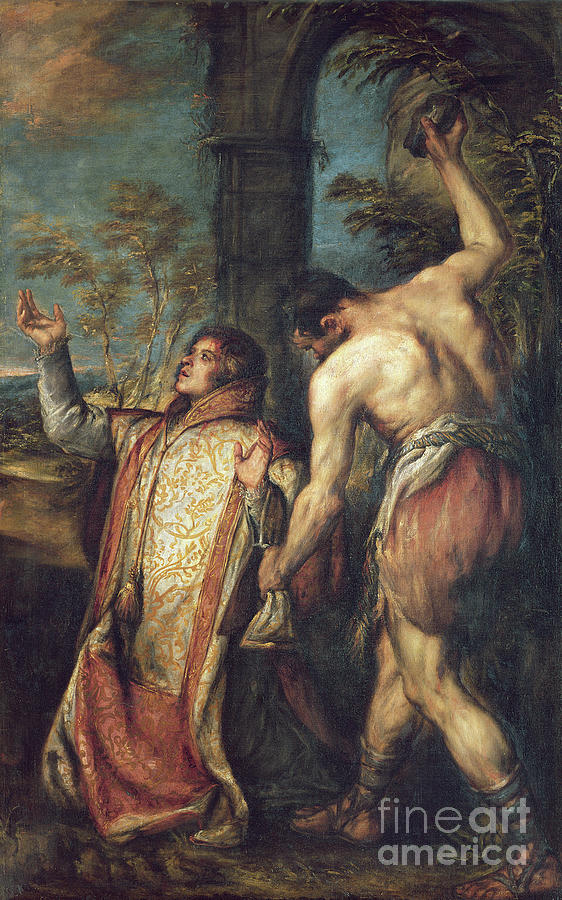
St. Stephen, the Martyr by Diego Polo
Thanks for your journey into this space again this week and Merry Christmas! We have several commemorations on a full calendar this week: Stephen, Deacon and Martyr, on Friday (I was named for both Paul and Stephen and Stephen’s martyrdom, of course, is connected to Paul, something my father made sure I understood), John, Apostle and Evangelist on Saturday, and The Holy Innocents, Martyrs, on Sunday. Their story derives from Matthew’s Gospel, something I will include in my reflection. I have also included the hauntingly beautiful carol, In the Bleak Midwinter, if you want a few moments of peace at some point this week. Finally, I have posted the fifth and final excerpt of the interview with Pastor Jen regarding the Malawi trip from October. Enjoy!
A Simple Strategy for Reading
#1: What is something NEW you learned in the reading?
#2: What is something that caused you to REFLECT?
#3: What is something you can RELATE to prior knowledge?
#4: What is something you would like to further DISCUSS?
The four-question approach to reading (NRRD) is a good way to take on Bible passages.
Give it a try this week!
This Week’s Readings
Christmas Eve 24 December
Isaiah 9: 2-7 Psalm 96 Titus 2: 11-14 Luke 2: 1-14 (15-20)
Christmas Day II 25 December
Isaiah 62: 6-12 Psalm 97 Titus 3: 4-7 Luke 2 (1-7) 8-20
Connections Between Readings and Common Themes for 1 Christmas
The readings for Christmas Eve, Christmas Day, and the First Sunday of Christmas form a kind of widening arc: Christmas Eve leans into anticipation and proclamation, Christmas Day celebrates the mystery of the Word made flesh, and 1 Christmas turns our attention to what that incarnation means for the world God loves. The 1 Christmas texts share a striking common thread: God’s fierce, protective solidarity with humanity. Isaiah 63 recalls God’s steadfast mercy and saving presence; Psalm 148 summons all creation into praise because God’s glory has drawn near; Hebrews 2 insists that Christ becomes fully human in order to break the power of fear and death; and Matthew’s account of the flight into Egypt shows that the incarnation enters the world’s danger, injustice, and displacement rather than avoiding it. Together, these readings reveal a God who not only comes among us but travels with us into the hardest places, turning vulnerability into redemption and inviting all creation to join the song of deliverance.
Prompt for Co-Pilot: “Provide a one paragraph explanation of the relationship between the readings for Christmas Eve, Christmas Day, and 1 Christmas and also an exploration of the common themes among the 1 Christmas Readings.” 20 December 2025.
Focus Reading from Matthew’s Gospel
Adoration of the Magi, c. 1487, by Ghirlandaio
Note: For context, here is a short summary of the preceding verses (2-12): The Magi arrive in Jerusalem seeking the newborn king after seeing his star rise in the east. Herod, disturbed by their news, gathers the chief priests and scribes to learn where the Messiah is to be born and secretly urges the Magi to report back to him. Guided again by the star, the Magi travel to Bethlehem, find the child with Mary, and offer gifts of gold, frankincense, and myrrh. Warned in a dream not to return to Herod, they depart for their own country by another road.
13 Now after they had left, an angel of the Lord appeared to Joseph in a dream and said, “Get up, take the child and his mother, and flee to Egypt, and remain there until I tell you, for Herod is about to search for the child, to destroy him.” 14 Then Joseph got up, took the child and his mother by night, and went to Egypt 15 and remained there until the death of Herod. This was to fulfill what had been spoken by the Lord through the prophet, “Out of Egypt I have called my son.” 16 When Herod saw that he had been tricked by the magi, he was infuriated, and he sent and killed all the children in and around Bethlehem who were two years old or under, according to the time that he had learned from the magi. 17 Then what had been spoken through the prophet Jeremiah was fulfilled:
18 “A voice was heard in Ramah, wailing and loud lamentation, Rachel weeping for her children; she refused to be consoled, because they are no more.”
19 When Herod died, an angel of the Lord suddenly appeared in a dream to Joseph in Egypt and said, 20 “Get up, take the child and his mother, and go to the land of Israel, for those who were seeking the child’s life are dead.” 21 Then Joseph got up, took the child and his mother, and went to the land of Israel. 22 But when he heard that Archelaus was ruling Judea in place of his father Herod, he was afraid to go there. And after being warned in a dream, he went away to the district of Galilee. 23 There he made his home in a town called Nazareth, so that what had been spoken through the prophets might be fulfilled, “He will be called a Nazarene.”
Reflection: Home By Another Way
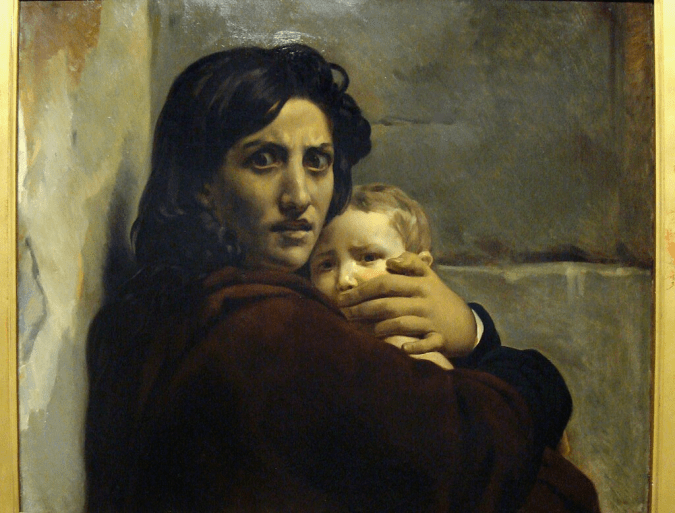
“Massacre of the Innocents” Léon Cogniet (1794-1880)
As a child, I was captivated by the Magi — mysterious travelers from the east, following a star across deserts and borders to kneel before a child. Part of my intrigue owed to the fact that my parents had an LP of Amahl and the Night Visitorsthat I listened to over and over again. Their story felt full of wonder: strange gifts, strange dreams, strange courage. But Matthew places their visit right on the edge of danger. Their quiet act of homage becomes the turning point in the narrative, for once they slip away by another road, Herod’s fear hardens into violence (James Taylor wrote a great song about this!). And so, in the days after Christmas, Matthew’s Gospel turns us from angels and shepherds toward a far harsher reality. An angel warns Joseph in a dream to take Mary and the child and flee to Egypt, and they escape just before Herod unleashes violence on Bethlehem’s children. Historians note that this event appears only in Matthew and debate whether it occurred exactly as described, yet the story rings true to Herod’s character and to the long pattern of rulers using violence to protect their power. Matthew frames it with Jeremiah’s haunting line: “Rachel weeping for her children… because they are no more.” The French artist Cogniet captured the horror in his famous painting — the terror in a mother’s eyes speaks volumes.
And, that ancient cry feels amazingly modern. I think back to the shooting at Abundant Life Christian School here in Wisconsin one year ago — one more entry in the long, heartbreaking list of school shootings in our country. And this week, again. A mass shooting at Brown University during a study session left two students dead and nine others wounded. And the world watched in grief as gunmen opened fire at a Hanukkah celebration on Sydney’s Bondi Beach, killing fifteen people, including a 12‑year‑old child. Once again, families ran for safety; once again, parents searched for their children; once again, Rachel wept.
In my forty‑one years of full‑time teaching, the hardest days were always those marked by school shootings somewhere in our state or nation—moments that sent a chill through the ordinary rhythms of the classroom. Active‑shooter drills gradually became part of our normal routine, and I often wondered what it meant for the psyche of our children to rehearse for unthinkable violence. Even now, I feel that same hollow ache each time tragedy erupts—the barricades, the hiding places, the surreal sense that we are preparing for something that should never happen. Matthew does not shield us from this reality. He tells the truth: the Incarnation unfolds in a world marked by fear, displacement, and violence. And yet this is precisely the world into which Christ comes — a world where families flee danger, where innocents suffer, where darkness seems to have the upper hand, and where God still chooses to dwell with us.
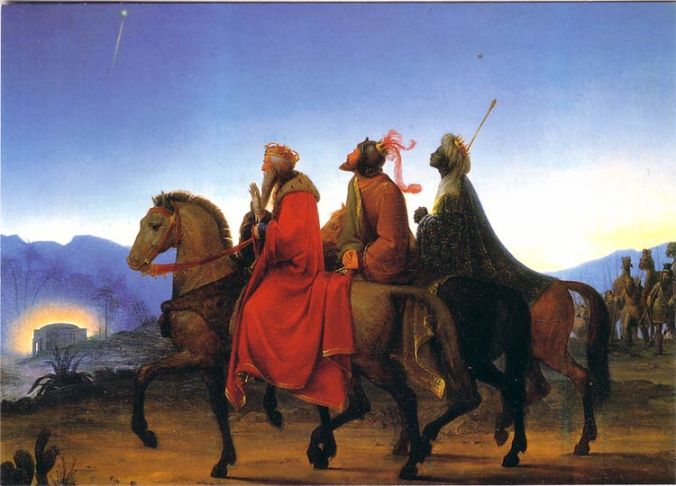
The March of the Wise Men by Leopold Kupelwieser, 1825
Let’s ponder this as we approach the powerful Christmas stories we will hear this week: As Christians, we walk in two worlds: the temporal one, where our civic engagement and moral clarity matter deeply, and the eternal one, where God’s promise of justice and peace anchors our hope. Holding both has never been easy. But Matthew’s story of the Magi, the warning dream, and the family’s flight reminds us that God has always been at work in history — quietly, persistently — guiding people toward life, even when the road bends unexpectedly. The Magi went home by another way, and so do we, trusting that God still works in the shadows, still protects the vulnerable, still leads us toward safety and light. May we listen for the angel’s voice, stand with those who flee danger, refuse to grow numb to Rachel’s tears, and trust that even in these troubled times, the light shines in the darkness, and the darkness has not overcome it.
Soli deo Gloria!
** Much has been written about the Massacre of the Innocents and whether or not it actually occurred as reported in Matthew. If interested, this author offers a thorough analysis of the story in all its complexity.
Musical Meditation: In the Bleak Midwinter
T.S. Eliot’s Journey of the Magi begins with that stark admission: “a cold coming we had of it… the worst time of the year for a journey.” Those of us who live in northern climates know exactly what he meant. Winter can feel endless—dark, biting, and wearying. Christina Rossetti wrote A Christmas Carol in 1872 out of this same wintry imagination. Her poem isn’t about Bethlehem’s climate but about the coldness and poverty of the human heart into which Christ is born. Years later, Gustav Holst set her words to the haunting melody we know today simply by its first line — In the Bleak Midwinter. Read alongside Eliot, Rossetti’s carol speaks to all of us who know real winter — the long nights, the frozen landscapes, the quiet waiting. Together they remind us that God enters our own bleak midwinters and asks only the offering of the heart. Revelation often comes in winter, and the light we seek is born in the cold. Here’s an excellent version of the familiar hymn from Tenebrae, a choral group from Great Britain.
In the bleak midwinter, frosty wind made moan, Earth stood hard as iron, water like a stone; Snow had fallen, snow on snow, snow on snow, In the bleak midwinter, long ago.
Our God, Heaven cannot hold Him, nor earth sustain; Heaven and earth shall flee away when He comes to reign. In the bleak midwinter a stable place sufficed The Lord God Almighty, Jesus Christ.
Enough for Him, whom cherubim, worship night and day, Breastful of milk, and a mangerful of hay; Enough for Him, whom angels fall before, The ox and ass and camel which adore.
Angels and archangels may have gathered there, Cherubim and seraphim thronged the air; But His mother only, in her maiden bliss, Worshipped the beloved with a kiss.
What can I give Him, poor as I am? If I were a shepherd, I would bring a lamb; If I were a Wise Man, I would do my part; Yet what I can I give Him: give my heart.
Tenebrae is a professional choral ensemble based in London, founded in 2001 by former King’s Singer Nigel Short. Known for its exceptional precision, rich sound, and dramatic performance style, the group performs a wide repertoire ranging from Renaissance polyphony to contemporary works. Tenebrae has toured internationally, recorded extensively, and is widely regarded as one of Britain’s leading vocal ensembles.
Prayer Reflection: A Vision of a World Made New
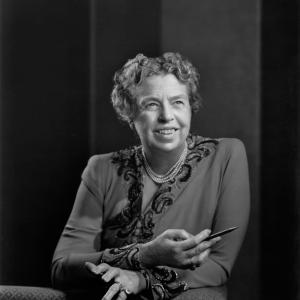
Eleanor Roosevelt (1944)
Eleanor Roosevelt’s prayer A Vision of a World Made New emerged from her work at the United Nations after World War II, where she helped guide the creation of the Universal Declaration of Human Rights. Though she wasn’t conventionally religious, her Episcopal upbringing and her deep trust in the dignity of every person shaped both her public leadership and her private devotions; her son remembered that she prayed these words every night. What moves me is how her prayer gathers moral imagination, compassion, and responsibility into a single plea—that God would ‘show us a vision of a world made new.’ It has become one of my favorite prayers, and it’s a good one for all of us to return to often.
Our Father, who has set a restlessness in our hearts and made us all seekers after that which we can never fully find, forbid us to be satisfied with what we make of life. Draw us from base content and set our eyes on far off goals. Keep us at tasks too hard for us that we may be driven to Thee for strength. Deliver us from fretfulness and self-pitying; make us sure of the good we cannot see and of the hidden good in the world. Open our eyes to simple beauty all around us and our hearts to the loveliness men hide from us because we do not try to understand them. Save us from ourselves and show us a vision of the world made new. Amen.
Faithful Conversation Updates
Join us for some free-flowing conversation about the Lectionary readings each Sunday. We meet from 10:45-11:30 in the church library each week, with some exceptions. No prior knowledge is necessary! ALL ARE WELCOME!
QUESTIONS FOR DISCUSSION THIS WEEK:
1. Matthew places the wonder of the Magi right next to the violence of Herod. How does holding these two realities together shape your understanding of the Incarnation and the world Christ enters? 2. Matthew’s story includes dreams, warnings, flight, and the weeping of Rachel. Where do you see echoes of this story in our world today, and how might Christians faithfully “walk in two worlds” as people of both realism and hope?
The Bible 365 Challenge! More than 60 members of our faith community have committed to the Bible 365 Challenge—a shared journey of reading through the entire Bible in one year. Each day, we engage with selected passages weaving together stories of faith, struggle, grace, and redemption. We have reached the 25% mark and beyond this week!
Reflections On Malawi: Part 5
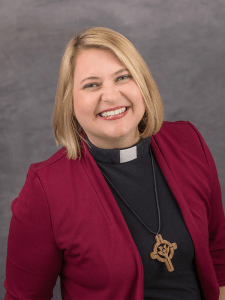
Pastor Jenny Hatleli
Since 1999, the Northwest Synod of Wisconsin and the Evangelical Lutheran Church of Malawi have been companions in ministry. Recently, several NW Synod representatives, including Pastor Jen Hatleli and Patti Whitworth from ELC, traveled there and met with many of our partners in the region. During Advent, I am posting excerpts from my interview with her about the trip. In our final exchange, I asked Pastor Jen how she felt the Malawi trip would impact her approach to ministry going forward.