Faithful Conversations #129
Introduction to Readers

(1896-1940)
“The test of a first-rate intelligence is the ability to hold two opposed ideas in the mind at the same time, and still retain the ability to function.”
(F. Scott Fitzgerald)
Fitzgerald’s oft quoted assertion from a 1936 essay comes to mind as I try to interpret the daily news cycle. Our world is complex, and few regions show that more clearly than the Middle East. For years, I tried to help students understand the basics of the Arab-Israeli conflict (here is a good primer), but I often stayed at the surface. As 21st century Christians, we must recognize that every time we open our Bible, we step into the world of our spiritual ancestors—a world fractured then and fractured now. Today’s political culture pushes us toward binary thinking: good or evil, oppressor or victim, loyalty or betrayal. But the Gospel invites us to see more deeply. It calls us to live in a “both-and” world, not an “either-or” one. We can grieve the brutal massacre of Israeli civilians on October 7, 2023, and condemn Hamas’s terrorism. At the same time, we can mourn the devastating loss of Palestinian life in Gaza—over 60,000 dead, many of them children—and name the ongoing occupation and siege as a moral failure. We can reject both antisemitism and Islamophobia. We can also stand with those—Jewish, Muslim, Christian, and secular—who cry out for justice, dignity, and peace. The ELCA’s recent memorial on Gaza, passed overwhelmingly at the Churchwide Assembly, reflects this kind of witness. It may not be perfect. It may make us uncomfortable. But it continues a long tradition of speaking truth in love—a tradition that holds tension, listens deeply, and speaks boldly (Sidebar: An elderly pastor once told me that “we have a tradition in the ELCA of talking things through a lot, sometimes for years, and that often frustrates many.” True!). Follow this link if you would like to have a description of the differences between our Social Statements and Memorials). May we continue to pray for all those impacted by this heart-breaking conflict — come heavenly Father!

Thanks for returning to this space again this week, and your continued exploration of the Lectionary! We have several commemorations in our church calendar in the days ahead, including Florence Nightingale (b.1820) who died on 13 August 1910. A social reformer, the “Lady with the Lamp” revolutionized healthcare during the Crimean War. Her nightly rounds to care for wounded soldiers became iconic, symbolizing compassion and dedication. An intriguing and courageous individual (with a beautiful name!), her work laid the foundation for professional nursing. The accompanying image is a lithograph drawn from a painting by British painter Henrietta Rae (1856-1928). We’re on round two of the Hebrews series this week and my reflections will also tie in to the challenging Gospel reading.
** Note 1: Links to outside references are bolded and italicized and are meant for further reading or research on your part. While the text I am including in the blog is my own, I am pulling from a multitude of sites for ideas and connections.
** Note 2: In my increasing use of A.I. (Copilot), I will cite sourcing of how I am using the tool, if necessary. I don’t want that to be overly cumbersome, but I am gradually incorporating more tools. I am exploring the A.I. world this summer prior to my next teaching semester. As you can imagine, it is a great challenge right now and will forever change the face of education!
** Note 3: The images I include in the blog are drawn from Wikimedia Commons to the fullest extent possible.
Common Themes Among the Readings
Pentecost 10 Readings
Jeremiah 23: 23-29
Psalm 82
Hebrews 11:29 – 12:2
Luke 12: 49-56
My source for the Bible readings each week is the Bible Gateway website. I generally use the NRSVUE translation.
The readings for Pentecost 10 (Year C) confront the listener with the disruptive power of divine truth. God’s word, like fire in Jeremiah and Jesus’ mission in Luke, does not soothe but purifies, divides, and demands response. Psalm 82 underscores the urgency of justice, as God rebukes those who fail to defend the vulnerable. Hebrews calls the faithful to endurance, drawing strength from the witness of those who persevered before them. Together, the texts challenge complacency and invite a deeper discernment of God’s presence and purpose in turbulent times.
“Describe the common themes among the readings for Pentecost 10.” Copilot, 25 7 August 2025, Copilot website.
LUTHER’S METHOD OF BIBLE READING
A Revision of the Lectio Divina, a method he learned in his Augustinian training
Three Steps
Oratio (Prayer): This is the starting point, where one humbly prays for the Holy Spirit’s guidance to understand God’s Word. Luther emphasized that prayer prepares the heart and mind to receive divine wisdom.
Meditatio (Meditation): This involves deeply engaging with Scripture, not just reading it but reflecting on it repeatedly. Luther encouraged believers to “chew on” the Word, allowing its meaning to sink in and shape their thoughts and actions.
Tentatio (Struggle): Often translated as “trial” or “temptation,” this refers to the challenges and spiritual battles that arise as one seeks to live according to God’s Word. Luther saw these struggles as a way God refines faith, making it more resilient and authentic.
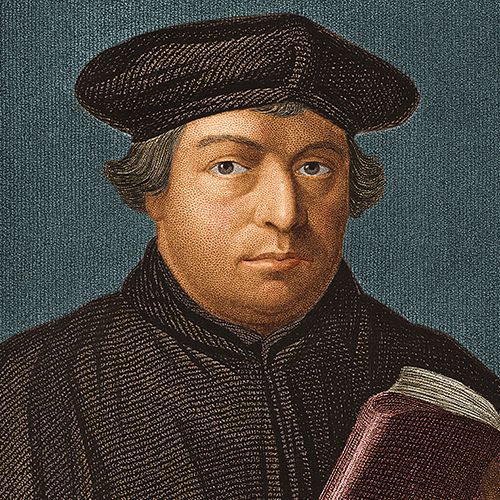
(1483-1546)
Hebrews 11:29 – 12:2
29 By faith the people passed through the Red Sea as if it were dry land, but when the Egyptians attempted to do so they were drowned. 30 By faith the walls of Jericho fell after they had been encircled for seven days. 31 By faith Rahab the prostitute did not perish with those who were disobedient,[a] because she had received the spies in peace. 32 And what more should I say? For time would fail me to tell of Gideon, Barak, Samson, Jephthah, of David and Samuel and the prophets, 33 who through faith conquered kingdoms, administered justice, obtained promises, shut the mouths of lions, 34 quenched the power of fire, escaped the edge of the sword, were made strong out of weakness, became mighty in war, put foreign armies to flight. 35 Women received their dead by resurrection. Others were tortured, refusing to accept release, in order to obtain a better resurrection. 36 Others suffered mocking and flogging and even chains and imprisonment. 37 They were stoned to death; they were sawn in two; they were killed by the sword; they went about in skins of sheep and goats, destitute, persecuted, tormented— 38 of whom the world was not worthy. They wandered in deserts and mountains and in caves and holes in the ground. 39 Yet all these, though they were commended for their faith, did not receive what was promised, 40 since God had provided something better so that they would not, apart from us, be made perfect.
12 Therefore, since we are surrounded by so great a cloud of witnesses, let us also lay aside every weight and the sin that clings so closely, and let us run with perseverance the race that is set before us, 2 looking to Jesus, the pioneer and perfecter of faith, who for the sake of the joy that was set before him endured the cross, disregarding its shame, and has taken his seat at the right hand of the throne of God.
Source: Bible Gateway
Luke 12: 49-56
49 “I have come to cast fire upon the earth, and how I wish it were already ablaze! 50 I have a baptism with which to be baptized, and what constraint I am under until it is completed! 51 Do you think that I have come to bring peace to the earth? No, I tell you, but rather division! 52 From now on five in one household will be divided, three against two and two against three; 53 they will be divided:
father against son
and son against father,
mother against daughter
and daughter against mother,
mother-in-law against her daughter-in-law
and daughter-in-law against mother-in-law.”
54 He also said to the crowds, “When you see a cloud rising in the west, you immediately say, ‘It is going to rain,’ and so it happens. 55 And when you see the south wind blowing, you say, ‘There will be scorching heat,’ and it happens. 56 You hypocrites! You know how to interpret the appearance of earth and sky, but why do you not know how to interpret the present time?
Reflection: “Running at Full Stride!”
Martin Luther didn’t hold back when it came to his opinions. As I mentioned last week, he gave the Book of Hebrews a respectful nod—but didn’t place it front and center. He doubted Paul wrote it, and for Luther, apostolic authorship mattered. No apostle? Less authority. He also struggled with Hebrews’ warnings about falling away from faith, which clashed with his deep trust in justification by faith alone. So, he tucked Hebrews into the “helpful but not essential” section of his Bible, alongside James and Revelation (which he famously called “barely worthy of firewood”). Still, I find Hebrews compelling. The writing is rich, and it speaks to a community facing hardship and spiritual drift. This week’s passage is especially powerful. It reminds us that by faith, the Israelites crossed the Red Sea, and by faith, Rahab welcomed the spies and found life amid destruction. Others—Gideon, Samson, David, and countless unnamed saints—endured suffering, exile, and death, trusting in promises they couldn’t yet see. Now, surrounded by this great cloud of witnesses, we’re called to run with perseverance, shedding what weighs us down and fixing our eyes on Jesus, who endured the cross and leads us forward in hope.


Let’s pause on Rahab. Her inclusion in Hebrews is stunning. Abraham, Moses, David—those names we expect. But Rahab? She was a woman, a Canaanite, a prostitute—someone living on the edges of society. And yet, her courageous faith placed her squarely in the story of redemption. In Joshua 2 and 6, she risked her life to hide Israelite spies and declared her belief in Israel’s God: “The LORD your God is God in heaven above and on the earth below” (Joshua 2:11). Because of her faith, she survived the fall of Jericho and joined the Israelite community. She married Salmon, gave birth to Boaz (who married Ruth), and became the great-grandmother of King David. (Sidebar: my mother would’ve been proud of me for tracing that lineage—we always admired her gift for unraveling royal family trees!). Early Christians knew Rahab’s story. But to hear her lifted up as a model of faith? That must have been both surprising and deeply moving. It reminds us that faith isn’t reserved for the polished or the powerful. It’s found in the margins, in unexpected places, and in people who dare to trust God against all odds.
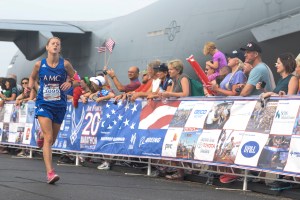
Rahab’s story reminds us that faith often rises from the margins—from places of risk, vulnerability, and unexpected courage. She didn’t just believe; she acted. And in doing so, she became part of something far greater than herself—a lineage of redemption, a testimony of grace. It’s no accident that her name appears just before the climactic turn in Hebrews. After listing the faithful—those who trusted God through trials, exile, and even death—the writer shifts from remembrance to invitation. We are not merely observers of this great cloud of witnesses; we are participants in the same story. “Therefore, since we are surrounded by so great a cloud of witnesses…” We are called to run—not casually, but with endurance. To fix our eyes on Jesus, who endured the cross and now leads us forward in hope. This is not a gentle stroll. It’s a race marked by fire. (Sidebar: There are six references to running in the New Testament — as a distance coach, these have always been among my favorites!)

Which brings us to this week’s Gospel: Luke 12:49–56. Jesus speaks with startling clarity—Do you think that I have come to bring peace to the earth? No, I tell you, but rather division! Unsettling words. They challenge our assumptions about the Prince of Peace but also clarify the cost of discipleship. The fire Jesus speaks of is not destruction—it’s purification. It’s the refining flame that burns away complacency. Just as Rahab stepped into danger to align herself with God’s purposes, we too are called to interpret the times. To run with endurance, even when the path divides us from convention, or consensus. Faith, in this light, is not passive. It’s active, discerning, and sometimes disruptive. It’s the flame of transformation.
Soli Deo Gloria!
A Prayer and Musical Offering: St. Aidan’s Prayer
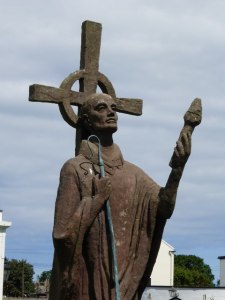
St. Aidan’s Prayer is a contemplative reflection attributed to St. Aidan of Lindisfarne (600-651 CE), a 7th-century Celtic monk and missionary known for his humility, evangelism, and deep spiritual life. The prayer beautifully captures the rhythm of solitude and service, using the imagery of tides to express a life centered in God’s presence and then poured out into the world. This prayer reflects the Celtic Christian balance between contemplation and mission. It’s especially resonant for those seeking spiritual renewal or discerning vocation in a noisy, demanding world. The interpretation you’re hearing comes from composer Lucy Walker. If you need a few moments of peace today, enjoy!
“Describe St. Aidan’s Prayer.” Copilot, 9 August 2025, Copilot website.

Leave me alone with God as much as may be.
As the tide draws the waters close in upon the shore,
Make me an island, set apart,
alone with you, God, holy to you.
Then with the turning of the tide
prepare me to carry your presence to the busy world beyond,
the world that rushes in on me
till the waters come again and fold me back to you.
Recorded on St Aidan’s Day in St Marys Parish Church, Holy Island. St. Martin-in-the-Fields.
Faithful Conversations: Three Updates
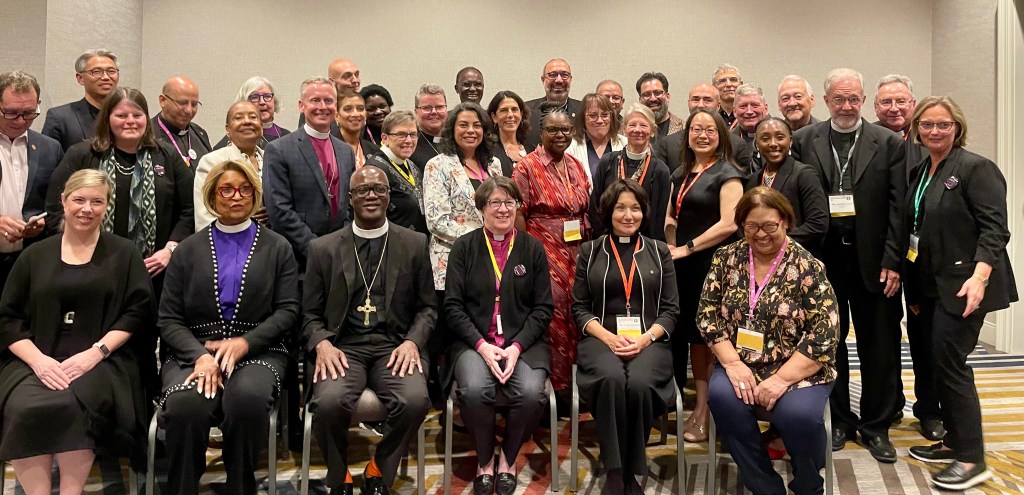
As reflected in the photo, the 2025 ELCA Churchwide Assembly in Phoenix highlighted a strong ecumenical and international presence, reflecting the church’s commitment to global partnership and interfaith dialogue. Pastor Jen spoke about this on Sunday. Leaders from Jewish, Muslim, Orthodox, Catholic, and Protestant traditions offered moving and challenging reflections that affirmed the ELCA’s mission “for the life of the world.” The Lutheran World Federation played a key role, with leaders emphasizing shared mission and solidarity within the global Lutheran communion. These voices enriched the Assembly’s worship and deliberations, I’m sure. If you’re interested, here is a link to Dr. Chad Rimmer’s Keynote Address to the assembly (30 July 2025). He hit on several key themes, among them the international character of the ELCA Assembly, and the need to be a church that listens to and learns from voices across cultures and contexts. It is a fascinating talk.
Our regular gatherings for discussing the weekly lectionary are on a pause. Summer worship at ELC is at 8:30 in town and 10:15 at Hatfield by the lake. The 8:30 service will be streamed. We will resume our Sunday morning gatherings at ELC on 14 September. Stay in touch!
📖 Ready to read the Bible in a year?
Starting this September, join our Bible 365 Challenge—a yearlong journey through Scripture for individuals, families, and groups. As Lutherans, we know God’s Word shapes our lives and deepens our faith. Luther once said, “The Bible is alive… it lays hold of me.” Whether you choose the print path or go digital, we’ll grow together—with daily readings, mutual support, and spiritual connection. Details are coming soon. Let’s dive in, walk together, and let the Word come alive in us!
