Faithful Conversations #13
Note to readers: My reflection this week focuses on the Gospel and the reading from Acts. You will also note that I have included the Apostles’ Creed and will be referencing that.
Readings for the Sixth Sunday in Easter:
Acts 17: 22-31
Psalm 66: 8-20
1 Peter 13: 13-22
John 14:15-21
The Apostle’s Creed
(First Article) I believe in God, the Father almighty, creator of heaven and earth.
(Second Article) I believe in Jesus Christ, God’s only Son, our Lord, who was conceived by the Holy Spirit, born of the virgin Mary, suffered under Pontius Pilate,
was crucified, died, and was buried; he descended to the dead. (or, into hell)
On the third day he rose again; he ascended into heaven,
he is seated at the right hand of the Father,
and he will come to judge the living and the dead.
(Third Article) I believe in the Holy Spirit, the holy catholic Church, the communion of saints, the forgiveness of sins, the resurrection of the body, and the life everlasting. Amen.
The Gospel: John 14: 15-21: The Promise of the Holy Spirit
15 “If you love me, you will keep my commandments. 16 And I will ask the Father, and he will give you another Advocate, to be with you forever. 17 This is the Spirit of truth, whom the world cannot receive because it neither sees him nor knows him. You know him because he abides with you, and he will be in you. 18 “I will not leave you orphaned; I am coming to you. 19 In a little while the world will no longer see me, but you will see me; because I live, you also will live. 20 On that day you will know that I am in my Father, and you in me, and I in you. 21 They who have my commandments and keep them are those who love me, and those who love me will be loved by my Father, and I will love them and reveal myself to them.”
The Reading from Acts 17: 22-31: Paul in Athens
22 Then Paul stood in front of the Areopagus and said, “Athenians, I see how extremely spiritual you are in every way. 23 For as I went through the city and looked carefully at the objects of your worship, I found among them an altar with the inscription, ‘To an unknown god.’ What therefore you worship as unknown, this I proclaim to you. 24 The God who made the world and everything in it, he who is Lord of heaven and earth, does not live in shrines made by human hands, 25 nor is he served by human hands, as though he needed anything, since he himself gives to all mortals life and breath and all things. 26 From one ancestor he made all peoples to inhabit the whole earth, and he allotted the times of their existence and the boundaries of the places where they would live, 27 so that they would search for God and perhaps fumble about for him and find him—though indeed he is not far from each one of us. 28 For ‘In him we live and move and have our being’; as even some of your own poets have said, ‘For we, too, are his offspring.’ 29 “Since we are God’s offspring, we ought not to think that the deity is like gold or silver or stone, an image formed by the art and imagination of mortals. 30 While God has overlooked the times of human ignorance, now he commands all people everywhere to repent, 31 because he has fixed a day on which he will have the world judged in righteousness by a man whom he has appointed, and of this he has given assurance to all by raising him from the dead.”
This Week’s Reflection
Let’s all picture the most enthusiastic person you know. One of my college friends, Steve Clute, immediately comes to mind for me. He naturally spreads infectious laughter and joy in any situation. As mentioned in a prior post, the word enthusiasm derives from the Greek “entheos,” literally meaning “God in us.” As Christians and Lutherans, this makes perfect sense and we are reminded of this throughout the scriptures. Like many of our brothers and sisters in the faith here and across the globe, we believe in the doctrine of the Trinity — that God is manifested in three persons, God the Father, Jesus Christ, and the Holy Spirit. The belief statements in the three articles of the Apostles’ Creed illustrate this. Sunday’s Gospel reading prompts our thinking in this regard, especially regarding the Holy Spirit.
We are hearing from Jesus after his triumphal entry into Jerusalem and he is foreshadowing what will happen when he is gone. In verse 16, he speaks of the gift of the Holy Spirit, one who will be alongside us — an advocate — and what a beautiful image that conjures in my mind. His Spirit, in fact, will be in us as the Spirit of Truth (verse 17), something the “world” will not understand. He further assures us we will not be orphaned (verse 18). And, take a few moments and meditate on verse 20, a powerful passage alluding to the Trinity! (And, if you’re interested, take time to look up Luther’s explanation of the Third Article of the Creed — maybe you learned it many years ago!)
Let’s carry the idea of “God in us” as we reflect on the passage from Acts. This has always been one of my favorite moments in the life of St. Paul. First, some context. Paul converted to Christianity in 34 CE (one year after the crucifixion), and roughly 12 years later began the first of several missionary journeys. It is estimated that between 46-60 CE, he traveled more than 10,000 miles throughout the Mediterranean world, most on foot! In this week’s reading, we catch up with him on his second missionary trip (51 CE) and he and his companions are in Athens (prior to this, by the way, they had been run out from both Thessalonica and Berea due to the various controversies swirling around them!). Let’s imagine what it would have been like to travel with Paul and these early Christians!

View of the Areopagus (foreground) and the Acropolis (atop the hill)
In Athens, we see Paul carrying the story of Christ to the “wider world.” He preaches in the local synagogues, and bustling marketplaces of the famous city. In chapter 17, we find him preaching at the Areopagus, a famous site northwest of the Acropolis, addressing a diverse crowd of curious people. Ever the missionary, Paul appeals to them on their own turf, challenging their belief in many gods (which he has witnessed in the various shrines around the city), and pointing them toward God and his son, Jesus Christ who “gives to all mortals life and breath” (verse 25). He further reinforces the idea that we are God’s “offspring,” (verse 28) by referencing lines from ancient Greek poetry (Epimenides and Aratus), a crafty move on his part. If we read on a bit (verses 32-33), we learn that some were converted that day, including Dionysius and his wife Damaris, two of those fascinating characters that briefly appear in scripture (these individuals always intrigue me because of their brief “cameo” appearances).
What practical lessons can we draw from this week’s Gospel and the story of Paul at the Areopagus? First, God’s love extends to all people and the gift of the Holy Spirit is open to all — we are all “God’s offspring.” This is an incredibly challenging truth for many of us to accept. We live in a broken world that promotes division and hate, and we must somehow navigate that grim reality. Second, it is that same Holy Spirit that moves us beyond ourselves and into the wider world — we cannot do it on our own! If we become insulated as Christians, if we spend all our time talking to people who are “like us,” if we isolate ourselves, we fall into self-absorption and become frozen with indifference and susceptible to the divisions that surround us. The Spirit says GO! Go into all aspects of our shared lives and “practice what we preach.” We were made for that work. We have a powerful story to share.
Soli Deo Gloria!
Prayer (in response to events of this week and inspired by 1 Peter 3: 14-15)
Dear God, Our hearts are broken and souls pierced by the violence afflicting our nation and world. We pray for the victims of violence, including wars and mass shootings, and those that have lost loved ones, and all those who mourn. We pray for community, state, and national leaders that must grapple with the challenges imposed on them by tragic events. We also pray for the broken souls that perpetrate such violence in our world — may you change their hearts and minds. We ask, Lord, for strength and courage, not to be intimidated by the circumstances of this world, but instead to share the hope that we have in you with those around us. We rely on your Spirit for courage and realize that we cannot do this on our own. In your strong name we pray, Amen.
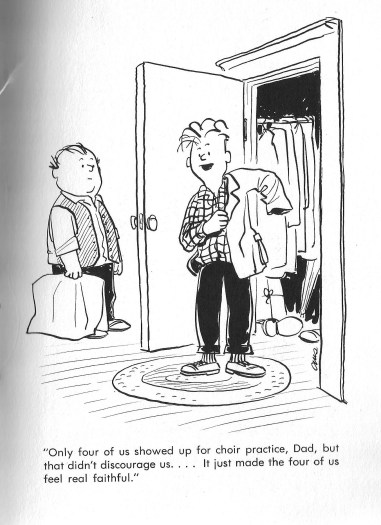
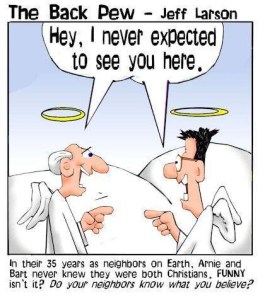
And finally, a bit of humor for today . . . Another installment of 1950s and 60s Lutheran humor! These come from the world of Charles Schultz, the same guy that did the Peanuts comic strip for all those years!




 There are eight instances of Christ appearing to people in the forty days after his resurrection recorded in scripture, eight times where people on this earth saw and, in some cases, directly interacted with him. In this week’s Gospel reading, we are walking along a road with Cleopas and his friend, both of whom are feeling dejected and without hope (verse 21). It is Sunday evening, three days after the crucifixion, and they are headed out of Jerusalem to the village of Emmaus. They are attempting to sort out the climactic events of the past several days and we sense their despondency. Versed in the tradition of Judaism, they expected a different sort of Messiah. Jesus’ death, and the fact that they had not seen him, (though some had spoken of his miraculous resurrection) leaves them puzzled and without hope. Suddenly Jesus appears and joins them on the path, though they fail to recognize him. In fact, they are taken aback that this “stranger” has not heard about the dramatic events of recent days. Jesus listens. Then he confronts them with a powerful interpretation of the Hebrew prophecies, clearly identifying himself as the promised Messiah, but they still don’t get it (verses 25-27). As they reach their destination, they invite the stranger to join them since it is late. And, in one of the truly powerful moments in the post-resurrection period, Jesus breaks bread with them, then vanishes. They suddenly realize WHO he is (verse 31) and in their excitement, they rush back to Jerusalem and recount their experience to the eleven disciples. I suspect they covered that seven miles in a hurry!
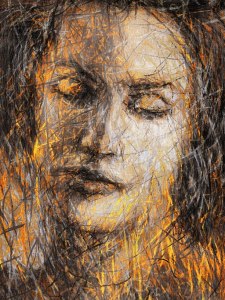
 Now, back to Robert Zund’s interpretative artwork. Many commentators note that he got the flora and fauna all wrong here. Instead of a Middle Eastern scene, the road to Emmaus is set in what appears to be the countryside of Switzerland, his home. It is a gorgeous setting, and , in fact, resembles the place that you and I live. Perhaps the artist did this with intent. Encounters with Christ can happen anywhere and he meets people, often unexpectedly, wherever they are. (As a sidebar, I have talked with Native American people who have recounted stories of Christ appearing to their ancestors in North America, something that seems entirely plausible to me).


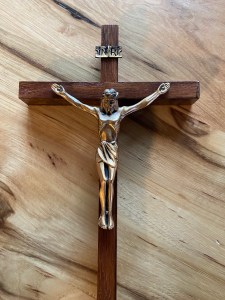
 “Displaying the corpus of Jesus on the cross is a stark visual aid that helps us to more easily focus on the very real sacrifice Jesus offered for us for our salvation . . . Our brothers and sisters of mainline Protestant and non-denominational traditions typically display an empty cross in recognition that Jesus died once and for all for us, and is now risen from the dead. The cross, like the tomb, is empty. We should see these not as opposing viewpoints, but as complimentary emphasis.”



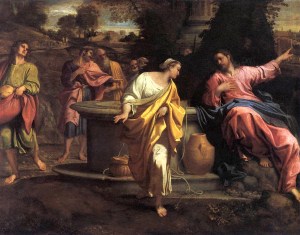 Back to the Samaritan woman. Among Eastern Orthodox churches, she is called by the name Photini and, in fact, is numbered among the Great Martyrs (you may want to explore more about her fascinating story). Though not named in John’s Gospel, her identity as a Samaritan is significant. Jesus and his disciples are traveling from Judea to Galilee and they chose to take the direct route through Samaria. The backdrop here is that Jews and Samaritans, though distant cousins ethnically, were enemies for a variety of reasons, but most notably their differences over the proper place to worship God. Jews viewed Jerusalem as the center of worship, while Samaritans believed it was Mount Gerizim. This argument among spiritual ancestors seems perplexing to us, but it was critically important two thousand years ago.
