Faithful Conversations #22

Jackson County, Wisconsin, July 2023
Introduction to Readers: Two things as you navigate the readings this week: first, those of us who live in a semi-rural environment can feel a natural affinity with these ancient texts — they speak to us across time. I thought about that while tooling through the hills, trees, and cornfields west and south of the city this week on my bike (my favorite verse from the Isaiah passage is, “the mountains and the hills before you shall burst into song, and all the trees of the field shall clap their hands” — what a great image!). And second, look for references to JOY in each of the readings, along with a sense of optimism and hope. I found that to be a welcome relief after some of the challenging texts of the past two weeks. It’s easy to become angry or bitter about things in 2023 with all that is going on around us – it’s a slippery slope. Our relationship with God helps us move in a different direction and enables us to be purveyors of joy, optimism, and hope within our communities. May God help us find our “better selves.”
My reflections this week will center on the Gospel reading, with a reference to the Isaiah passage. Thanks for your continued interest in the weekly lectionary!
Readings for Pentecost 7:
Isaiah 55:10-13
Psalm 65:(1-8) 9-13
Romans 8:1-11
Matthew 13:1-9, 18-23
The First Reading: Isaiah 55:10-13
10 For as the rain and the snow come down from heaven
and do not return there until they have watered the earth,
making it bring forth and sprout,
giving seed to the sower and bread to the eater,
11 so shall my word be that goes out from my mouth;
it shall not return to me empty,
but it shall accomplish that which I purpose
and succeed in the thing for which I sent it.
12 For you shall go out in joy
and be led back in peace;
the mountains and the hills before you
shall burst into song,
and all the trees of the field shall clap their hands.
13 Instead of the thorn shall come up the cypress;
instead of the brier shall come up the myrtle,
and it shall be to the Lord for a memorial,
for an everlasting sign that shall not be cut off.
The Gospel: Matthew 13:1-9, 18-23: The Parable of the Sower
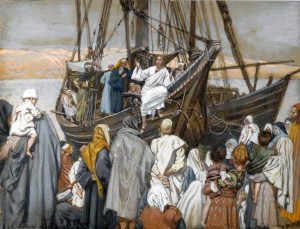
“Jesus Preaches in a Ship” by James Tissot (1836-1902)
13 That same day Jesus went out of the house and sat beside the sea. 2 Such great crowds gathered around him that he got into a boat and sat there, while the whole crowd stood on the beach. 3 And he told them many things in parables, saying: “Listen! A sower went out to sow. 4 And as he sowed, some seeds fell on a path, and the birds came and ate them up. 5 Other seeds fell on rocky ground, where they did not have much soil, and they sprang up quickly, since they had no depth of soil. 6 But when the sun rose, they were scorched, and since they had no root, they withered away. 7 Other seeds fell among thorns, and the thorns grew up and choked them. 8 Other seeds fell on good soil and brought forth grain, some a hundredfold, some sixty, some thirty. 9 If you have ears, hear!”
18 “Hear, then, the parable of the sower. 19 When anyone hears the word of the kingdom and does not understand it, the evil one comes and snatches away what is sown in the heart; this is what was sown on the path. 20 As for what was sown on rocky ground, this is the one who hears the word and immediately receives it with joy, 21 yet such a person has no root but endures only for a while, and when trouble or persecution arises on account of the word, that person immediately falls away. 22 As for what was sown among thorns, this is the one who hears the word, but the cares of this age and the lure of wealth choke the word, and it yields nothing. 23 But as for what was sown on good soil, this is the one who hears the word and understands it, who indeed bears fruit and yields in one case a hundredfold, in another sixty, and in another thirty.”
This Week’s Reflection: Sowing Seeds With Reckless Abandon!
Stories are central to our humanity. I have a bias in this regard, perhaps, because I was raised by a man who LOVED stories of all kinds. Unk (my father’s nickname) told me on more than one occasion that, “everyone has a story to tell and they are just waiting for someone to take the time to listen.” He was a great storyteller and listener. I think about that often and theorize that part of our polarized 2023 world results from us simply not knowing the story of “the others” in our midst, especially those who are different from us. More on that at another time.
This week’s Gospel reading — the parable of the sower — is familiar, I suspect, to most of us. It is one of more than 40 parables recorded as part of Jesus’ first century ministry. Owing to its significance, it is one of seven parables that appear in each of the Synoptic Gospels (Matthew, Mark, and Luke), and further, is explained by Jesus himself in verses 18-23. The word “parable,” by the way, comes from the Greek “para,” meaning “next to” and “bole” meaning “to throw.” A parable, then, refers to things that are thrown next to one another or compared. (As a sidebar, I encourage you right now to read Matthew 13:10-17, the portion in between the two passages cited in this week’s Gospel. Jesus deftly EXPLAINS why he utilizes parables in his teaching).
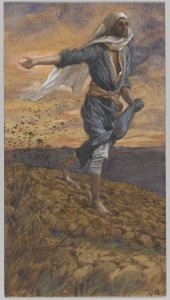
“The Sower” by James Tissot (1836-1902)
Here’s the story. A sower is out planting and scatters seed in multiple directions. Some falls on the path and the birds have a feast. Other seed lands on rocky ground, comes to life quickly, but soon withers due to shallow roots. Some seed gets choked among thorns. Finally, other seed falls in good soil and flowers abundantly (verses 4-8). If you’re like me, my “hearing” of this parable has always focused on those four possibilities for faith formation. It’s easy to place ourselves — and others — in one of those four spaces and make a judgement about the authenticity and growth of our faith, or lack thereof. But, it strikes me that there may be an alternative approach to this powerful parable. What if we focus on the sower, and not the seeds? The sower didn’t carefully spread those seeds. He threw them randomly — recklessly — without concern for where they landed — a perfect metaphor for the generous nature of God’s love for humanity! And, a good reminder that we should never be tentative about sharing that love, cautious about making sure the “conditions are right.” I suspect we can all think of instances where God’s love sprouted amidst thorns or the rocky spaces of our world. Jesus spent a good deal of time during his ministry in those difficult spaces and with people who didn’t fit the mold, much to the chagrin of the religious establishment of the day.

Charity Thunder (1947-2018)
“Ho-homp-gi-ka re-wi” (she lights up the earth)
The image of the generous sower reminds me of a long-ago conversation with a beautiful person named Charity Thunder. Charity graced my path on many occasions from 1990 to the time of her death in 2018. She served in a variety of capacities with the Ho-Chunk Nation, including an important time as a liaison between the Black River school district and the Nation’s education department. She was part of the interview team that recommended hiring me in 1990, something for which I remain forever thankful. Over many years, I conversed with her frequently and she graciously spent time with my students as well. One exchange I had with her in the early 1990s stands out. I was especially frustrated at the lack of progress in my work, especially as it related to revising my classes to be more inclusive in our understanding of American Indian history and contemporary issues — challenging work in our community. She listened and this wise elder said something I never forgot: “Remember Paul, as a teacher you are planting seeds. You may not see the results immediately, but you continue to plant those seeds and have faith they will flourish. Planting those seeds is the right thing to do.” The clarity of her words lifted me then and continue to resonate with me today. God Bless her memory!
The writer of Isaiah echoed those same sentiments in the 8th Century BCE: “For as the rain and the snow come down from heaven and do not return there until they have watered the earth, making it bring forth and sprout, giving seed to the sower and bread to the eater, so shall my word be that goes out from my mouth; it shall not return to me empty, but it shall accomplish that which I purpose and succeed in the thing for which I sent it.”
May we continue to spread those seeds of faith with reckless abandon!
Soli Deo Gloria.
Prayer (inspired by Romans 8:1-11 ):
Lord God, You assure us that there is no condemnation for those who live in Christ. Help us to set our minds on the Spirit, and empower us with your presence in our hearts. Amen.
And, a second prayer with some further reading. Last week I mentioned Reinhold Niebuhr. Among other things, this powerful theologian is remembered as the author of the Serenity Prayer, made famous, in part, due to its connection to Alcoholics Anonymous (AA). It is a truly wonderful prayer:
God, give us grace to accept with serenity the things that cannot be changed, courage to change the things that should be changed, and the wisdom to distinguish the one from the other.

Paul, may I share this directly with a local pastor. He told me what his sermon is going to be, and it parallels so well with what you’ve written he generally doesn’t go to others about his sermons, but I think your insights are extraordinary.
Gratefully,
LikeLike
Greetings Doris! Feel free to share, of course, and thank you for the kind words. I had never thought of this parable from the perspective of the sower before, and that’s the beauty of revisiting these passages — “you can’t step in the same river twice,” right?
LikeLike