Faithful Conversations #37
Introduction to Readers:
The readings for Pentecost 24 challenge me to ponder WHY we spend so little time in the ELCA on Christ’s second coming (or am I “off” in that assessment?). It is clearly central to our theology, as noted in our public recitation of the Apostles’ Creed each Sunday (“he is seated at the right hand of the Father, and he will come to judge the living and the dead”). Further, we have Christ’s clear language on the matter (note Luke 17:22-24, among other passages). We live with the anticipation of the Second Coming! Let’s think about this as we walk through this week’s readings. My reflections will focus on the passage from Thessalonians, and my prayer is inspired by the words of Amos.
On another note, we have three Sundays left in our church year (Lectionary A) and on 3 December we will be in Advent and turn the page into Year B (2024). Forgive my repetition, but I cannot believe how fast the time goes! As always, thank you for your continuing interest in taking on the challenge of God’s word!
(Note: I do highlight phrases, and also offer hyperlinks that offer background — those are of a different color, italicized, and bolded).
Readings for Pentecost 24
Amos 5:18-24
Psalm 70
1 Thessalonians 4:13-18 (focus passage)
Matthew 25:1-13
Why do you want the day of the Lord?
It is darkness, not light,
19 as if someone fled from a lion
and was met by a bear
or went into the house and rested a hand against the wall
and was bitten by a snake.
20 Is not the day of the Lord darkness, not light,
and gloom with no brightness in it?
21 I hate, I despise your festivals,
and I take no delight in your solemn assemblies.
22 Even though you offer me your burnt offerings and grain offerings,
I will not accept them,
and the offerings of well-being of your fatted animals
I will not look upon.
23 Take away from me the noise of your songs;
I will not listen to the melody of your harps.
24 But let justice roll down like water
and righteousness like an ever-flowing stream.
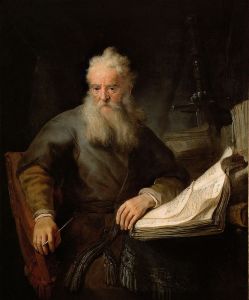
St. Paul by Rembrandt (1606-1669)
The Second Reading: 1 Thessalonians 4:13-18
13 But we do not want you to be uninformed, brothers and sisters, about those who have died, so that you may not grieve as others do who have no hope. 14 For since we believe that Jesus died and rose again, even so, through Jesus, God will bring with him those who have died. 15 For this we declare to you by the word of the Lord, that we who are alive, who are left until the coming of the Lord, will by no means precede those who have died. 16 For the Lord himself, with a cry of command, with the archangel’s call and with the sound of God’s trumpet, will descend from heaven, and the dead in Christ will rise first. 17 Then we who are alive, who are left, will be caught up in the clouds together with them to meet the Lord in the air, and so we will be with the Lord forever. 18 Therefore encourage one another with these words.
This Week’s Reflection: “The Second Coming”
My father was a gracious individual but could be blunt at times. Just weeks before his death, I asked him if he expected to see Cathy (his wife of 64 years who died 7 months ahead of him) when he died. It wasn’t unusual for me to ask such questions of him, since we often talked theology. My question was prompted, in part, by the comments people make when a loved one journeys on, and especially the notion that they have now joined their departed loved ones in heaven. In clear language, Unk (my father) responded to me by asserting that “that’s not what our theology tells us — those that have gone before us are at rest and will rise when Christ returns.” I recall being a bit taken aback by his comments and asked him if that is what he truly believed — it seemed less than comforting. Then he winked at me and said, “you know, sometimes we tell ourselves things just to feel better, but death remains a great mystery.” It was a conversation I never forgot.

Paul’s Second Missionary Journey, 49 CE
So, the Second Coming — what to make of that? Paul’s language in 1 Thessalonians is helpful. As with many books of the Bible, context is truly key. This letter, according to most scholars, is the oldest book of the New Testament, probably written in the early 50s CE, roughly 20 years after the crucifixion. As part of his second missionary journey in 49 CE, Paul and his companions traveled throughout the Roman Empire, in this case to the Macedonian city of Thessaloniki. As was often the case, Paul (and companions Sylvanus and Timothy) were writing to the Thessalonian Christians on many matters of faith to follow-up their earlier visit. Specifically in this passage, Paul is addressing their fear that believers who had died would not share in glory of Christ’s return (verse 13). He assures them that those who have died will be ushered into heaven first, followed by those still alive (verses 14-18), and that all will be with Christ forever.
It is worth noting three things here. First, the notion of our God taking human form and dying a brutal death on the cross and rising again has divided believers since the time of those first-generation Christians. In fact, in the earliest centuries of the Church’s formation, there were those who sought to guard the divinity of Christ — called Docetists — who believed that Jesus, because he was divine, only seemed to die. The Apostles’ Creed, in fact, was written directly in opposition to those who questioned Christ’s humanity — you may want to look at the Creed again. Second, Paul’s language in this passage indicates that he believed Christ would return in his lifetime — a common belief among our earliest Christian ancestors. Amazingly, there were those alive when Paul was writing that had actually witnessed the crucifixion AND may have been among the hundreds of people that saw Christ, post-resurrection! And, let me now circle back to my initial question in the introduction — WHY we spend so little time talking about Christ’s second coming. My sense, based on what I have learned, and especially Luther’s skepticism about the book of Revelation, is that we are wary of getting caught up in predictions regarding the return of Christ. Jesus, in fact, is clear on this point when he tells his followers: “About that day and hour no one knows, neither the angels of heaven, nor the Son, but only the Father” (Matthew 24:36). Further, our emphasis on God’s grace perhaps precludes us from coming down too harshly on the notion of eternal damnation — just a thought. Finally, in spite of the mysteries surrounding many aspects of our faith, let us lean in on the assurance of Christ’s return, and let that awe-inspiring hope guide our approach to life. Barbara Rossing, professor of New Testament and the environmental ministry coordinator at the Lutheran School of Theology at Chicago, offers this terrific commentary:
Early Christians definitely thought they were living at the brink of the end of the world. Love of neighbor and hospitality to strangers was early Christians’ surest response to life on the brink of the end-times. They gathered and worshiped God. They ministered to the poor. They visited prisoners. They broke bread together, they sang hymns. Early Christians nurtured community. By their lifestyle of love and welcome, early Christians resisted the claims of the empire. People around them marveled at their joy and boldness. To look for the coming of Christ, and to live in urgency, means to share God’s love for the world. “Thy kingdom come, thy will be done, on earth as in heaven” is what Jesus taught us to pray. It is not a prayer to take us away from earth but rather a prayer that God’s reign will come to earth — and that it will even come through us, as Martin Luther explained in the 16th century.
Soli Deo Gloria
Prayer (inspired by the Amos passage):
Lord, help us to worship you with integrity, and not for show or to elevate ourselves in the eyes of others. Inspire us to “let justice roll down like water and righteousness like an ever-flowing stream” in all that we say and do. We ask this humbly in the Spirit of Christ. Amen.
Postscript:

United Church of Christ
Ho-Chunk Mission
Established 1878
Finally, this week, a few words about a special event. On Sunday (12 November) we will be joined by several members of the UCC Ho-Chunk Mission Church east of Black River Falls. The church was established in 1878 by missionaries from the German Reformed Church. We are a “full communion partner” with the United Church of Christ, so this joint worship is a natural for us. In addition, within the ELCA we continue to grapple with the difficult history of settler-colonialism and the centuries-long harm inflicted on Indigenous people prompted, in part, by the 15th Century Papel edict known as the Doctrine of Discovery. The ELCA and UCC, along with several other denominations, have repudiated the Doctrine in recent years. Notably, the Catholic Church has done so most recently. Our worship will combine elements of both the UCC and ELCA and will include prayers for healing the divide in our community and beyond.
As we continue to do this work, our steps feel tentative and halting, but we pray for the Holy Spirit’s guidance. I ran across this compelling statement from El Salvadoran Archbishop Oscar Romero (1917-1980) — a beautiful and timely reflection:
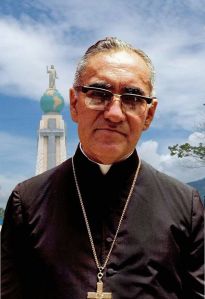
Oscar Romero
(1917-1980)
“It helps, now and then, to step back and take a long view. The kingdom is not only beyond our efforts, it is even beyond our vision. We accomplish in our lifetime only a tiny fraction of the magnificent enterprise that is God’s work. Nothing we do is complete, which is a way of saying that the Kingdom always lies beyond us. No statement says all that could be said. No prayer fully expresses our faith. No confession brings perfection. No pastoral visit brings wholeness. No program accomplishes the Church’s mission. No set of goals and objectives includes everything. This is what we are about. We plant the seeds that one day will grow. We water seeds already planted, knowing that they hold future promise. We lay foundations that will need further development. We provide yeast that produces far beyond our capabilities. We cannot do everything, and there is a sense of liberation in realizing that. This enables us to do something, and to do it very well. It may be incomplete, but it is a beginning, a step along the way, an opportunity for the Lord’s grace to enter and do the rest. We may never see the end results, but that is the difference between the master builder and the worker. We are workers, not master builders; ministers, not messiahs. We are prophets of a future not our own.”

I totally agree with Unk that we believe things about Exiting this world that bring comfort and might not be exactly as the Bible writes and that there is so much mystery but what we do know is that His Love and Grace will be so vast and mind-boggling when we see it without any veiling that there will be nothing left to do but yell our praises! Even if Cathy and Unk are “sleeping” I believe their sleep is the deep kind where they’ll think they were asleep but for 20 seconds… ; )
I love Oscar Romero’s prayer! Indeed we are but workers and not the Master Builder, ministers and not the Messiah but we’re honored to just be His apprentices. A daily declaration of our desperate dependence on Jesus places us on His “Home Row” as we proceed to type out this life of ours…
Thanks, Paul, for your being an apprentice of His that blesses so many!
LikeLiked by 1 person
Thanks Kris! Reading the texts this week gave me a new appreciation for 1 Thessalonians, and yes, the Romero quote, in my estimation, should be framed and hung in every church — a great perspective.
LikeLike