Faithful Conversations #46
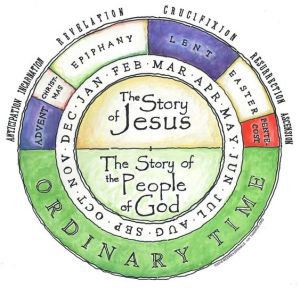
The Church Calendar
Introduction to Readers:
The season of Epiphany extends from 6 January through 13 February — the day before Ash Wednesday (within the ELCA). Epiphany means appearance or manifestation and its roots go deep into the 4th Century Eastern Orthodox Church. During this phase of the church year, we reflect on God’s revelation in His Son, including the birth, the visit of the Magi to Bethlehem, His presentation in the Temple, and later, Jesus’ baptism by John. Recall that at Christ’s baptism, the Holy Trinity appeared — Father, Son, and Holy Spirit. If you are interested in the traditions surrounding Epiphany, click here for a good overview!
Think about the concepts of “seeing and being seen” as you work through this week’s lectionary. How does God see us? How do we see others? My reflections this week will center on the Psalm, with references to the Gospel. As always, thanks for your continued journey through the scriptures!
Note: I do utilize various hyperlinks within the body here for further exploration if interested! They are a different color and italicized. If you click out to the supplemental information, simply click back to return to the blog.
Readings for Epiphany 2 (14 January)
1 Samuel 3: 1-10 (11-20)
Psalm 139: 1-6, 13-18
1 Corinthians 6: 12-20
John 1: 43-51
The Psalm for Epiphany 2: 139: 1-6, 13-18

“King David in Prayer” by Pieter de Grebber (1600-1653)
circa 1635-1640
You have searched me, Lord, and you know me.
2 You know when I sit and when I rise;
you perceive my thoughts from afar.
3 You discern my going out and my lying down;
you are familiar with all my ways.
4 Before a word is on my tongue
you, Lord, know it completely.
5 You hem me in behind and before,
and you lay your hand upon me.
6 Such knowledge is too wonderful for me,
too lofty for me to attain.
For you created my inmost being;
you knit me together in my mother’s womb.
14 I praise you because I am fearfully and wonderfully made;
your works are wonderful,
I know that full well.
15 My frame was not hidden from you
when I was made in the secret place,
when I was woven together in the depths of the earth.
16 Your eyes saw my unformed body;
all the days ordained for me were written in your book
before one of them came to be.
17 How precious to me are your thoughts, God!
How vast is the sum of them!
18 Were I to count them,
they would outnumber the grains of sand—
when I awake, I am still with you.

Depiction of Nathanael:
St. John’s Anglican Church, New South Wales
The Gospel Reading: John 1: 43-51
43 The next day Jesus decided to leave for Galilee. Finding Philip, he said to him, “Follow me.” 44 Philip, like Andrew and Peter, was from the town of Bethsaida. 45 Philip found Nathanael and told him, “We have found the one Moses wrote about in the Law, and about whom the prophets also wrote—Jesus of Nazareth, the son of Joseph.” 46 “Nazareth! Can anything good come from there?” Nathanael asked. “Come and see,” said Philip. 47 When Jesus saw Nathanael approaching, he said of him, “Here truly is an Israelite in whom there is no deceit.” 48“How do you know me?” Nathanael asked. Jesus answered, “I saw you while you were still under the fig tree before Philip called you.” 49 Then Nathanael declared, “Rabbi, you are the Son of God; you are the king of Israel.” 50 Jesus said, “You believe because I told you I saw you under the fig tree. You will see greater things than that.” 51 He then added, “Very truly I tell you, you will see ‘heaven open, and the angels of God ascending and descending on’ the Son of Man.”
This Week’s Reflection:
The Season of Epiphany prompts me to think about those Aha! moments in our lives — moments of Epiphany that we experience from time to time (Pastor Jen alluded to this in her sermon last Sunday). Anna and Simeon said Aha! when Jesus was presented in the Temple. The Magi said Aha! as their camels sauntered into that stable in Bethlehem (my comic brain pictures Balthasar, Melchior, and Gaspar — yes, their names! — raising their fingers and saying Aha! in unison). And picture those witnessing Jesus’ baptism on the banks of the Jordan River and the appearance of the Holy Spirit looking at one another and saying, Aha! (As a sidenote, I have always been fascinated by how people come to know things. We tend to think of knowledge acquisition as something that happens over time and with deliberation, but I’m convinced that much of what we know comes through Epiphany moments, but that’s another topic).

Thomas Cranmer,
Archbishop of Canterbury
(1489 – 1556)
In turn, Epiphany moments remind me that God reveals Himself in our lives both persistently and surprisingly. The writer of this week’s Psalm (attributed to David), for example, in very personal and poetic language, describes God’s persistent revelation as he attempts to comprehend the Creator’s infinite knowledge of his inner thoughts, his actions, his life. Some may read Psalm 139 and feel suffocated by or afraid of such a God (do we really want God to know everything about us?). My sense, however, is that the Psalmist feels both comforted and liberated by this view of God’s all-encompassing wisdom and intervention in his life. In a recent post, theologian Dan Clendenin connects Psalm 139 to something called the Collect for Purity, a prayer dating back over a thousand years, and translated from Latin to English by Thomas Cranmer, Archbishop of Canterbury, during the time of the English Reformation (associate Cranmer with the reign of Henry VIII and all those difficult marital situations!). Cranmer (a Protestant) was responsible for publishing the Book of Common Prayer in 1549. Here is the prayer (it may seem familiar):

The Evangelical Lutheran Worship (ELW) Hymnal (2006)
Almighty God, to whom all hearts are open, all desires known, and from whom no secrets are hid: Cleanse the thoughts of our hearts by the inspiration of your Holy Spirit, that we may perfectly love you, and worthily magnify your holy Name; through Jesus Christ our Lord. Amen.
Yes, the Collect for Purity shows up at the beginning of several worship settings in the front pages of the ELW (specifically in Settings 1 and 2 and the Service of the Word), a reminder that we draw from many traditions in the ELCA. Clendenin writes the following regarding this beautifully haunting prayer: The purpose of the “collect” is to summarize, focus, clarify and remind ourselves exactly what it is we hope to do in the service that follows . . . At first glance, the Collect feels like a harsh exposure to guilt, fear, and shame — the terrifying realization that God knows all my distracted thoughts and disordered loves, my unruly desires and unwanted dreams. In fact, the exact opposite is true. Instead of judgment, the Collect expresses the paradoxical combination of human confession that brings liberation, and divine comfort that brings consolation. In other words, I am both nakedly revealed before the infinite God, and lovingly sheltered by his intimate love. Aha! God’s persistent revelation in our lives!
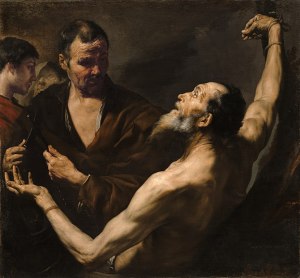
The Martyrdom of Saint Bartholomew (1634)
by Jusepe de Ribera
And then there are those surprising Epiphany moments when the truth is suddenly clear to us. In this week’s Gospel, Nathanael experienced such a moment. Jesus is in Galilee and calls Philip to follow him (verse 43). Philip, in turn, seeks out Nathanael and informs him that Jesus, the fulfillment of ancient prophecies, has arrived (verse 45). **Nathanael, though initially skeptical (verse 46), is greeted by Christ and immediately recognizes him as the Son of God (verses 48-49). Aha! God’s surprising revelation in our lives, forever changing our journey!
Soli Deo Gloria
** Nathanael is also identified as Bartholomew and shows up in the four “lists” of disciples in the New Testament: Matthew 10: 2-4, Mark 3: 16-19, Luke 6: 14-16, and Acts 1: 13. Not all scholars agree that Nathanael and Bartholomew were the same person, however.
This Week’s Prayer (designated for Epiphany 2, Year B in the RCL):
Thanks be to you, Lord Jesus Christ, most merciful redeemer, for the countless blessings and benefits you give. May we know you more clearly, love you more dearly, and follow you more nearly, day by day praising you, with the Father and the Holy Spirit, one God, now and forever more. Amen.
If you need a moment of uplift this week, here is a wonderful version of the hymn, The Summons. You are hearing from the Notre Dame Folk Choir and seeing images of Notre Dame University. Having visited there a number of times, I thoroughly enjoyed seeing the sites of the campus — brought back great memories. Though most commonly associated with the Catholic Church, this hymn is in the ELW (page 798). It is a suggested hymn for Epiphany 2, I believe, referencing the reading from 1 Samuel.
Enjoy!
Announcement Regarding Our Lectionary Discussions:
Join us, if you can, for a free-wheeling discussion of this week’s readings after worship on Sunday (10:45) in the library. Come to listen in or participate — you will not be put on the spot to exhibit your knowledge of the Lectionary! All are welcome!

In our gospel reading for this week we see that Nathaniel refers to Christ as Rabbi in John 1:49. We’re often led to believe that the term Rabbi only means “teacher” but this article gives us a greater understanding of what the term meant to a Jewish audience.
https://renew.org/rabbis-and-their-disciples-between-the-1st-century-b-c-and-the-2nd-century-a-d/
This explains why Jesus was allowed to teach in the synagogue.
Jerry Humphrey
LikeLike
An excellent article Jerry! Very interesting.
Also, couldn’t help but think of the expression, “Jumping Jehoshaphat!” while reading it, which, of course, has nothing to do with the article. Curious phrase associated with, among others, Yosemite Sam, a reference that will be familiar to people over a certain age!
LikeLike